love manifestation
Dating App Burnout? Try a 5-Minute Love Audio
Dating app burnout can make love feel like admin. Try a 5-minute audio practice that steadies your nervous system before you swipe, reply, or stop.

Your phone is face down, but you can still feel it asking. Dating app burnout means the search for love has started to feel like unpaid work. A 5-minute love manifestation audio helps by quieting the reactive loop, restoring your sense of self, and giving you one clean next step.
What is dating app burnout really telling you?
Dating app burnout is a signal that your nervous system has been asked to treat intimacy like a queue.
You open the app to find connection. Ten minutes later, you’ve judged 40 faces, decoded 6 bios, ignored 3 likes, and wondered why your chest feels tight. Nothing dramatic happened. Still, something in you is tired. Pew Research Center reported in 2023 that 30% of U.S. adults had used a dating site or app, and 53% of adults under 30 had done so. That is a lot of people asking small screens to hold a very tender hope.
Burnout often starts softly. You stop reading profiles. You swipe from boredom. You answer late, then feel guilty. You begin to confuse being wanted with being chosen. A 2016 study in the Journal of Social and Personal Relationships found that larger dating pools can reduce willingness to choose, a form of choice overload. More options do not always make the heart feel safer.
Dating app burnout is not a character flaw. It is what happens when the body meets too much evaluation with too little repair. The apps are built around fast signals: photos, first lines, distance, age, timing. Love asks for slower signals: consistency, kindness, repair, presence. Those two clocks do not always agree.
If love starts to feel like admin, the practice is not to work harder. The practice is to come back to what is true.
A 5-minute audio pause is small enough to do before you swipe and honest enough to interrupt the loop. It does not ask you to become more attractive. It asks you to become more present. That is different. That is cleaner.
Why does swiping feel so hard on the body?
Swiping feels hard because it mixes hope, rejection, novelty, and uncertainty in a tight reward loop.
Your brain is not neutral around intermittent rewards. Dr. Andrew Huberman has often described dopamine as tied to motivation, pursuit, and reward prediction, not simple pleasure. Dating apps use variable results: sometimes a match, sometimes silence, sometimes a message that makes you stand up straighter in the kitchen. Variable reward schedules have been studied since B.F. Skinner’s work in the 20th century because they can keep behavior going even when the reward is inconsistent.
That pattern can make checking feel urgent. Not meaningful. Urgent. You pick up the phone for 2 minutes and stay for 22. You tell yourself you’re being open, but your shoulders are near your ears. In a 2020 paper in BMC Psychology, researchers connected problematic Tinder use with motives like entertainment, social approval, and relationship seeking. The mix matters. When care and validation share the same button, the button gets loud.
A few signs your body is asking for a pause:
- You feel worse after most app sessions.
- You check when you’re lonely, angry, or unable to sleep.
- You keep talking to people you don’t actually like.
- You feel replaceable after swiping.
- You start editing yourself for strangers instead of telling the truth.
The body keeps score in small ways. Dry mouth. Shallow breath. A low ache behind the eyes. You may call it boredom, but it may be grief. The grief of wanting something real inside a system that rewards speed.
For more grounding on the wider practice, I like to keep manifestation simple: you return your attention to the life you’re choosing, then act from that place. Not fantasy. Not pressure. A remembered direction.
How does a 5-minute love manifestation audio change the pattern?
A 5-minute love manifestation audio changes the pattern by replacing reactive checking with a rehearsed inner state.
This is where the AYA Method comes in quietly. The AYA Method is a daily audio manifestation practice. Each day you listen to a short personalized recording — your Dream-Self Moment — narrated from the version of you who has already manifested the life you intend. Listening is the practice. Repetition is the work. The audio is the method.
For dating app burnout, that matters because the problem is rarely only the app. The problem is the state you bring to the app after 2 weeks of near-matches, poor replies, and tiny disappointments. Joe Dispenza often teaches that mental rehearsal can condition the body toward a future state; you do not have to accept every claim around his work to notice the practical point. Repeated inner rehearsal can shape what feels available.
In cognitive science, mental imagery has been studied for decades. A 2018 review in Nature Reviews Neuroscience described mental imagery as drawing on many of the same neural systems used in perception. In plain terms: what you rehearse inside is not nothing. Your body listens.
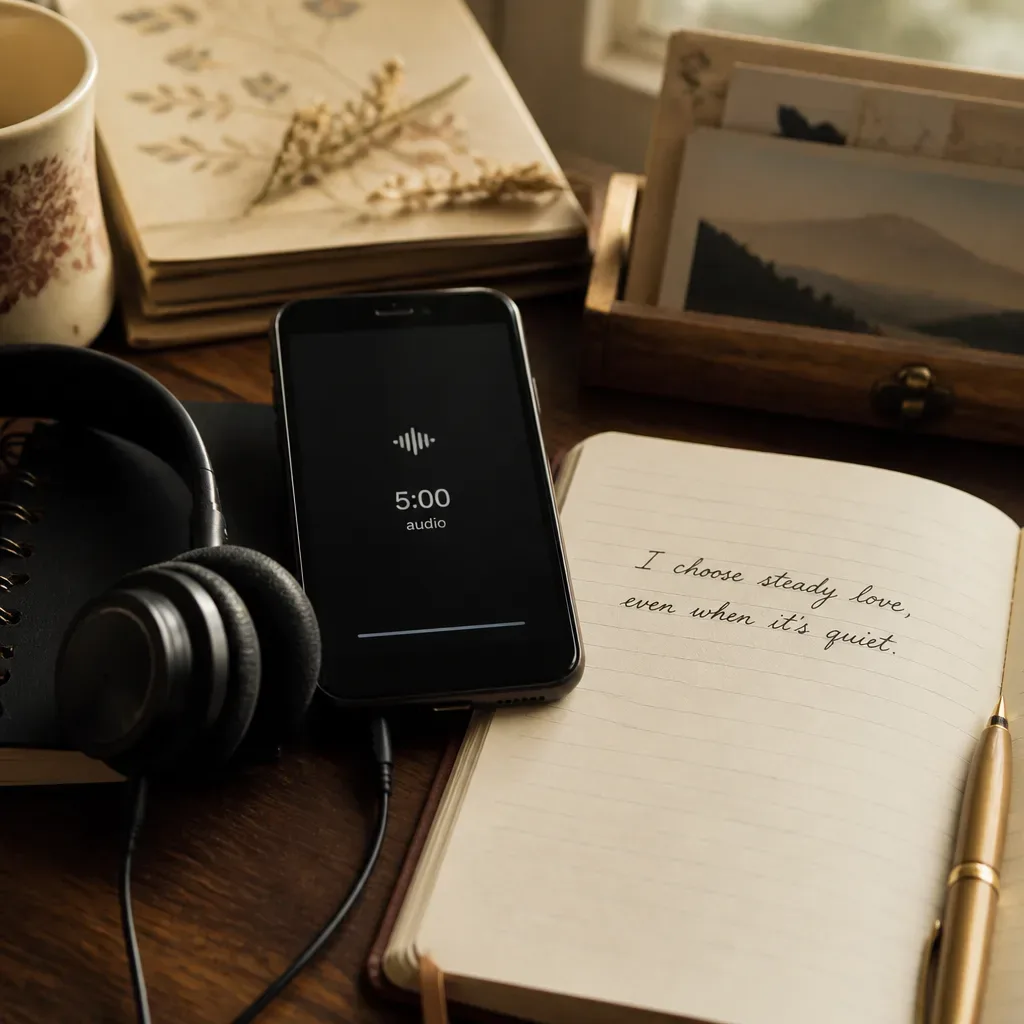
The audio gives you a scene to inhabit before the app gives you a feed to react to. That scene might sound like you waking beside someone steady. Or leaving a date without guessing. Or feeling chosen without performing. Five minutes is enough time to change your breathing, soften your face, and remember that the goal is not a match. The goal is love that feels real when the phone is gone.
The future self is not there to impress you. She is there to remind you how you behave when you already feel safe.
How do you do the 5-minute practice before opening an app?
You do the practice by pausing the swipe loop, listening once, and choosing one action from a calmer state.
Set a timer if you need structure. Five minutes can feel almost suspicious because burnout tells you repair has to be large. It does not. A 2022 review in JAMA Psychiatry found that brief mindfulness-based interventions can reduce symptoms of anxiety and stress, though effects vary by study quality and practice design. Small practices can work when they are repeated and easy to begin.
Here is the clean version:
- Put the phone face down for 10 breaths. Do not negotiate with the app yet.
- Name the honest state. Say, “I’m lonely,” “I’m tired,” or “I’m performing.” One sentence is enough.
- Play the 5-minute audio. Let the Dream-Self Moment speak from the love you intend, already lived.
- Notice one body shift. Jaw, chest, breath, hands. Look for evidence that you are here.
- Choose one next action. Reply to one person, swipe for 10 minutes, update one line, or stop.
Do not use the practice as a spell to make a specific person text. That will usually tighten the body. Use it to return to the version of you who does not audition for affection. Neville Goddard wrote often about assuming the feeling of the wish fulfilled. The useful part here is not force. It is identity. You act differently when you are not begging the room to choose you.
If affirmations help, keep them spare. The affirmations page can support this, but remember the order: audio first, affirmation as a complement. One line is enough: “I am available for steady love, and I don’t abandon myself to find it.” Say it once. Then move slowly.
What should you listen for inside the audio?
Listen for the version of you who is loved without becoming smaller.
A good love manifestation audio is not a shopping list for another person’s face, height, income, or timing. It is a felt rehearsal of mutual care. You are listening for how your body behaves when love is not a chase. In small studies on self-affirmation, including work discussed in Social Cognitive and Affective Neuroscience in 2016, researchers found that affirming personally meaningful values can activate brain systems related to self-processing and future orientation. The content matters when it feels true.
The audio should include details that make your nervous system exhale:
- You are not checking your phone every 4 minutes.
- You feel free to speak plainly.
- The other person is consistent over time.
- Your life remains yours.
- Desire and peace can sit in the same room.
There is a difference between wanting love and outsourcing your worth to being picked. Dating app burnout often blurs that line. The audio helps redraw it. You are not trying to become indifferent. You are trying to become less available for confusion.
Here is a simple listening map:
| Moment in the audio | What it trains | Dating app effect |
|---|---|---|
| Opening breath | Safety before action | Less reactive checking |
| Future-self narration | Identity rehearsal | Clearer standards |
| Specific love scene | Emotional detail | Less vague longing |
| Closing line | One remembered truth | Cleaner next choice |
The app also includes a daily affirmation and a Manifestation Board. I see those as useful supports. They give words and images to what the audio has already made audible. They are not the center. The center is listening.
Your standard is not a wall. It is a door with a handle only the right life knows how to use.
When should you take a break from dating apps instead?
You should take a break when the app is costing more steadiness than it gives you in possibility.
There is no prize for staying visible while you disappear from yourself. If you are sleeping less, checking during work, comparing your body, or feeling dread before opening the app, pause. A 2023 Pew report found that 46% of online dating users said their time on dating sites or apps had been at least somewhat positive, while a similar share described it as at least somewhat negative. Mixed results are the norm. Your mixed feelings are data.
Try a 7-day reset. Not forever. Seven days. Long enough for the checking impulse to quiet, short enough that your mind does not turn it into a dramatic vow. During the reset, keep the 5-minute audio. You are not stepping away from love. You are stepping away from a format that may have become too noisy.
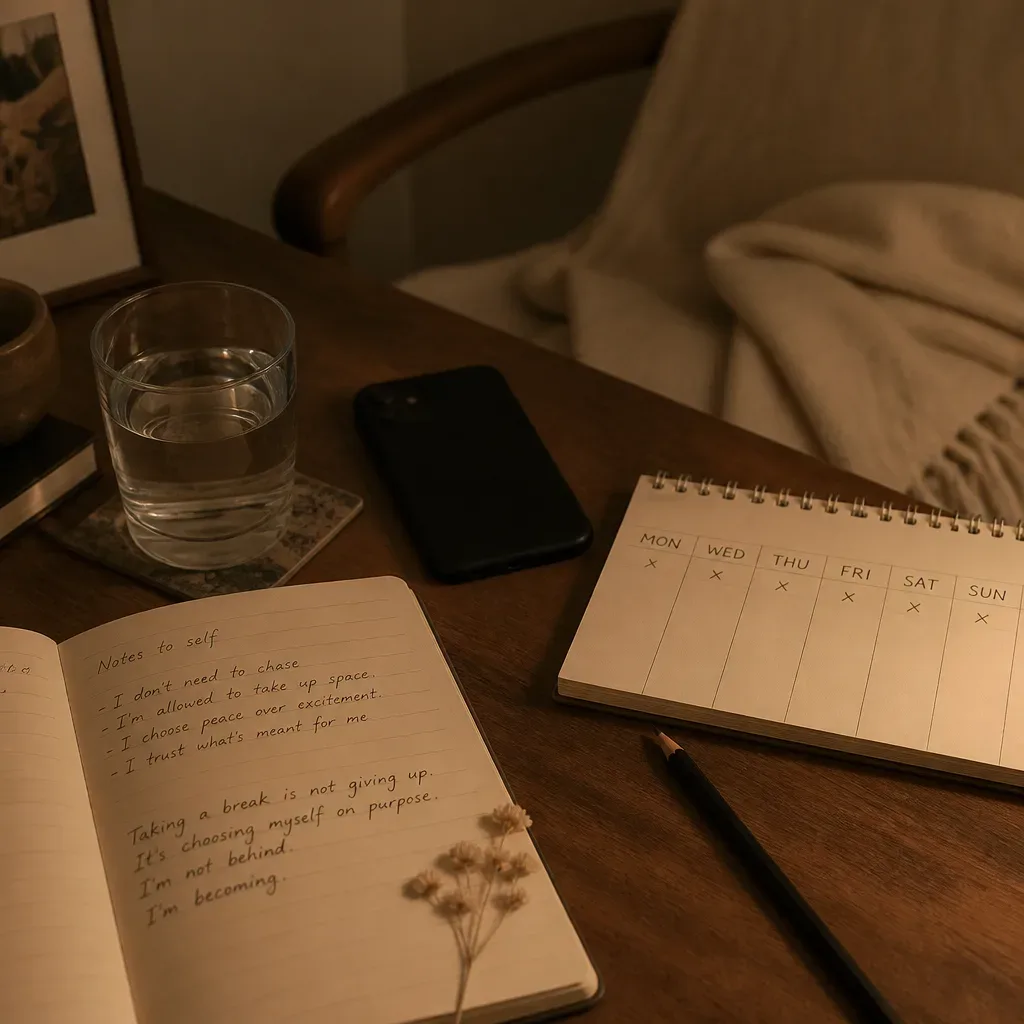
Use this reset rule:
- If you feel relief on day 1, rest.
- If you feel panic on day 2, do not reopen yet.
- If you feel clearer by day 4, write down what changed.
- If you miss one specific person, consider whether it is care or craving.
- If you return on day 8, return with limits.
This is also where timing beliefs can get tender. If you track moon phases or birth charts, keep them practical. Astrology and manifestation can be a reflective tool, but it should not make you abandon common sense. A kind person who replies consistently matters more than a perfect transit.
A break is not failure. It is maintenance. Tools that serve you should survive being turned off. I say this as someone who reviews apps for a living: if a tool makes you less honest, it is not helping yet.
What changes after a week of the practice?
After a week, the first change is usually not your match count. It is the way you meet the screen.
On day 1, you may still reach for the app with a tight chest. On day 3, you may notice the tightness before you open it. On day 5, you may close it after one strange message instead of giving 40 minutes to a person who has already shown you enough. Behavioral change research often points to repetition and context as key. A 2009 study in the European Journal of Social Psychology found habit formation took a median of 66 days, with wide variation. Seven days is not a finished habit. It is a first signal.
Track simple things, not mystical proof. Use a note on your phone:
| Day | Before audio | After audio | One action |
|---|---|---|---|
| 1 | Restless | Softer breath | Closed app |
| 3 | Lonely | Clearer | Replied to one person |
| 5 | Numb | Sad but steady | Took a break |
| 7 | Curious | Open | Updated profile honestly |
Keep the metrics human. Did you abandon yourself less? Did you answer from truth? Did you stop rewarding low effort with unlimited access? Those are not small wins. They are the architecture of a different dating life.
For a wider frame, love manifestation is not about pretending longing is gone. It is about practicing from the inner life you want to make normal. The manifestation pillar gives the larger map; this 5-minute audio is the small doorway you can use tonight.
The cleanest sign of progress is not that everyone wants you. It is that you stop wanting what costs you your peace.
If you keep using apps, use them in a container: 10 to 20 minutes, no bed, no checking after alcohol, no replying to messages that make your stomach fold. If you pause, pause without turning it into a verdict on your future. Love has never required you to be constantly available to strangers.
Put the phone down. Stay near yourself.