vision boards
Digital Vision Board App With Future-Self Audio
A digital vision board app works best when images are paired with future-self audio, so the picture becomes a daily cue, not decoration.
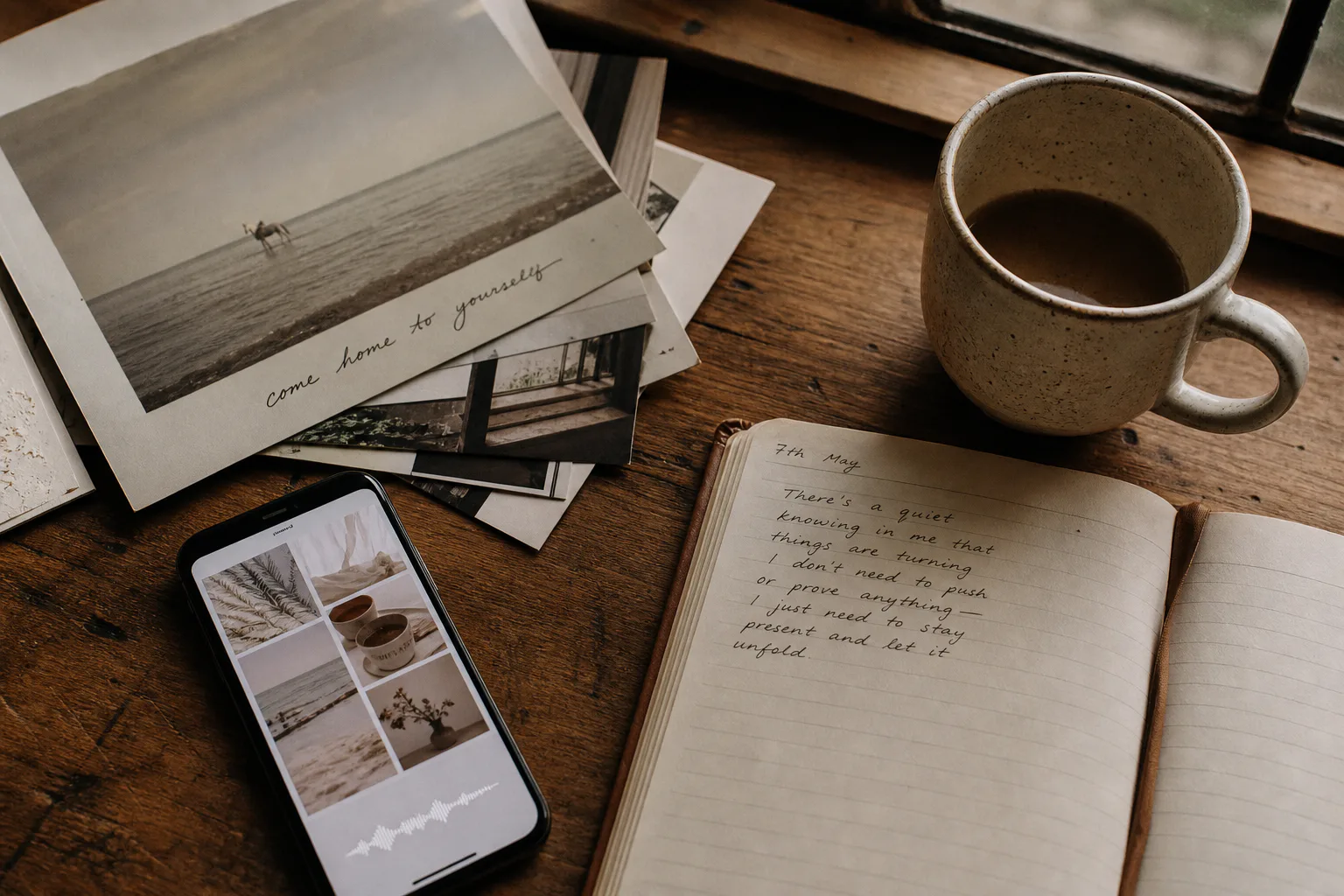
The phone is face down beside your tea. A digital vision board app works best when it pairs clear images with future-self audio, so you do not just look at a desired life. You listen to it, return to it daily, and let one small action follow.
What should a digital vision board app actually do?
A digital vision board app should make your future self easier to remember, not give you another place to store pretty pictures.
A vision board is the part of the practice you can see. It does not have to be beautiful. It has to be true. In a digital format, that means the app should hold images, words, and timing in a way you can return to without friction. Pew Research Center reported in 2024 that 91% of U.S. adults own a smartphone. If your board lives there, it can appear inside a device you already touch dozens of times a day.
The risk is obvious. Your phone is also where distraction lives. DataReportal estimated in 2024 that the average internet user spends about 6 hours and 40 minutes online each day. A digital board has to be quiet enough to cut through that. The app should not ask you to decorate forever. It should ask you to remember, listen, and act.
A useful digital vision board app does four simple things:
- Holds 6 to 12 images that feel specific.
- Lets you connect those images to a short future-self recording.
- Opens quickly, without a long setup ritual.
- Helps you repeat the practice at the same time each day.
The picture gets your attention. The voice gives it shape. A board without repetition is an archive. A board with a daily cue can become part of how you move.
If you want the wider frame for the practice, the Manifestation pillar explains why manifestation is not passive wishing. It is attention, identity, repetition, and behavior. A digital board belongs there only when it changes what you notice and what you do next.
How do you choose images that are more than decoration?
Choose images that show daily evidence of the life you intend, not only the finished prize.
Start small. Six images are enough. One for the body. One for home. One for work. One for money or stability. One for love or friendship. One for the ordinary texture of your day. Miller’s often-cited 1956 paper on working memory gave the phrase seven plus or minus two, and later research has refined that number downward. The useful point is still plain. Too many items become noise.
An image of a house can be honest. So can an image of a clean kitchen counter at 7:12 a.m. The second one may work better because it tells your nervous system what a Tuesday looks like. Research on implementation intentions by Peter Gollwitzer, first developed in the 1990s, shows that behavior becomes more likely when a cue is tied to a specific action. Your image should be a cue, not a trophy.
Use this quick filter before adding anything:
- Can I name what this image means in one sentence?
- Does it show a lived moment, not only an outcome?
- Would I still choose it if no one else saw it?
- Does it point toward one action I can take this week?
Here is the quiet test. If an image makes you perform, delete it. If it helps you remember, keep it. The board is not a public moodboard. It is a private instrument.
| Image type | Better question | Example |
|---|---|---|
| Outcome image | What does this look like on an ordinary day? | A desk with one open notebook |
| Identity image | Who am I practicing being? | A person walking after dinner |
| Relationship image | What do I tend with care? | Two cups on a small table |
| Stability image | What feels safe and real? | A paid bill beside a calendar |
A good board does not shout at you. It waits for you to become honest enough to see it.
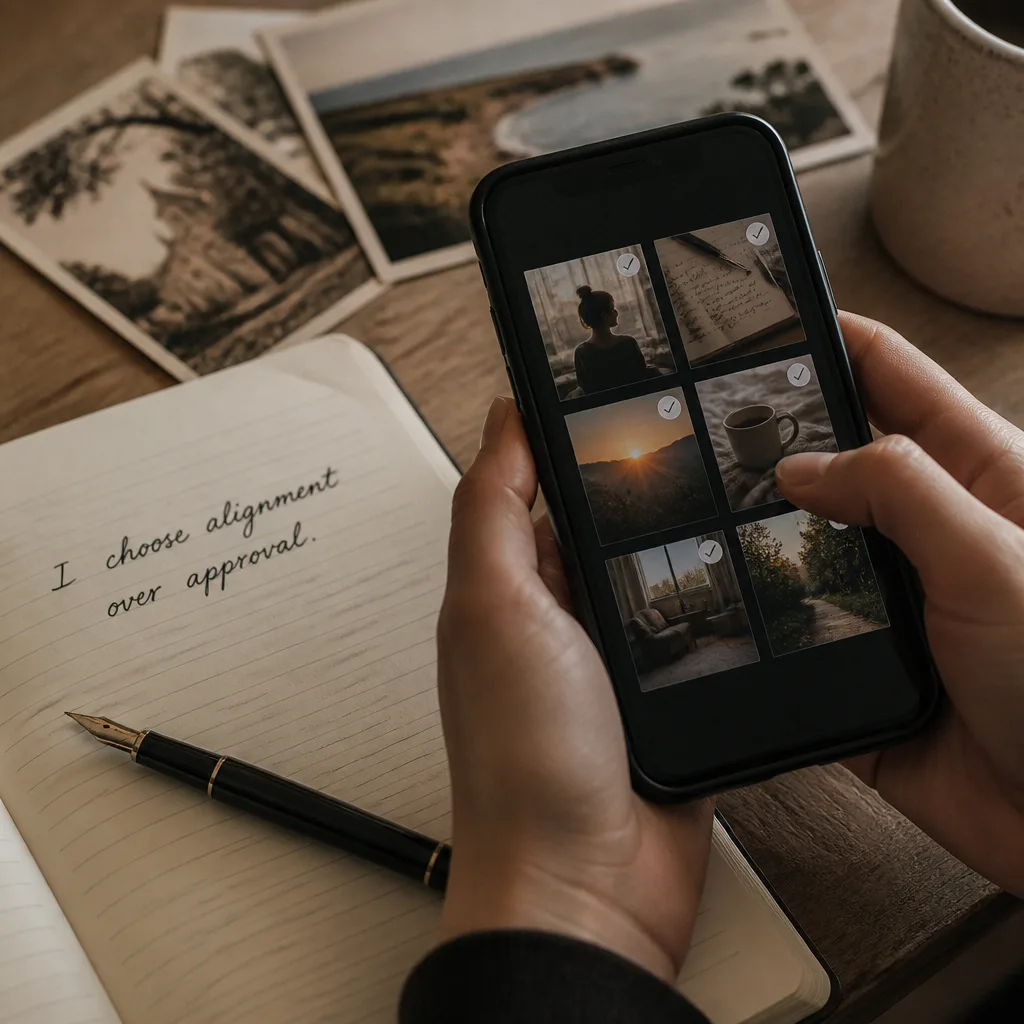
How do you pair images with future-self audio?
Pair images with future-self audio by listening first, then looking at the board while the voice gives the images context.
This is where the AYA Method comes in quietly. The AYA Method is a daily audio manifestation practice. Each day you listen to a short personalized recording — your Dream-Self Moment — narrated from the version of you who has already manifested the life you intend. Listening is the practice. Repetition is the work. The audio is the method.
That matters because images are open to interpretation. One day a photo of a calm bedroom feels comforting. Another day it can feel accusing, as if you are behind. Audio narrows the meaning. It says, in your own direction, this is where I am returning. Not because I am missing. Because I am practicing.
Studies on mental imagery have long shown that rehearsal can affect performance and emotion. A 2016 review in the journal Cognitive Behaviour Therapy found that imagery can carry stronger emotional impact than verbal thought alone. Audio adds another layer. It gives timing, intimacy, and a first-person thread. The image becomes less static. It starts to feel near.
Keep the recording short. Two to five minutes is enough. Dr. Andrew Huberman has often pointed to the value of brief, repeatable protocols over heroic routines. Habit design says the same thing. A small practice repeated 30 times usually beats a dramatic practice done twice.
Try this structure for your recording:
- Begin with the present-tense self. I wake into a room that feels cared for.
- Name the visible evidence. The counter is clear. The message is sent. The money is tracked.
- Name the felt truth. I do not rush to prove myself.
- End with one return phrase. I know what is mine to do today.
The audio should not flatter you. It should recognize you. That is different.
What does a 15-minute setup look like?
A 15-minute setup is enough if you stop trying to make the board perfect and build only the first usable version.
Set a timer. This protects the practice from becoming a design project. A 2022 Adobe report on digital work found that people spend hours each week switching between apps and searching for assets. You do not need that here. You need a board you can use tomorrow morning.
Here is a simple setup:
- Minute 1: Write one sentence. I am the person who keeps promises quietly.
- Minutes 2 to 6: Choose 6 to 12 images from your camera roll or a private image source.
- Minutes 7 to 10: Arrange them by daily life, not by importance.
- Minutes 11 to 13: Record or generate a 2-minute future-self audio.
- Minutes 14 to 15: Choose when you will use it tomorrow.
Do not overwork the sentence. In habit research, clarity beats intensity. Lally and colleagues found in the European Journal of Social Psychology in 2009 that a new behavior took 66 days on average to feel automatic, with a wide range. If the setup is too elaborate, you will not stay with it long enough for the cue to settle.
Your daily affirmation can sit nearby, but it is not the center. The app may also include a Manifestation Board, and that can support the visual side. Still, the audio leads. The daily affirmation and board are complements. The listening is the practice.
If you want to refine the language later, read the Affirmations pillar. Affirmations are strongest when they are believable enough to repeat and specific enough to change attention. One true sentence will do more for you than 40 sentences you secretly reject.
How do you use the board each day without making it a chore?
Use the board by attaching it to a habit you already have and keeping the full practice under 10 minutes.
Do not build a new morning around it unless your morning already has room. Pair it with tea. Pair it with the train. Pair it with skincare. Pair it with the first quiet minute after work. Behavior scientist BJ Fogg has written for years about tiny habits and anchoring new actions to existing routines. The point is mercy. The practice needs a place to land.
A daily use can look like this:
- Open the app.
- Put on headphones if you can.
- Listen to the future-self audio once.
- Look at each image slowly.
- Ask what one small action fits today.
- Close the app before you start editing.
That last step matters. Editing can become avoidance. You can spend 27 minutes changing a photo and call it manifestation. It is not. The board should send you back into the day with one small behavior. If the home image is a calm table, clear one corner. If the work image is a clean draft, write 100 words. If the money image is steadiness, check one number.
The vision board practice is not about staring harder. It is about making the future self familiar enough that the next action feels less foreign. Hal Hershfield’s research on future-self continuity, including work published around 2011, found that people who felt closer to their future selves were more willing to make choices that helped that future person. Familiarity changes care.
Use the app once daily for 30 days before judging it. Thirty days is not magic. It is just long enough to notice whether the cue is becoming easier to return to.
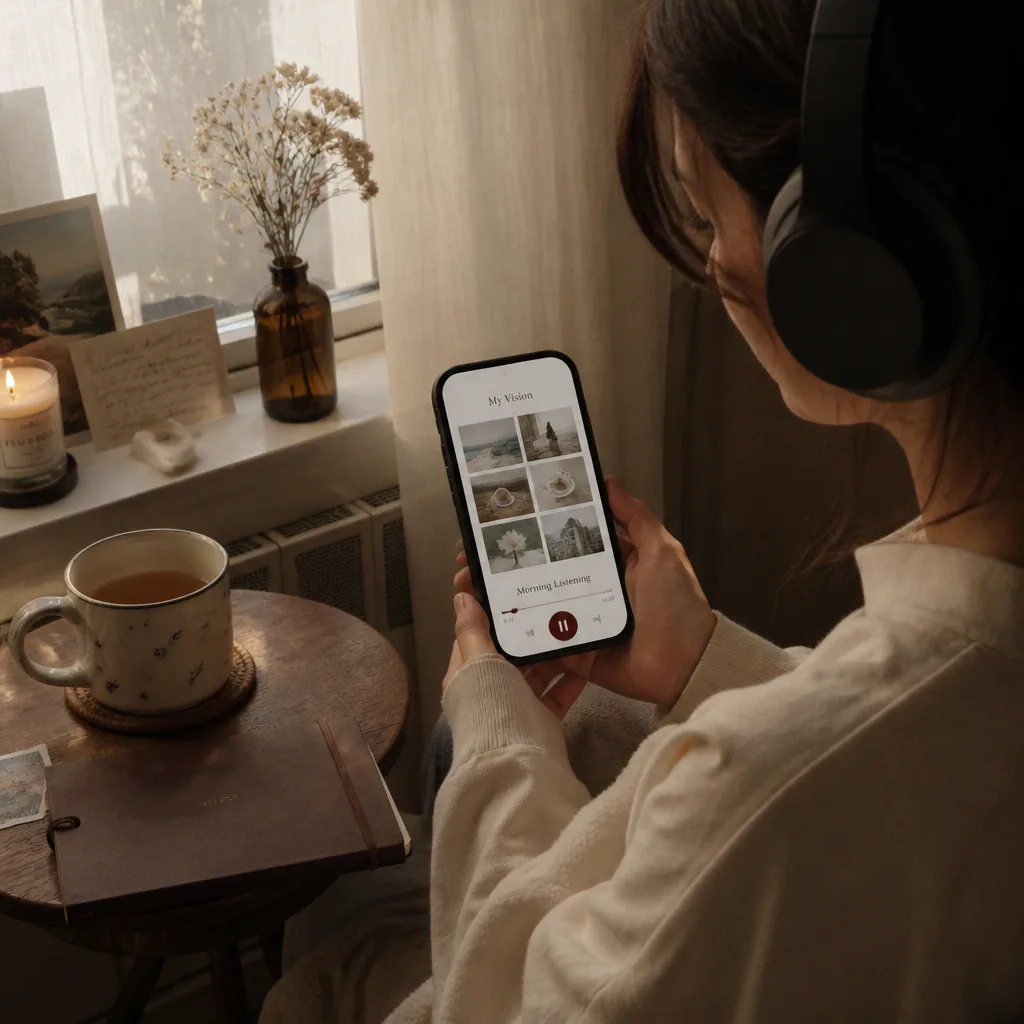
What should you avoid when building a digital board?
Avoid vague images, social comparison, over-editing, and any setup that makes you feel late to your own life.
The first mistake is choosing images that belong to someone else’s taste. A luxury hotel bed may not be your truth. Your truth might be clean sheets, a 10 p.m. phone boundary, and a book you actually finish. Social comparison research has been active for decades, and a 2014 paper in the Journal of Social and Clinical Psychology linked Facebook use with depressive symptoms through social comparison. Your board should not become another feed.
The second mistake is making the board too crowded. Twelve images can be plenty. If every desire gets equal space, nothing has a clear signal. Attention is finite. Cognitive load theory, associated with John Sweller’s work in the late 1980s, reminds us that working memory can be overwhelmed. A digital board should reduce load, not increase it.
The third mistake is using words that your body does not believe. If a phrase creates a quiet no, soften it. Instead of I am rich, try I am learning to meet money clearly. Instead of I am healed, try I keep one promise to my body today. The words need to be true enough to repeat.
The fourth mistake is treating astrology, timing, or signs as a substitute for practice. You can enjoy timing. You can track cycles. If that language helps you reflect, the Astrology and manifestation piece gives a grounded way to hold it. But the board still needs repetition. The audio still needs listening. The day still asks for one next action.
Your board is not a verdict. It is a reminder you are allowed to revise.
How do you know the app is working?
You know the app is working when it changes what you notice, what you repeat, and what you do within 24 hours.
Do not measure it only by big outcomes. Measure it by evidence. Did you open the app 5 days this week? Did the audio feel more familiar by day 10? Did one image prompt a real action? Did you send the email, take the walk, save the receipt, clear the table, or speak more honestly? These are small data points. They count.
A simple tracker helps. I built a habit-tracking app once, and about fourteen thousand people used it. The pattern was not glamorous. People returned when the action was small, visible, and emotionally clean. The same applies here. A digital vision board app should make the right action easier to see. It should not require a new personality.
Use this 4-week review:
| Week | What to check | Good sign |
|---|---|---|
| 1 | Did I open it daily? | The cue has a place |
| 2 | Did the audio feel familiar? | The words feel less distant |
| 3 | Did I take tiny actions? | The board enters the day |
| 4 | What should I remove? | The board gets cleaner |
If you miss days, return without ceremony. Habit research does not require perfection. In the 2009 Lally study, missing one opportunity did not erase the whole pattern for many participants. That is useful. You are not building a streak to impress an app. You are building a return.
For a broader understanding of how affirming language, imagery, and repeated attention work together, move between the Affirmations pillar, the Manifestation pillar, and the daily audio of the AYA Method. Keep the order clear. The audio is the method. The board helps you see what you are listening toward.
Let the picture stay quiet, and listen.