manifestation for life areas
Manifest Passing an Exam With Future-Self Audio
Manifest passing an exam by using future-self audio before studying, so your nervous system hears the result and your study plan gets clear.
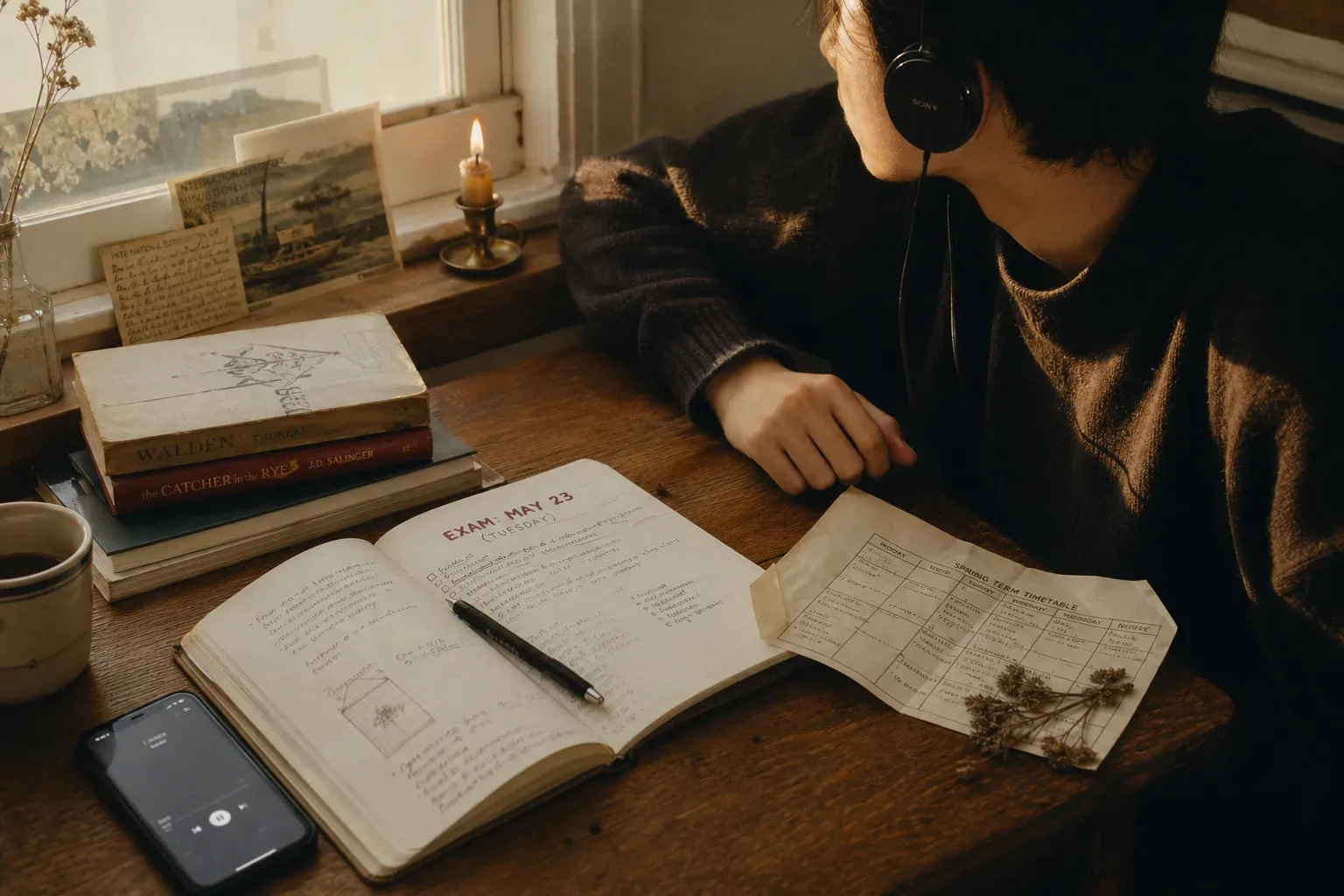
Your notebook is open. The exam date sits at the top of the page. To manifest passing an exam, listen to a short future-self audio before you study, then let that version of you choose the next exact action: recall, practice, review, sleep, repeat. The audio steadies you. The studying carries it.
Can you manifest passing an exam before you start studying?
Yes, if manifestation becomes the way you enter study, not the way you avoid it.
Passing an exam asks for two things at once. You need the material in your mind, and you need enough steadiness to reach it under pressure. The first is built through study. The second can be trained before you touch the notes. That is where future-self audio belongs. It gives your body a clean signal: this result is knowable, and the next action is small.
Psychologist Albert Bandura wrote about self-efficacy in 1977: the belief that you can execute a behavior changes whether you begin, persist, and recover after mistakes. Exam preparation is full of those moments. You miss 6 practice questions. You want to shut the book. A future-self recording doesn’t erase the gap. It helps you stay long enough to close it.
This is close to the heart of manifestation, but it has to stay honest. A test doesn’t bend because you want it. Your behavior changes because you rehearse the self who has already done what the test requires. Manifestation is not a substitute for effort; it’s a way of making effort feel like it belongs to you.
Here is the clean order:
- Name the exam result.
- Listen to the future-self audio.
- Begin with active recall.
- Track what you missed.
- Return tomorrow.
The whole pre-study ritual can take 4 minutes. In a 2013 review in Psychological Science in the Public Interest, Dunlosky and colleagues rated practice testing and distributed practice as high-utility learning methods. That means the audio should send you toward retrieval and spacing, not toward more wishing.
What should future-self audio say before an exam?
It should narrate one believable scene from after the exam, with the passed result already real.
Keep it specific. Not grand. Not cinematic. You might hear yourself walking out of the exam room, noticing your breath, remembering that the hardest question was still workable because you’d practiced that format 3 times. You might hear the result page opening. You might hear the quiet sentence: I passed. I knew more than fear said I did.
The AYA Method is a daily audio manifestation practice. Each day you listen to a short personalized recording — your Dream-Self Moment — narrated from the version of you who has already manifested the life you intend. Listening is the practice. Repetition is the work. The audio is the method.
For exams, your Dream-Self Moment should include evidence. The future self has passed because she completed timed papers, slept enough, answered what was asked, and came back after low scores. Neville Goddard often taught the idea of occupying the state of the wish fulfilled; for study, that state has homework inside it. The future self isn’t a fantasy self. It’s the self who did the next ordinary thing.
Use this simple script shape:
- Result: “I passed my biology final with the score I needed.”
- Scene: “I’m seeing the result on my screen.”
- Body cue: “My shoulders are low. My breath is slow.”
- Proof: “I practiced recall every day, even when it was messy.”
- Next action: “Now I open the first topic and test myself.”
A 2020 review in Nature Reviews Psychology noted that mental imagery recruits many of the same perceptual and emotional systems used in real situations. You don’t need to overdo it. Two to five minutes is enough. A good exam audio doesn’t make you float away from the desk. It brings you back to it.
How do you build a pre-study ritual that doesn’t waste time?
You build it small enough that you’ll still do it on a tired day.
A ritual for exam manifestation should be shorter than the time it takes to talk yourself out of studying. Put your headphones on. Sit where you’ll work. Play the audio once. When it ends, don’t check messages. Open the first question set. This matters because the brain learns cues. In Charles Duhigg’s popular summary of habit research, a cue, routine, and reward form a loop; exam preparation needs a clean cue that leads straight to effort.
Use the same place if you can. Use the same first action every time. BJ Fogg’s behavior model at Stanford emphasizes that behavior happens when motivation, ability, and prompt meet. The audio is the prompt. The study block has to be easy to start. Ten minutes of recall is better than a 90-minute plan you keep avoiding.
| Moment | What to do | Why it helps |
|---|---|---|
| Before audio | Write one target topic | Reduces choice friction |
| During audio | Listen without multitasking | Trains one clear state |
| First 10 minutes | Blank-page recall or quiz | Uses active retrieval |
| After block | Mark misses in one list | Shows the next study target |
| End of day | Schedule tomorrow’s first block | Protects repetition |
The Pomodoro Technique is often set at 25 minutes of work and 5 minutes of rest. You don’t have to worship that number. For anxious students, even 12 minutes can start the loop. A 2014 study in Journal of Experimental Psychology: General found that brief breaks can help maintain attention during prolonged tasks. Your ritual should respect that attention is a finite thing.
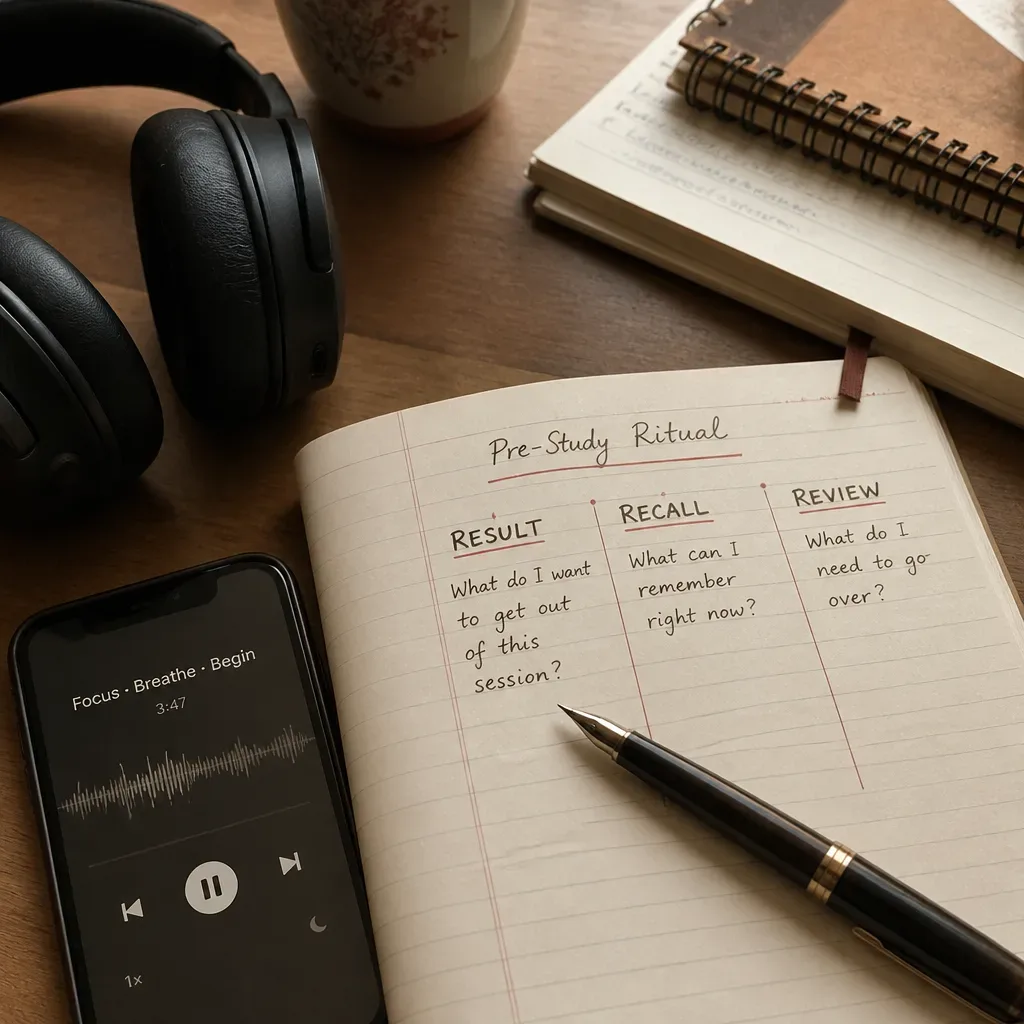
The app also includes a daily affirmation and a Manifestation Board, but keep their role clear. They support the listening. They don’t replace it. If you use affirmations, let them be plain: “I recall what I practice.” One sentence. No performance.
Which study method should follow the audio?
Active recall should come first, because exams reward retrieval more than recognition.
Rereading feels safe because the page looks familiar. Familiar isn’t the same as remembered. In Roediger and Karpicke’s 2006 research on the testing effect, students who practiced retrieval remembered more later than students who repeatedly studied the material. That should change what you do in the first 20 minutes after your audio.
Start with a blank page. Write everything you remember about one topic. Then check the notes. Then correct in a different color. If it’s math, cover the worked solution and try the problem cold. If it’s law, state the rule before reading the case. If it’s medicine, answer the question before checking the explanation. The exam asks you to retrieve; your study should ask the same.
Try this order after every listen:
- Recall: Write or answer from memory for 10 to 25 minutes.
- Check: Compare against the source.
- Repair: Add missed facts, formulas, or reasoning steps.
- Repeat later: Put the miss into a spaced review slot.
- Simulate: Once a week, use timed conditions.
Spaced repetition matters because forgetting is predictable. Hermann Ebbinghaus described the forgetting curve in the 1880s, and later research has repeatedly shown that spacing beats cramming for durable memory. Dunlosky’s 2013 review placed distributed practice among the strongest methods across learners and subjects.
Future-self audio belongs right before the recall block because it changes the emotional entry point. You aren’t opening the notes as someone trying to prove worth. You’re opening them as someone collecting evidence for a result already rehearsed. For more context on how timing and belief interact, astrology and manifestation can be read gently: as a mirror for rhythm, not an excuse to wait.
What do you do when exam anxiety interrupts the practice?
You treat anxiety as body data, then return to the next testable action.
Anxiety is not proof that manifestation failed. It’s often proof that the outcome matters. The American Psychological Association’s 2023 Stress in America report found that adults commonly report stress affecting sleep, mood, and focus; students know this pattern well. The night before an exam can make a familiar chapter look foreign. That doesn’t mean you know nothing.
Use a 90-second reset before you abandon the desk. Neuroscientist Dr. Andrew Huberman has discussed the physiological sigh: two inhales through the nose followed by a long exhale. In a 2023 Cell Reports Medicine study from Stanford researchers, cyclic sighing for 5 minutes daily improved mood and reduced breathing rate more than mindfulness meditation in that sample. You can use one or two sighs before replaying the first 20 seconds of your audio.
Then name the next action in writing. Not “study chemistry.” Too large. Write: “Do 8 acid-base questions.” Or: “Recall 5 causes of the French Revolution.” The number matters. A 2022 meta-analysis on implementation intentions found that if-then planning reliably helps behavior follow intention across contexts, though effect sizes vary. Your plan might be: “If I panic, then I do 3 breaths and answer 1 question.”
Keep a small anxiety protocol beside your notes:
- Put both feet on the floor.
- Exhale longer than you inhale for 3 rounds.
- Read one line from your future-self script.
- Do the smallest practice question available.
- Mark completion, not mood.
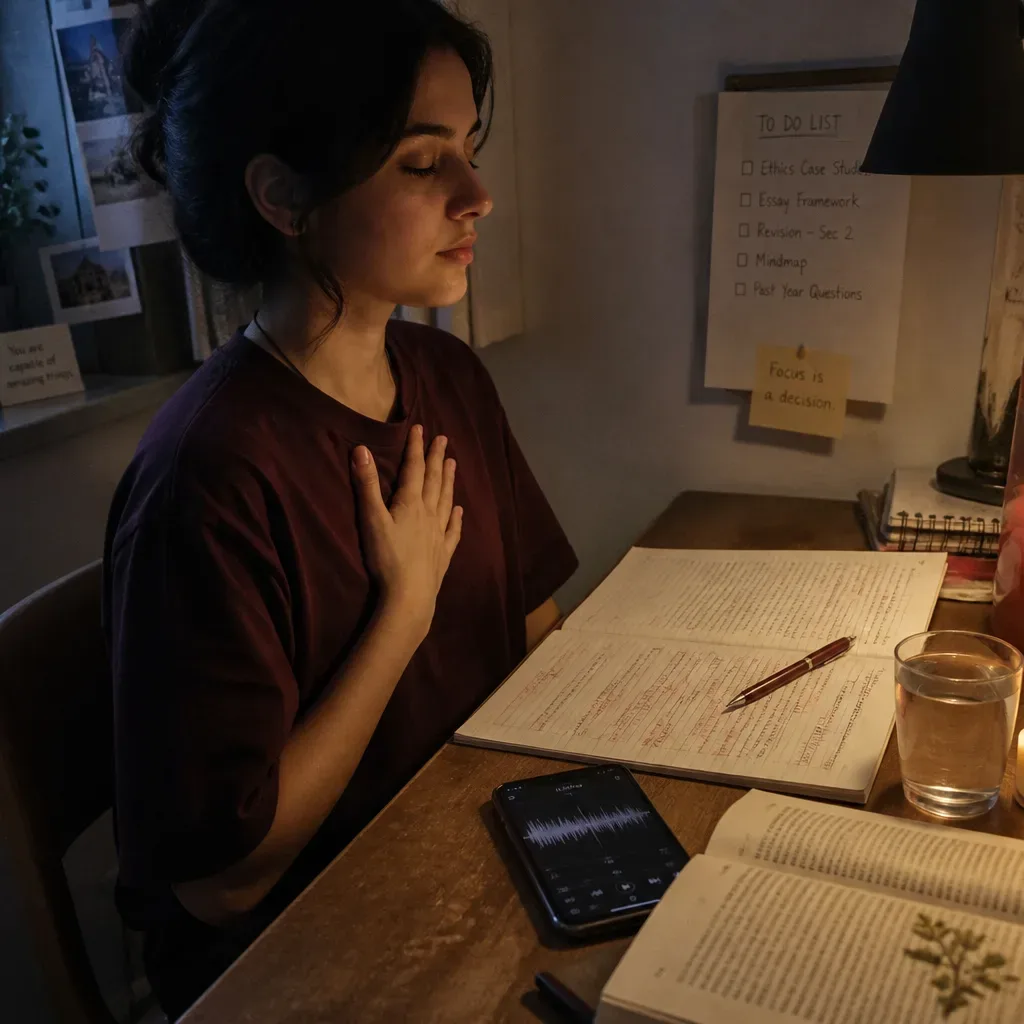
This is where the AYA Method can feel practical rather than soft. The recording doesn’t argue with fear. It gives fear a place to stand while you keep moving. Calm isn’t the price of beginning. Beginning is how calm often returns.
How many days should you repeat future-self audio before the exam?
Repeat it daily until the exam, and pair each listen with one visible study action.
If you have 30 days, use them. If you have 7, use those. If you have one night, be kind and practical. The daily repetition matters because identity is slow to believe one dramatic speech. It believes patterns. You listened. You recalled. You corrected. You slept. You came back.
A 2019 paper in European Journal of Social Psychology is often summarized with the idea that habits take more than 21 days; the original 2009 study by Lally and colleagues found an average of 66 days for a behavior to become automatic, with wide variation. Exam prep may not have 66 days. Still, repetition gives the mind fewer negotiations to run.
Use this schedule if your exam is two weeks away:
| Days before exam | Audio focus | Study focus |
|---|---|---|
| 14–10 | Passing scene and calm start | Map topics, begin recall |
| 9–6 | Proof of preparation | Practice weak areas |
| 5–3 | Timed confidence | Past papers, mixed questions |
| 2 | Steady review | Light repair, no new overload |
| 1 | Trust and sleep | Key errors, pack materials |
| Exam morning | Clear body, clear first step | Brief recall, arrive early |
Don’t keep changing the audio every day. The nervous system likes recognition. You can update one line when you discover a weak topic, but the passed scene should stay stable. Joe Dispenza often speaks about rehearsing a future state until it feels familiar; whether you read that as science, spirituality, or both, the useful part is repetition with feeling and behavior.
The AYA app’s Manifestation Board can hold the exam date, your pass mark, or a photo of your study desk. Good. Let it be visual support. The core remains listening. Then work. If you need a broader frame, the manifestation pillar explains how desire, attention, and action sit together without pretending action is optional.
What should you avoid when trying to manifest passing an exam?
Avoid using manifestation to soothe yourself while quietly avoiding the material.
There is a fake peace that comes from planning. Color-coded schedules. New pens. A perfect audio script. None of these are wrong. But if no practice questions get answered, you haven’t prepared. In academic coaching, this is sometimes called productive procrastination: doing adjacent tasks that feel responsible while avoiding the hard cognitive work. The exam won’t ask how beautiful your plan was.
Also avoid making the audio unbelievable. If you need a 70 to pass and you’re currently scoring 42 on practice papers, don’t record a scene that says, “I got 100 with no stress.” Your mind may reject it. Better: “I passed because I found the gaps early and practiced them daily.” Specific enough to trust. Strong enough to follow.
Here are the quiet rules I use when reviewing wellness tools for my own readers:
- If a tool makes you avoid reality, it’s too expensive at any price.
- If a practice can’t survive a tired Tuesday, it isn’t your practice yet.
- If the audio doesn’t lead to action, shorten it.
- If the study plan has no testing, fix the plan.
- If fear returns, you haven’t failed. You’ve found the next place to practice.
Pew Research Center reported in 2024 that many teens use digital tools for learning support, while educators remain concerned about distraction and overreliance. Both can be true. Your phone can carry the audio that steadies you, then become the device that steals 40 minutes. Put it on airplane mode after listening.
This is the standard: audio first, study next, evidence after. Use affirmations if they help you keep one sentence near. Read about astrology and manifestation if timing language helps you reflect. But for the exam, the pass is built in recall, spacing, sleep, and the repeated sound of your own future self telling the truth.
The desk is still here. So are you.