frequencies binaural
Theta Waves Manifestation Before Dream-Self Audio
theta waves manifestation can soften attention before Dream-Self audio. Here is my quiet, science-literate 12-minute routine for listening without strain.

September 23. The kettle clicked off while my headphones were still cold. Theta waves manifestation is best used as a short settling ritual before Dream-Self audio, not as a guarantee. I use 4–8 Hz theta-style sound for 6 minutes, then listen while my attention is soft but awake.
What are theta waves, and what can they actually do?
Theta waves are slow brain rhythms, usually described as 4–8 Hz, that often appear during drowsiness, memory work, and the borderland before sleep.
I am writing that plainly because theta gets dressed up very quickly online. In EEG research, frequency bands are measurements, not magic categories. Delta is often listed around 0.5–4 Hz, theta around 4–8 Hz, alpha around 8–12 Hz, beta around 13–30 Hz, and gamma above that, though laboratories do not always draw the borders in exactly the same place. A 2018 review in Frontiers in Human Neuroscience notes that theta activity is involved in memory and cognitive control, but not in one single, simple way.
This morning, my coffee cooled beside my left hand while I listened to a low, pulsing track. I did not feel transported. I felt less defended. That is a small thing, but small things count in practice. Sleep scientists have long associated theta with stage N1, the first stage of non-REM sleep, which usually takes only a few minutes and can include drifting images or loose thoughts. The American Academy of Sleep Medicine scoring rules treat N1 as a real physiological state, not a personality test.
For Manifestation pillar, I keep the language clean: the practice is not forcing reality to obey me. It is rehearsing a self I can act from. Theta-style audio may make that rehearsal feel more absorbable because attention is less sharp-edged. But a frequency is not a promise. A tone cannot do the work of repeated choice.
A frequency can prepare the room, but it cannot live the life for me.
Why use theta before Dream-Self audio instead of during it?
I use theta before the Dream-Self audio because the audio itself needs room to be heard, not hidden under another effect.
In the AYA Method, The AYA Method is a daily audio manifestation practice. Each day you listen to a short personalized recording — your Dream-Self Moment — narrated from the version of you who has already manifested the life you intend. Listening is the practice. Repetition is the work. The audio is the method. I keep returning to that last sentence when I am tempted to add too many extras.
The brain is very good at using context as a cue. Habit researchers Wendy Wood and Dennis Rünger wrote in 2016 that habits depend heavily on repeated context-response links. Phillippa Lally and colleagues found in a 2009 study in the European Journal of Social Psychology that a new habit took a median of 66 days to reach automaticity, with large variation from 18 to 254 days. I do not need a dramatic state. I need a repeatable doorway.
That is why I keep theta separate. First, I give my nervous system 6 minutes of the same sound. Then I press play on the Dream-Self Moment. The sequence teaches my body what comes next, the way the kettle teaches morning, or the same chair teaches reading. Dr. Andrew Huberman often describes breath and non-sleep deep rest as tools for shifting autonomic state; I borrow the principle, not the hype.
I also do not want the theta track competing with the words. Personalized language matters. In self-referential processing research, the medial prefrontal cortex is repeatedly implicated when people think about themselves. A 2012 meta-analysis by Murray, Schaer, and Debbané found reliable medial prefrontal involvement across self-processing tasks. If the Dream-Self audio is full of self-relevant language, I want to hear it clearly.
How do I set up a 12-minute theta preparation?
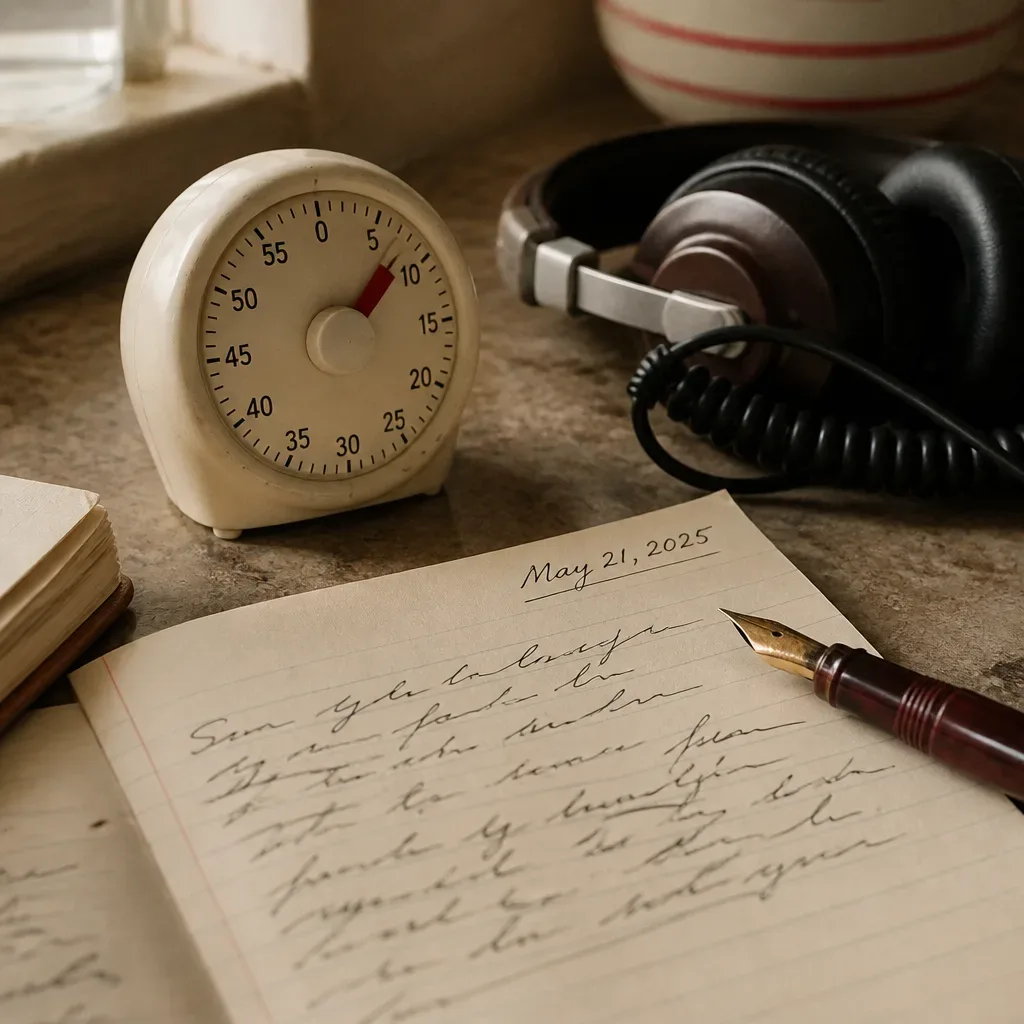
I set it up as 6 minutes of theta preparation, 4 to 5 minutes of Dream-Self audio, and 1 minute of writing one dated line.
Here is the version I used this week, timed with the kitchen clock because my phone makes me restless. The whole thing takes 12 minutes. A 2022 Pew Research Center report found that 31 percent of U.S. adults say they are online almost constantly; I believe that number when I watch my own thumb reach for messages. So I put the phone face down before I begin.
- Choose one theta-style track between 3 and 6 minutes.
- Sit upright enough to stay awake.
- Set the volume low, around the level of quiet rain.
- Breathe in for 4 counts and out for 6 counts, six times.
- Start the Dream-Self Moment immediately after the track ends.
- Write one dated sentence before leaving the chair.
I do not change the track every day. Novelty is expensive. Repetition is how the nervous system learns that this little sound means I am about to listen inward. In a 2018 paper in Health Psychology Review, habit strength was described as increasing through repetition in stable contexts, not through intensity. That sentence has saved me from many overbuilt morning routines.
| Minute | What I do | Why I keep it |
|---|---|---|
| 0–1 | Sit down, headphones on | The body receives a clear start cue |
| 1–6 | Theta-style sound, low volume | Attention softens without losing the words later |
| 6–11 | Dream-Self Moment | The personalized audio is the actual practice |
| 11–12 | One dated line | Memory gets a small hook |
A daily affirmation sometimes comes after, especially if a sentence from the audio stays with me. I keep that in its proper place. Affirmations can support the practice, but they are not the center of mine. The center is listening.
What should I notice in my body while the theta track plays?
I notice ordinary signs first: slower blinking, easier shoulders, longer exhales, and fewer arguments with the morning.
I do not chase tingles. I do not ask my scalp to prove anything. In many EEG studies, theta increases are measured with sensors and signal processing, not by feeling a special sensation. A consumer audio track may be labeled 6 Hz, but my brain is not a metronome that obeys a number printed on a thumbnail. A 2020 review of binaural beats reported mixed findings across mood, attention, and memory outcomes, partly because protocols differ so much.
So I use a plain checklist. If my jaw softens, that counts. If I stop planning lunch for 90 seconds, that counts. If I notice resistance without obeying it, that counts too. The point is not to become blank. The point is to become available.
These are the signs I write in the page when I remember:
- My breath lengthened after 2 or 3 minutes.
- My hands felt heavier in my lap.
- The room sounded farther away.
- One sentence from the Dream-Self Moment landed more clearly.
- I felt sleepy, which meant I needed to sit more upright tomorrow.
The last one matters. Theta-adjacent states can tip into sleep, especially if I practise before bed. Stage N1 sleep is light and easily broken, but it can still blur attention. If I miss half the Dream-Self audio, I have not deepened the practice. I have taken a nap with nice headphones.
A useful state is one I can return from with a sentence in my hand.
What does the science say about theta waves manifestation claims?
The science says theta may support imagery, memory, and relaxed attention, but theta does not prove that an intention will become an event.
This is where I become the person my friends tease me for being. I like wonder, but I like it better when it has edges. There are good reasons to pair relaxed attention with identity rehearsal. Mental imagery has measurable effects in some domains. In a well-known 1995 study, Pascual-Leone and colleagues reported that mental practice of a piano sequence changed motor cortical maps and improved performance, though physical practice was stronger. That is not the same as changing the outside world by thought alone. It is still interesting.
Self-affirmation research also gives me a careful handle. Cohen and Sherman reviewed decades of work in 2014 and described how affirming core values can reduce defensiveness under threat. Creswell and colleagues reported in 2013 that self-affirmation affected stress responses during a laboratory stress task. These are not mystical claims. They are modest claims about attention, threat, and self-story.
I put theta waves manifestation in that same modest category. The theta preparation may lower friction. The Dream-Self Moment may repeat self-relevant language often enough that I begin to recognize certain choices as mine. My daily behavior still has to move. If I ask for steadier work, I still send the email. If I ask for kinder love, I still answer differently.
Some teachers, including Joe Dispenza, speak about brain states and future self rehearsal in far more expansive terms. I read that work with interest and a pencil in my hand. My pencil underlines useful practices and circles claims that outrun the evidence. The distinction keeps the practice honest.
I feel the same way about timing systems. I enjoy reading Astrology and manifestation on certain evenings, but I do not let the sky replace my calendar. A ritual can give shape to attention. It does not absolve me from action.
How do I move from theta into the Dream-Self Moment without breaking the state?
I move immediately, with no checking, no choosing, and no extra ritual between the two audios.
The gap matters. If I finish the theta track and open messages, my attention attaches to the first little emergency it can find. Research on task switching has shown measurable costs for moving between tasks; Rubinstein, Meyer, and Evans reported in 2001 that switching can slow performance, especially when tasks are complex or unfamiliar. My practice is not complex, but my attention is very suggestible at 7:14 a.m.
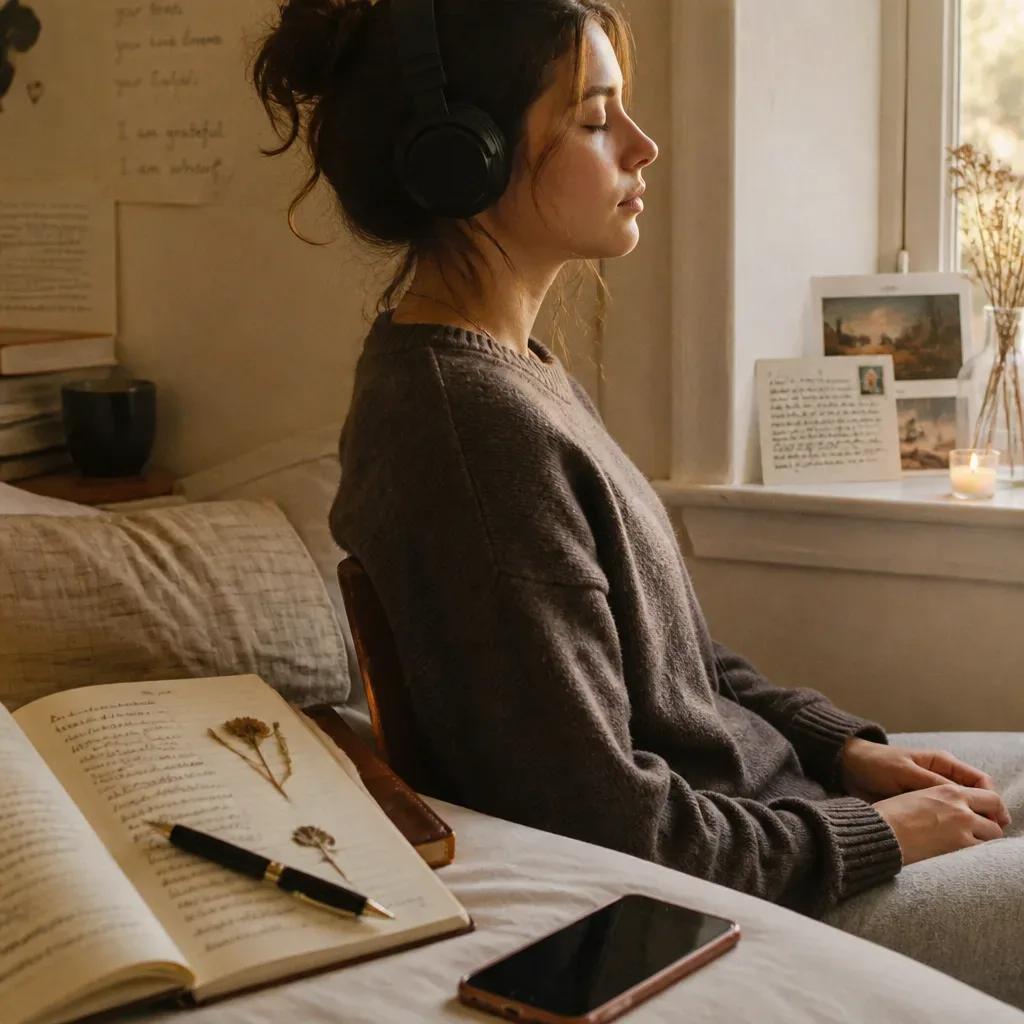
So I set the Dream-Self Moment in the queue before I start. When the theta sound ends, my finger only has to press once. I keep my eyes closed for the first 20 seconds if I can. The first sentence usually matters. It tells my body whose voice I am going to borrow today.
I do not analyze the audio while it plays. I listen the way I listen to my mother leaving a voice note: with my whole ordinary life in the room. If a line feels untrue, I do not fight it. I let it pass and notice the next line. Cognitive reappraisal studies, including work by James Gross and colleagues, suggest that changing interpretation can alter emotional response, but forced belief is brittle. Gentle repetition has better manners.
Afterward, I write one dated line. Not three pages. Not a speech. Today I wrote: Wednesday, I heard the sentence about being steady and did not argue. That was enough. The line gives memory a tag. It also tells me whether I am practising or merely collecting methods.
The state is only useful if it carries me back to the page, the email, the apology, the walk.
How do I keep this routine from becoming one more thing to fail at?
I keep it small enough that I can do it badly and still keep it.
This is not a joke. Perfection breaks more practices than doubt does. In the Lally habit study, missing one opportunity did not erase habit formation, which is one of the kindest findings in behavioral psychology. I have missed mornings. I have listened on the bus with one earbud because the other one was lost in my coat. I have used 3 minutes instead of 6. The record kept going.
I use three rules:
- Same chair when possible, but not required.
- Same theta track for 7 days before changing it.
- One dated line, even if the line says, I was distracted.
The Manifestation Board sometimes sits open on my desk after I listen. I use it like a visual afterthought, not as another pillar. A picture can remind me what I named, but the named thing still needs practice. The audio is where I return. If I have only 5 minutes, I skip the theta track and listen to the Dream-Self Moment. That rule protects the center.
I also keep my claims low enough that my nervous system trusts me. I am not promising myself that a 6 Hz tone will rearrange my life by Friday. I am promising that I will sit down, listen, and act from the sentence I can bear to believe today. Over 30 days, that is not nothing. Over 66 days, the median habit window from Lally’s study, it may become the way morning knows me.
There is a quiet dignity in a practice that does not need to impress anyone.
Wednesday now. I left the headphones on the chair.