astrology manifestation
11/11 Manifestation Ritual With Dream-Self Audio
A quiet 11/11 manifestation ritual using Dream-Self audio, intention, repetition, and one small next step you can keep after the date passes.
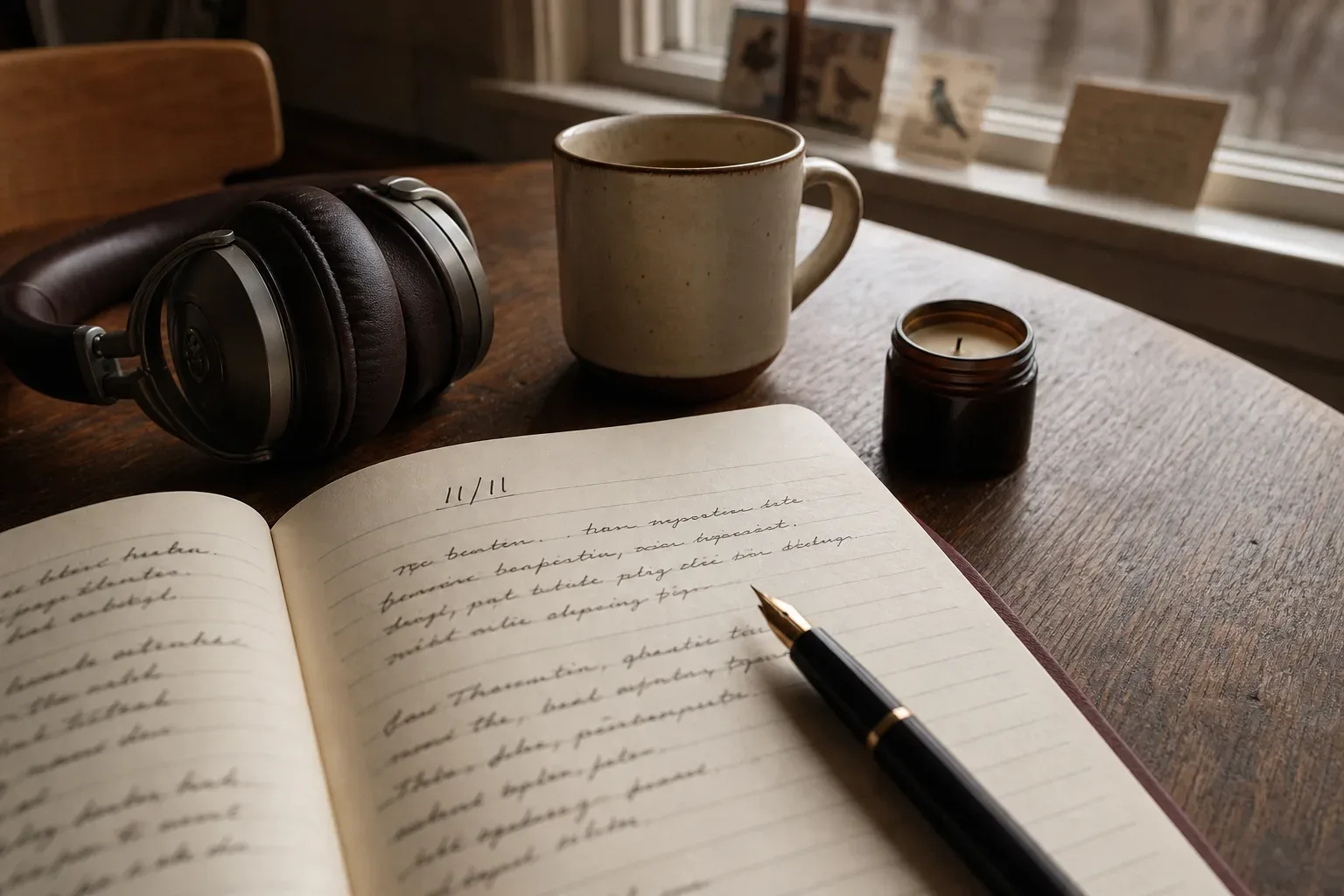
November 11. I put my headphones beside the kettle before the room was fully awake. An 11/11 manifestation ritual works best when it gives the date a job: name one intention, listen to Dream-Self audio, write one grounded line, and take one small action before the day ends.
What is an 11/11 manifestation ritual with Dream-Self audio?
An 11/11 manifestation ritual with Dream-Self audio is a timed intention practice where the listening does the heavy work.
I mean that plainly. I do not need the date to carry the whole weight of my life. November 11 is useful because it is easy to remember, and repeated numbers catch the eye. Pew Research Center reported in 2018 that 29% of American adults said they believe in astrology, which tells me that many of us already use symbols to organize private meaning. The date is a handle. It is not the door itself.
The audio matters because it asks less of me than a blank page. In the AYA Method, the practice is daily audio manifestation. Each day I listen to a short personalized recording, my Dream-Self Moment, narrated from the version of me who has already manifested the life I intend. Listening is the practice. Repetition is the work. The audio is the method.
I have reviewed too many wellness apps that ask for a new identity before breakfast. This one, at least in my own use, survived the bad-day test by day eight. I could listen while my coffee cooled. I could listen before brushing my teeth. A ritual that cannot survive a Tuesday is not a ritual. It is a costume.
For 11/11, I use the date as a bright mark in the notebook. I do not treat it as a lottery ticket. I treat it as a scheduled meeting with the self I keep postponing. The best ritual is not the one that feels most dramatic. The best ritual is the one you can repeat when nobody is watching.
Why does 11/11 feel useful without making it magical?
11/11 feels useful because repeated numbers create a clean cue, and cues help behavior repeat.
I know some people come to 11/11 through numerology, where 11 is often called a master number and connected with intuition, decision, and spiritual attention. I can respect the symbolism without handing over my common sense. The number gives the mind a place to rest. That is enough. The Astrology and manifestation guide says something similar in a wider frame: timing can support attention, but attention still has to become practice.
There is behavioral science under the small romance of it. A 2009 study by Phillippa Lally and colleagues in the European Journal of Social Psychology found that habit formation took a median of 66 days, with a wide range from 18 to 254 days depending on the behavior. That range comforts me. It means a single date can start something, but it cannot replace repetition.
The repeated time, 11:11, works like a bell. Wendy Wood and Dennis Rünger wrote in 2016 in Annual Review of Psychology that habits are shaped by context cues and repetition. If the clock, the candle, the chair, and the audio repeat, the body starts to understand the assignment faster than the intellect does.
Here is the part I had to learn the slow way: meaning is allowed to be chosen. A symbol does not have to prove itself in a lab before it helps me behave better. But behavior does have to show up. If I say 11/11 matters and then do nothing different, I have only decorated the day.
What do I need before I start the ritual?
You need one intention, one audio track, one page, and one action small enough to do today.
I set my materials out like a person with limited bandwidth, because I am one. Headphones. Notebook. Pen. Water. A chair that does not make the practice feel precious. Dr. Andrew Huberman often points to morning light, breath, and simple environmental cues when discussing nervous system regulation on Huberman Lab; I borrow the spirit of that without turning my kitchen into a lab.
I keep the intention narrow. The Manifestation pillar is helpful here because it separates vague wanting from clear naming. I do not write, I want my whole life to feel better. I write, I am available for work that pays fairly and does not make me disappear from myself. That sentence has edges. Edges help.
I also make a small rule: no more than one main intention for this ritual. In venture, every founder says they have three target customers, and usually that means they have none. Desire behaves the same way. If I ask the day to hold five unrelated futures, I have not created richness. I have created noise.
My short setup looks like this:
- A quiet place I can return to tomorrow
- One Dream-Self audio recording
- One written intention of 10 to 25 words
- One support sentence, if I want an affirmation later
- One ten-minute action connected to the intention
I sometimes open the Affirmations pillar afterward, not before. I want the audio to lead. A daily affirmation can support the listening, and a Manifestation Board can hold an image after the fact, but neither one is the center for me. The center is the track in my ears and the repeatable act of returning.
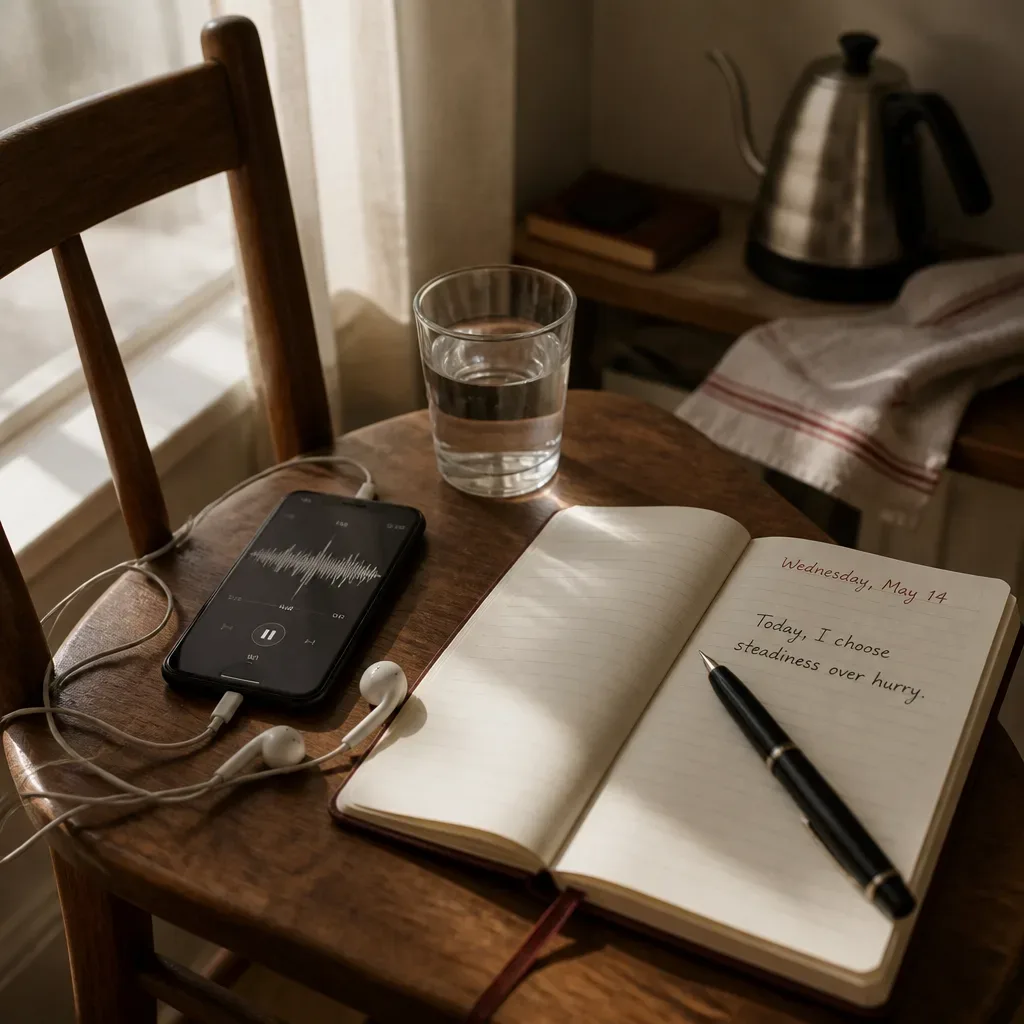
How do I do the 11/11 ritual step by step?
I do the ritual by moving from cue to listening to writing to action, in that order.
This is the version I used last year, written in my notebook with a coffee ring touching the margin. It took 22 minutes. That length matters because it is short enough to fit inside a normal day. A 2006 meta-analysis by Peter Gollwitzer and Paschal Sheeran found that implementation intentions, the if-then plans people make before acting, had a medium-to-large effect on goal achievement across 94 studies. I do not need a perfect plan. I need a next move.
- At 11:11, sit down. If I miss 11:11, I sit down when I remember. I do not punish myself for being human.
- Write the intention once. I use present-tense language only if it does not make me feel fake.
- Listen to the Dream-Self Moment. I do not scroll. I do not optimize. I listen.
- Write one received sentence. I ask, what did the future version of me seem to know?
- Choose one action under ten minutes. I do it before dinner if possible.
- Mark the page. I date it, because dated pages tell the truth later.
I have tried doing this with candles, music, moon calendars, and all the little objects people recommend. Some were lovely. None mattered as much as finishing the loop. Intention without action becomes theater. Action without listening becomes old pressure in new clothes.
Here is the table I keep taped inside the back of my notebook:
| Ritual part | Time | Why I keep it |
|---|---|---|
| Sit and breathe | 2 minutes | It marks the switch from ordinary time |
| Listen to audio | 5 to 8 minutes | It gives the future self a voice |
| Write one line | 3 minutes | It catches the sentence before I edit it |
| Take one action | 10 minutes | It makes the desire visible in behavior |
Mental rehearsal has some support outside spiritual practice, too. In a 1995 Science paper, Alvaro Pascual-Leone and colleagues found that mental practice of a piano exercise produced measurable changes in the motor cortex, though physical practice remained strongest. I think about that when I listen. The mind rehearses. Then the hands have to touch the keys.
What should I say after the audio ends?
After the audio ends, say one sentence that is believable enough to repeat and specific enough to guide behavior.
I wait a few seconds before writing. The urge is to perform insight. I know that urge well. It sounds expensive. Instead, I ask for the plainest sentence. Last November, mine was: I do not have to prove my seriousness by being exhausted. That sentence did more for me than a page of polished declarations.
The sentence can be an affirmation, but I keep it modest. Claude Steele’s self-affirmation theory, first developed in the 1980s, was not about pretending everything is fine. It was about restoring a sense of integrity under threat. Later research has been mixed by context, which is worth saying. Still, small value-based statements can reduce defensiveness in some settings, especially when they reconnect people to what matters.
I use this structure when I get stuck:
- I am practicing the kind of life where…
- I can take one honest step by…
- I no longer need to…
- I am allowed to choose…
- Today I will behave as if…
There is a difference between a sentence that opens the body and a sentence that argues with it. If my nervous system rolls its eyes, I rewrite. I would rather say, I am willing to receive work that respects my time, than, I am wildly successful in every way. One has a handle. The other floats away.
The Manifestation pillar helped me name that distinction. A desire gets stronger when it becomes more honest, not when it becomes louder. This is also where the support affirmation can come in later, while I am on the bus or washing a cup. Not as a second pillar. Just as a small thread back to the audio.
How do I keep the ritual from becoming another performance?
I keep the ritual private, short, and measured by use rather than mood.
This matters because spiritual practice can become content very quickly. I say that as someone who has reviewed products built to turn every private act into a shareable streak. The global wellness economy was valued at $5.6 trillion by the Global Wellness Institute in its 2023 report. There is real money in convincing us that a quiet practice needs accessories.
I do not post my 11/11 page. I do not grade the candle. I do not buy a new notebook if the old one still has paper. The ritual is allowed to be visually boring. Boring is underrated. Boring is often where repetition can live.
I use three checks:
- Did I listen? Not did I feel moved, not did I cry, not did the room change. Did I listen.
- Did I write one honest sentence? Honest beats impressive every time.
- Did I take one small action? Less than ten minutes, completed today.
The Princeton Engineering Anomalies Research program, often called PEAR, studied consciousness-related anomalies for nearly 28 years before closing in 2007. Its conclusions remain debated, and I do not use them as proof that intention controls outcomes. I use the controversy as a reminder to stay humble. Mystery is not a business model. Mystery is a reason to keep good notes.
If I want timing support, I read Astrology and manifestation for context, then I close the tab. The reading can frame the day. The audio still has to be played. The action still has to be done. Nobody can outsource their attention and still call it devotion.
What do I do on November 12?
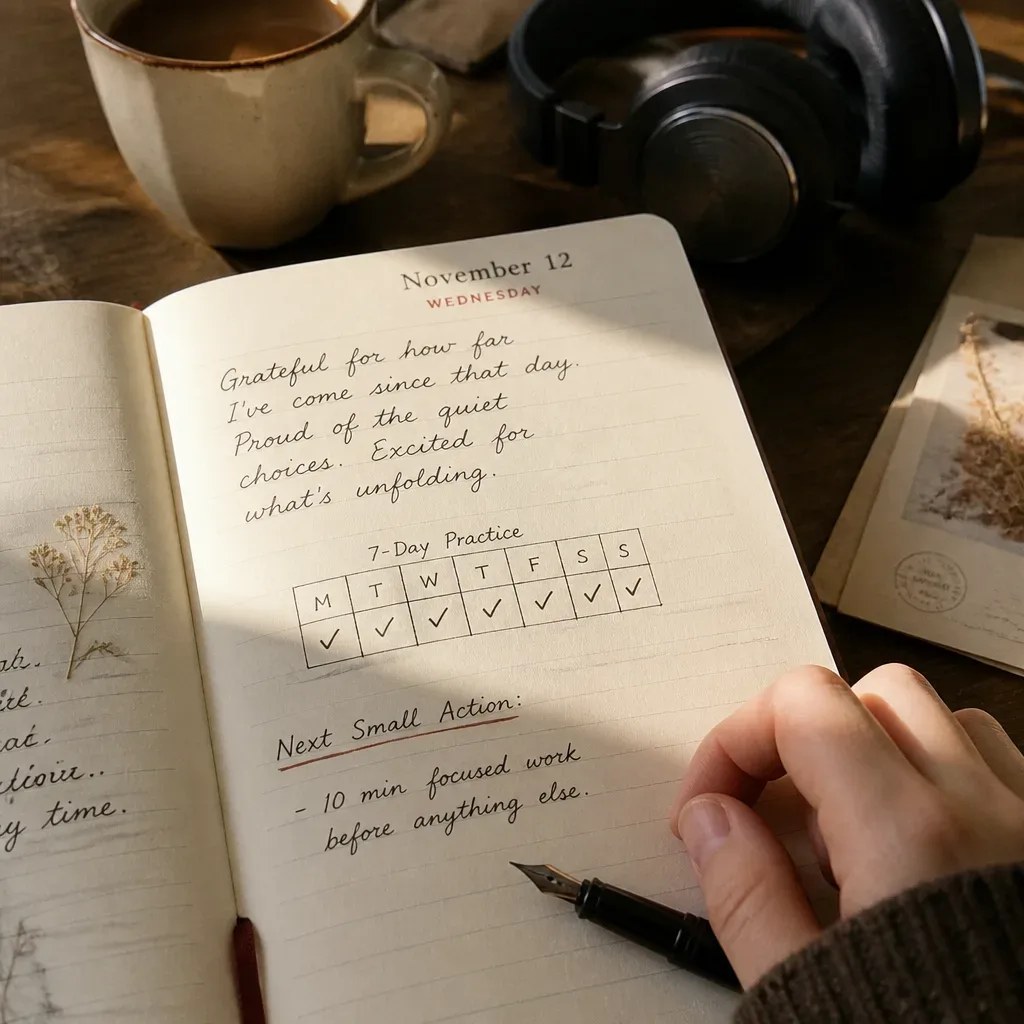
On November 12, I repeat the listening so the date becomes a beginning rather than a souvenir.
This is the unglamorous part, and therefore the part I trust most. I wake up. I make coffee. I listen again. Maybe the sentence from 11/11 still feels alive. Maybe it does not. Either way, I keep the appointment. Lally’s habit study found missed days did not necessarily destroy habit formation, which is a mercy I have written in the margin twice.
I keep a seven-day aftercare plan because one ritual can stir a lot and support very little if I abandon it immediately. Mine looks like this:
| Day | Practice | Small action |
|---|---|---|
| Nov 12 | Listen again | Repeat yesterday’s action or reduce it |
| Nov 13 | Listen before phone | Remove one friction point |
| Nov 14 | Listen and walk | Send one message |
| Nov 15 | Listen at night | Review what changed in behavior |
| Nov 16 | Listen in the kitchen | Clear one physical space |
| Nov 17 | Listen without notes | Rest from analysis |
| Nov 18 | Listen and date the page | Choose next week’s step |
There is a useful finding from Taylor, Pham, Rivkin, and Armor in a 1998 Journal of Personality and Social Psychology paper: students who visualized the process of studying tended to perform better than those who only visualized the outcome. I take that seriously. Dream-Self audio gives me the outcome voice, but the next-day plan gives me the process.
This is also where I return to the AYA Method as daily practice, not special occasion theater. The audio is not a souvenir from a meaningful date. It is the thing I play again when the sink is full, when the inbox is rude, when my older patterns come back wearing practical shoes.
I do not need November 12 to feel charged. I need it to be kept. A life changes less through one bright promise than through the ordinary keeping of it.
Friday now. The blue mug is clean.