astrology manifestation
Last Quarter Moon Ritual With Dream-Self Audio
A quiet last quarter moon ritual using Dream-Self audio, reflection, and release to review the month without forcing a new beginning.
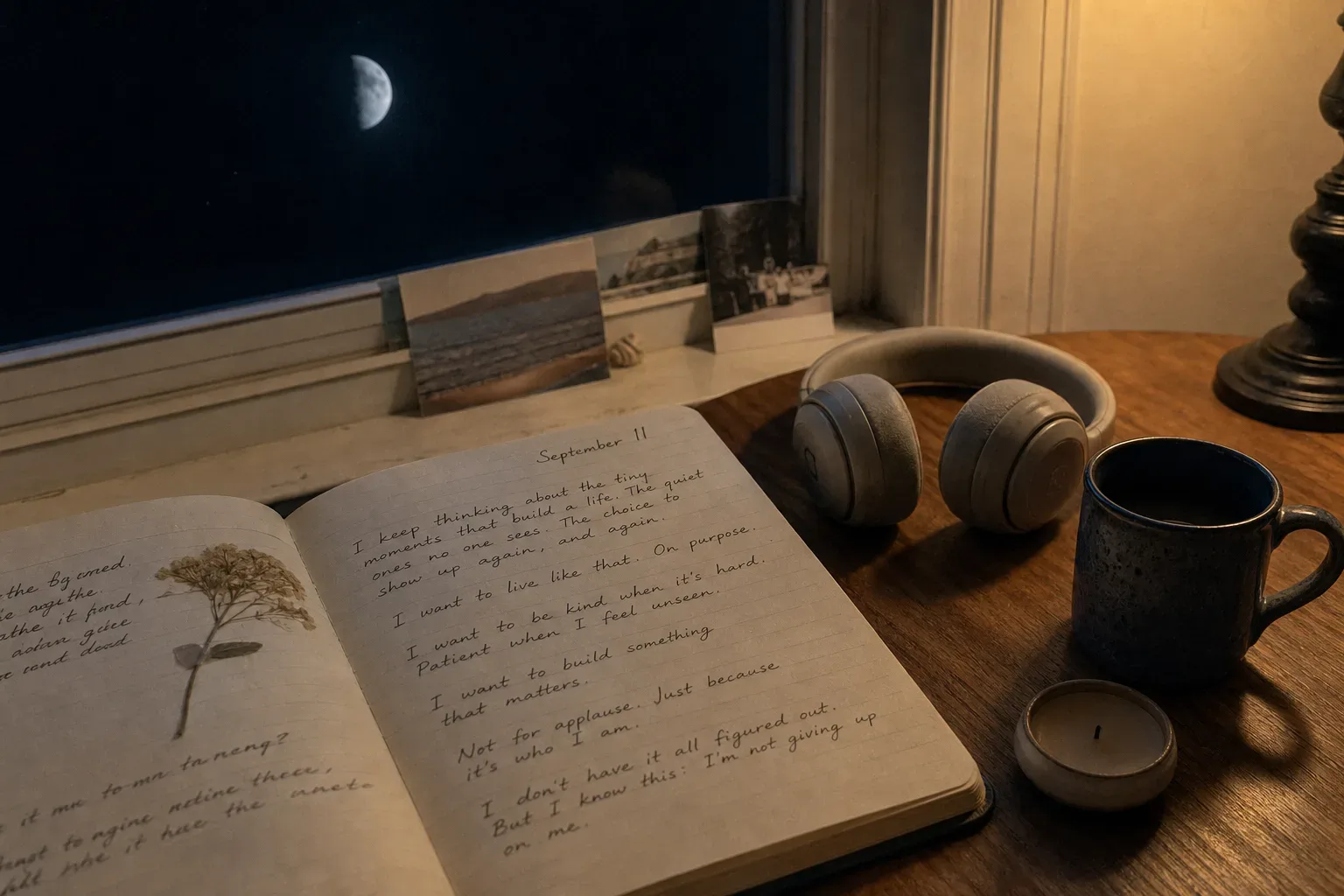
September 11. The kettle clicked off before the moon came up. A last quarter moon ritual is a short review-and-release practice: I listen to my Dream-Self audio, write what no longer fits, and choose one small action before the next new moon. It takes about 22 minutes.
What is the last quarter moon asking me to do?
The last quarter moon asks me to review, reduce, and choose what I will stop carrying into the next cycle.
I am writing this at the kitchen table, where the light makes the page look older than it is. The last quarter moon is the half-lit waning moon, usually about seven days after the full moon and about seven days before the new moon. A full lunar cycle takes about 29.5 days, according to NASA’s basic lunar phase descriptions, which means this review point returns often enough to become useful and not so often that I start ignoring it.
In astrology, the last quarter moon is often treated as a point of adjustment. I like that word better than release sometimes. Release can sound dramatic. Adjustment sounds like moving one chair so the room works again. On the Astrology and manifestation page, I have marked this phase as less ceremonial and more honest. The moon is not asking me to become a different person by midnight. It is asking me to notice which story I have been rehearsing for four weeks.
The science part of me keeps one hand on the table. A moon ritual can work as a temporal landmark, a term used in behavioral research for dates or moments that help people mentally separate one period from another. Dai, Milkman, and Riis described the “fresh start effect” in 2014, showing that people are more likely to pursue goals after landmarks like Mondays, birthdays, or the start of a new year. The last quarter moon is quieter than January 1, but it still gives the mind a clean edge.
A ritual does not need to prove the moon moved your life. It only needs to help you tell the truth at the right time.
Tonight I am not asking for a new beginning. That belongs more naturally to the new moon. I am asking what became heavy after the full moon. One sentence on the page is enough to begin: “This month taught me that I keep protecting a version of myself I no longer want to practice.”
Why do I use Dream-Self audio instead of only journaling?
I use Dream-Self audio because listening gives my nervous system a repeatable identity cue before I try to write anything true.
My journal alone can become a courtroom. I list evidence, defend myself, prosecute myself, and somehow call it reflection. The audio changes the order. In the AYA Method, The AYA Method is a daily audio manifestation practice. Each day you listen to a short personalized recording — your Dream-Self Moment — narrated from the version of you who has already manifested the life you intend. Listening is the practice. Repetition is the work. The audio is the method.
I listened to my Dream-Self Moment tonight before brushing my teeth. That is the order I do them in on difficult evenings, because if I wait until I feel clean and composed, I often do not listen at all. The recording was under seven minutes. It said my own name twice. That matters more than I used to think. Self-referential language recruits brain systems linked with self-processing, including regions often discussed as part of the medial prefrontal cortex network. In cognitive neuroscience, self-related material is generally remembered better than information processed in less personal ways, a finding that goes back to Rogers, Kuiper, and Kirker’s 1977 self-reference effect work.
Joe Dispenza writes often about mental rehearsal, and Neville Goddard wrote about living from the assumed state. I read both with a pencil in my hand. I keep what is useful and leave the overstatement. The brain can tell imagination from reality in many important ways. But repeated imagined self-language can still influence attention, expectation, and behavior. That is a smaller claim. It is also the claim I trust more.
The audio keeps the ritual from becoming only a mood. A daily affirmation can help too, especially when I need one sentence to hold onto, and I keep notes from the Affirmations pillar close for that reason. But tonight the affirmation is a complement. The listening comes first.

How do I prepare before I start the ritual?
I prepare by making the room plain, choosing one object, and deciding in advance that I will not solve my whole life tonight.
At 8:40 p.m., I cleared the table. Not perfectly. There was still a spoon, a receipt from the pharmacy, and my mother’s blue mug. I put my headphones beside the notebook and wrote the date at the top of the page. Specificity lowers the drama for me. One study on implementation intentions by Peter Gollwitzer, often cited from the late 1990s, found that specifying when and where an action will happen can meaningfully increase follow-through. The ritual begins before the candle. It begins when the conditions are simple enough to repeat.
Here is the preparation I kept tonight:
- I checked the moon phase and wrote “last quarter” under the date.
- I set a timer for 22 minutes.
- I placed one object on the table, the blue mug, to make the ritual feel located.
- I opened my Dream-Self audio and did not open messages.
- I wrote one question before pressing play: “What am I done rehearsing?”
I do not always light a candle. Sometimes I do. Ritual objects can help attention, but they can also become a way to postpone the practice. A 2020 Pew Research Center report found that about 29% of U.S. adults said they believe in astrology, and belief levels vary by age and gender. I write that down because it reminds me that people come to moon work from very different places. Some come with devotion. Some come with curiosity. Some come with a nervous system that likes a monthly appointment.
If I am tired, I make the ritual smaller, not later. I use water instead of tea. I write three lines instead of a page. I sit in the chair nearest the outlet because my headphones are low. A practice that requires a perfect atmosphere will become a practice I only do when my life is already gentle.
| Preparation choice | Why I keep it small | Time |
|---|---|---|
| Write the date and moon phase | Marks the review point clearly | 1 minute |
| Set out headphones | Makes audio the center of the practice | 1 minute |
| Choose one object | Gives attention a place to land | 1 minute |
| Write one question | Prevents scattered journaling | 2 minutes |
The room does not need to be sacred before I begin. Sometimes beginning is what makes it sacred enough.
What are the exact steps of my last quarter moon ritual?
The ritual has six steps: arrive, review, listen, write, choose one release action, and close gently.
I like steps because they stop me from making a ceremony out of self-criticism. The last quarter moon already has enough shadow in it. I do not need to add a trial. Dr. Andrew Huberman has often summarized habit formation around cues, repetition, and state-dependent learning; the broader behavioral literature says something similar. A cue repeated in the same context has a better chance of becoming automatic over time. For me, the cue is the moon phase and the sound of the Dream-Self Moment beginning.
My 22-minute version
- Arrive for two minutes. I put both feet on the floor and breathe normally. I do not force calm. I only notice whether I am clenched.
- Review for three minutes. I list three events from the last four weeks. Not interpretations. Events.
- Listen for five to seven minutes. I play my Dream-Self audio once. I do not journal during it.
- Write for seven minutes. I answer: “What no longer matches the person I am practicing becoming?”
- Choose one release action for two minutes. I pick something visible and small.
- Close for one minute. I write one future-self sentence and leave the page open until morning.
The release action is the part I used to skip. It is also the part that makes the ritual honest. Research in the Journal of Behavioral Medicine and related health psychology journals has repeatedly shown that self-monitoring and specific action planning are stronger than intention alone for behavior change. The exact effect size varies by study and behavior, but the pattern is sturdy enough that I trust it more than a beautiful paragraph.
Tonight my release was not grand. I moved a conversation thread out of view. I had been checking it in the bath, on the bus, before making coffee. The phone told me I had opened that app 37 times yesterday. That number embarrassed me in a useful way. The ritual did not ask me to become detached. It asked me to stop feeding one loop.
For the bigger frame of asking, attention, and behavior, I keep returning to the Manifestation pillar. I like the parts that treat manifestation as a practice of naming, noticing, and acting. The moon gives me a date. The audio gives me a voice. The action gives the night somewhere to go.
What should I write during the release part?
I write about the pattern I am ready to stop rehearsing, not about everything that hurts.
The page can become a place where pain multiplies if I do not give it edges. So I use prompts that are narrow. James Pennebaker’s expressive writing research, beginning in the 1980s, found that writing about emotional experiences for around 15 to 20 minutes across several sessions could be linked with health and psychological benefits in some groups. But even that research is not a permission slip to drown in the page. Structure matters.
These are the prompts I used tonight:
- “The story I repeated most this month was…”
- “The evidence that this story is old is…”
- “The cost of keeping it for another month would be…”
- “The smallest release I can make in 24 hours is…”
- “My Dream-Self would not argue with this pattern. She would…”
I keep the word “small” in almost every prompt. Small is not weak. Small is trackable. If I write, “I release fear,” I have written fog. If I write, “I will not reread that email after 9 p.m. this week,” I have written a behavioral experiment. In small studies on implementation intentions, the if-then format has helped people follow through on goals by linking a situation to a response. So I often add one line: “If I want to reopen the thread after 9 p.m., then I will put the phone on the kitchen counter.”

The Dream-Self sentence comes last. I do not use it to scold myself. I write it as if it were spoken from the version of me in the recording: “I do not keep returning to rooms where my body has already said no.” That sentence may be more useful than three pages of analysis.
A good release sentence has a door handle on it. You can do something with it when you stand up.
If I need a softer entry, I borrow the language of affirmations, but carefully. The Affirmations pillar is useful when I remember that an affirmation is not a spell I throw at discomfort. It is a sentence I repeat until my behavior has a chance to answer.
How does this fit with astrology without making claims I cannot prove?
I let astrology provide timing and symbolism, while I let psychology explain the repeatable parts of the practice.
This distinction keeps me honest. The last quarter moon has a long symbolic association with waning, discernment, and release. I respect that. I also know that a strong claim needs strong evidence. Princeton’s Global Consciousness Project reported statistical deviations in random number generator data during major world events, but the interpretation remains debated, and it is not evidence that my moon ritual changes external events. I do not need it to be that. I need it to change what I notice, repeat, and choose.
Astrology works best for me as a meaning calendar. It tells me when to ask certain questions. The new moon asks what I am beginning. The full moon asks what has become visible. The last quarter asks what I can stop feeding. That symbolic sequence is useful even if someone approaches it as metaphor. In a 2018 Pew report on New Age beliefs, 62% of U.S. adults endorsed at least one belief such as spiritual energy in physical things, psychics, reincarnation, or astrology. People are already mixing meaning systems. The kinder task is to do it with precision.
Here is the sorting I use when I feel myself becoming too certain:
| Part of the ritual | I can claim | I cannot claim |
|---|---|---|
| Moon phase timing | It creates a recurring review cue about every 29.5 days | It guarantees an outcome |
| Dream-Self audio | Repeated self-relevant language may shape attention and self-talk | The brain cannot tell imagination from reality |
| Journaling | Structured writing can support reflection and planning | Every painful page is healing |
| Release action | Specific behavior is easier to track | One action fixes the whole pattern |
I still love the moon. I just do not make her carry claims that belong to my calendar, my attention, and my hands. That sentence feels almost like a relief.
The wider practice of astrology and manifestation becomes sturdier when I separate poetry from mechanism. Poetry gives the night meaning. Mechanism tells me what to repeat tomorrow.
What do I do the morning after the ritual?
The morning after, I check whether I kept the release action and listen again without reopening the whole ritual.
This is the part I learned by failing. I used to have a beautiful moon night and then live the next morning as if the page had burned itself. Now I leave the notebook open on the table. When the kettle comes on, I read only the release action and the Dream-Self sentence. It takes less than 90 seconds. A 2009 study by Lally and colleagues in the European Journal of Social Psychology found that habit automaticity took a median of 66 days to form, with wide variation. One morning will not make me new. One morning can keep the thread from breaking.
I listen to the audio again if I can. Not as another ritual. Just as practice. The AYA Method has taught me that repetition does not have to feel dramatic to count. Some mornings the voice in the recording feels close. Some mornings it feels like it is speaking from another room. I count both.
The follow-up has only three checks:
- Did I do the release action within 24 hours?
- Did my environment support it or sabotage it?
- What is the next smallest adjustment before the new moon?
If the answer to the first question is no, I do not rewrite the whole ritual. I reduce the action. If “do not check the thread all week” was too large, I make it “do not check the thread before breakfast.” Behavioral research is full of this humbling lesson: design beats willpower more often than pride admits. BJ Fogg’s behavior model, used widely in habit design, emphasizes that behavior depends on motivation, ability, and prompt. When ability is low, make the action easier.
The morning after a ritual is where sincerity becomes visible.
I also mark the next new moon in my calendar. Not because I need to rush toward beginning again, but because endings are easier when they have somewhere to rest. The last quarter moon is an editing table. The new moon can wait.
Friday morning. The blue mug is still on the table, and I have not moved it yet.