frequencies binaural
528 Hz Manifestation Under Your Dream-Self Audio
528 hz manifestation can support your Dream-Self audio when it stays quiet, steady, and secondary. Here is the simple way I test it.

Saturday. 528 Hz manifestation is best used as a quiet support under your Dream-Self audio, not as the main practice. I keep the spoken recording clear, place the 528 Hz track low, and judge it by one plain measure: did I listen again tomorrow without making the morning harder?
What does 528 Hz manifestation actually mean?
528 Hz manifestation means using a 528 hertz tone or music track as a background cue while you listen to the audio practice that names the life you are asking for.
I wrote that sentence in my notebook this morning because the internet makes it sound more mystical than it needs to be. A hertz is just a unit of frequency, one cycle per second. 528 Hz means 528 cycles per second. That part is not hidden. It is arithmetic. The part that gets soft around the edges is the claim people attach to it.
Some solfeggio frequency circles call 528 Hz the love frequency. I am careful with that phrase. In a small Japanese study published in 2018, researchers reported short-term changes in stress markers after people listened to 528 Hz music, but the sample was small enough that I would not build a religion on it. I would build a test. That is different.
For me, the useful question is not whether 528 Hz can force a result. It is whether it helps my body stay long enough with the words I chose. The words matter because the AYA Method is a daily audio manifestation practice. Each day I listen to a short personalized recording, my Dream-Self Moment, narrated from the version of me who has already manifested the life I intend. Listening is the practice. Repetition is the work. The audio is the method.
A sound can become a door handle for attention. It does not have to be magic to be useful.
I keep the frequency in its proper place. It is like the kettle clicking on, the chair by the window, or the blue mug I use too often. It tells my system, we are doing this now. Habit researchers often call this a cue. In a 2009 European Journal of Social Psychology study, Phillippa Lally and colleagues found that automaticity took 18 to 254 days to form, with 66 days as the often-cited average. A tiny cue matters when the practice has to survive ordinary weather.
How do I play 528 Hz under Dream-Self audio without ruining it?
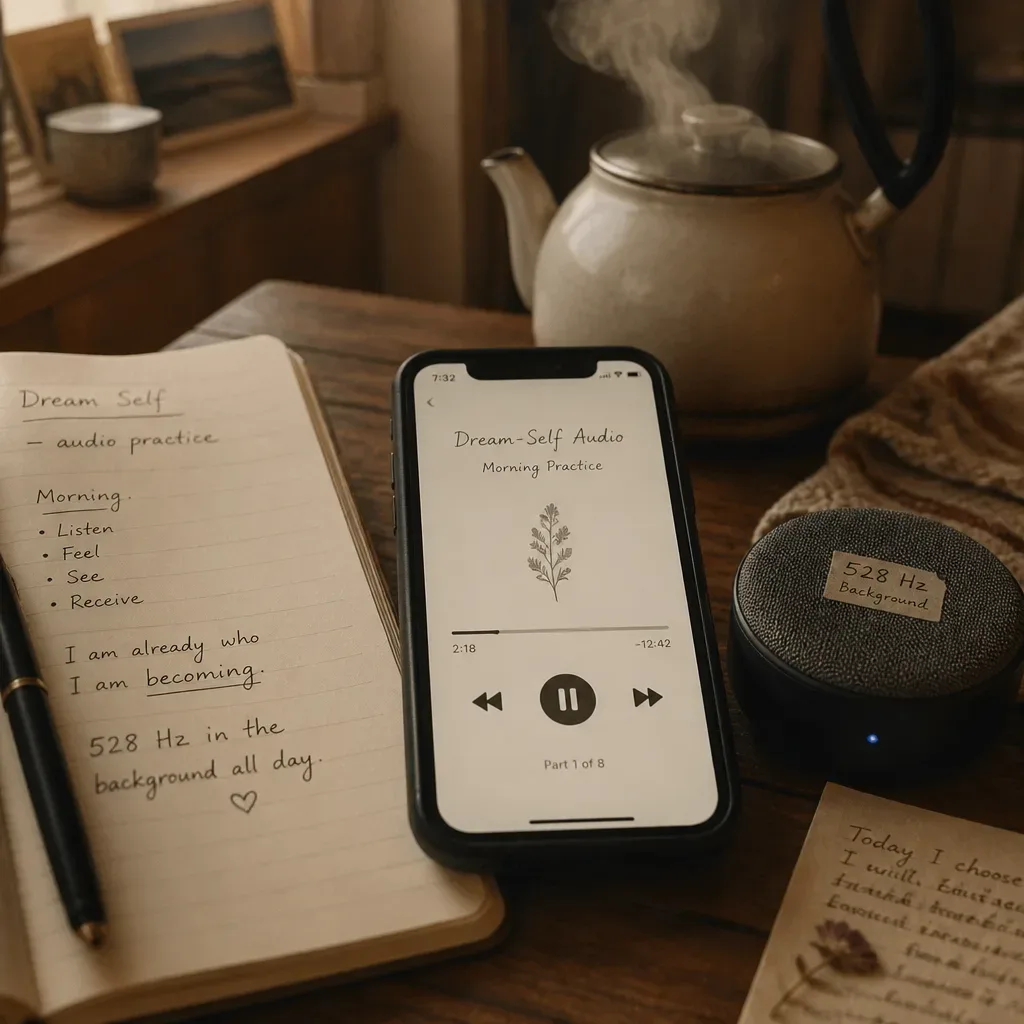
I play the Dream-Self audio first, then add 528 Hz so low that the voice stays completely intelligible.
The order matters. If I start with the frequency, I can become busy adjusting it, comparing tracks, wondering if one is more correct than another. That is how a five-minute practice turns into a twenty-two-minute product review, and I have done enough of those for one life. I start the audio. Then I add the tone. If the tone pulls focus, it goes down.
Here is my setup from this week:
- I open my Dream-Self Moment.
- I press play and listen for the first sentence.
- I start one 528 Hz track from the same playlist.
- I lower it until it is more felt as background than heard as content.
- I put the phone face down and stop touching it.
That last step is not romantic. It is design. A 2018 RescueTime report found that people checked phones dozens of times daily; the exact number varies by study and age group, but the pattern is steady. The phone is not neutral once it is in my hand. If I keep adjusting the stack, I stop listening.
I use a simple rule from audio editing: speech wins. Podcasts often keep background music many decibels lower than the spoken track because the human brain works hard to decode language when another sound competes. I do not need a perfect studio mix in the kitchen. I need every sentence to land.
| Layer | Job | My rule |
|---|---|---|
| Dream-Self audio | Main practice | Clear enough to transcribe |
| 528 Hz track | Background cue | Barely audible |
| Daily affirmation | Small complement | One line only if useful |
| Manifestation Board | Visual complement | Look later, not during |
The daily affirmation and Manifestation Board can help me remember the shape of what I am practicing, but they are not the pillar. The audio is. I learned this the hard way after testing wellness apps for two years: the routine with fewer moving parts usually survives week three.
What is the ten-minute setup I use in the morning?
I use a ten-minute setup because it is short enough for a bad morning and long enough to settle my attention.
This is the version I kept after three Tuesdays of changing it. I listened before brushing my teeth, which sounds small because it is small. BJ Fogg, who writes about tiny habits, often points to making behaviors easier rather than demanding more motivation. I believe him more on wet mornings than on bright ones.
My ten minutes look like this:
- Minute 0 to 1: I sit down and start the 528 Hz track at low volume.
- Minute 1 to 6: I listen to my Dream-Self Moment without reading, scrolling, or fixing anything.
- Minute 6 to 7: I let the last line sit in silence or near-silence.
- Minute 7 to 9: I write one dated line in the page.
- Minute 9 to 10: I choose the first ordinary action that matches the recording.
The ordinary action is important. If my audio describes me as calm with money, the first action may be opening my banking app and looking without flinching. If it describes me as someone who writes daily, the action is three sentences, not a new desk. The Manifestation pillar says the practice becomes stronger when attention and behavior agree. I have found the same thing in my own boring data.
I do not add breathwork, candles, stretching, cards, and a second journal. I have nothing against any of it. I have something against routines that require a better version of my morning than the one I actually own. The CDC says adults need at least 7 hours of sleep per night; many do not get it. A practice that depends on waking earlier is already negotiating with a tired body.
A good ritual should not ask for your best personality. It should fit the Tuesday version of you who is late and still willing.
How loud should the 528 Hz track be?
The 528 Hz track should be quiet enough that you can forget it while still knowing it is there.
I use what I call the kettle test. If the kettle begins to warm and I can still hear every word of the Dream-Self Moment, the mix is probably fine. If the tone makes me lean toward the speaker, it is too loud. If the narration feels like it is fighting for space, the tone is too loud. The background does not get to win.
Hearing safety matters here. The CDC and NIOSH commonly cite 85 decibels as a level where prolonged exposure can increase risk over time. Most phone speakers at low room volume are below that, but earbuds make guessing harder. I keep the volume low enough that I can hear the room. I am not trying to drown out the morning. I am trying to stay with one clear recording.
There is also a cognitive reason to keep it soft. Studies on background music and reading comprehension have mixed results, but many show that lyrics or attention-grabbing changes can impair verbal tasks. Your Dream-Self Moment is language. If the 528 Hz track contains voices, big swells, or sudden bells, it is no longer a neutral layer. It has become another speaker at the table.
These are the tracks I avoid:
- Anything with spoken affirmations over the top
- Sudden chimes every few seconds
- Heavy bass that pulls attention into the body too strongly
- Long introductions with talking
- Tracks labeled with extreme promises
I will use plain 528 Hz tone, soft instrumental music, or a very steady ambient bed. If I am listening through headphones, I go lower than I think I need. Dr. Andrew Huberman has often discussed the nervous system in terms of arousal and attention; I borrow the practical part and ask, does this sound raise me, settle me, or scatter me? Scatter is a no.
What should I write down after listening?
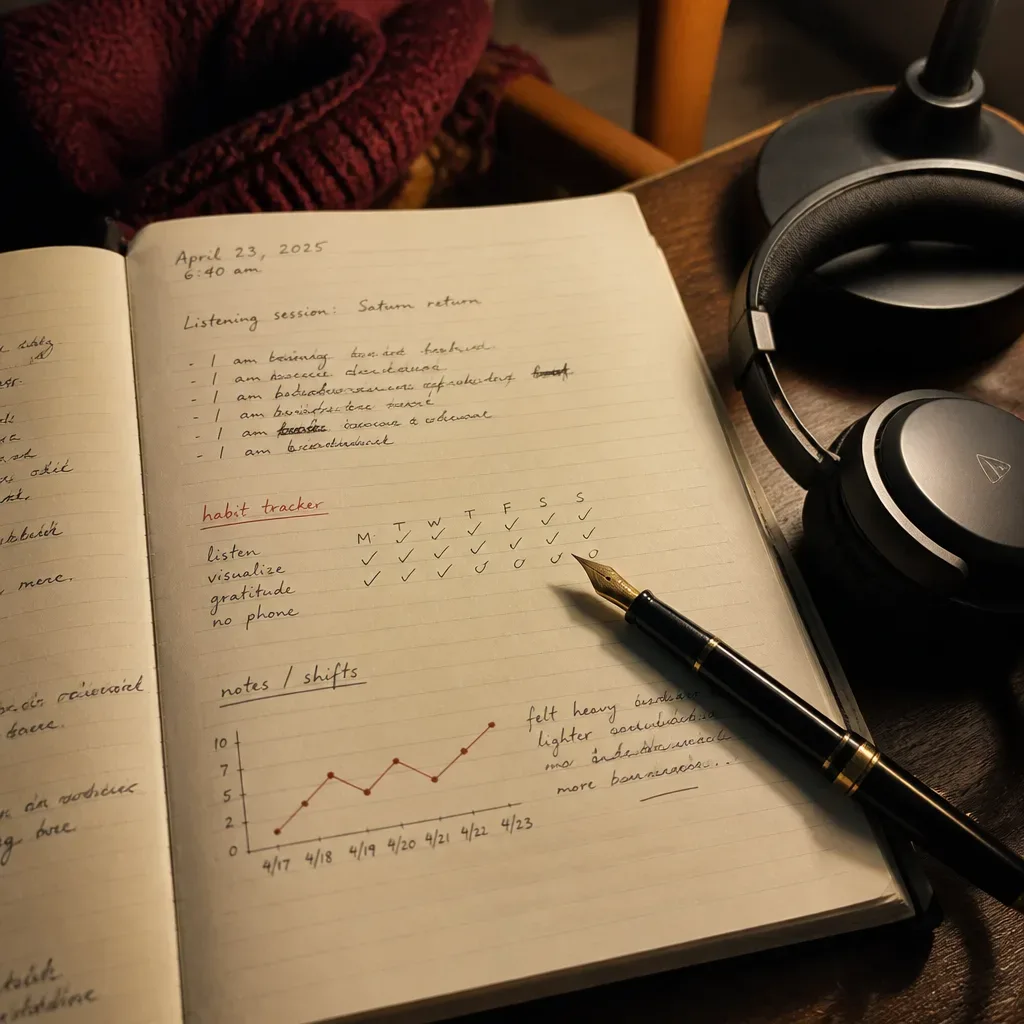
I write down whether I listened, whether the 528 Hz layer helped or distracted, and what one small action followed.
This is the part that keeps me honest. Feelings are welcome, but they are not the whole record. When I reviewed wellness apps, almost everything felt useful on day one. Novelty is persuasive. By day twenty-one, the truth had usually arrived in plain clothes. Either I was still using it, or I was not.
My tracking note is one line. Today mine said: Sept. 26, listened at 7:14, 528 Hz low, clear voice, opened invoice folder. That is enough. It gives me a date, a cue, and a behavior. In behavior research, self-monitoring is one of the more reliable change techniques. A 2011 review in the British Journal of Health Psychology found that interventions prompting self-monitoring and intention formation tended to perform better than advice alone.
I do not write a page unless I want to. The practice is not journaling. The practice is listening. The line after listening is only a receipt.
I also mark whether the 528 Hz track changed friction. Friction means setup time, annoyance, volume fiddling, searching, second-guessing. A tool that feels spiritual but adds four minutes of setup is not neutral. It is expensive. Attention has a budget, even when no money changes hands.
What should I avoid when pairing frequencies with manifestation audio?
I avoid turning the frequency into the main event, adding too many layers, or treating 528 Hz claims as certainty.
The first trap is stacking. A little 528 Hz, then binaural beats, then rain, then another affirmation video, then a timer, then a moon calendar. I like calendars. I sometimes read Astrology and manifestation when I want language for timing and attention. But timing is not a substitute for the daily listen.
The second trap is outsourcing responsibility to the sound. No frequency can decide whether I send the email, apologize, study, save the money, or rest before I break. The Affirmations pillar is useful here because it treats repeated language as training for attention, not as a vending machine. I need that distinction. Otherwise I start asking a track to do what only a choice can do.
The third trap is certainty. Some 528 Hz pages make medical or biological claims that outrun the evidence. I do not repeat those claims in my notes. Princeton Engineering Anomalies Research, often cited in consciousness discussions, reported small statistical deviations in random event generator studies over decades, but the interpretation remains disputed. Disputed does not mean useless. It means I should speak carefully.
Here is the rule I kept after a month:
- If 528 Hz helps me listen daily, I keep it.
- If it makes me chase the perfect track, I remove it.
- If I cannot hear the Dream-Self audio clearly, I lower it.
- If I start believing the frequency is doing the work for me, I take a week off.
A support is allowed to be beautiful. It is not allowed to become the boss.
For more on related sound practices, I keep a separate note from binaural beats and manifestation and another on solfeggio frequencies for manifestation. I do not test all of them at once. One variable at a time is the kindness that data asks from us.
How do I know if 528 Hz manifestation is working for me?
I know it is working only if the practice becomes easier to repeat and my next actions become more consistent with the Dream-Self audio.
I do not count a warm feeling as enough. Warm feelings are lovely and unstable. I count repeat listening, lower friction, and small behavior changes. If I listen seven mornings in a row because the 528 Hz cue makes the practice feel available, that is useful. If I miss five days because I keep searching for a better track, that is not useful.
I use a seven-day test before I make any claim to myself. Seven days is not enough to prove a life change, but it is enough to notice whether a setup is annoying. Many consumer habit apps push streaks because streaks are easy to display. A 2023 Pew Research Center report noted that many Americans use digital tools for health information, but use does not equal adherence. The question is not whether the tool is clever. The question is whether it survives contact with the kitchen.
At the end of seven days, I ask three questions:
- Did I listen more consistently with 528 Hz than without it?
- Did the setup take less than two minutes?
- Did one daily action become clearer after listening?
If the answer is yes to at least two, I keep the layer for another week. If not, I return to the plain Dream-Self Moment. There is no shame in a simpler practice. Simpler is often where the work finally starts.
A quiet cue can help the body return. It cannot replace the return.
Saturday night. I left the speaker on the chair.