evening rituals
After Work Routine: 5-Minute Dream-Self Audio
A quiet after work routine using 5 minutes of Dream-Self audio to decompress, mark the day complete, and return to yourself before evening.
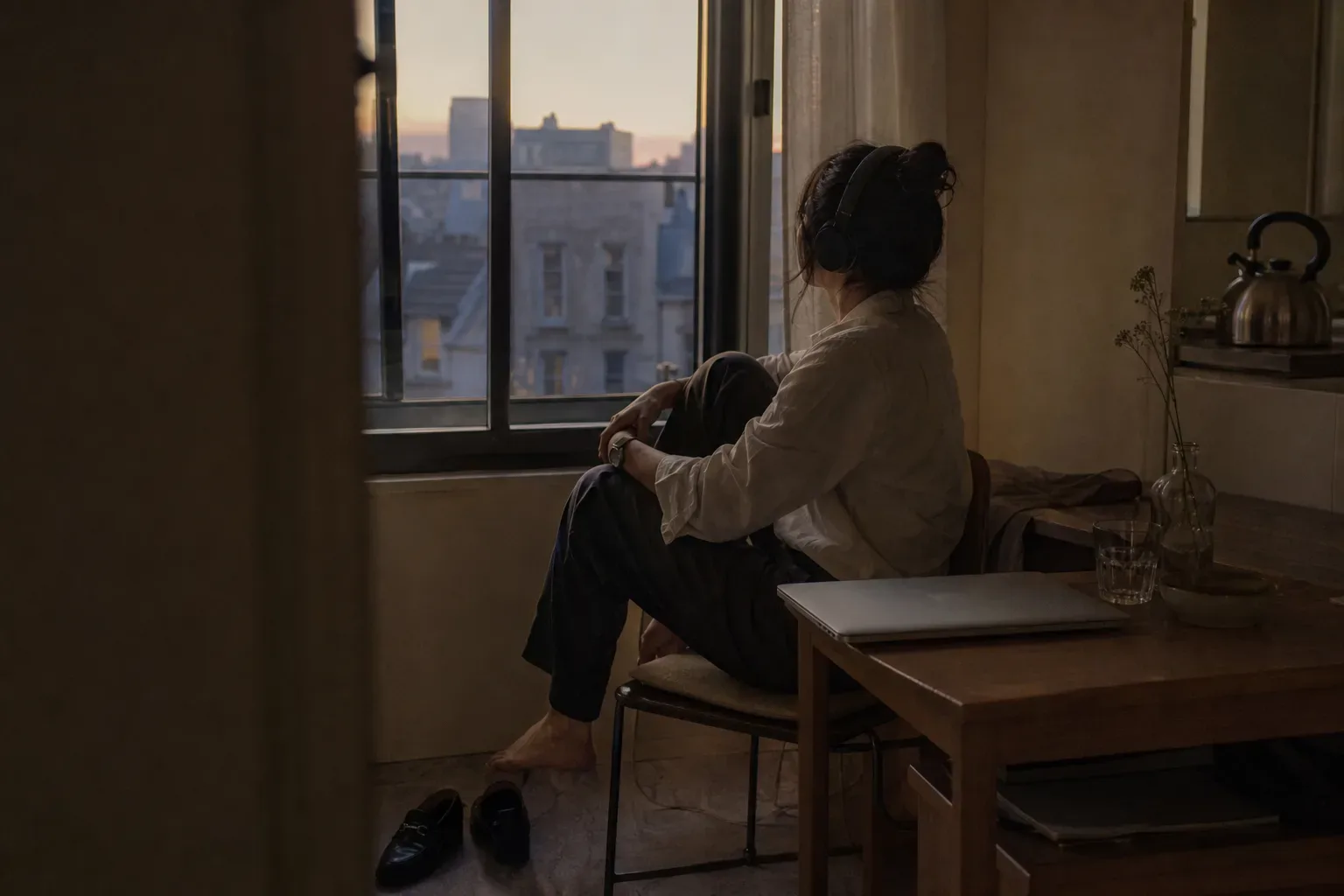
Sunday, 6:12 p.m. An after work routine works best when it is short, repeatable, and attached to a cue you already have. Mine is five minutes of Dream-Self audio after I close the laptop, before dinner, so my nervous system gets a clear signal that the workday is over.
What does a 5-minute after work routine need to do?
A 5-minute after work routine needs to close the work loop, lower stimulation, and give the evening a first gentle shape.
I used to treat the end of work like a door that would close by itself. It did not. At 6 p.m., my body was still inside the last email, the last Figma comment, the last unread message. The laptop was shut, but the working part of me kept pacing. The American Psychological Association reported in its 2023 Stress in America survey that 76% of adults experienced health impacts from stress in the previous month, including headaches, fatigue, and feeling nervous. I think about that number when I try to make my rituals smaller, not grander.
The routine has only one job at first: help the body believe the day has changed rooms. A clear cue matters more than a perfect mood. Habit researchers Wendy Wood and David Neal wrote in 2007 that repeated behavior becomes more automatic when it is tied to stable contexts. That sounds dry on the page, but in my kitchen it means this: same chair, same headphones, same five minutes.
I use the AYA Method here because it is already designed as a daily audio manifestation practice. Each day I listen to a short personalized recording, my Dream-Self Moment, narrated from the version of me who has already named the life I intend. Listening is the practice. Repetition is the work. The audio is the method.
A good routine should feel almost too small to respect. That is usually why it survives.
Here is the version I keep taped inside my notes app:
- Close the laptop or leave the workplace.
- Put the phone face down, unless the audio is on it.
- Sit, stand, or ride without adding another task.
- Listen to the full five-minute Dream-Self Moment.
- Name one thing that is complete for today.
- Do one ordinary evening action next.
The routine is not a second work shift wearing softer clothes. It is a boundary with a sound.
Why use Dream-Self audio instead of scrolling or silence?
Dream-Self audio gives my attention a single, kind track to follow when silence feels too open and scrolling keeps the workday alive.
I learned this the plain way. Three Tuesdays ago, I sat down after work and opened my phone for one minute. Eleven minutes later, I was reading a stranger arguing about office lighting. Microsoft reported in its 2023 Work Trend Index that 64% of employees said they struggled to find enough time and energy to do their work. After a day like that, my brain does not need more inputs pretending to be rest.
Silence can be beautiful, but at 6:15 p.m. it sometimes gives my thoughts too much room to reorganize themselves into a meeting. Audio is different. A voice gives the mind a rail. Dr. Andrew Huberman has often discussed non-sleep deep rest protocols in the range of 10 to 30 minutes for downshifting the nervous system, and while my Dream-Self Moment is shorter, the principle I borrow is attention placed somewhere steady.
The future-self frame matters too. Neville Goddard wrote often about assuming the feeling of the wish fulfilled. I keep the phrase carefully, because I do not use it to deny the day I actually had. I use it to remember that my identity is not limited to the most irritated version of me at 5:48 p.m. The workday can be real without being sovereign.
I keep Manifestation pillar bookmarked for days when I need the wider frame again. Manifestation, at its most useful, is not wishing loudly. It is the repeated practice of naming what I am living toward, then letting my attention rehearse that direction in a way my nervous system can tolerate.
| Option after work | What it gives | What it can cost |
|---|---|---|
| Scrolling | Quick novelty | More stimulation and comparison |
| Silence | Space | Rumination if the day is still loud inside |
| Chores immediately | Visible progress | No transition for the body |
| Dream-Self audio | Guided decompression | Requires repeating the cue |
A quiet voice can interrupt a loud day without fighting it.
How do I set up the routine without making it another task?
I set it up by attaching the audio to one cue that already exists, then removing every decision around it.
The cue is the part I used to over-design. I tried alarms. I tried a habit tracker with 31 empty circles. I tried a sunset reminder that looked lovely and became invisible in 9 days. B.J. Fogg, in his behavior design work at Stanford, argues that tiny behaviors take root when motivation is not asked to do all the lifting. I have found that painfully true. Motivation is a guest. Context is the furniture.
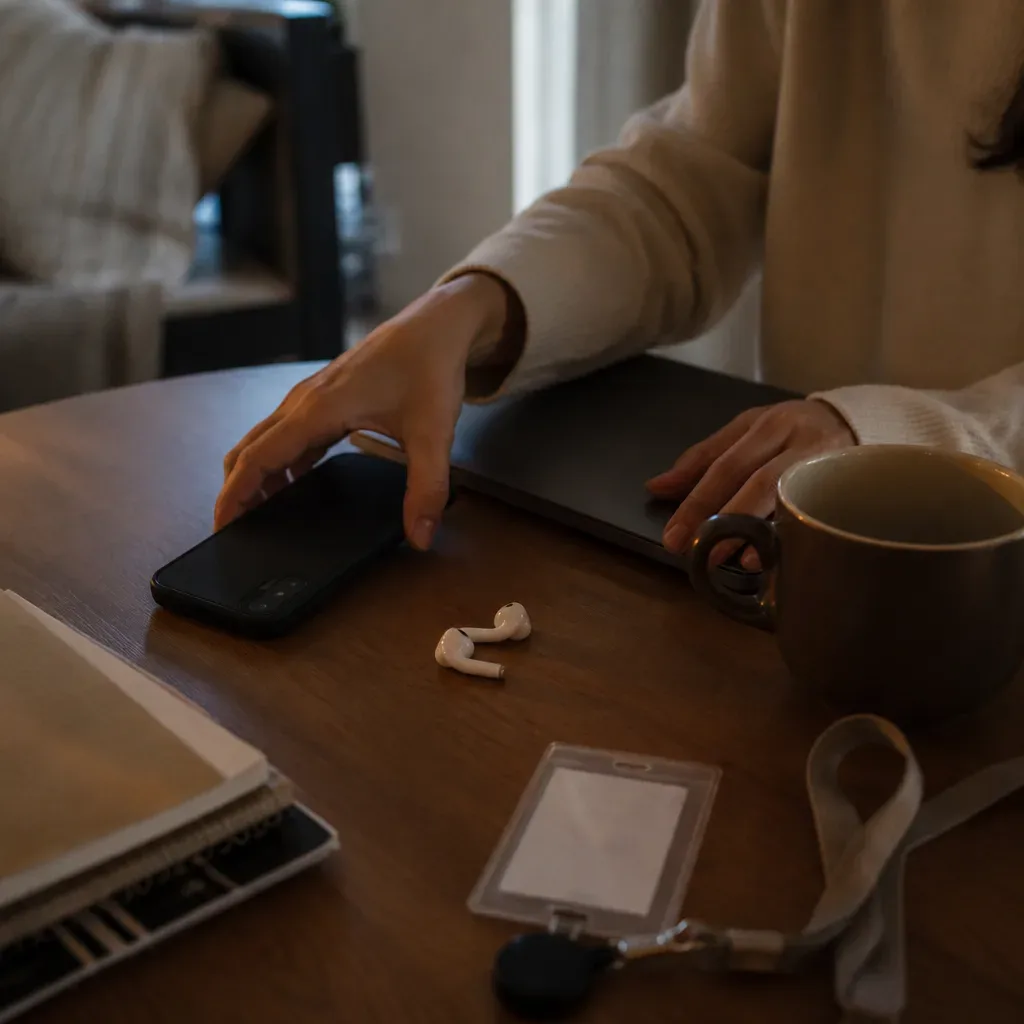
My cue is closing the laptop when I work from home. On office days, it is putting my card into the train gate. On days with client calls that run late, it is washing my hands before I touch the kettle. The cue can move, but it has to be real. Not poetic. Not aspirational. Real enough that a tired person can find it.
The setup looks like this:
- The audio is downloaded, not hunted for.
- The headphones live in the front pocket of my bag.
- The chair is not special, just available.
- The practice is five minutes, not twenty.
- I do not grade the session afterward.
In product design, friction is often measured in taps. In a ritual, friction is measured in excuses. If I need to choose the track, dim the lights, find a candle, write three pages, and become a better person first, I will not do it after work. I will make toast and resent the idea.
This is where the AYA Method has held for me. The audio is the pleasant part, so the loop pays me at the moment I do it. The daily affirmation and Manifestation Board can sit nearby as complements, and sometimes they do. But they are not the spine of this routine. The listening is.
I also keep the Affirmations pillar for mornings when words on the page help. After work, though, my eyes are tired. I need to be spoken to, not asked to produce more sentences.
A practice that respects attention is more likely to still be here in six months.
What should I do during the five minutes?
During the five minutes, I listen without multitasking and let the recording do the carrying.
This was harder than I expected. My hands kept wanting a job. Fold the towel. Wipe the counter. Check whether the message came back. In 2010, Harvard researchers Matthew Killingsworth and Daniel Gilbert published a study in Science using experience sampling from 2,250 adults and found that minds wandered 46.9% of the time. I think of that number whenever I catch myself halfway through the audio and halfway into tomorrow.
The instruction I use is almost embarrassingly simple: stay with the next sentence. Not the whole recording. Not the perfect receptive state. Just the next sentence. If I miss one, I return at the next one. The return is part of the practice, not proof that I failed it.
Sometimes I sit with both feet on the floor. Sometimes I stand by the kitchen counter because the chair has laundry on it. Sometimes I listen on the bus with my thumb over the phone screen so I do not open anything else. The body position matters less than the agreement: for these five minutes, I am not available to the workday.
Here is the small protocol I follow:
- Press play before checking messages.
- Let the first breath be ordinary.
- Notice where the day is still held in the body.
- Listen for the sentence that feels like it belongs to the person I am becoming.
- When the audio ends, wait one breath before moving.
I learned not to force emotion here. Joe Dispenza often writes and speaks about rehearsing a future state until the body begins to know it. I take the useful part and keep it gentle. I am not trying to produce a dramatic feeling at 6:20 p.m. I am practicing familiarity.
The after work routine is not a test of calm. It is a place to return to before the evening starts taking requests.
How does this help my nervous system come down after work?
It helps by combining a predictable cue, guided attention, and a short recovery period before the next demand arrives.
Work has a way of making the body efficient and braced. Even good work can do this. My shoulders rise during design reviews. My jaw tightens when I am solving something abstract. The U.S. Bureau of Labor Statistics reported that employed people worked an average of 7.99 hours on days they worked in 2023, and many of those hours now include screens, messages, and rapid task switching. Five minutes sounds small beside that, but a threshold does not need to be the same size as the room it closes.
Brief recovery is not imaginary. Occupational health research has repeatedly linked psychological detachment from work during nonwork time with lower strain and better well-being. Sabine Sonnentag, whose work on recovery from job stress is widely cited, has written about detachment, relaxation, mastery, and control as recovery experiences. My five-minute audio mainly gives me detachment and a little control. That is enough for a Tuesday.
The Dream-Self Moment also changes the content of my inner speech. Left alone, my mind reviews what I forgot. With the audio, it hears a version of me speaking from completion. That does not erase unfinished tasks. It puts them back into scale.
I keep a tiny comparison in my notebook because I like seeing the mechanics:
| Part of the loop | What happens in my routine | Why it helps |
|---|---|---|
| Cue | Laptop closes or train gate taps | The brain gets a stable start signal |
| Action | Five-minute Dream-Self audio | Attention has one guided object |
| Reward | Body feels less claimed by work | The loop has a reason to repeat |
| After-action | Tea, shower, walk, dinner | Evening begins with something ordinary |
There is a page on Astrology and manifestation that I return to when I want timing to feel less mechanical. Some evenings I do pair this routine with my moon calendar in Notion, not because the calendar performs the work, but because it helps me date the pattern. A dated practice becomes easier to trust.
The nervous system likes proof. Repetition is proof written in the body.
How can I make the routine last for busy weeks?
I make it last by lowering the standard before the busy week begins.
This is the part I wish I had learned earlier. I used to build routines for my most available self, then feel betrayed when my actual Wednesday arrived with a low battery and a wet umbrella. Research on implementation intentions by psychologist Peter Gollwitzer found that if-then plans can improve follow-through across many goals because they reduce the need to decide in the moment. My if-then is plain: if I close work, then I press play.
Busy weeks need a minimum version. Mine is headphones in, audio on, eyes open if I am too tired to close them. No candles. No journal unless I want it. No punishment for listening while sitting on the floor beside the laundry basket. A ritual that only works in perfect conditions is not a ritual yet. It is a mood board.
I also keep a 2-day rule. If I miss one evening, I do not explain myself to myself for half an hour. I return the next day. The habit literature is more forgiving than most people think. A 2009 study in the European Journal of Social Psychology by Phillippa Lally and colleagues found that habit formation took a median of 66 days, with wide variation, and that missing one opportunity did not destroy the process. I needed that sentence more than once.
For travel days, I move the routine to the first doorway that feels like arrival: hotel room, lift lobby, bus seat, my mother’s kitchen. For social evenings, I listen before changing clothes. For very late nights, I listen in bed and let that count. Counting is not cheating. Counting is how a practice stays alive.
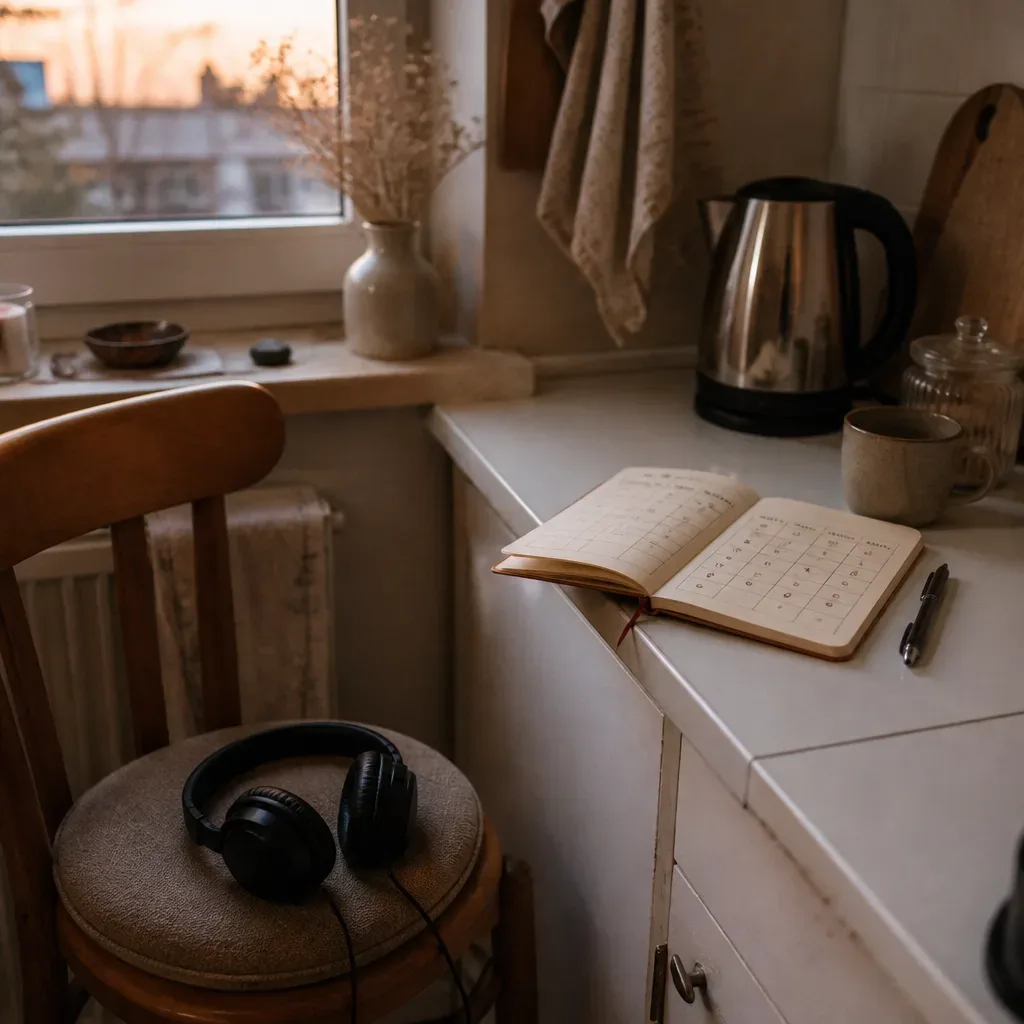
The Manifestation pillar reminds me that repetition is not supposed to look cinematic. Most of the work is almost invisible. The kettle comes on. The chair receives me. The audio begins again.
Make the smallest version honest, and the larger version can come back when the week softens.
What changes should I look for after 7 days?
After 7 days, I look for a cleaner transition, not a completely different life.
I write that down because I am prone to asking too much from small rituals and too little from repeated ones. Seven days is not long enough to reorganize everything. It is long enough to notice whether the body starts anticipating relief. It is long enough to see if the first 20 minutes after work become less jagged. It is long enough to learn which cue is real and which cue was decorative.
I track only 3 things for the first week:
- Did I press play within 10 minutes of the cue?
- Did I listen to the whole audio?
- Did the evening feel 1% less hijacked by work?
That last question is subjective on purpose. Perceived stress is still data when it is tracked honestly. The Perceived Stress Scale, developed by Cohen, Kamarck, and Mermelstein in 1983, uses self-report because the felt sense of coping matters. I am not running a lab in my kitchen. I am learning how my day ends.
Some changes are very small. I stop opening Slack after dinner. I answer my partner with more than a nod. I remember to taste the first sip of tea. Once, on the fifth day, I noticed that I did not carry a client’s sentence into the bath. That felt like a small miracle, but I am trying not to overstate it. It was also just practice.
I sometimes pair the listening with one written line from the Affirmations pillar, especially if a phrase from the audio stays with me. I write it in the margin of the day. Not as homework. As a receipt.
Here is my 7-day note format:
| Day | Cue used | One thing I noticed |
|---|---|---|
| 1 | Laptop closed | I wanted to check messages |
| 2 | Train gate | The audio felt easier in motion |
| 3 | Handwashing | My shoulders dropped at minute 3 |
| 4 | Laptop closed | I missed it, returned after dinner |
| 5 | Chair by window | The evening started softer |
| 6 | Bus seat | I listened with eyes open |
| 7 | Kitchen kettle | The cue felt familiar |
The change does not arrive carrying flags. It arrives as the hand that does not reach for the phone.
Monday now. The headphones are still on the chair.