evening rituals
Sunday Scaries Routine With Dream-Self Audio
A quiet sunday scaries routine for easing Monday dread with Dream-Self audio, light planning, and a softer nervous system before sleep.
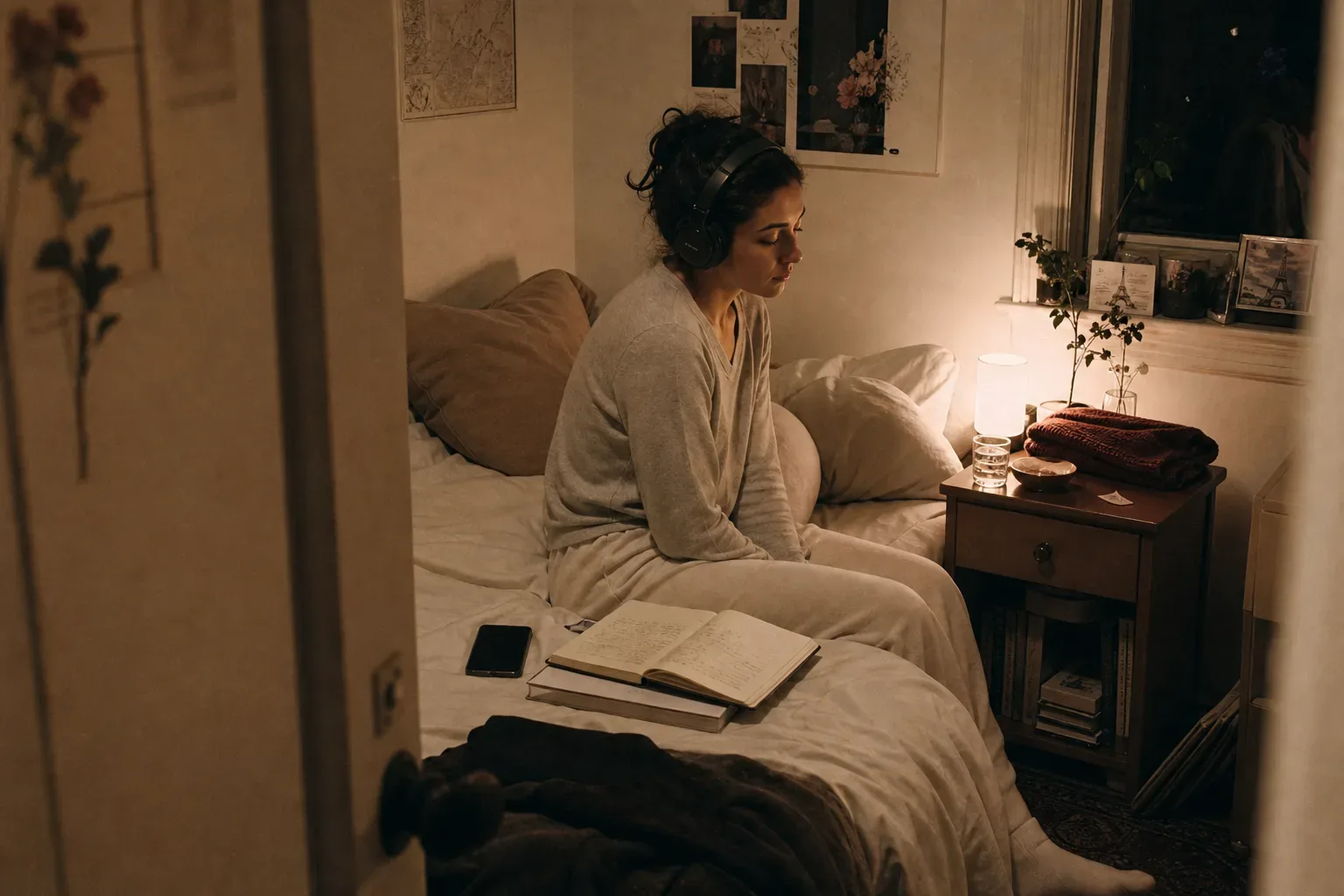
The lamp is low. Your phone is warm in your hand. A sunday scaries routine works best when it’s short: clear one worry list, choose Monday’s first move, then listen to Dream-Self audio before sleep. The point isn’t to fix the week. It’s to make tomorrow feel knowable.
What are the Sunday scaries actually asking for?
The Sunday scaries are usually asking for safety, not a more perfect schedule.
That matters because dread is often practical and physical at the same time. You may have real work waiting. You may also have a nervous system that reads unread messages as threat. A 2018 LinkedIn survey of about 1,000 U.S. adults found that 80% of professionals reported Sunday anxiety, with younger workers reporting it even more often. The number is blunt. You aren’t strange for feeling it.
What makes Sunday night sharp is the gap. Friday had edges. Saturday had permission. Sunday night asks your brain to cross back into structure. If Monday is vague, the brain fills the blank with noise. The amygdala is more likely to react to uncertainty than to a known difficulty, according to research on intolerance of uncertainty published in clinical anxiety literature across the 2000s and 2010s. A hard thing can be met. A foggy thing keeps moving.
A useful routine does three jobs:
- It lowers stimulation in the room.
- It names what is unfinished without trying to finish it.
- It gives your attention a future scene that feels specific and lived.
That third job is why Dream-Self audio belongs here. The Manifestation pillar explains manifestation as a practice of attention, identity, and repeated inner seeing. On Sunday night, that doesn’t need to be grand. It can be one quiet sentence: I know what I do first tomorrow.
A Sunday routine should not become another test you can fail. If it needs a candle, a perfect journal, 45 minutes, and a clean apartment, it’s too fragile. The better version survives a sink full of dishes. It survives a low battery. It survives being tired.
The right Sunday night practice is small enough to do when you’re already scared.
Why use Dream-Self audio instead of scrolling or planning?
Dream-Self audio gives your mind a rehearsed future, while scrolling and overplanning often give it more inputs to fear.
The AYA Method is a daily audio manifestation practice. Each day you listen to a short personalized recording — your Dream-Self Moment — narrated from the version of you who has already manifested the life you intend. Listening is the practice. Repetition is the work. The audio is the method.
Sunday night is exactly the kind of hour where audio helps. You don’t need to invent better thoughts while anxious. You press play and let a steadier version of you speak first. In cognitive psychology, mental imagery has been studied for decades as a way to rehearse action and emotion. Sports psychology uses imagery scripts because the brain practices cues before the body performs. A 2012 review in the journal Neuropsychologia noted overlap between imagined and executed action networks, especially when imagery is vivid and repeated.
Scrolling does the opposite for many people. Pew Research Center reported in 2021 that 31% of U.S. adults said they were online almost constantly. On a Sunday night, that constant access can make your work, friends, news, and comparison all sit on the pillow with you. You call it decompressing. Your body may call it more noise.
Planning has a place, but too much planning becomes disguised worry. The Zeigarnik effect, first described by psychologist Bluma Zeigarnik in 1927, suggests unfinished tasks stay mentally active. Writing them down can help. Trying to solve all of them at 10:14 p.m. can keep the loop open.
Use this simple split:
| Sunday night tool | What it does well | Where it can go wrong |
|---|---|---|
| Worry list | Clears mental clutter | Turns into problem-solving |
| Calendar check | Reduces surprise | Becomes week-long forecasting |
| Dream-Self audio | Rehearses a calmer identity | Gets diluted if followed by scrolling |
| Affirmation | Gives one phrase to return to | Feels thin without repetition |
The app also includes a daily affirmation and Manifestation Board, but they are complements. The audio is the center. If you want language for a single phrase, the Affirmations pillar can help. Keep it small. One affirmation. One listen. Phone down.
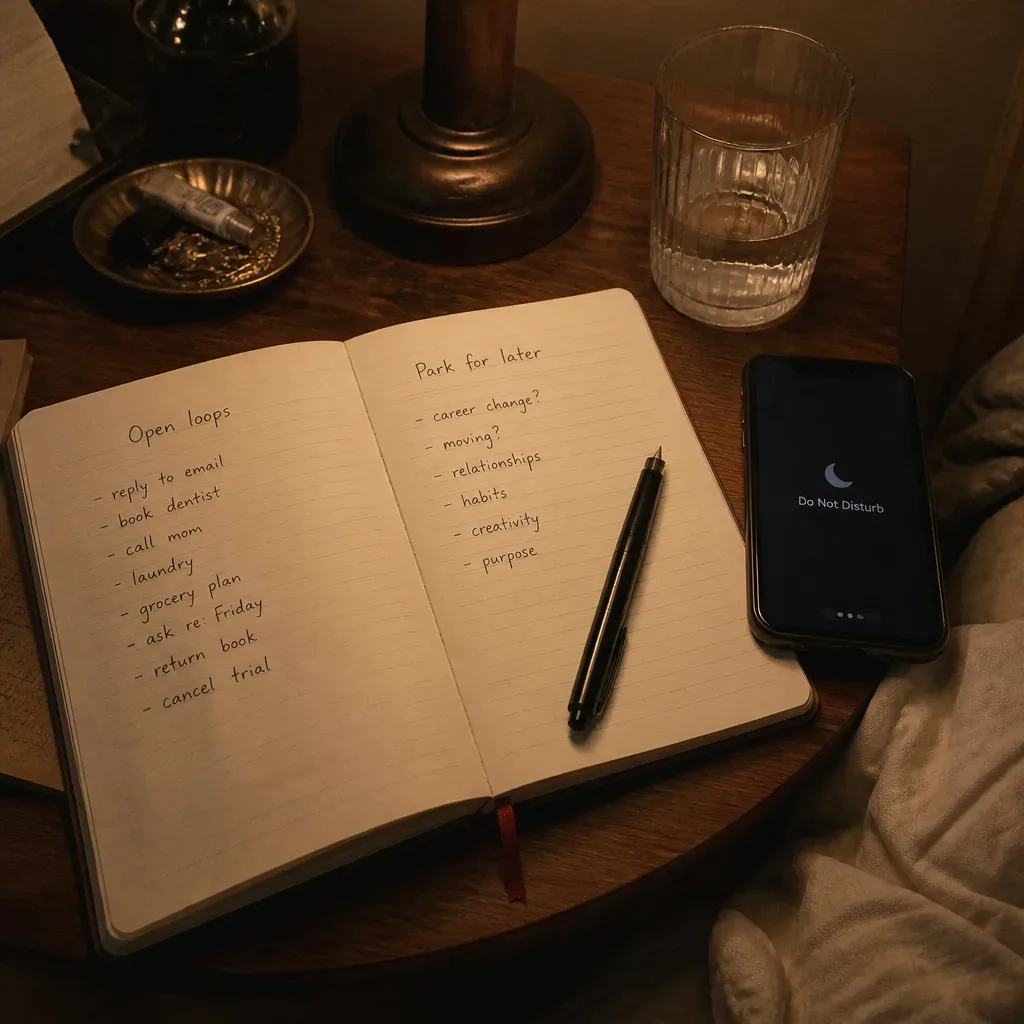
How do you set up the room in the first three minutes?
Set up the room by lowering light, reducing alerts, and giving your body one clear sign that work has ended.
This is not decoration. Light changes biology. Dr. Andrew Huberman has often summarized the sleep research simply: bright light late at night can delay sleep timing, while morning light helps set the circadian clock. The American Academy of Sleep Medicine also recommends a consistent wind-down and reduced light exposure before bed. You don’t need a perfect sleep sanctuary. You need fewer signals shouting now.
Start with the smallest visible shifts:
- Turn off the overhead light.
- Put one lamp on, across the room if possible.
- Set the phone to Do Not Disturb for 20 minutes.
- Place a notebook or note app in front of you.
- Put water nearby.
Three minutes is enough. In behavior design, BJ Fogg’s work at Stanford has emphasized that tiny behaviors are more likely to repeat when they fit naturally into an existing moment. Sunday night already has a moment: the point when you notice dread. Attach the routine there. Not earlier. Not after you become a better person. Here.
The room should not feel theatrical. If you perform calm, you may start judging whether you’re doing it correctly. Instead, make the next right thing obvious. A dim lamp says stop. A closed laptop says not now. A notebook says the thoughts have somewhere to go.
There is also a productivity reason for this. Cal Newport has written about shutdown rituals as a way to mark the end of work and reduce cognitive residue. You can borrow the shape without making it rigid. Sunday night gets one soft shutdown. Not a full review. Not a new system.
A calm room does not solve Monday. It helps your body stop arguing with Sunday.
If you live with other people, don’t wait for silence. Use headphones. Face away from the television. Let the ritual be portable. A routine that requires everyone else to change first will rarely survive.
What should you write down before pressing play?
Write down the open loops, then choose only Monday’s first move.
This is the part where most routines get too ambitious. You sit down to reduce anxiety and accidentally begin running your life like a quarterly meeting. Don’t. The evidence for expressive writing is helpful here. James Pennebaker’s research, beginning in the 1980s and followed by many later studies, found that writing about concerns for even 15 to 20 minutes across several days can support emotional processing. On Sunday night, you only need a lighter version: name the loops so they stop floating.
Use two columns:
| What is circling | The first visible move |
|---|---|
| Email from Ana | Open it at 9:10 and read only |
| Presentation draft | Add title slide |
| Laundry | Put clothes in basket before bed |
| Money worry | Check balance Tuesday, not tonight |
Notice the discipline. You are not solving the email. You’re not finishing the presentation. You’re deciding the first contact point. David Allen’s Getting Things Done method uses the phrase “next action” for this reason. A project can be heavy. A next action has a handle.
For a sunday scaries routine, the best first move is physical and measurable. “Be less behind” is not a move. “Open the document and write three rough bullets” is. Your brain trusts what it can picture. This is also why the AYA Method pairs well with Sunday planning: the written first move clears the fog, and the Dream-Self Moment lets you hear yourself already meeting the day.
Keep the list capped at five lines. A 2020 Microsoft Work Trend Index noted that digital work often creates more meetings, chats, and after-hours signals than people can reasonably process. Your Sunday list is not the place to catch all of it. It is a small doorway.
If a worry has no action, write “not tonight” beside it. This is not denial. It is timing. Some thoughts arrive late because there is finally room. They do not all deserve the chair.
How do you listen to the Dream-Self Moment without forcing belief?
Listen as if you’re borrowing a steadier memory, not proving every word is true.
Belief is often too heavy a demand on a Sunday night. If you require total confidence before you press play, anxiety wins by procedure. The practice is gentler than that. You listen. You let the words arrive. You notice the version of you who can meet Monday without clenching around it.
Neville Goddard taught that imagination works through the felt sense of already being. Joe Dispenza speaks often about rehearsing a future self until the body becomes familiar with it. You don’t have to accept every claim from every teacher to use the practical part: repetition changes what feels available. In clinical settings, imagery rehearsal has been used for nightmares, and a 2001 study in JAMA found imagery rehearsal therapy reduced nightmare frequency among sexual assault survivors with PTSD. Different context, yes. Same basic respect for repeated inner scenes.
Try this listening sequence:
- Sit or lie down with the phone screen facing away.
- Take one normal breath. Not a special breath.
- Press play on your Dream-Self Moment.
- When a doubt appears, say silently, “heard.”
- Return to the next sentence of the audio.
- After it ends, don’t evaluate it for two minutes.
That last step matters. Many people finish a practice and immediately grade it. Did it work? Do I feel different? Am I fixed? This turns the nervous system into a dashboard. Let the audio settle before you inspect yourself.
You don’t need to believe harder. You need to return more kindly.
The Dream-Self Moment is not a pep talk. It is a short contact with identity. The words point to you as someone who has already crossed the bridge you’re afraid of. On Sunday, that bridge may be simple: opening the laptop, answering the message, walking into the meeting, making tea after lunch.
If you use astrology and manifestation as part of your reflection, keep it supportive rather than predictive. A moon phase can be a beautiful marker. It should not become another reason to fear Monday. The audio remains the method. The symbols can sit beside it.
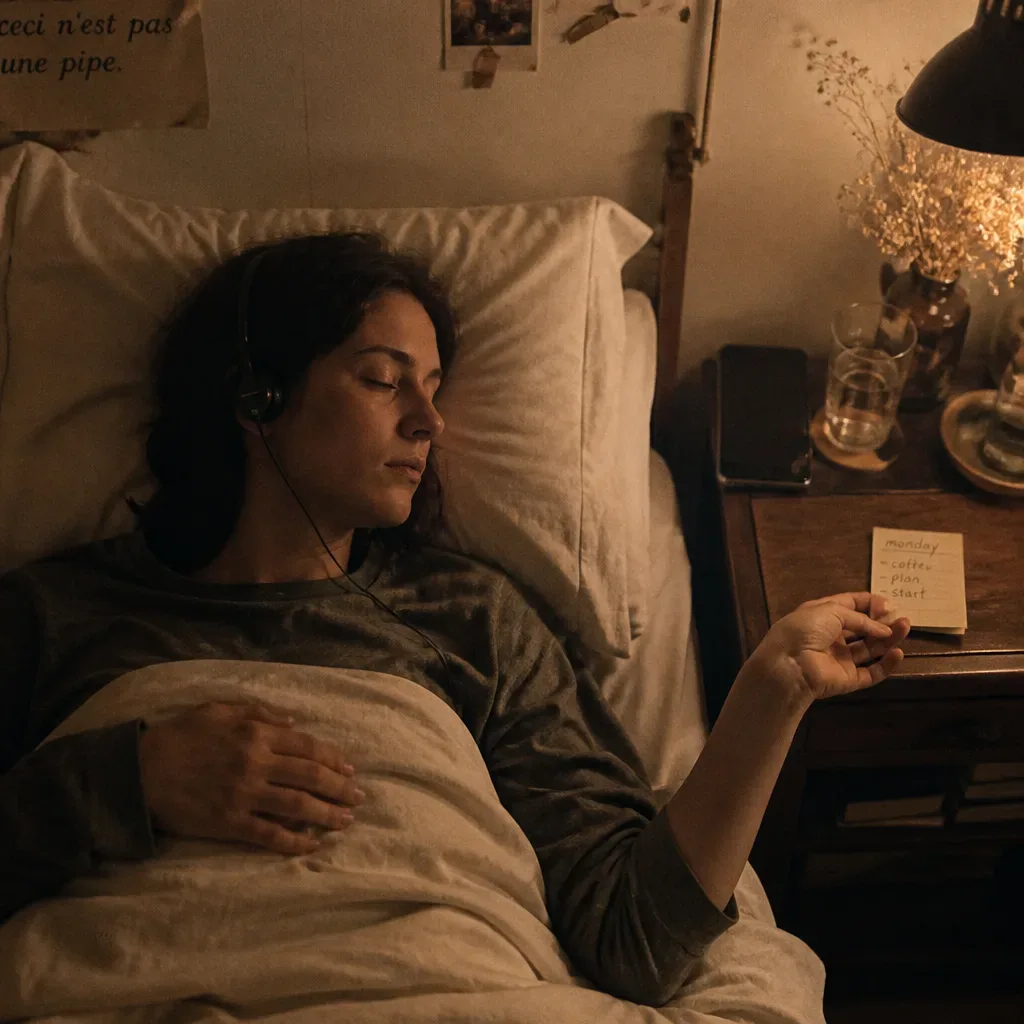
What do you do after the audio ends?
After the audio ends, protect the quiet by choosing one support and closing the phone.
This is the fragile part. You may feel a little softer, then reach for one harmless check. Weather. Email. A message. Then the mind is awake again. A 2019 report from Common Sense Media found that many adults check phones within the hour before sleep, and sleep researchers have repeatedly linked late-night phone use with shorter sleep and more alertness. The exact effect varies by person, but the pattern is familiar. The phone keeps asking.
Choose one support for Monday before you put it away. Not ten supports. One. It should be almost boring:
- Put socks or clothes where you’ll see them.
- Fill a glass of water.
- Move the coffee or tea to the counter.
- Write one line on a sticky note: “Start with the title slide.”
- Set your bag near the door.
These cues matter because the morning brain is not neutral. Sleep inertia can last 15 to 60 minutes, according to sleep medicine research, especially after short or poor sleep. If Monday morning has to make every decision from scratch, Sunday fear was not entirely wrong. Give morning-you one small rail to hold.
Then close the phone. If the AYA audio plays from your phone, make the last action clear: stop, lock, place it across the room. Don’t bargain. Your future self does not need one more article at 11:03 p.m.
You can pair the routine with a broader evening manifestation routine if that already feels natural. But if Sunday is tender, do less. The strongest ritual is often the one that ends on time.
A routine becomes trustworthy when it knows when to stop.
If you share a bed, closing the phone is also relational. It says: I’m here now. Even if you’re alone, it says the same thing to the room.
How can you repeat this next Sunday without making it a project?
Repeat the same short routine with the same order, and let repetition carry what motivation can’t.
The nervous system likes patterns it can recognize. This is one reason cognitive behavioral therapy often uses repeated practices between sessions. It is also why habit researchers such as Wendy Wood emphasize context. The cue matters. The room, the hour, the sequence: these become part of the behavior. You don’t have to feel inspired. You have to remember the next small step.
Use this 18-minute version for four Sundays before you edit it:
| Minute | Action | Why it helps |
|---|---|---|
| 0-3 | Lower light and silence alerts | Reduces stimulation |
| 3-7 | Write open loops | Clears mental load |
| 7-9 | Choose Monday’s first move | Reduces uncertainty |
| 9-16 | Listen to Dream-Self audio | Rehearses identity |
| 16-18 | Add one support and close phone | Protects sleep |
Four repetitions are enough to learn whether it fits. Not enough to make a lifetime claim. That is fine. I test wellness apps for a living, and most fail at the same point: they ask for a new personality. AYA survived because the core asks for listening. Small. Repeatable. Hard to aestheticize into a performance.
There is room for complements. A daily affirmation can give you one line to carry into Monday. A Manifestation Board can hold the visual shape of what you’re practicing. But if the night is tight and you can only do one thing, choose the audio. Listening is the practice.
If Sunday dread is severe, persistent, or tied to panic, depression, workplace harm, or unsafe conditions, care needs to be wider than a routine. The World Health Organization has noted that anxiety disorders are among the most common mental health conditions worldwide, affecting hundreds of millions of people. A ritual can support you. It should not isolate you.
For ordinary Sunday fear, though, keep returning. Same lamp. Same list. Same first move. Same voice from the life you’re learning to recognize.
The night doesn’t need your performance. It only needs your return.