affirmations
Askfirmations Manifestation: 3-Minute Future-Self Audio
Use askfirmations manifestation as a 3-minute future-self audio practice: turn stiff affirmations into useful questions your mind can rehearse daily.
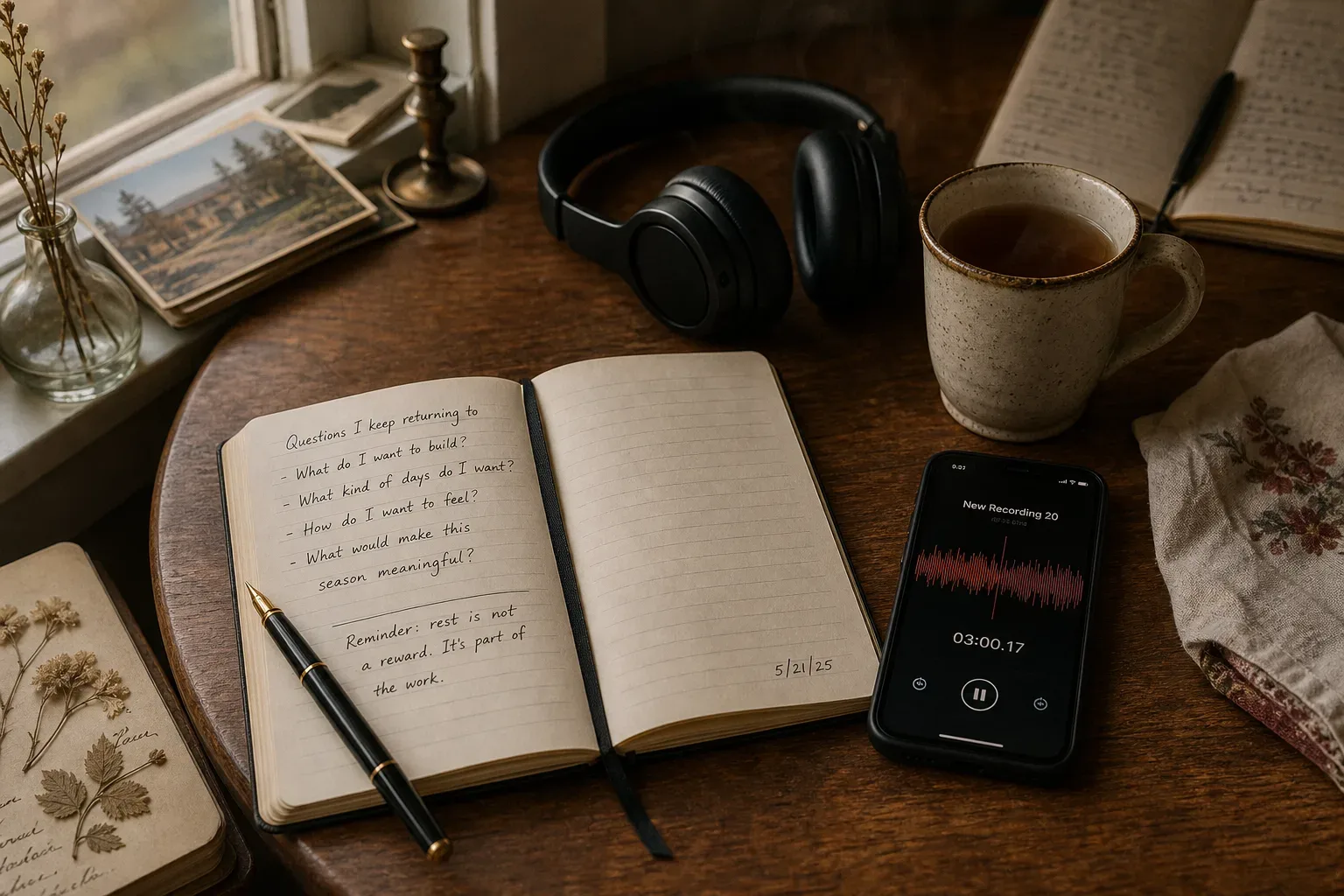
Friday, 6:20 a.m. Askfirmations manifestation works best when I turn a doubtful affirmation into a useful question, record it as a short future-self audio, and listen daily for three minutes. The question gives my attention a task. The audio makes the task repeatable before my morning can argue.
What is an askfirmation, and why does it feel less false?
An askfirmation is an affirmation written as a question, so the mind starts searching instead of defending.
I wrote that in my notebook this morning while the kettle clicked itself off. The old sentence was stiff: I am confident with money. I did not believe it. My shoulders knew before my mind did. So I changed it to: Why am I becoming more careful and calm with money this week? That sentence did not ask me to pretend. It asked me to notice.
There is a small research trail under this. In 2010, Ibrahim Senay and colleagues published work in Psychological Science showing that interrogative self-talk, such as Will I?, led to stronger goal-directed behavior than declarative self-talk, such as I will, in several lab tasks. The point was not magic. A question can invite reasons. A claim can invite cross-examination.
I think of askfirmations as a narrow bridge between affirmations and behavior. They keep the sentence pointed at identity, but they do not force belief before evidence has arrived. Neville Goddard wrote often about living from the end, but even that phrase can become theatrical if I use it to skip the body. A question is humbler. It keeps the door open.
A good askfirmation has 3 parts:
- It names a direction, not a fantasy.
- It uses becoming, learning, allowing, noticing, or choosing.
- It gives the mind a place to look today.
A question does not need me to lie to myself; it only asks me to look again.
For me, askfirmations manifestation is not a louder sentence. It is a better prompt. I have built habit software for about 14,000 users, and the pattern was blunt: people do not repeat what feels ridiculous at 7:00 a.m. They repeat what fits inside the morning they actually have.
Why put askfirmations into future-self audio?
Future-self audio lowers the effort of repetition and places the question inside a scene I can return to.
I listened to my Dream-Self Moment before brushing my teeth. That is the order I do them in. The AYA Method is a daily audio manifestation practice: each day I listen to a short personalized recording, my Dream-Self Moment, narrated from the version of me who has already manifested the life I intend. Listening is the practice. Repetition is the work. The audio is the method.
I like audio because it removes one decision. I do not have to open a journal, invent words, or decide whether I feel spiritual enough. I press play. In BJ Fogg’s behavior model, behavior happens when motivation, ability, and a prompt meet at the same time. A 3-minute audio raises ability because it is easy to do, and it gives the prompt a home.
The future-self part matters because identity is sticky. James Clear popularized identity-based habits in Atomic Habits, but the idea is older than the book. Cognitive rehearsal has been used in sports psychology for decades; a 1994 meta-analysis by Driskell, Copper, and Moran found mental practice had a positive effect on performance, especially when tasks had cognitive elements. I am not throwing a javelin. I am practicing the self who answers email without panic.
Here is the difference I felt this week:
| Format | What it asks of me | Where it can fail |
|---|---|---|
| Written affirmation | Believe the sentence now | My doubt interrupts it |
| Askfirmation | Search for evidence | I forget to return to it |
| Future-self audio | Listen and rehearse daily | I make it too long |
The best delivery mechanism is the one I do not renegotiate every morning.
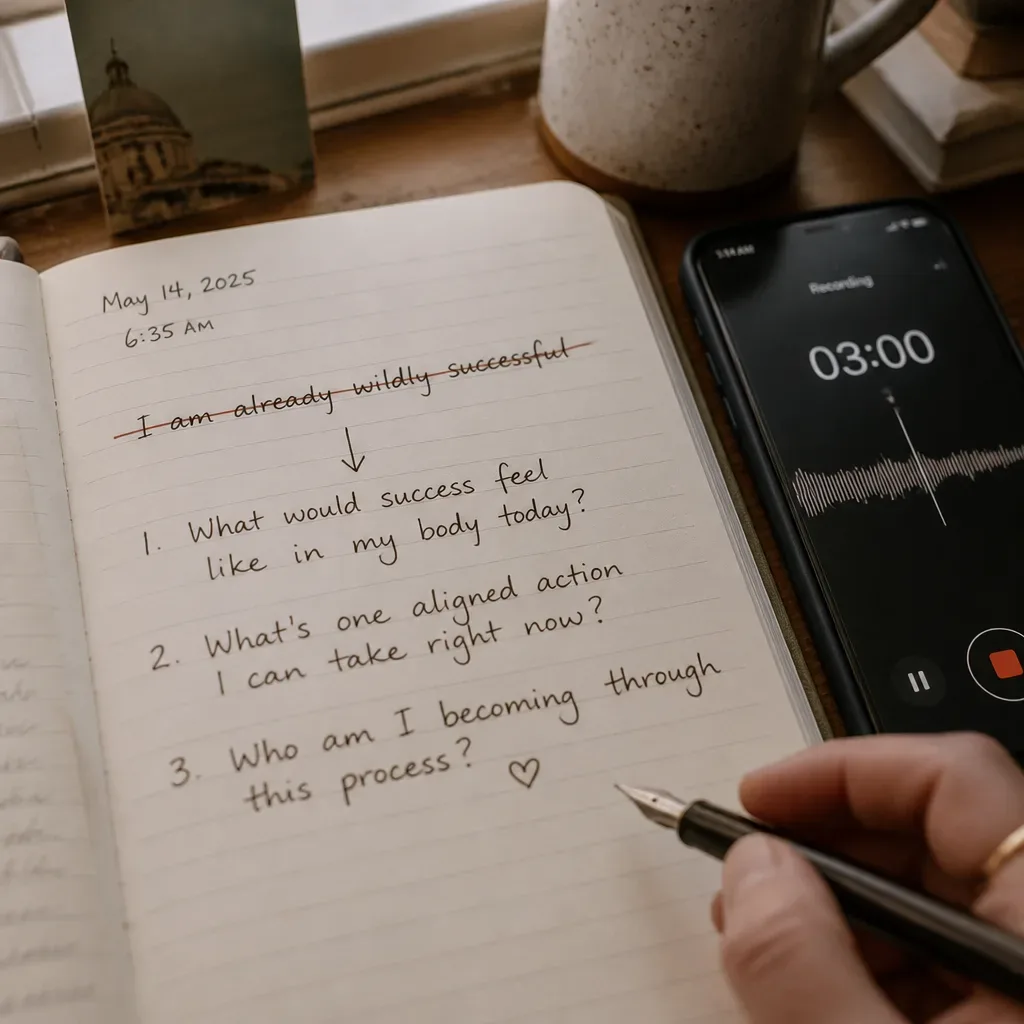
How do I write a 3-minute askfirmation script?
I write the script by choosing one friction point, making 3 to 5 questions, and placing them in a future-self scene.
Three minutes sounds small until I time it. Spoken slowly, 3 minutes is often 360 to 450 words. That is not much. It is enough for one subject, not five. When I try to fit money, sleep, love, body, and work into one recording, I make a fog. The mind needs an address.
This is the script shape I used today, dated in the corner of the page:
- Opening cue, 20 seconds. I name where I am: I am standing in the kitchen. My hands are around the blue mug.
- Future-self frame, 30 seconds. I speak from the version of me who has already practiced this for 30 days.
- Askfirmations, 90 seconds. I ask 3 to 5 questions, slowly.
- Evidence line, 30 seconds. I name one small behavior I am already doing.
- Closing return, 30 seconds. I end with the next ordinary action.
For example, I did not record: Why am I rich? That question was too vague and too loaded. I recorded: Why am I checking my account without flinching? Why am I sending invoices within 24 hours? Why am I letting small numbers tell the truth before they become large numbers? These questions give me handles.
In habit data, specificity keeps people alive. In one well-known 2009 study by Phillippa Lally and colleagues in the European Journal of Social Psychology, habit formation took an average of 66 days, with a range from 18 to 254 days. That range is the whole story. A practice needs to survive boring Tuesdays, travel days, and the morning after poor sleep.
I keep a tiny line from my daily affirmation beside the script, but I do not make it carry the practice. The audio carries it. If I add my Manifestation Board later, it is only a visible reminder, like leaving the shoes by the door.
Which askfirmation questions work best for manifestation practice?
The best questions are specific, believable at the edge, and tied to a behavior I can recognize within 24 hours.
I still use the word manifestation, but carefully. On the manifestation pillar, I keep returning to the same point: naming a life is not the same as performing certainty. The sentence has to meet the nervous system, the calendar, and the chair I sit in when I do not want to begin.
Useful askfirmations often begin like this:
- Why am I becoming more willing to receive help?
- How am I learning to speak before resentment collects?
- Why is my body starting to trust rest again?
- What is helping me choose the next right invoice, message, or meal?
- Why am I noticing proof sooner than I used to?
I avoid questions that shame me. Why am I finally not lazy? is not a practice. It is an insult wearing a costume. The nervous system tends to protect against threat. Dr. Andrew Huberman has often described the role of physiological state in attention and behavior; if the body reads the sentence as danger, attention narrows around defense rather than change.
The sentence that helps is the sentence tomorrow-me will still agree to hear.
There is also a timing issue. I keep questions close to the day because attention is expensive. A 2023 Pew Research Center report on technology use noted that many adults feel overloaded by information, and that tracks with what I saw in app retention. Too many prompts become no prompt. One clear question beats seven pretty ones.
I use this small test before recording:
| Test | Yes means record it | No means rewrite it |
|---|---|---|
| Can I say it without rolling my eyes? | It is near belief | It is too grand |
| Can I notice evidence today? | It has a behavior | It is abstract |
| Would I say it to a friend? | It is kind enough | It is pressure |
Kind is not soft. Kind is durable.
How do I record the audio so I actually listen tomorrow?
I record it plainly, in my own voice or a voice I trust, and I make the first listen too easy to refuse.
This is the part where I used to overbuild. I wanted the perfect microphone, the perfect room, the perfect sentence. That was just resistance with better stationery. Phone audio is enough for a draft. The first recording is not a monument. It is a working object.
I sit in the same chair and record one take. If I stumble, I pause and continue. Research on self-compassion by Kristin Neff and others, with scales first developed in 2003, suggests that harsh self-judgment is not the best fuel for persistence. I have seen the same in product data. Users who miss one day and return are more valuable than users who protect a streak until the first break destroys it.
My recording rules are plain:
- Keep it between 2:30 and 3:15.
- Use one life area only.
- Ask no more than 5 questions.
- Leave 2 breaths between questions.
- End with the next physical action: open the laptop, wash the cup, put on shoes.
If I want a more structured practice, I use the AYA Method because the Dream-Self Moment gives the audio a clean container. I do not need to design the whole thing from scratch every week. The method keeps the daily unit small enough to repeat.
There is a reason I keep saying small. In Stanford habit design, tiny behaviors are not childish. They are engineered. A behavior that can happen on a bad day has a better chance of compounding than a beautiful plan that requires a new personality.
Where should the 3-minute practice fit in the day?
The practice should attach to something I already do, because a borrowed cue is stronger than a fresh intention.
For me, it is the kettle. Water on, audio on. On travel days, it becomes toothbrush, audio, socks. I do not attach it to mood. Mood is weather. Cues are furniture. Wendy Wood and David Neal wrote in 2007 that habits are learned associations between context and response. That sentence explains half my life.
I use this 3-minute morning version:
- Minute 0 to 1: I listen to the opening scene and let my breathing slow.
- Minute 1 to 2: I hear the askfirmations and answer none of them on purpose.
- Minute 2 to 3: I notice one piece of evidence and move into the next action.
Not answering the questions is important. The conscious mind loves turning practice into homework. I let the question sit. Later, on the bus or while washing a cup, an answer often appears: I sent the email before noon. I took the call. I checked the number. Small evidence is still evidence.
I also keep the practice separate from timing systems I do not control. I like astrology and manifestation as a reflective lens sometimes, especially for noticing cycles, but I do not wait for a transit to listen. The daily audio belongs to the ordinary morning. That is where it gathers force.
A practice becomes trustworthy when it does not require the day to be special.
If I miss a day, I restart without drama. In the 14,000-user habit app I built, the most useful retention feature was not a punishing streak. It was a gentle return path. People need a door back in.
How will I know the askfirmations are working?
I know they are working when my attention, choices, and evidence change before my feelings fully catch up.
I do not expect fireworks. I expect a small delay between old identity and new behavior. That delay is normal. In the Lally habit study, missing one opportunity did not necessarily ruin habit formation, which is one of the most merciful findings I know. The body learns by return.
I track 3 signals for seven days:
| Signal | What I write down | Example from this week |
|---|---|---|
| Attention | What did I notice sooner? | I saw the unpaid invoice before avoiding it |
| Behavior | What did I do within 24 hours? | I sent the reminder at 9:10 a.m. |
| Identity | What felt slightly more like me? | I checked the account without making tea first |
This is where affirmations and askfirmations can work together. The affirmation names the self. The askfirmation opens the search. The future-self audio repeats the identity until it has somewhere to live. None of this replaces action. It prepares attention for action.
I keep one line from the recording on the page: Why am I becoming someone who tells the truth sooner? That one has teeth. It showed up at 4:40 p.m. when I wanted to postpone a reply. I sent the reply. Not beautifully. Sent is a holy enough word on a Friday.
If a question produces only pressure for 3 days, I rewrite it. If it produces avoidance, I make it smaller. If it produces one honest action, I keep it. The practice is allowed to be adjusted. A script is not a vow carved into stone.
The future self is not a fantasy version of me; it is the next repeatable version of me.
Friday now. The kettle has gone quiet.