affirmations
Positive Affirmations for Women as Dream-Self Audio
Positive affirmations for women can feel more believable as Dream-Self audio, because the words arrive in a calm voice you can return to daily.

Tuesday. The kettle clicked off before my phone lit up. Positive affirmations for women work best, for me, when they are specific, believable, and repeated in a voice I can receive. Dream-Self audio turns the sentence into a daily listening practice, so the words are not decoration. They become a cue.
I have kept written affirmations in notebooks, in Notes app folders, on bathroom mirrors, and once on the inside of a kitchen cabinet where only I could see them. Some lasted 3 days. A few lasted 3 weeks. The ones that stayed were the ones I could hear.
A deeper guide to affirmations helped me name what I had been doing badly for years: I had treated affirmations like slogans, when they needed to behave like practice. The line had to arrive at the right time, in the right tone, with a small enough ask that I did not resist it before breakfast.
1. Why do positive affirmations for women feel different when they are heard?
They feel different because audio carries timing, tone, and repetition in a way a written sentence often cannot.
This morning I listened while rinsing the blue mug. The voice said a sentence about speaking slowly and not apologizing before I had said anything. On paper, I might have skipped it. In my ear, while my hands were wet, it landed somewhere quieter. Dr. Andrew Huberman often describes the brain as being strongly shaped by repetition, attention, and emotional state; audio can gather all 3 without asking me to sit like a perfect student.
A sentence becomes a practice only when it has somewhere to live. For me, that place is 4 minutes between the kettle and the first message of the day. The American Time Use Survey has shown for years that adults spend hours daily in routine domestic tasks, often more than 1 hour on food preparation, cleaning, or household care. Audio can fit inside those already-existing pockets.
Written affirmations still matter. I have one taped near my desk this week. But the written page asks my eyes to participate, and my eyes are tired by 9 a.m. Audio asks for less. It lets the body keep moving. It also makes repetition easier, which matters because a 2009 study by Lally and colleagues found habit formation averaged 66 days, with a wide range from 18 to 254 days.
Here is the difference I noticed in my own week:
| Format | What it asks of me | What usually happens |
|---|---|---|
| Mirror note | I must stop and read | I stop noticing it after day 5 |
| Journal line | I must open the page | I write beautifully, then forget |
| Phone reminder | I must tolerate another alert | I swipe it away by Thursday |
| Dream-Self audio | I press play and listen | I repeat because it feels gentle |
The kindest affirmation is the one my nervous system can believe by Tuesday.
2. What makes Dream-Self audio more than a list of nice sentences?
Dream-Self audio gives the affirmation a point of view, so the words sound like memory from the woman I am practicing becoming.
In the AYA Method, the core is daily audio: each day you listen to a short personalized recording, your Dream-Self Moment, narrated from the version of you who has already manifested the life you intend. Listening is the practice. Repetition is the work. The audio is the method. I write that plainly because I have confused methods before, adding trackers and boards until the simple thing disappeared.
The Dream-Self frame changes the grammar. Instead of I want to feel confident, I hear, I walk into the room and my body remembers it is allowed to take up space. That is not a louder sentence. It is a dated one. It has a room, a body, and a behavior. Neville Goddard wrote often about assuming the feeling of the wish fulfilled; whether someone reads him spiritually or psychologically, the practical point is clear enough: rehearse the state as if it is available now.
I do not need the sentence to be grand. I need it to be usable. In small self-affirmation studies, including work following Claude Steele’s 1988 self-affirmation theory, people who reflected on values often showed less defensiveness when facing threat. The mechanism is not that a sentence fixes a life. It is that a sentence can steady identity long enough for a better choice.
My current audio includes 7 lines. That number feels important, not because 7 is sacred, but because I can remember the emotional shape of it. A 40-line recording would become wallpaper. A 2-line recording would feel thin. Seven lets me return without bracing.
Audio does not make an affirmation true; it makes the return easier.
3. Which positive affirmations for women belong in Dream-Self audio?
The best lines are specific enough to picture and soft enough to repeat without starting an argument inside the body.
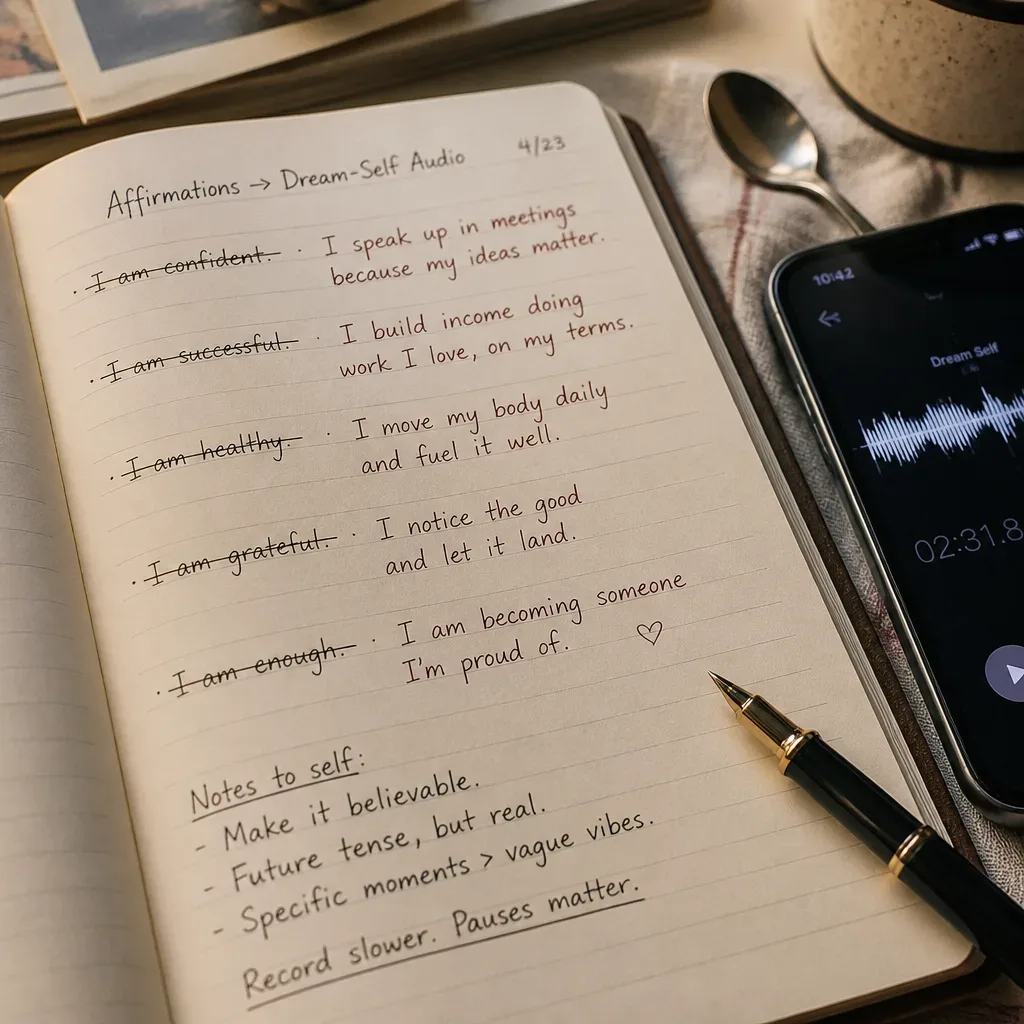
I keep a small list in my notebook, dated this week. Some are for work. Some are for money. Some are for love without performance. I avoid sentences that sound like they were written for a poster in a co-working space. If I would not say it to my closest friend at the kitchen table, I do not put it in my ear.
These are the 9 forms I return to most:
- Safety: I am safe enough to be honest today.
- Voice: I finish my sentence before I soften it.
- Money: I look at my numbers without shame.
- Body: I speak to my body like someone I am staying with.
- Work: I let my work be seen before it is flawless.
- Love: I do not audition for care.
- Rest: I stop before resentment becomes the signal.
- Desire: I name what I want without making it smaller.
- Future self: I keep one promise today that she already trusts me to keep.
The Centers for Disease Control and Prevention has reported that women are more likely than men to experience frequent mental distress in several survey years, with 2022 data showing notable gender differences among adults. I think about that when I write affirmations. I do not want decorative positivity for exhausted people. I want language that respects load.
There is a difference between encouragement and pressure. Encouragement gives me a handle. Pressure gives me another version of failure. The Manifestation pillar says practice works better when desire becomes daily attention, and that helped me edit my lines down from fantasy to behavior.
A useful affirmation does not flatter me. It gives me a next sentence to live from.
4. How can affirmations support women without pretending life is simple?
They can support women by naming agency inside real limits, without denying money, care work, health, bias, grief, or time.
I am careful here. I do not want to write sentences that scold a tired woman for being tired. Pew Research Center has reported that mothers in many households still take on more caregiving and household labor, even when both partners work. In 2023, Pew noted that in opposite-sex marriages where both spouses earn similar pay, women still spent more time on caregiving and housework. An affirmation that ignores that is not kind. It is bad design.
So I write lines that include the room as it is. Not I have endless time. I write, I protect 10 minutes before I give the day away. Not I am always calm. I write, I notice the first sign of resentment and pause. Not I attract perfect people. I write, I believe patterns more than promises.
When I am using astrology and manifestation as a timing tool, I still keep the audio practical. A moon note in my Notion might say edit, release, ask, or rest. The audio says what I will actually do at 8:15 a.m. Those are different jobs. The calendar can hold rhythm; the recording holds the voice.
The line I kept longest this year was plain: I do not abandon myself to be easy to love. I listened to it for 31 mornings. Nothing dramatic happened on morning 32. But I answered a message more slowly. I did not explain my no 4 times. The change was small, but it had a receipt.
Hope becomes safer when it tells the truth about the room.
5. How do I turn written affirmations into audio I will actually repeat?
I turn them into audio by editing for belief, placing them in a short script, and attaching listening to one daily cue.
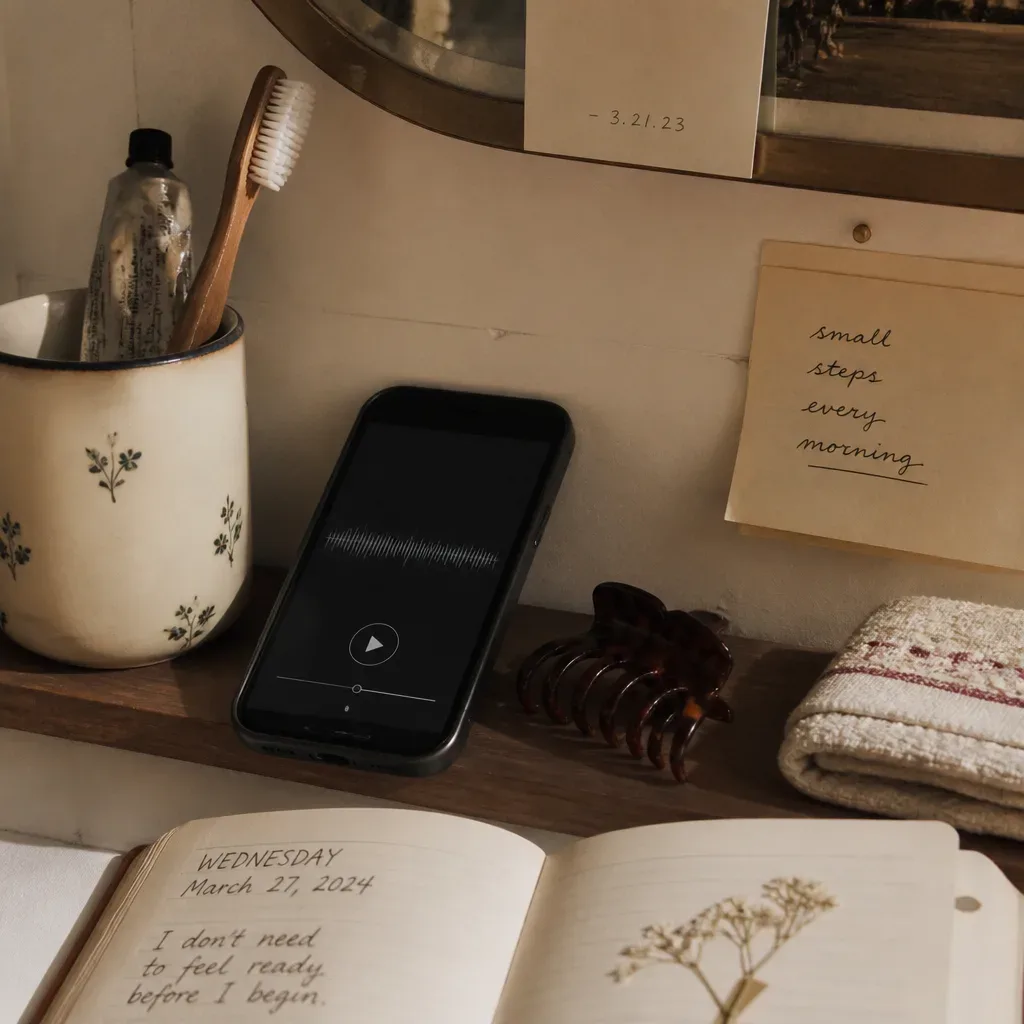
I learned this from product design before I learned it from practice. A habit loop needs a cue, an action, and a reward. Charles Duhigg popularized that model in 2012, and later behavior researchers like BJ Fogg made the point even smaller: make the action easy enough to do now. My cue is brushing my teeth. My action is pressing play. The reward is that the audio feels like being spoken to kindly.
Here is the 6-step edit I use on a Sunday night:
- Write 12 raw affirmations without making them pretty.
- Cross out every line that makes my body tense.
- Rewrite vague words into visible behavior.
- Keep 5 to 9 lines, no more.
- Record or generate a calm Dream-Self version in present tense.
- Listen at the same daily cue for at least 14 days before changing it.
Fourteen days is not a magic number. It is just long enough for me to stop judging the script every morning. In Lally’s habit study, the average was 66 days, but the curve mattered more than the calendar: repetition in a stable context made the behavior more automatic. I give a script 2 weeks because my first reaction is often noise.
A written line might say, I am confident at work. My audio version says, I sit with both feet on the floor, ask the clear question, and let silence do its job after I speak. That version gives my body instructions. It is not more poetic. It is more usable.
I also keep one daily affirmation on the page, but only as a complement. The audio is the practice. The page is a small witness.
6. What mistakes make affirmations feel fake for women?
Affirmations feel fake when they are too broad, too cheerful, too detached from action, or too far from what the body can currently accept.
I have made all 4 mistakes. I once wrote I am wildly successful on a sticky note during a week when I could not open my bank app. The sentence did not comfort me. It made me feel dishonest. A better line would have been, I look at the number, breathe once, and make the next clean choice. The second line is less glamorous. It is also less likely to make me shut down.
Research on self-talk in sport psychology often distinguishes instructional self-talk from motivational self-talk. A 2011 review by Hatzigeorgiadis and colleagues found self-talk interventions could improve performance, especially when matched to the task. I think daily affirmations behave similarly. If the task is courage, the line can be warm. If the task is execution, the line needs instructions.
These are the mistakes I now check for:
- Too absolute: I never doubt myself.
- Too vague: I am radiant and powerful.
- Too distant: I live my perfect dream life now.
- Too punitive: I do not allow low thoughts.
- Too dependent on others: Everyone notices my worth.
The repair is usually simple. I add a scene, a verb, or a boundary. I change I am chosen into I choose myself in the first 5 minutes of uncertainty. I change I am rich into I answer money with attention, not avoidance. I change I am loved into I let care be mutual.
There is no shame in needing the sentence to be smaller. Small is often where the door is.
7. How do I know if Dream-Self audio is working?
I know it is working when the sentence returns during the day and changes one small choice before I force myself to be different.
I do not measure this by mood alone. Moods move. Hormones move. Sleep moves. The National Sleep Foundation recommends 7 to 9 hours for most adults, and I can tell the difference between an affirmation problem and a 5-hour sleep problem now. If I slept badly, the practice may feel flat. That does not mean it failed.
I look for 5 quieter signs:
- I remember the line without pressing play.
- I pause before my usual apology.
- I make one cleaner decision with money, work, food, or rest.
- I stop editing my desire down for someone else’s comfort.
- I return the next morning without needing to be inspired.
Joe Dispenza writes about rehearsing a future self through repeated mental and emotional practice. I hold that lightly, and I also hold the ordinary evidence in my hand: did I behave 1 degree differently today? Princeton Engineering Anomalies Research and later Global Consciousness Project work are often mentioned in manifestation circles, but even people skeptical of that research can agree on one grounded point. Attention changes behavior, and repeated behavior changes a life by accumulation.
I keep a 3-line log, not a tracker with 14 columns. Date. Listened or did not listen. One sentence that followed me. Last Friday the sentence was, I can be direct and still be kind. I used it on the bus before sending a message I had rewritten 6 times.
The proof of an affirmation is not how beautiful it sounds in the morning. The proof is whether it finds me at 3:40 p.m.
If someone is new, I would send them first to the AYA Method, then back to the affirmations guide. I would say to keep the practice almost too easy. Press play. Listen. Let the words become familiar before asking them to become dramatic.
Wednesday now. The kettle is clean, and I have left the blue mug by the sink.