manifestation for life areas
Career Change Manifestation With a 5-Minute Audio
Career change manifestation works best when it becomes a kept daily practice: five minutes of future-self audio before the day starts deciding for you.

Monday. The kettle clicked off before I opened my laptop. Career change manifestation works when I make the new workday familiar before it is real: five minutes of future-self audio, listened to daily, followed by one small career action I can actually keep.
What is career change manifestation when I only have five minutes?
Career change manifestation is a short daily practice of rehearsing the identity, decisions, and ordinary evidence of the work life I am asking for.
I need the word ordinary there. If I make the future too shiny, my mind treats it like a poster. If I make it specific, it becomes useful. The chair. The calendar. The person I email. The salary number I stop avoiding. The first Monday when my stomach does not fold in half before 9 a.m.
The Bureau of Labor Statistics reported median employee tenure in the United States at 3.9 years in January 2024. That number helped me. It reminded me that changing work is not a rare spiritual emergency. It is part of modern working life. Pew Research Center found in 2022 that 63% of workers who quit a job in 2021 named low pay or no advancement as a major reason. Sometimes the inner nudge has a spreadsheet behind it.
I use the AYA Method here in its plain definition: The AYA Method is a daily audio manifestation practice. Each day you listen to a short personalized recording — your Dream-Self Moment — narrated from the version of you who has already manifested the life you intend. Listening is the practice. Repetition is the work. The audio is the method.
That matters because I do not need another board, tracker, or dramatic morning ceremony. I need a practice that survives Tuesday. Five minutes is small enough to repeat and long enough to change the first thought of the day.
A career change begins to move when the future stops sounding like a speech and starts sounding like a Tuesday.
How do I write a future-self audio that does not feel fake?
I write it as evidence from a normal day, not as a speech from a perfect life.
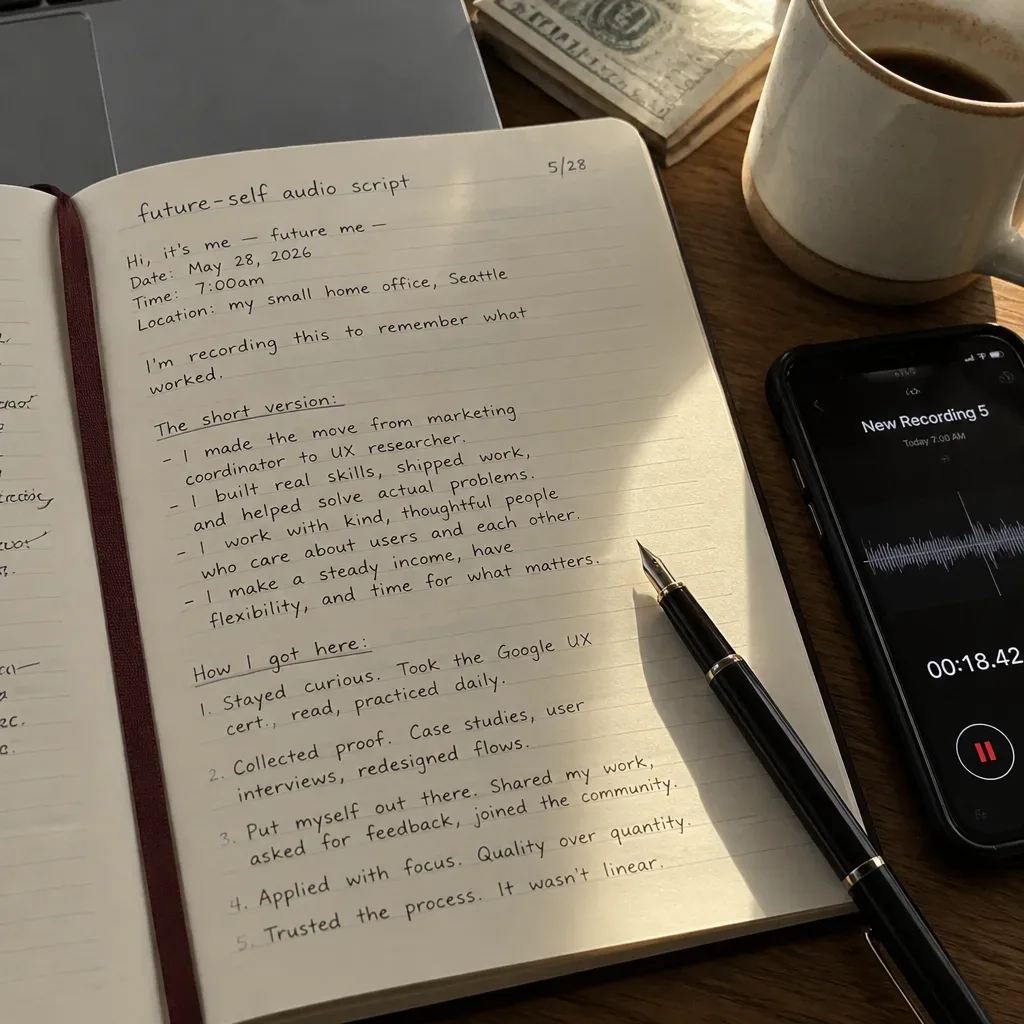
This morning, I wrote mine in the blue notebook I keep near the coffee. I did not write, “I am wildly successful.” I wrote, “I opened the project brief and knew why I had been hired.” That line felt less impressive and more believable. Believable matters. In a 2006 meta-analysis, Peter Gollwitzer and Paschal Sheeran found that implementation intentions, the simple practice of linking a goal to a specific cue and action, had a medium-to-large effect on goal achievement. The average effect size was reported around d = .65.
For a five-minute future-self audio, I use this shape:
- One scene: I choose a specific work moment, such as joining a Monday meeting in the new field.
- Three pieces of proof: I name what I did, what I stopped doing, and what changed around me.
- One body cue: I mention my breath, shoulders, hands, or pace.
- One next action: I end with the small thing I do today.
- One sentence I can believe: I keep it plain enough to repeat for 30 days.
Here is the difference I keep taped to the inside of my notebook:
| Weak line | Better line |
|---|---|
| I have my dream career. | I am paid for work I can explain without shrinking. |
| Everything worked out. | I sent the application, asked for the call, and kept my calendar honest. |
| I am fearless. | I feel fear and still take the next clean step. |
Neville Goddard wrote often about assuming the feeling of the wish fulfilled. I take the useful part and remove the theatre. The feeling I want is not glitter. It is self-trust at 8:40 a.m.
The future self is not a fantasy character; it is a behavioral draft.
What should I include in the 5-minute career audio?
I include concrete work evidence, emotional regulation, and one near-term action, because a career change needs both imagination and logistics.
The first minute is arrival. I tell myself where I am and what has changed. “I am sitting at the kitchen table before work. The role is different now. My skills are being used. I am not bargaining with dread before breakfast.” This is not poetry. It is a location pin for the mind.
The next two minutes are proof. I name the kind of work, the people, the money, and the tradeoffs. If I want a new career in product research, I say what I studied, who I spoke to, and which portfolio piece I finished. If I want to leave management, I say what I no longer carry. The American Psychological Association has repeatedly noted that specific, challenging goals tend to outperform vague goals, a finding tied to decades of goal-setting research by Edwin Locke and Gary Latham.
Then I regulate the body. Dr. Andrew Huberman has discussed how breathing patterns can shift arousal quickly; one common tool he has described is the physiological sigh, two inhales followed by a longer exhale. I do not turn the audio into breathwork, but I let the future self sound calm enough that my nervous system has something to copy.
I end with one small action. Not “change my life.” More like this:
- revise one résumé bullet
- send one honest message
- save three roles without judging myself
- ask one person what the work is really like
- spend 20 minutes learning the missing tool
I keep the daily affirmation separate when I use one. A sentence on the page can help, and the Affirmations pillar has more on that, but the audio is the practice for me. The affirmation is a matchstick. The recording is the candle I return to.
When should I listen so the practice actually stays kept?
I listen at a cue that already exists, because a new life cannot depend on a heroic morning.
For me, the cue is the kettle. I start the audio before the coffee blooms. On bus days, I listen after the second stop, when the bakery with the green awning passes on the left. BJ Fogg’s behavior model from Stanford is useful here: behavior happens when motivation, ability, and a prompt meet at the same time. Five minutes keeps the ability side low. The kettle supplies the prompt.
I tested night listening too. It made me softer, but it did not change my workday as much. Morning listening gave the future self first access to the room. That is not mystical. It is practical. The first input often sets the frame for what I notice next.
I kept a simple seven-day table last month, because I do not trust my memory when I am tired:
| Day | Cue | Listened? | One career action |
|---|---|---|---|
| Monday | kettle | yes | rewrote summary line |
| Tuesday | bus | yes | messaged Ana |
| Wednesday | kettle | yes | saved 4 roles |
| Thursday | bath | no | none |
| Friday | kettle | yes | practiced answer aloud |
| Saturday | chair | yes | read salary report |
| Sunday | coffee | yes | planned two calls |
Six out of seven was enough. I did not restart the whole practice because Thursday collapsed. In productivity writing, I have watched people quit at the first missed day as if the habit were porcelain. It is not porcelain. It is a towel. Pick it up.
The practice that works is usually the one boring enough to survive your real calendar.
How do I turn listening into real career movement?
I treat the audio as the starting bell, then I take one action small enough to finish before resistance organizes itself.
This is where Manifestation pillar language can become either useful or vague. I have to ask for a life in a way my day can recognize. If the future-self audio says I am in a new field, then today needs one receipt from that field. A message sent. A course module completed. A portfolio paragraph edited. A salary range researched.
In 2023, LinkedIn reported that skills for jobs had changed by about 25% since 2015 and projected that the shift could reach 65% by 2030. I wrote that number on a sticky note because it lowered the shame. Needing to learn new tools is not proof I am late. It is the condition of the market.
After listening, I use a 10-minute action rule. The audio is five minutes. The action is ten. Fifteen minutes total is often less time than I have spent rereading one unhelpful email.
My small action menu looks like this:
- Evidence action: update one line of the résumé with a measurable result.
- People action: ask one person for a 15-minute call about their work.
- Skill action: practice one tool or concept for 10 minutes.
- Money action: check one salary range and write down the number.
- Courage action: say the new direction out loud to one safe person.
Joe Dispenza writes about rehearsing a new state until it becomes more familiar to the body. I stay cautious with big claims, but I understand the practical edge. Repetition reduces novelty. When the new identity feels less strange, the email gets easier to send.
Wanting is not the same as moving; the bridge is a receipt.
What if doubt comes up while I am listening?
I let doubt sit in the room and keep the audio honest enough that it does not have to fight me.
Doubt is information, not a verdict. If my recording says, “I doubled my income in three weeks,” my doubt is doing its job. If the audio says, “I am learning to speak about my work without apology,” and doubt still arrives, I can keep listening. The sentence is close enough to truth to train with.
Cognitive behavioral therapy often uses repeated exposure to reduce avoidance. The mechanism is not identical here, and I do not pretend a five-minute audio replaces therapy or career counseling. But the principle rhymes: repeated contact with a feared future can make it less charged. In small studies on mental imagery and performance, rehearsal has been associated with improved confidence and task execution, especially when paired with physical practice.
I also watch for borrowed fear. My mother grew up with work as survival. Stability was not a preference; it was oxygen. When I hear her voice in my head, I do not insult it. I date it. 1998. Rent due. No safety net. Then I come back to 2026, my current bank balance, my current skills, and the call I can make on Thursday.
A useful doubt asks for a plan. An unhelpful doubt asks for your whole life back.
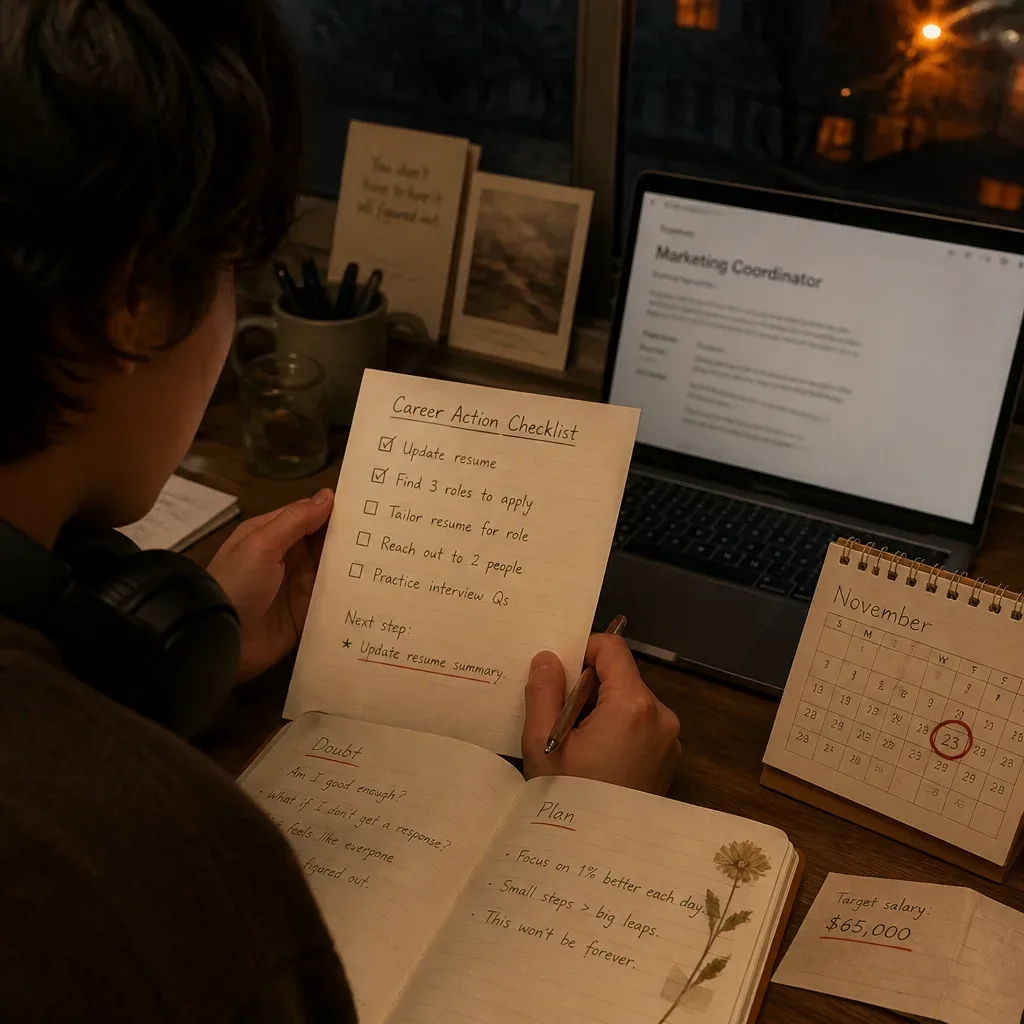
If the fear is financial, I put numbers inside the practice. Runway months. Minimum salary. Application count. The future self should not float above rent. If I need six months of savings before moving, the audio can say that. Clean limits make the practice safer, not smaller.
How will I know the career change manifestation is working?
I know it is working when my behavior changes before my circumstances do.
That is the quiet measure. Not a sign. Not a sudden offer. Behavior. I answer the message. I stop making jokes about wanting out. I spend 20 minutes on the portfolio instead of 20 minutes scrolling job titles and calling it research. According to a 2024 Gallup report, only about 23% of employees globally were engaged at work. If I am waiting for my current job to make me feel alive before I move, I may wait too long.
I track four signals:
- Language: I describe the next role more clearly than last week.
- Nervous system: I recover faster after fear spikes.
- Evidence: I create visible proof, even small proof.
- Network: I have more honest conversations about the change.
I do not use astrology to make the decision for me, but timing rituals sometimes help me pay attention. If that is part of your language, Astrology and manifestation may give you a gentler frame. I still put the call on the calendar. The moon does not send the email for me.
Some days I also open the Manifestation Board after listening. I keep it secondary. A picture can remind me, and a daily affirmation can steady the sentence, but the audio is where the repetition lives. When I forget that, the practice becomes decoration.
I return to the AYA Method because it asks so little from my morning and so much from my honesty. The Dream-Self Moment has to sound like someone I am willing to become by calendar, receipt, and repeated attention.
The first proof of a new career is not the offer letter. It is the day you stop abandoning the next step.
Monday night now. The chair is back under the table.