manifestation for life areas
Job Interview Manifestation: Dream-Self Audio Prep
Job interview manifestation can steady your nerves before you walk in. Use Dream-Self audio, practical prep, and a short review ritual.
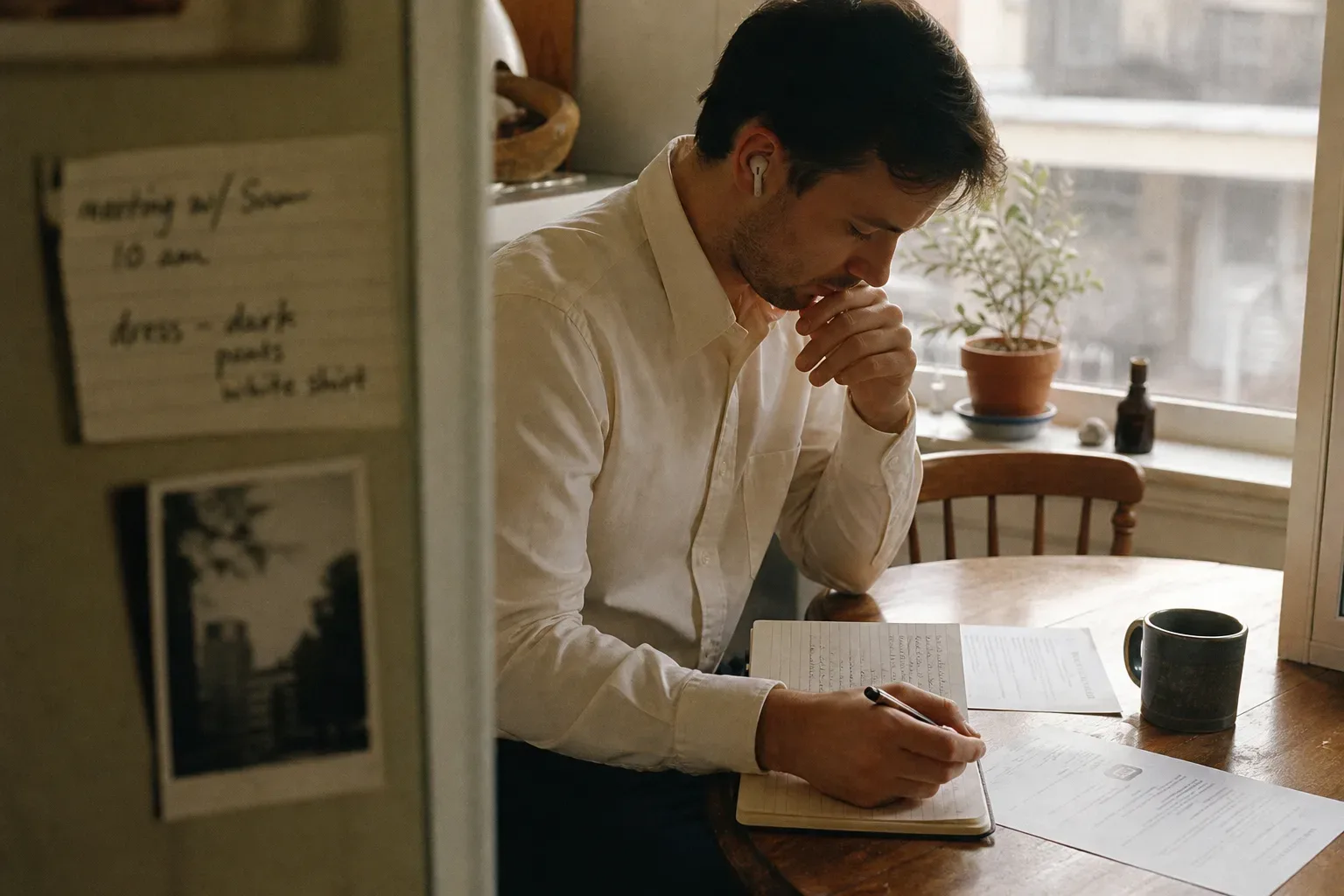
August 26th. I put my coffee beside the chair and listened before opening the laptop. Job interview manifestation works best when it is treated as rehearsal plus regulation: hear yourself as prepared, prepare the evidence, calm the body, then walk in with one clean next sentence.
What is job interview manifestation actually asking me to do?
Job interview manifestation asks me to practice the state and behavior of the person who interviews clearly before I am under pressure.
I used to distrust anything that sounded soft around hiring. Six years in venture made me allergic to claims without usage data. But interviewing is not only a skills test. It is also a state test. The question is whether I can retrieve examples, listen under pressure, and speak in complete sentences while my body is sending alarms. A 2023 Pew Research Center report noted that many workers changed jobs or considered doing so after the pandemic years, and the labor market kept asking people to explain themselves in rooms with strangers. That is not nothing.
The useful version is plain. I listen to a short Dream-Self audio, then I prepare the interview like a grown person. I check the role. I write proof. I make my examples smaller and cleaner. I do not ask the practice to replace competence. I ask it to help me access competence.
This is where the AYA Method fits my actual morning. The AYA Method is a daily audio manifestation practice. Each day you listen to a short personalized recording, your Dream-Self Moment, narrated from the version of you who has already manifested the life you intend. Listening is the practice. Repetition is the work. The audio is the method.
Neville Goddard wrote often about assuming the feeling of the wish fulfilled, especially in his 1944 lectures and later books. I keep the part that is useful and testable: state rehearsal changes what I notice and how I act. Joe Dispenza says similar things in more biological language, asking people to rehearse a future state until it becomes familiar. I still bring my resume.
A job interview is not the place to become someone new. It is the place to remember who can already do the work.
How do I use Dream-Self audio before I walk in?
I use Dream-Self audio before an interview by listening early enough to settle, then turning immediately to concrete prep.
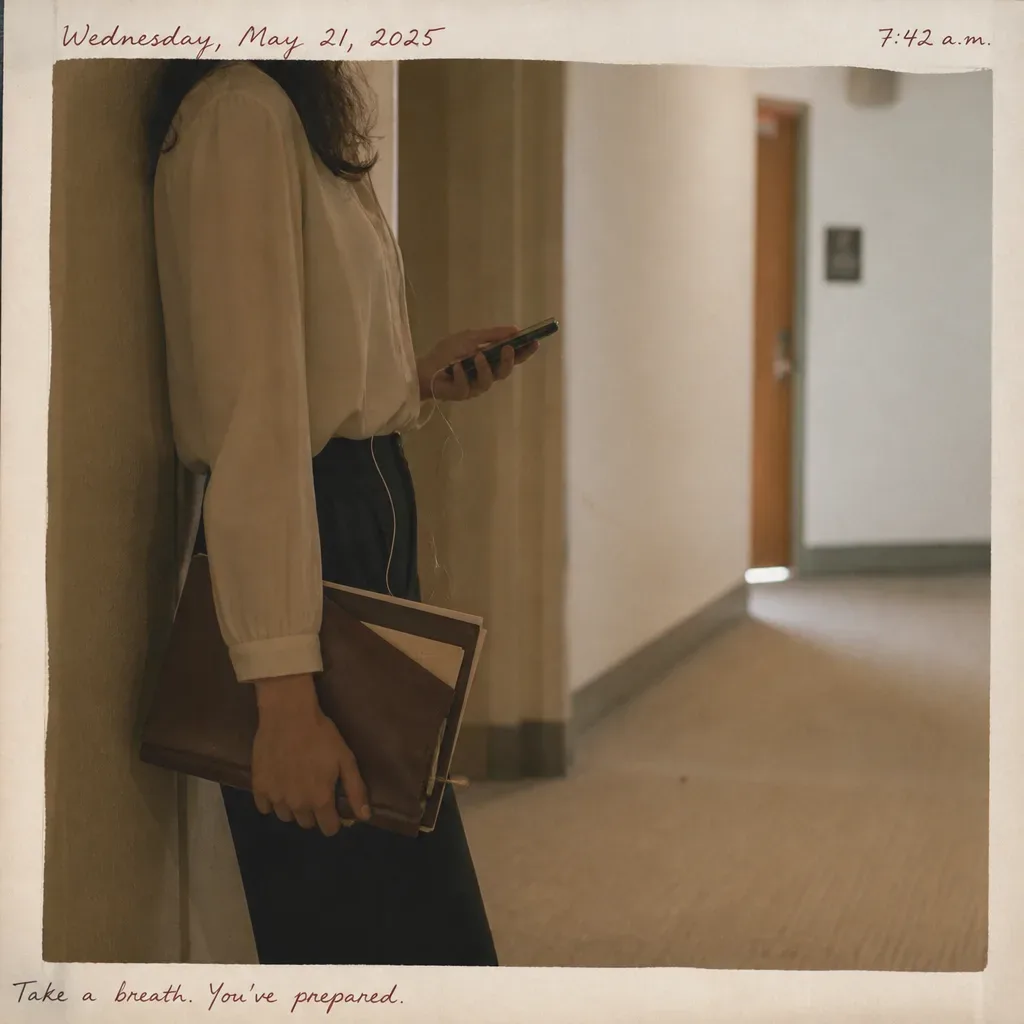
This week I tested the timing on a call I did not particularly want to take. I listened once after the kettle came on. Then I listened again in the hallway 12 minutes before the meeting. Twelve minutes was enough. Less than 5 felt rushed. More than 20 gave my mind time to start decorating the fear. Stanford researchers led by Balban published a 2023 Cell Reports Medicine study where 5 minutes of daily breathwork, especially cyclic sighing, improved mood and reduced anxiety more than mindfulness meditation in their sample. I keep that number close because it reminds me that small durations can count.
Here is the 15-minute version I wrote on the back of an envelope before I forgot:
- Minute 0 to 4: Listen to the Dream-Self Moment without multitasking.
- Minute 4 to 7: Read the job description and circle the 3 words they repeat.
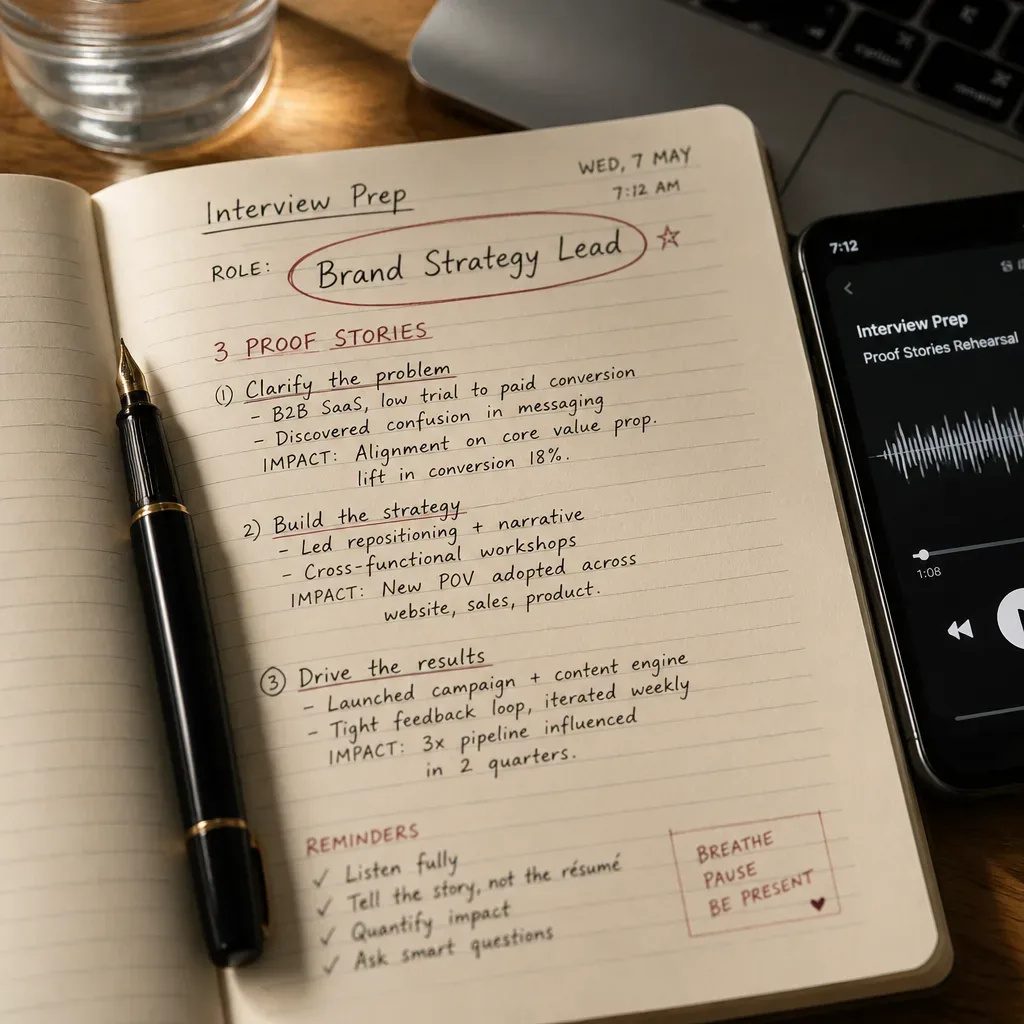
- Minute 7 to 11: Review 3 proof stories, each no longer than 60 seconds.
- Minute 11 to 13: Do slow breathing, with a longer exhale than inhale.
- Minute 13 to 15: Say your first sentence out loud once.
The first sentence matters more than I used to think. In a 2019 LinkedIn Global Talent Trends report, soft skills were ranked as a major priority by employers, with creativity, persuasion, collaboration, adaptability, and time management appearing near the top. Interviews are where those claims get sampled. If my first answer is scattered, the room has to work harder to trust the rest.
I do not listen because I expect the hiring manager to become kinder. I listen because my attention gets less feral. The audio gives my mind a track. The prep gives my mouth facts.
| Time available | What I do | What I avoid |
|---|---|---|
| 3 minutes | One listen or one breathing reset | Rewriting my whole story |
| 10 minutes | Audio, first sentence, 3 proof points | Scrolling salary threads |
| 30 minutes | Audio, role review, examples, questions | Starting from panic |
What should my Dream-Self audio include for an interview?
My interview audio should include the room, the role, my prepared evidence, and the way I want to speak under pressure.
I like specificity because vague confidence has a short shelf life. If the audio says only that I am confident, my nervous system argues back. If it says I pause before answering the compensation question, or I smile when I do not know something and ask for a moment, my body has something to rehearse. Mental rehearsal has been used in sports psychology for decades. A 2012 review in the Journal of Mental Imagery described imagery as most useful when it includes physical, emotional, and environmental detail.
When I write input for an interview-focused Dream-Self Moment, I keep it to 5 pieces. The job title. The company or team. Three qualities I want to embody. Three proof stories. One line about how I handle uncertainty. That is enough. More becomes a pitch deck, and I have seen too many pitch decks die under their own adjectives.
A useful script seed might sound like this: I am sitting in the chair with both feet on the floor. I hear the question fully before answering. I speak about the customer migration project, the hard stakeholder call, and the week I fixed the reporting error. I do not rush to fill silence. I let my experience arrive.
The Manifestation pillar has a wider map for this, but on interview day I keep the map folded. I need one road. I need the version of me who has already practiced telling the truth cleanly.
Specificity is mercy. The mind calms down when it knows what to do with its hands.
Can job interview manifestation help when my body feels anxious?
It can help when I treat anxiety as body data, not as a verdict about my chances.
My hands get cold before interviews. They did when I was twenty-two and trying to look employable in borrowed shoes. They did when I was thirty-nine and had already sat through hundreds of founder meetings. Experience did not remove the signal. It changed what I did with it. The American Psychological Association has noted that acute stress can narrow attention and affect working memory. That explains why a question I know how to answer can disappear for 8 seconds when the stakes feel high.
I use the audio to create familiarity, then I use the body to prove safety. Dr. Andrew Huberman has popularized the physiological sigh, usually described as two inhales through the nose followed by a long exhale. The mechanism is older than the podcast clip: extended exhales are associated with parasympathetic activity, the branch involved in downshifting arousal. I do 3 rounds, not 30. I am not trying to become a monk in the lobby.
Self-affirmation research is relevant here, but I hold it carefully. In small studies, including work by Creswell and colleagues published in PLOS ONE in 2013, self-affirmation helped buffer stress effects on problem-solving performance. That does not mean a sentence on a sticky note gets me hired. It means identity reminders can reduce threat enough for cognition to come back online.
These are the cues I keep:
- Feet flat, because floating thoughts need a floor.
- Jaw loose, because clenched speech sounds like defense.
- One slow breath before hard questions.
- Permission to say, I would like a moment to think.
- A glass of water if one is offered.
Anxiety is not disqualification. Sometimes it is just unused voltage.
What do I say to myself in the final 10 minutes?
In the final 10 minutes, I say fewer things, not better things.
I learned this the expensive way. Before one partner interview years ago, I kept adding information until I had turned myself into a browser with 27 open tabs. The interview was fine, but I remember the cost. Attention is finite. A 2015 Microsoft Canada report, often cited and sometimes overused, claimed average human attention had dropped to 8 seconds, but the exact number matters less than the pattern: divided attention performs poorly. On interview day, I refuse to spend my last clean minutes on noise.
My final 10-minute script is almost boring. That is why it works. I read the company mission once. I read the role outcomes once. I review 3 stories: one about results, one about conflict, one about learning. Then I close everything.
I say this, quietly if I am in a public place: I have prepared. I can answer one question at a time. I can pause. I can ask for clarity. I can leave the room knowing I was present. It is not mystical. It is instruction.
If the interview is remote, I add 2 technical checks. Camera height and microphone input. A 2022 SHRM article reported that virtual interviews had become normal across many hiring processes after 2020, and the basics still ruin people. I have watched qualified candidates spend their first 90 seconds apologizing to a laptop. I have also been that person.
The final 10 minutes are not for becoming impressive. They are for becoming available.
How do I combine affirmations, research, and the audio without overdoing it?
I combine them by giving each tool one job and refusing to stack rituals as avoidance.
The audio is the practice. Research is the evidence. A daily affirmation is a small complement when it helps me keep one sentence near the surface. I am careful about this because wellness products love to multiply steps. More steps make a deck look better. Fewer steps survive Tuesday. If you want the deeper affirmation frame, the Affirmations pillar is useful, especially for making sentences believable instead of decorative.
My rule is 1 audio, 3 proof stories, 1 sentence. That is the whole kit. In hiring, structured interviews tend to be more predictive than unstructured ones. Industrial-organizational psychology has said this for years, and Schmidt and Hunter’s 1998 meta-analysis remains one of the most cited summaries on personnel selection validity. Since I cannot control whether the company structures the interview well, I structure my side.
The 3 proof stories should be chosen before the day gets loud. I use STAR only if it helps: situation, task, action, result. I prefer a simpler version on paper:
- What was messy?
- What did I do?
- What changed by a number, date, or decision?
- What did I learn that I would repeat?
If the role involves sales, I bring one metric. If it involves operations, one process change. If it involves care work, one example of judgment under pressure. Numbers do not have to be flashy. A 12 percent reduction in errors, a 2-week turnaround, a team of 4, a budget of $18,000. Specific proof has a calming effect because it gives the conversation something solid to stand on.
I sometimes check Astrology and manifestation the night before, not to outsource the outcome, but because symbols can make me sit with timing and temperament. Then I close it. The interview still belongs to preparation, presence, and the next answer.
What should I do after the interview so the practice keeps working?
After the interview, I review the facts once, write the follow-up, and stop turning the room into a courtroom.
This is the part I am worst at. I can replay a sentence for sport. After one interview in late spring, I remembered saying efficient three times and wanted to walk into the sea. The hiring manager did not notice, or did not care. I got the next round. Memory under stress is not a clean recording. Research on rumination, including work discussed in the Journal of Behavioral Medicine, links repetitive negative thinking with higher distress. The post-interview spiral is not analysis after a point. It is just billing me attention.
I use a 6-line review. It takes 7 minutes, which is long enough to learn and short enough to prevent punishment.
- What questions did they ask?
- Which answer landed well?
- Which answer needs a cleaner version?
- What did I learn about the role?
- What follow-up should I send?
- What is now out of my hands?
Then I send the note if a note is appropriate. I keep it under 150 words. I mention one specific part of the conversation. CareerBuilder surveys have often found that follow-up notes can affect hiring impressions, though exact percentages vary by year and sample. I do not write the note to beg. I write it to be clear.
Before bed, I may listen again, not to change the past, but to keep my identity from shrinking around one outcome. The manifestation guide says this in broader terms, and the AYA Method makes it practical for me: repetition is the work. One interview is data. It is not a final name for me.
The room can evaluate my fit. It does not get to define my size.
Wednesday now. The coffee went cold, and I drank it anyway.