money manifestation
Financial Anxiety? Use Audio Before Checking Money
Financial anxiety can spike before a balance check. Learn a 3-minute audio-first ritual that steadies your body before you open your bank app.

The phone is face down beside your tea. Financial anxiety before checking your bank account is best met with a short audio pause first: listen, breathe, name the fear, then open the app once. The number matters. So does the state you bring to reading it.
Why does a bank balance feel like a threat?
A bank balance can feel threatening because your body reads uncertain money information as possible danger before your mind has facts.
This is not a character flaw. It is a threat response. The American Psychological Association reported in 2023 that 63% of adults named money as a significant source of stress, with the economy close behind at 64%. A number on a screen can become more than a number. It can stand in for rent, food, family, shame, or the sentence you fear someone else would say about you.
Your bank app is not neutral when your body expects bad news. A balance check gives instant feedback, and instant feedback can train a loop. You open the app. Your chest tightens. You close it. For a few seconds, the fear drops because the screen is gone. That relief teaches avoidance. Behavioral psychology has described this pattern for decades: when avoidance lowers distress in the short term, the habit tends to repeat.
There is also a real economic layer. In the Federal Reserve’s 2023 Survey of Household Economics and Decisionmaking, 63% of adults said they would cover a $400 emergency expense using cash or its equivalent, meaning a large minority would need another method or could not cover it. If your margin is thin, your nervous system is not being dramatic. It is doing math with old pain attached.
Financial anxiety often speaks in absolutes: I am behind. I am unsafe. I have ruined it. The bank balance may be specific, but the fear is usually global. That is why a softer entry matters. You are not trying to make the number pretty. You are trying to meet it without letting panic become the person in charge.
A number can be true without being the whole truth.
Why use audio before you open the banking app?
Audio helps because it gives your attention a steady place to land before the balance asks for all of it.
Reading is easy to rush. Thinking is easy to argue with. Audio enters through time. You have to receive it second by second, which is why it can interrupt the reflex to tap, scan, flinch, and shut the app. In a 2023 Cell Reports Medicine study led by David Spiegel and colleagues, five minutes of cyclic sighing improved mood and reduced physiological arousal more than mindfulness meditation in that small randomized trial. The exact practice was breathing, not manifestation, but the point is useful: paced sound and breath can change the state of the body before a hard task.
This is where the AYA Method belongs, quietly. The AYA Method is a daily audio manifestation practice. Each day you listen to a short personalized recording — your Dream-Self Moment — narrated from the version of you who has already manifested the life you intend. Listening is the practice. Repetition is the work. The audio is the method.
The audio is not a promise that your balance will rise while you listen. That would be a way to avoid reality. It is closer to rehearsing the self who can look. In manifestation, the useful question is not whether a thought magically pays a bill. The useful question is whether repeated attention changes the action you can take next.
Audio does not change the number. It changes the person reading it.
For financial anxiety, that distinction matters. You are not asking the audio to rescue you. You are asking it to hold the first minute, the minute when old stories shout. After that, you open the app. You let the truth arrive. Then you choose one action small enough to do now.
How do you do the 3-minute audio-first bank check?
You do it by making the audio the first step, the bank app the second step, and one concrete money action the third.
Set a timer for three minutes. That is long enough to create a boundary and short enough that it does not become avoidance. Peter Gollwitzer’s research on implementation intentions, often summarized as if-then planning, has shown across many studies that specific cues improve follow-through. So the cue becomes simple: if I need to check money, then I listen first.
Use this order:
- Place the phone face down for 10 seconds. Do not open the banking app yet. Let your hand stop reaching.
- Play your audio. If you use Aya, choose your Dream-Self Moment. Keep your eyes soft or closed.
- Put one hand on your chest or the table. Give the body a fixed point. Count 6 slow exhales if you need structure.
- Name the fear in one sentence. Try: I am afraid the balance will mean I am not safe.
- Open the bank app once. No repeated checking. No hunting for a second emotional answer.
- Take one small action. Write the balance, pay one bill, move a small amount, cancel one charge, or schedule the next review.
A three-minute ritual works best when it is boring enough to repeat. In a well-known 2009 European Journal of Social Psychology study, Phillippa Lally and colleagues found that habit formation took a median of 66 days, with wide variation. That means the first week may feel awkward. Awkward is still allowed.
Here is the simple shape:
| Minute | What you do | What it protects |
|---|---|---|
| 0:00-1:00 | Start audio and slow the breath | The first panic spike |
| 1:00-2:00 | Hear the steadier self speak | The story around the number |
| 2:00-3:00 | Name the fear and open the app | The move from avoidance to contact |
Do not make the practice ornate. The more steps you add, the easier it is to fail. One audio. One check. One action. That is enough for the morning.

What should the audio say when money feels unsafe?
The audio should speak from the self who can be honest about money without becoming cruel.
A good money audio is not sugary. It does not pretend every purchase was wise or every bill is light. It names steadiness. It gives the body an instruction. Cognitive therapy, shaped by Aaron Beck in the 1960s and 1970s, works partly by noticing automatic thoughts and testing them against reality. Your audio can do a gentler version of that before you look at the balance.
You might hear something like this:
I can look at the number without disappearing into it. I can read one balance. I can take one next step. I do not need to punish myself to become responsible. I can be exact and kind at the same time.
That sentence is not decoration. It is a behavioral cue. Financial anxiety often turns money into identity. The audio brings money back to information. If you use affirmations, keep them close to action. I am safe can feel false when rent is due. I can make one honest move now is harder to reject.
Try changing the wording like this:
| Fear phrase | Audio-first phrase |
|---|---|
| I cannot look | I can look for 30 seconds |
| I have ruined everything | I can name what is true today |
| I am bad with money | I am learning one clear money habit |
| There is no point | One small action still counts |
There is evidence that writing about worries can reduce their grip. In a 2018 study in Psychophysiology, anxious students who wrote about their worries before a test used fewer cognitive resources during the task. The study was about test anxiety, not bank apps, so be careful with the comparison. Still, the pattern is familiar: naming fear before the task can make the task less consuming.
The best phrase is the one you can believe by 1%. Not 100%. Just enough to keep your hand from closing the app.
What if the balance is worse than you expected?
If the balance is worse than expected, lower the scope immediately and choose one next financial action.
Bad numbers invite total life review. Do not accept the invitation. Your job is not to repair every month in one sitting. Your job is to keep contact with the facts. The Consumer Financial Protection Bureau’s budgeting guidance often starts with listing income, bills, and due dates because clarity lowers the fog. You can do that later in a longer session. Right now, you need the smallest useful move.
Use this emergency order:
- Write the current balance.
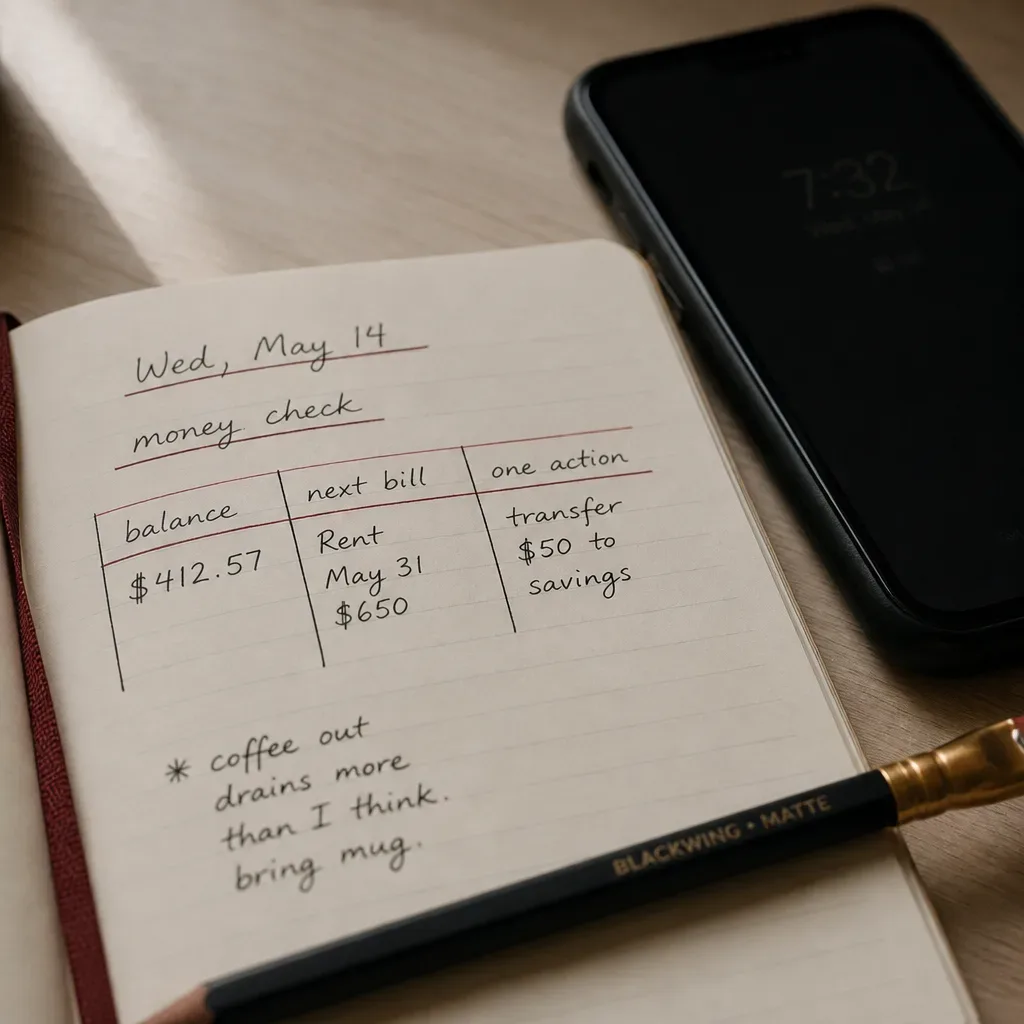
- Write the next bill due and its date.
- Check pending charges once.
- Choose one action under 10 minutes.
- Stop before panic starts making plans.
Possible actions are plain: move $15 to cover a fee, cancel a subscription, text a housemate, schedule a payment, call the lender, or set a reminder for a 20-minute budget block. According to the Federal Reserve’s 2023 SHED report, 17% of adults said they had gone without some medical care because of cost. Money stress touches real choices. That is why your next action should be concrete, not performative.
This is also where symbolic practices need good boundaries. If you like timing rituals, moon notes, or reflective planning, astrology and manifestation can sit beside your money review as meaning-making. It should not replace the bill date. The calendar still matters.
One small action is not small when it keeps you in relationship with reality.
If you see overdraft risk, debt spirals, or repeated missed essentials, bring in human support. Nonprofit credit counseling agencies, local financial counselors, and community aid programs exist because money problems are not solved by mindset alone. Audio first does not mean audio only. It means you meet the moment with less self-attack, then use the right tool.
How do you make this a daily habit without avoiding money?
You make it daily by giving bank checks a fixed container and refusing to let the ritual become a hiding place.
Choose one money check time. Not twelve. Pew Research Center reported in 2024 that 91% of U.S. adults own a smartphone, which means your bank can follow you into bed, the bus, the bathroom, and breakfast. Access is not the same as care. Care has a time. Care has an end.
For most people with financial anxiety, one brief daily check or three scheduled checks per week is better than random scanning. If your finances are very tight, daily may be practical. If you are using checking as reassurance, less often may be healthier. The question is whether the check leads to action or only another spike.
Keep the rule visible:
- Audio first.
- Bank app second.
- One written fact.
- One small action.
- Stop.
The app can also include a daily affirmation and a Manifestation Board, but they are complements. The audio is the method. The board may help you see what you are practicing toward; the affirmation may give one sentence to carry. But when the fear rises before the bank app, listening comes first.
You can connect this to a broader manifestation practice without turning money into fantasy. Manifestation, at its cleanest, is repeated contact with the self who acts from the life you intend. It asks for rehearsal, then evidence. The evidence may be very small at first: one fee avoided, one bill opened, one honest note written in your calendar.
Track only what helps. A simple note is enough:
| Date | Did I listen first? | Did I check once? | One action |
|---|---|---|---|
| Monday | Yes | Yes | Paid phone bill |
| Tuesday | Yes | Yes | Canceled trial |
| Wednesday | No | Yes | Wrote rent date |
This is calm productivity in its plainest form. You reduce friction around the task that scares you. You repeat it until the task becomes less theatrical. Some days your body will still tighten. That does not mean you failed. It means you are practicing contact.
The balance is a fact. Your steadiness can become one too.
Open the app when your breath has come home.