money manifestation
Spending Guilt: 5-Minute Future-Self Audio
Spending guilt can make ordinary purchases feel unsafe. Try a 5-minute future-self audio practice to calm your body and choose with care.

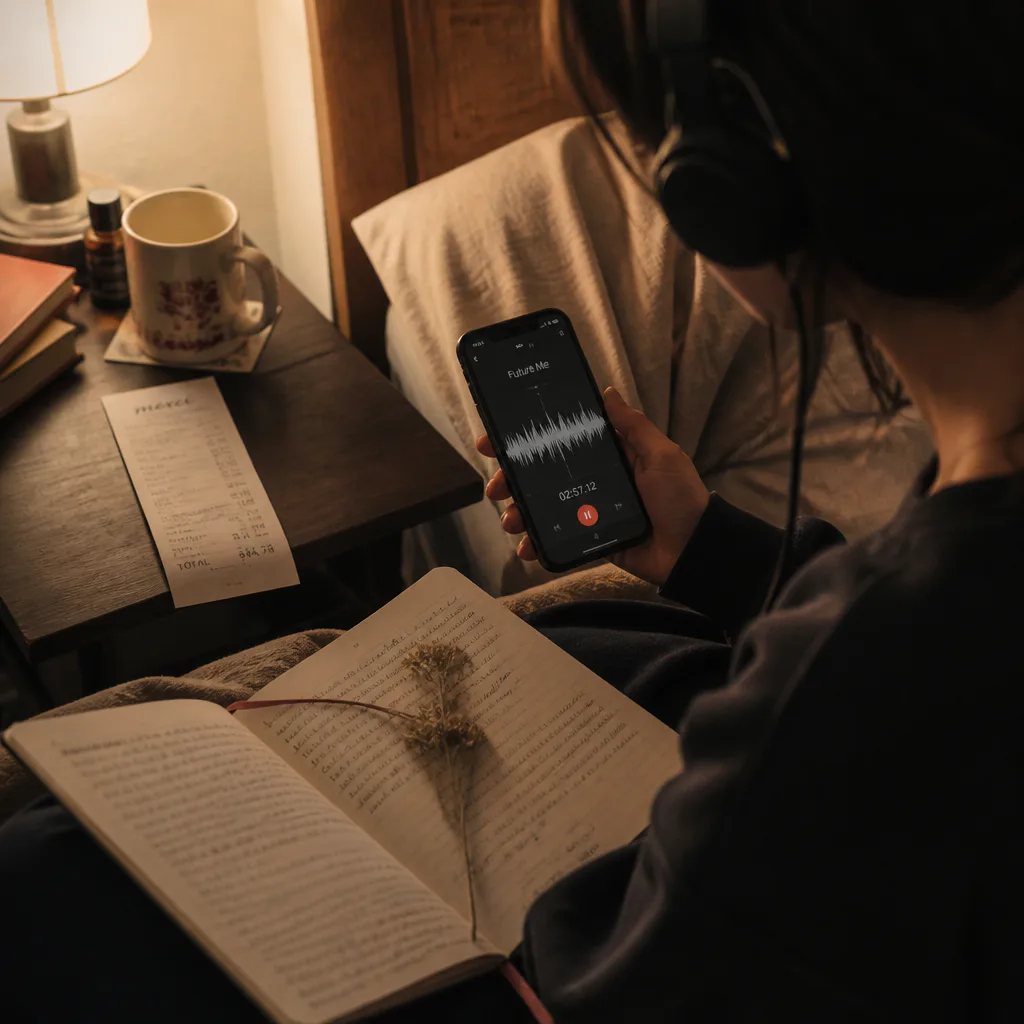
The receipt is still on the table. Spending guilt is the tight, ashamed feeling that can follow a purchase, even when you needed it. A 5-minute future-self audio helps by slowing the alarm, sorting feeling from fact, and giving your brain a repeated cue of money safety.
What is spending guilt really telling you?
Spending guilt is usually telling you that your body has confused a purchase with danger, or that your plan needs one honest adjustment.
Sometimes the guilt is practical. You spent money that was meant for rent. You ignored a bill. You bought something to soothe a hard hour, and now the number doesn’t fit. The Federal Reserve’s 2023 Survey of Household Economics and Decisionmaking found that 37% of U.S. adults would have difficulty covering a $400 emergency expense. If your margin is thin, guilt may be asking for protection, not punishment.
Sometimes the guilt is older than the purchase. You may have learned that wanting anything was selfish. Or that rest had to be earned. Or that money disappears the moment you touch it. The American Psychological Association reported in 2023 that money remains one of the most common stressors for adults in the U.S., with inflation and basic costs named again and again. So if your body reacts quickly, you’re not strange. You’re patterned.
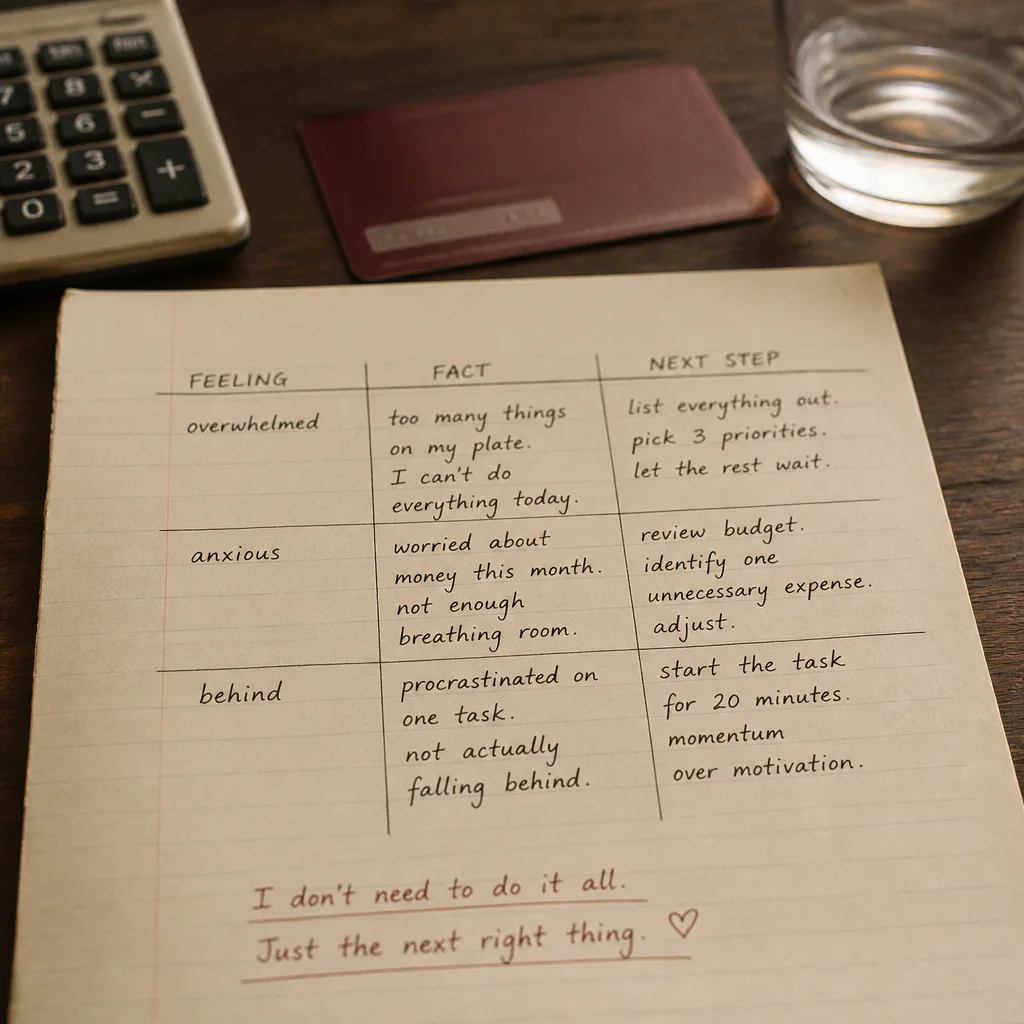
The first quiet move is separation. The feeling is one line. The facts are another line. You can write: “I spent $38 on groceries because I needed food.” Then: “My chest feels tight.” Both can be true. Neither needs to become a verdict.
Guilt is not always guidance. Sometimes it’s an old alarm wearing the clothes of wisdom.
If you’re building a broader practice around money, place this beside the Manifestation pillar, not above it. Manifestation begins with what you repeatedly rehearse as true. Money safety begins the same way: one repeated cue, one calmer return, one purchase seen clearly.
Why use future-self audio for money safety?
Future-self audio works because repeated spoken cues can make a calmer identity feel more available when shame rises.
Your brain is not a blank page. It predicts. It uses memory, body state, and repeated language to decide what a moment means. Cognitive neuroscience often calls this predictive processing: the brain is constantly using past data to interpret the present. A 2018 review in Nature Reviews Neuroscience described perception as strongly shaped by prior expectations. Money guilt is no different. If your prior expectation is “spending means danger,” a receipt can feel like proof.
This is where audio matters. Reading a sentence can help. Hearing a voice can land differently. Studies on self-affirmation, including work discussed in Social Cognitive and Affective Neuroscience in 2016, suggest that values-based self-statements can engage brain regions linked with self-related processing and future orientation. The claim doesn’t need to be grand. It needs to be believable enough to repeat.
The AYA Method is a daily audio manifestation practice. Each day you listen to a short personalized recording — your Dream-Self Moment — narrated from the version of you who has already manifested the life you intend. Listening is the practice. Repetition is the work. The audio is the method.
For spending guilt, the Dream-Self Moment is not about pretending the bank account is different. It’s about hearing yourself relate to money with less fear. The app also includes a daily affirmation and a Manifestation Board, but they are complements. The audio leads.
Use this simple distinction:
| Practice | What it does | When to use it |
|---|---|---|
| Future-self audio | Rehearses a safer money identity | When guilt spikes after spending |
| Budget check | Shows the numbers plainly | Before bills, returns, or planning |
| Daily affirmation | Gives one sentence to carry | When you need a small cue |
| Manifestation Board | Makes the intention visible | When you want to remember what you’re building |
A safer sentence can become a familiar room. You enter it by listening again.
How do you prepare before the 5-minute practice?
You prepare by giving your nervous system facts before you ask it to believe a new story.
Set a timer for 60 seconds first. Not five minutes yet. Just one minute to write the purchase plainly. The amount. The category. The reason. The payment method. This matters because vague guilt grows quickly. A 2022 CFPB report on financial well-being noted that people with clearer financial control tend to report less money-related distress. Control starts small. A number on paper is smaller than a storm in the head.
Use this quick check before recording:
- What did I buy? Name the item or service.
- How much was it? Write the exact amount.
- Was it needed, supportive, optional, or impulsive? Choose one word.
- Does it affect a bill in the next 14 days? Yes or no.
- What action is available now? Keep, return, adjust, pause, or plan.
Then notice your body. Jaw. throat. hands. belly. A study in Proceedings of the National Academy of Sciences in 2014 mapped how different emotions are often felt in distinct body areas, across more than 700 participants. Shame and anxiety are not just thoughts. They have places they live for a while.
You don’t need a perfect calm before audio. You need enough steadiness to speak. If your breathing is sharp, lengthen the exhale for 3 rounds. Dr. Andrew Huberman has often discussed the “physiological sigh,” a double inhale followed by a long exhale, as a fast way to reduce arousal. You can use a gentler version: inhale, sip a little more air, exhale slowly.
Keep the setup spare:
- Sit somewhere you won’t be interrupted for 5 minutes.
- Put the receipt, phone, or bill where you can see it.
- Open a voice memo or your audio practice.
- Speak softly, as if you’re not trying to convince anyone.
Money safety is not the absence of numbers. It’s the ability to look at the numbers and stay with yourself.
What should your future-self audio say?
Your future-self audio should speak in present-tense, specific language from the you who spends with care and comes back to facts.
Do not make the script too shiny. If your nervous system doesn’t believe “I never feel guilty about money,” it may reject the whole thing. Research on self-talk in sport and behavior change often distinguishes instructional self-talk from motivational self-talk; both can help, but specificity tends to matter. In small performance studies, short self-statements tied to a concrete action often do better than broad praise.
Use this 5-minute structure:
- Minute 1: Name safety. “I am here. I can look at this purchase. I don’t need to disappear.”
- Minute 2: Name the facts. “I spent $__. I bought it because __. The next bill is __.”
- Minute 3: Name the new identity. “I am someone who spends with care, checks the facts, and repairs when needed.”
- Minute 4: Name one kind choice. “If I need to return it, I can. If I keep it, I can let it serve me.”
- Minute 5: Name return. “I don’t have to earn peace by being perfect. I return to myself now.”
Here is a sample script you can adapt:
I can feel the guilt, and I don’t have to obey it. I spent money, and I am still safe enough to look clearly. This purchase is not my whole life. It is one choice. I can keep what supports me. I can return what doesn’t. I am becoming someone who checks the numbers without leaving herself. I am allowed to learn in real time.
Neville Goddard wrote often about assuming the feeling of the wish fulfilled. In a money context, that doesn’t mean denial. It means rehearsing the inner posture of the person who handles money with steadiness. Joe Dispenza uses different language, often linking rehearsal with future self and nervous system change. You don’t need to accept every claim from either teacher to use the practical overlap: repetition teaches familiarity.
If you already use Affirmations pillar practices, keep the sentence modest. “I can spend with care” is often more useful than a sentence your body fights. A true sentence is stronger than a dramatic one.
How do you listen after recording it?
You listen by letting the audio be the practice, while your body learns that the receipt can be present without shame taking over.
Press play once. Don’t fix the audio. Don’t rerecord because you stumbled. The stumble may make it more believable. Voice carries human evidence. A 2021 review in Frontiers in Psychology discussed how voice and prosody shape emotion perception, including feelings of safety, threat, and social closeness. Your own calm voice can become a cue. Not magic. Repetition.
During the 5 minutes, do three things only:
- Keep both feet on the floor.
- Let your eyes rest on one simple object.
- When guilt speaks, say silently, “heard.”
That last word matters. You’re not arguing. You’re not suppressing. You’re acknowledging the alarm without making it the leader. In Acceptance and Commitment Therapy, a well-studied behavioral approach, defusion practices help people notice thoughts as thoughts rather than commands. A 2015 meta-analysis in Behavior Research and Therapy found ACT had evidence across anxiety, depression, and other concerns, though results vary by condition and study quality.
If tears come, let them come. If nothing happens, that’s also fine. Nervous system learning can be quiet. Habit researchers such as Phillippa Lally have found that automaticity can take much longer than the often repeated 21 days; a 2009 study in the European Journal of Social Psychology found a range from 18 to 254 days, with an average of 66 days. One listen is not the whole practice.
After the audio, choose one action. Only one. Return the item. Move $20. Update the budget. Close the banking app. Drink water. If the purchase was harmful, repair. If the purchase was fine, receive it.
The goal is not to feel worthy of spending. The goal is to stop making shame the price of being alive.
When is spending guilt a signal, not a story?
Spending guilt is a signal when it points to a real mismatch between your purchase, your values, and your current numbers.
Use the body, then use the math. Both matter. If you feel guilty after buying lunch because you skipped breakfast and had a full workday, that may be an old story. If you feel guilty after spending bill money on something you don’t need, that may be a signal. The difference is not moral. It’s practical.
A simple decision table can help:
| What you notice | Likely meaning | Next step |
|---|---|---|
| Guilt after a planned need | Old alarm | Listen, keep, release shame |
| Guilt after hiding a purchase | Avoidance | Tell the truth somewhere safe |
| Guilt plus missed bill | Practical signal | Make a repair plan today |
| Guilt after rest or pleasure | Worthiness story | Practice receiving without apology |
| Guilt after repeated impulse buys | Coping pattern | Add friction before spending |
Behavioral economics has shown for decades that humans feel losses sharply. Kahneman and Tversky’s work on prospect theory, first published in 1979, described loss aversion: losing can feel heavier than gaining the same amount feels good. Spending can register as loss even when you receive something useful. Your body may mark the money leaving more loudly than the support arriving.
If you want to work with timing, you can pair this practice with lunar or seasonal reflection from Astrology and manifestation, but keep the receipt in the room. Symbol can support practice. It should not replace the numbers.
Here is the quiet repair plan:
- Name the mismatch.
- Choose the smallest repair within 24 hours.
- Remove one trigger for the next purchase.
- Listen to the audio again before bed.
You don’t become safe by never spending. You become safer by telling the truth sooner.
How do you make this a daily money practice?
You make it daily by keeping the audio short, repeating it at the same cue, and letting the app’s visual tools support rather than lead.
Choose one anchor. After you check your bank balance. After you buy groceries. Before you open a shopping app. Before sleep. BJ Fogg’s behavior model, described in his 2019 work on tiny habits, emphasizes that small behaviors are more likely to stick when attached to an existing prompt. Five minutes is small enough to repeat. That is the point.
For 7 days, don’t change the whole script. Repetition gives the brain a stable cue. If you use the AYA Method, your Dream-Self Moment can hold this identity: the you who spends with care, checks facts, and returns to safety. The daily affirmation can be one line from the audio. The Manifestation Board can hold one image of enoughness that feels real: a paid bill, a warm meal, a clean desk, a calendar with space.
You may also want to read the wider Manifestation pillar if you’re asking how repeated inner rehearsal relates to outer choices. If affirming feels hard, return to the Affirmations pillar and choose sentences your body doesn’t fight.
Track only three things for one week:
- What purchase triggered guilt?
- What did the facts say?
- What did I do after listening?
A 2020 Pew Research Center report found that many adults say money worries affect household decisions and emotional strain, especially during unstable periods. Your practice lives inside that reality. It should not shame you for being affected by real costs.
After 7 days, revise the audio by 10%. Not more. Keep what worked. Change the lines that felt false. Let the practice become familiar, not perfect.
The receipt can stay on the table, and you can stay with yourself.