subliminals
How to Listen to Subliminals: Start With Audible Audio
How to listen to subliminals safely: begin with audible Dream-Self audio, set a low volume, repeat daily, and treat hidden tracks as optional.

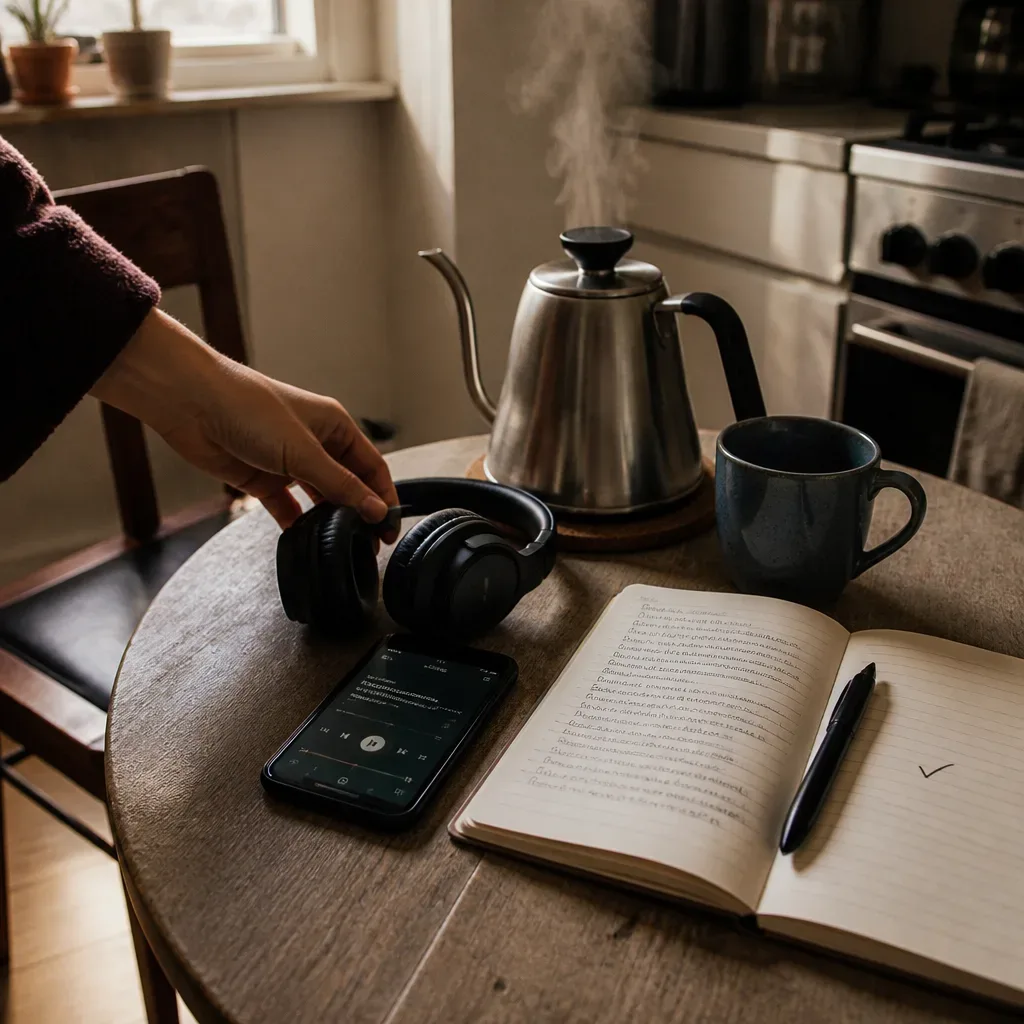
September 6. The kettle clicked off while I put my headphones on. To learn how to listen to subliminals, I would begin with audible Dream-Self audio, listen once daily at a safe volume, then use subliminals only as background. The clear message comes first because attention needs something it can hold.
Why do I start with audible Dream-Self audio before subliminals?
I start with audible Dream-Self audio because the mind repeats what it can recognize, rehearse, and place inside an ordinary day.
This morning I listened before brushing my teeth. That is the order I keep. In the AYA Method, the audio is not decoration around the practice. The AYA Method is a daily audio manifestation practice. Each day you listen to a short personalized recording: your Dream-Self Moment, narrated from the version of you who has already manifested the life you intend. Listening is the practice. Repetition is the work. The audio is the method.
I like that sentence because it removes theatre from the table. If I can hear the words, I can notice whether they are honest. If the recording says I answer the email calmly, I can test that at 10:14 a.m. when the email arrives. A subliminal track may be soothing, but it gives me fewer handles.
The old self-help subliminal studies are sobering. Greenwald, Spangenberg, and Pratkanis published a well-known 1991 paper in the Journal of Applied Psychology showing that expectation and labeling effects were stronger than the specific hidden content on the tapes. That does not make subliminals useless. It does mean I do not build the house on the hidden part.
A message I can hear can become a choice I can repeat.
I keep the audible Dream-Self Moment short, usually under 5 minutes. In habit design, smallness is not a concession. It is the mechanism. BJ Fogg at Stanford has taught for years that tiny actions work because they lower the need for motivation. My habit-tracking app taught me the same thing, less elegantly, across about 14,000 users.
How should I set up the first listen of the day?
I set up the first listen by attaching it to one existing action and removing every decision around it.
The chair matters. The mug matters. The fact that I always put the headphones on after the kettle matters more than the mood I bring to it. Wendy Wood and colleagues have estimated that about 43 percent of daily behavior is performed in habitual contexts, not under active decision every time. I think about that number whenever someone tells me they need to feel ready.
Here is the setup I used today, written before I forget:
- I put the audio on my phone home screen.
- I listened after the kettle, before messages.
- I kept the volume low enough that my shoulders stayed down.
- I did not check whether I believed every word.
- I marked one behavior in the evening.
The order is important. I do not open social apps first. Pew Research Center reported in 2024 that large majorities of adults in many countries use phones constantly or near constantly, and I can feel that in my own hand. If the first input is the inbox, the day begins as a reaction.
A hidden audio track cannot rescue a day that has no place for listening. The place is the practice. I also keep one line from my daily affirmation on the page sometimes, but I treat it as a note in the margin, not as the pillar. If affirmations are your entry point, I would still read the basics in the Affirmations pillar and then give the spoken audio a steady home.
What volume, device, and timing are safest for subliminals?
I use the lowest comfortable volume, avoid pressure in headphones, and keep the session short enough that my nervous system does not start arguing with it.
The boring health note belongs near the top. The World Health Organization warned in 2022 that more than 1 billion young people may be at risk of hearing loss from unsafe listening practices. The CDC commonly points to about 70 dBA as a level unlikely to cause hearing damage over long exposure, while louder sound becomes risky faster. I do not measure every session, but I do not blast any audio that claims to work better when forced.
Subliminals tempt people into a strange volume logic. Because the words are hidden, people turn the track up to feel sure something is happening. I did that years ago on a train in Tokyo and got off with a tight jaw. That was not discipline. That was noise with a costume on.
This is the table I keep in my notes:
| Listening choice | What I use it for | My rule |
|---|---|---|
| Audible Dream-Self audio | Daily identity rehearsal | Once daily, clear and calm |
| Subliminal track | Optional background | Low volume, never forced |
| Overnight audio | Rare use | Only if sleep stays clean |
| Headphones | Focused listening | Comfortable, no pressure |
| Speaker | Kitchen or bath | Soft enough to ignore |
If I am tired, I use a speaker. If I am on the bus, I use headphones at the same level I would use for a podcast. Dr. Andrew Huberman often makes the plain point that nervous system state changes learning. I do not need to turn listening into stress to prove I care.
How long should I listen each day?
I listen long enough to repeat the identity clearly, and short enough that I can keep doing it on an ordinary Tuesday.
For me, that means 3 to 7 minutes of audible Dream-Self audio, followed by silence or a very soft subliminal if I still want it. The 2009 European Journal of Social Psychology study by Phillippa Lally and colleagues found that habit automaticity varied widely, from 18 to 254 days, with 66 days often cited as the average. That range made me kinder to myself. It also made me less impressed by seven-day promises.
The hidden track is not the clock. The repetition is the clock. A 2-hour playlist that I resent will lose to a 4-minute listen that I keep. Fourteen thousand habit app users taught me that missed days usually come from friction, not lack of desire. Travel, illness, late work, and family interruptions break streaks more reliably than doubt does.
The practice that survives a bad day is the practice that counts.
If you are comparing this to broader Manifestation pillar work, I would separate the wish from the training. Naming what you want is one act. Rehearsing who you become around it is another. Subliminals blur that distinction because they feel passive. Audible Dream-Self audio keeps the identity in the room.
My minimum is one clean listen. On days when I want more, I do not add volume or drama. I add one small proof. I send the invoice. I drink the water. I walk for 12 minutes. Specific numbers keep me honest.
What should I listen for during the audible recording?
I listen for the sentence that changes my next small action, not the sentence that gives me the strongest feeling.
This part took me a while. I used to rate a recording by whether it moved me. Now I rate it by whether it gives me a next behavior by noon. If the Dream-Self Moment says I am a person who handles money plainly, the proof might be opening the banking app for 90 seconds. If it says I speak cleanly, the proof might be one direct sentence in a meeting.
Cognitive psychology has a name for part of this: implementation intentions. Peter Gollwitzer has studied if-then planning for decades, and meta-analyses have found reliable small-to-medium effects across many behavior domains. I hear that when I listen. If the audio gives me an identity, I give that identity a place: if the kettle clicks, then I listen; if I avoid the task, then I do 2 minutes.
The sentence I choose often sounds unimpressive. That is how I know it may work. A good line fits inside a normal day. It does not require a new personality by breakfast.
I wrote three examples on the page this week:
- I answer before I spiral.
- I put the first draft down before I judge it.
- I let the small proof be enough for today.
If you use astrology as a timing language, keep it in its proper size. I sometimes read the Astrology and manifestation notes for season and reflection, but I do not let a transit replace the listen. The calendar can mark the weather. It cannot do the reps.
Where do subliminals fit after the audible practice?
Subliminals fit after the audible practice as low-friction background, not as the main engine of change.
I am not against them. I am against asking them to do work that belongs to attention, environment, and repeated behavior. In small laboratory studies, subliminal priming effects can appear under controlled conditions, but the effects are often brief and context-dependent. That is a very different claim from a playlist rewriting a life while I sleep through my alarms.
The useful place for a subliminal is narrow. It can make the room feel consistent with the identity I named. It can soften the transition into work. It can stop me from reaching for a louder input. But I still need the audible sentence first, because that is the part I can carry into the kitchen, onto the bus, and into the email I do not want to answer.
Hidden audio should support the promise you have already made out loud.
I also keep one visual cue nearby. Sometimes it is a line on my Manifestation Board, sometimes a note in the margin of my planner. It is not a second pillar. It is evidence placed where tomorrow-me will trip over it. If you are sorting all of this under subliminals, I would still keep the main map close: the AYA Method for the daily audio practice, the Manifestation pillar for the broader frame, and the audible recording for the actual morning.
A simple weekly structure is enough:
- Choose one Dream-Self Moment for the week.
- Listen once each morning.
- Add a soft subliminal only after the audible listen.
- Track one behavior, not ten feelings.
- Review on day 7 without punishing the misses.
How do I know if the practice is working?
I know it is working when my behavior changes in small visible ways before my self-image has fully caught up.
I do not ask whether I feel different every day. Feelings move around too much. I ask whether I did the thing a slightly steadier version of me would do. James Clear popularized identity-based habits, but the older behavioral point is simple: repeated actions teach the self what is normal. One proof is better than 20 minutes of checking for proof.
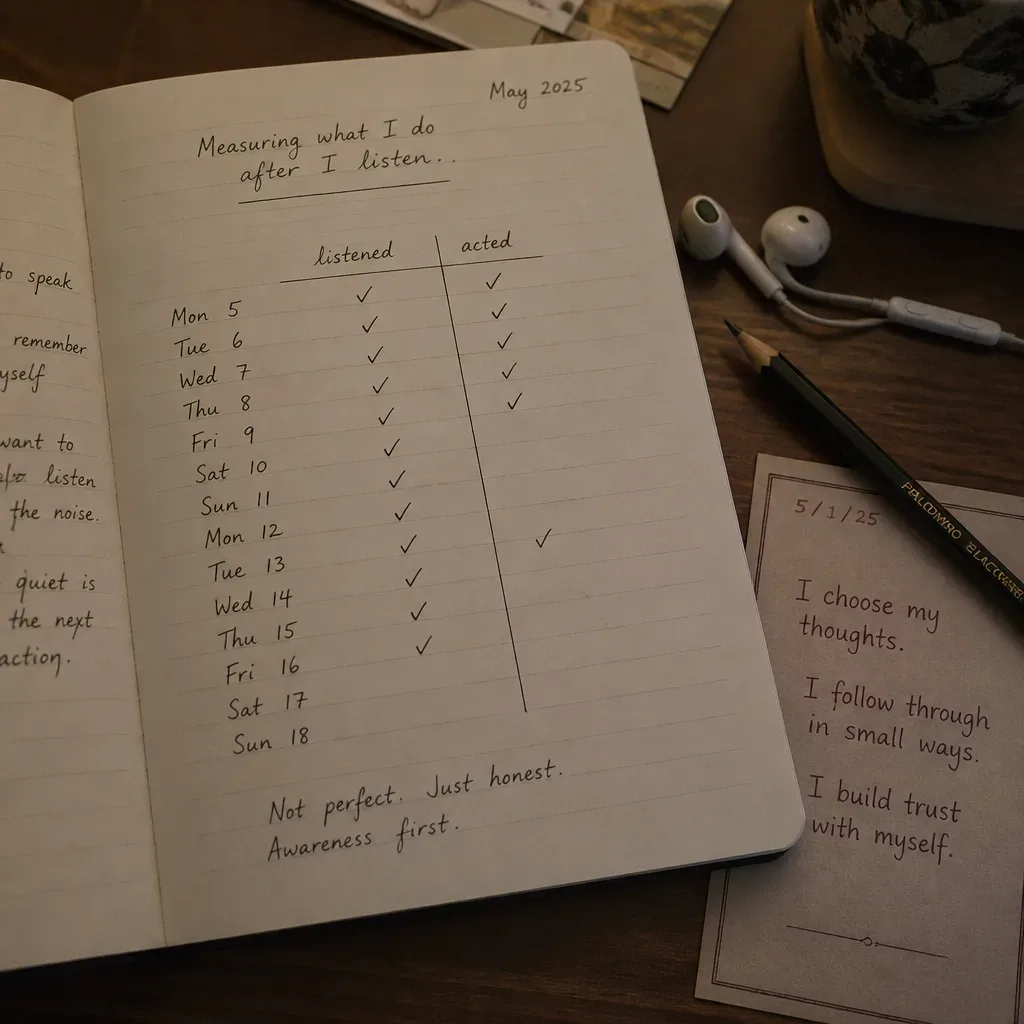
For 30 days, I track only two marks: listened, acted. The first mark says I kept the practice. The second says the practice touched the day. In the Journal of Behavioral Medicine and related health psychology literature, self-monitoring is repeatedly associated with better behavior change outcomes, especially when the target is clear and near. I try not to make a mystical mess out of a useful measurement.
My review questions are plain:
- Did I listen at least 20 of the last 30 days?
- Did one sentence become familiar without forcing it?
- Did I take one action I used to avoid?
- Did the subliminal stay supportive rather than compulsory?
- Did my sleep, hearing, or attention get worse?
If the answer to the last question is yes, I change the method immediately. No result is worth bad sleep or ringing ears. If the answer to the first three is yes, I keep going for another 30 days. The practice does not need to feel dramatic to be real.
I closed the app at 8:41 tonight and wrote one mark beside the date. Listened. Sent the email. That was enough data for the day.
The cup is in the sink now.