subliminals
Subliminals vs Affirmations: Future-Self Audio
Subliminals vs affirmations compared plainly: what each practice does, where evidence is thin, and why audible future-self audio may be easier to keep.
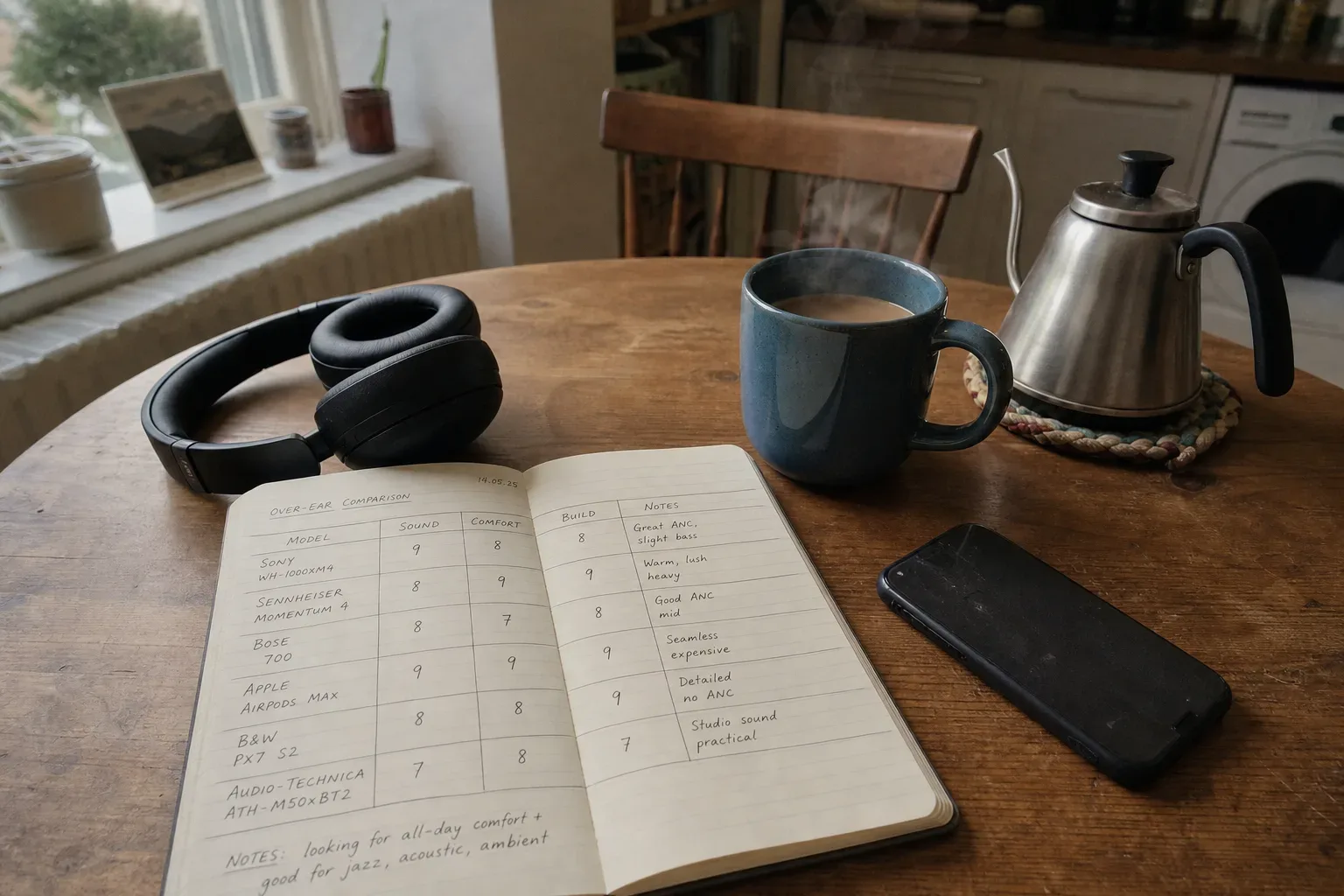
Tuesday. The kettle clicked off before I found my socks. Subliminals vs affirmations comes down to attention: subliminals hide the words, affirmations speak them plainly, and audible future-self audio does something steadier. It lets me hear the person I am practicing becoming, one short recording at a time.
What am I really comparing when I compare subliminals vs affirmations?
I am comparing hidden suggestion, spoken self-talk, and audible identity rehearsal.
The cleanest way I can say it is this: subliminals ask my conscious mind to step aside, affirmations ask it to repeat a sentence, and future-self audio asks it to listen. That distinction matters because attention is not a small detail. In 1957, James Vicary claimed hidden movie-theater messages increased popcorn and Coca-Cola sales, then later admitted the famous experiment was not reliable. The myth stayed. I still see it dressed in headphones and rain sounds.
Affirmations have a different history. They are not usually hidden. They are spoken, written, or read. Claude Steele’s self-affirmation theory dates to 1988, and later research studied how affirming core values can reduce defensiveness under threat. That is not the same as saying a sentence can bend reality on command. It is smaller and more useful than that. A sentence can give the mind a less punishing place to stand.
Future-self audio sits between those two. It does not hide the message, but it also does not make me bark a phrase at the mirror. When I use the AYA Method, the practice is audio first: The AYA Method is a daily audio manifestation practice. Each day you listen to a short personalized recording, your Dream-Self Moment, narrated from the version of you who has already manifested the life you intend. Listening is the practice. Repetition is the work. The audio is the method.
I keep coming back to one sentence in my notebook: what changes a day is not the tool that sounds most mystical, but the tool I can repeat without making a performance of it.
Do subliminals work better because they bypass resistance?
Subliminals may influence simple perception in controlled settings, but self-help claims are much larger than the evidence.
I understand the appeal. If I am tired, ashamed, or bored by my own patterns, a hidden message sounds merciful. No effort. No confrontation. Just sleep, rain audio, maybe a title promising confidence in 21 days. I have tested enough wellness apps to know the seduction of low-friction change. The problem is that low friction can also mean low contact. If I cannot hear the words, I cannot check whether I consent to them.
The study I return to is Greenwald, Spangenberg, Pratkanis, and Eskenazi, published in 1991 in Psychological Science. They tested 237 participants using commercial subliminal self-help tapes for memory and self-esteem. The tapes did not produce specific improvements in the promised areas, though people sometimes believed they had improved when they thought they were using the matching tape. That is a useful finding, and a humbling one. Expectation is powerful. It is not the same as proof.
There are lab studies showing unconscious priming can affect choices for seconds or minutes under precise conditions. But a 2-millisecond masked word in a laboratory is not the same thing as an 8-hour audio called Rich Mindset playing under ocean sounds. I am not dismissing all subliminal research. I am refusing to treat the strongest claim as the default claim.
I wrote this in the margin last winter: if the message has to be hidden from me to work, I want to know who benefits from my not hearing it.
Why do affirmations help some days and irritate me on others?
Affirmations help when they are believable, specific, and tied to action, but they can backfire when they deny the body’s present truth.
There is research here, though it is often less glamorous than social media makes it. A 2013 PLOS ONE study by Creswell and colleagues found that self-affirmation improved problem-solving under stress in a sample of 73 undergraduates. The mechanism was not magic. Participants reflected on personal values, which appeared to buffer stress. Values are sturdier than slogans. They give the sentence roots.
I have had days when an affirmation helped. Before sending a hard email, I have written, “I can be clear without being cruel.” That sentence changed my hands on the keyboard. But I have also tried lines like “Money comes easily to me” on a morning when two invoices were late and my rent was already counting the days. My body rejected it. Not morally. Physically. My chest tightened as if I had asked it to sign a false statement.
That is why I keep the affirmations pillar bookmarked, not as a rulebook, but as a reminder to make the sentence close enough to live with. A daily affirmation can be a complement. It is not the whole practice. The body does not need a prettier lie. It needs a sentence with a door in it.
Here is the comparison I keep taped inside a notebook, because I forget when I am tired:
| Practice | What I hear | Main risk | Best use |
|---|---|---|---|
| Subliminals | Usually nothing clear | Outsourcing attention | Background experiment, tracked lightly |
| Affirmations | One direct sentence | Feeling fake or forced | Naming a value before action |
| Future-self audio | A clear narrated scene | Overwriting it with fantasy | Daily identity rehearsal through listening |
A good affirmation does not argue with the present. It gives the present a next sentence.
What makes audible future-self audio different from both?
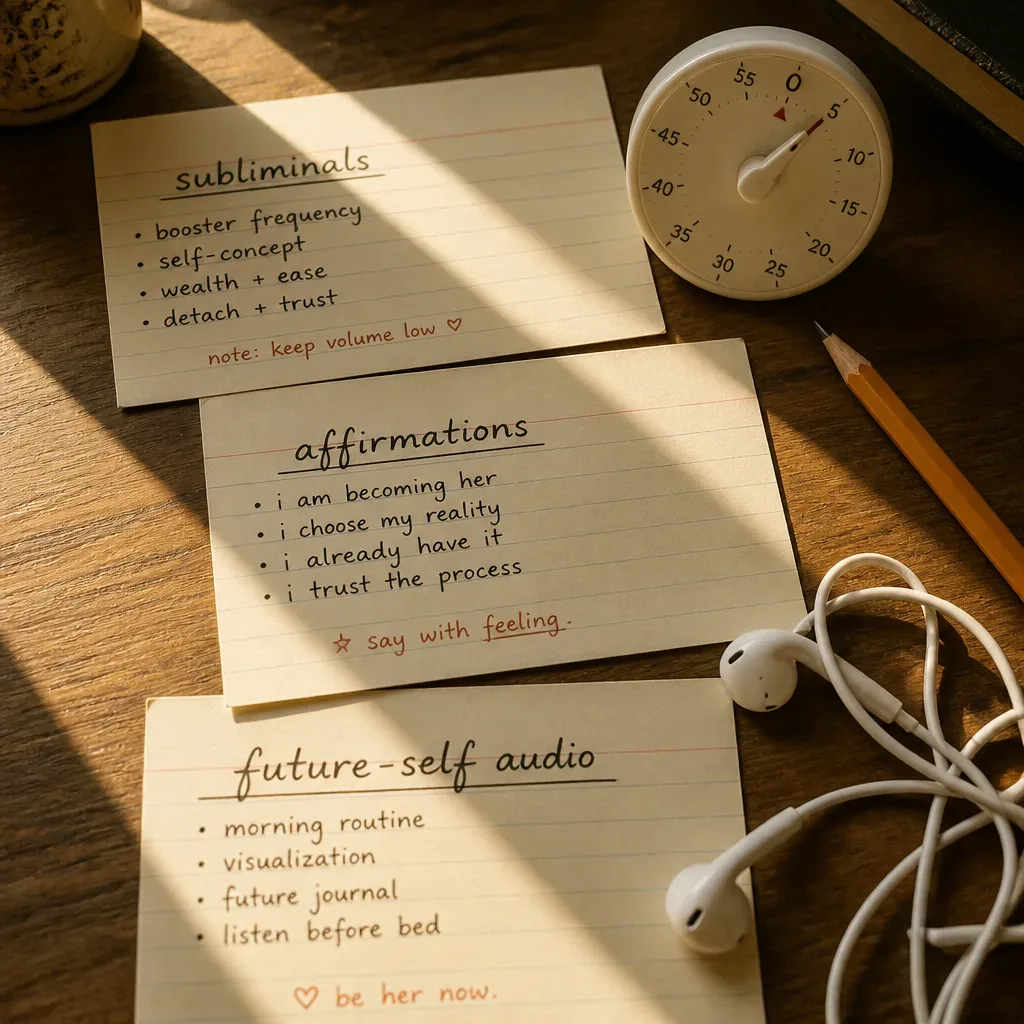
Audible future-self audio gives the mind a clear, repeated identity cue without hiding the words or reducing the practice to one sentence.
This is the part I did not expect to respect. I am suspicious of ornate systems. Years of testing apps gave me a reflex: strip the interface away and ask what behavior remains. With the manifestation pillar, I care less about decorative belief and more about repeated attention. With future-self audio, the remaining behavior is simple. I listen for a few minutes. I hear a version of myself speaking from a finished place. Then I go wash a cup or answer a message.
The difference is length and context. A single affirmation might say, “I am calm in conflict.” A future-self recording can place me in the chair after the conflict, breathing normally, having told the truth without performing. That scene gives my nervous system more information. Neuroscientist Dr. Andrew Huberman often speaks about visualization needing detail and repetition, though he also cautions that action matters. I take the same modest view here. The audio does not do my living for me. It rehearses the person who will.
A 2019 review in Social and Personality Psychology Compass noted that mental imagery can affect emotion more strongly than verbal processing in some contexts. I notice that difference in my own mornings. Plain words help me think. A heard scene helps me remember. The voice has a way of entering the day before the day hardens.
There is no prize for choosing the most invisible practice. There is only the quiet evidence of what I keep doing after novelty leaves.
How should I choose between subliminals, affirmations, and future-self audio?
I choose by asking which practice I can repeat honestly for 14 days and which one changes my next action.
I like a short test because the mind can make anything romantic on day 1. By day 10, the truth starts showing. The Centers for Disease Control and Prevention reported that meditation use among U.S. adults rose from 4.1% in 2012 to 14.2% in 2017, which tells me something plain: more people are willing to use quiet daily practices, but use is not the same as kept practice. The keeping is the hard part.
This is the small protocol I used on myself in São Paulo, written at the kitchen table with construction noise outside:
- Pick one practice only for 14 days.
- Use it at the same time each day, preferably before the phone starts deciding the morning.
- Track one behavior, not a mood. For me it was “sent the first hard message before noon.”
- Write one line after each session: kept, skipped, or resisted.
- At day 14, ask whether the practice made the next right action easier.
That last question removed a lot of drama. A subliminal track can feel soothing, and soothing matters. An affirmation can create a clean interruption. Audible future-self audio, for me, did the best job of making the next action feel like it belonged to the person I had just heard.
I still use small complements. Some days I write one affirmation on the page. Some days I look at my Manifestation Board for 30 seconds after listening. But I do not confuse the complements with the method. The audio is the practice I keep.
Where do astrology, timing, and ritual fit without making the practice heavy?
Astrology and ritual can give a practice a date and texture, but they should not become another way to postpone the work.
I say this as someone who likes dates. I like a Monday. I like the first morning after rain. I like the page header that says September 29, 2026, because the date makes the promise less foggy. Some readers use astrology and manifestation as a timing language. New moons, returns, transits. I do not mind that. Ritual can help memory. Research on implementation intentions by Peter Gollwitzer, widely cited since 1999, shows that “if-then” plans can improve follow-through because they attach action to cues.
But I get careful when timing becomes avoidance. If I need Venus to be kinder before I send the application, I may be hiding from the application. If I need the perfect moon before I listen to a 5-minute audio, I have made the doorway too narrow. A practice should make life more possible, not more conditional.
For me, the ritual is almost embarrassingly plain:
- Coffee first, if the beans are already ground.
- Headphones on before I open messages.
- Dream-Self Moment once, no multitasking.
- One line in the notebook if there is time.
- Then the first real task, before I start rearranging the desk.
A ritual that cannot survive an ordinary Tuesday is probably decoration. The quiet ones survive because they are small enough to repeat.

What did I keep after testing all three?
I kept audible future-self audio as the main practice, affirmations as occasional support, and subliminals as optional background rather than a foundation.
That answer is not dramatic, which is why I trust it. Subliminals gave me rest sometimes, and rest is not nothing. But I could not tell whether the message, the music, or my expectation was doing the work. Affirmations helped when I wrote them carefully, especially before a specific action. They failed when I used them to cover fear with a slogan. Future-self audio was different because I could hear the whole proposition. I could accept it, resist it, edit my response to it, and return the next morning.
In behavior-change research, repetition and cue consistency matter. Wendy Wood’s work on habit, including her 2019 book Good Habits, Bad Habits, keeps pointing back to context and repetition more than heroic willpower. That matches my kitchen data. The days I listened in the same chair went better than the days I negotiated with myself from bed.
If I were advising myself six months ago, I would write this in plain ink: choose the practice that leaves you more honest, not more enchanted. For me, that means clear audio, heard daily, with enough future in it to guide me and enough present truth to keep me from floating away.
I still compare tools. I still test claims. But the kept list is short now. The AYA Method stayed because the behavior stayed: a few minutes of personalized listening, repeated until the day began to answer differently.
Wednesday now. The blue mug is clean.