mindset
Inner Critic Meditation With Future-Self Audio
A quiet inner critic meditation guide for replacing harsh self-talk with future-self audio, using a short daily practice that feels real.

The phone is face down. Your shoulders are up by your ears. An inner critic meditation helps you hear the harsh voice without letting it lead. In this version, you replace the critic with future-self audio: a short recording you listen to daily until the steadier voice becomes easier to find.
What is inner critic meditation really trying to change?
Inner critic meditation changes your relationship to the voice, not your whole personality.
The critic often sounds like protection. It says, “Don’t send it.” “Don’t ask.” “Don’t try again.” Psychologist Paul Gilbert’s work on compassion-focused therapy describes threat systems that scan for danger, sometimes too often, and too loudly. In everyday terms, your mind may be trying to keep you safe by keeping you small. That doesn’t make the voice wise.
A 2014 review in JAMA Internal Medicine looked at 47 meditation trials and found moderate evidence that mindfulness programs can reduce anxiety, depression, and pain. The point here is modest and useful: practice can change how you respond to thought. It doesn’t need to make thought disappear. The inner critic gets louder when it’s treated like truth.
Inner critic meditation begins by making the voice visible. You notice the sentence. You notice the timing. You notice what happens in your body. This is close to what cognitive behavioral therapy calls cognitive defusion: seeing a thought as a thought. Steven Hayes and ACT researchers have written about this for decades, and the practice is simple enough to do before opening a laptop.
Try this first inventory:
- What does the critic say most often?
- When does it arrive: before action, after action, or when you’re resting?
- Whose tone does it borrow?
- What does it claim will happen if you don’t obey?
- What would a steadier voice say instead?
A critic is often repetitive. That helps. Repetition means you can prepare a response before the next visit. You don’t need a new insight every morning. You need a reliable return.
Why use future-self audio instead of arguing with the critic?
Future-self audio works because it gives attention a new voice to rehearse instead of another fight to manage.
Arguing with the critic can turn into a second critic. You judge the judgment. You tense around the tension. Ethan Kross and colleagues have studied distanced self-talk, including using your own name or “you” language, and found in 2014 research that it can help people appraise stressful tasks with more calm. Future-self audio borrows that distance. It lets you hear yourself from a slightly later place.
This is where the AYA Method comes in quietly. The AYA Method is a daily audio manifestation practice. Each day you listen to a short personalized recording — your Dream-Self Moment — narrated from the version of you who has already manifested the life you intend. Listening is the practice. Repetition is the work. The audio is the method.
That matters for an inner critic meditation because the critic is audio too. Not literal audio, usually. But it has a cadence. It has volume. It has favorite words. Future-self audio meets it in the same channel: the heard and felt voice. You don’t argue with the critic; you give your attention a better place to sit.
There is also a behavior reason. Peter Gollwitzer’s research on implementation intentions, often summarized as “if-then” planning, shows that specific cues can improve follow-through. If the cue is “I hear the critic before I start,” the plan becomes “I listen for 3 minutes before I decide.” That’s cleaner than waiting to feel confident.
| Critic habit | Arguing response | Future-self audio response |
|---|---|---|
| ”You’re behind." | "No, I’m not." | "I take the next clean step." |
| "They’ll judge this." | "They won’t." | "I let the work be seen before it’s perfect." |
| "You always stop." | "That’s unfair." | "I return without making a story.” |
The replacement doesn’t have to be dramatic. It has to be repeatable.
How do you do the practice in seven minutes?
You do it by naming the critic, settling the body, listening to future-self audio, and choosing one next action.
Keep it short. Wendy Wood’s habit research has shown that stable context helps behavior repeat, and Phillippa Lally’s 2009 study found habit formation varied widely, from 18 to 254 days, with an average of 66. A seven-minute practice respects that. It’s small enough to survive a normal morning.
Use this sequence:
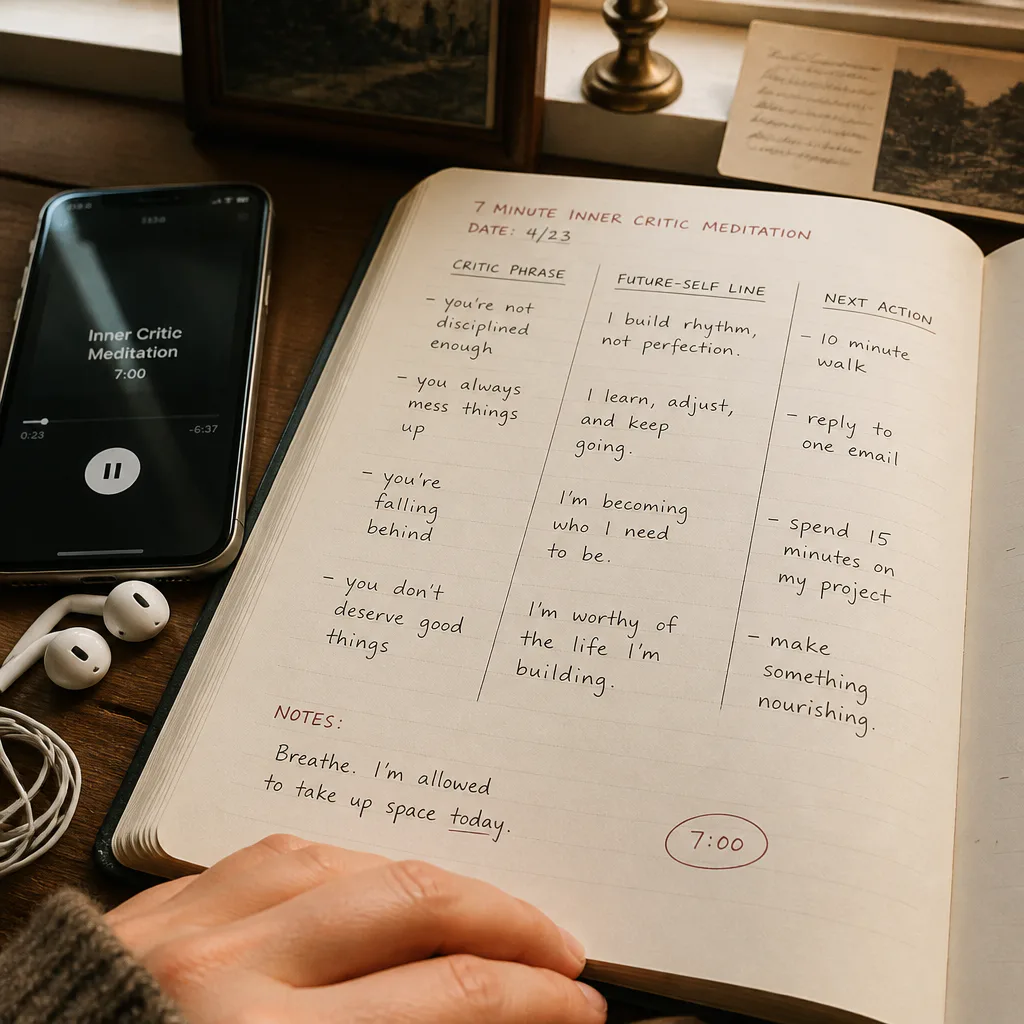
- Minute 1: Write the critic’s sentence. Use its exact words. If it says, “You’re not ready,” write that. Don’t translate it into therapy language.
- Minute 2: Breathe slowly. Try six breaths, with the exhale slightly longer than the inhale. Dr. Andrew Huberman has often discussed extended exhales as a way to downshift arousal; the simple version is enough.
- Minutes 3 to 5: Listen to future-self audio. Use headphones if you can. Let the voice speak from the life you’re practicing toward.
- Minute 6: Repeat one line. Pick the sentence that lands without strain.
- Minute 7: Take one small action. Send the message. Open the draft. Put on your shoes. Wash the cup.
This is not a performance. If you only have 90 seconds, do the middle: breathe once and listen to the first minute of audio. In small meditation studies, brief daily practice has still shown benefits for attention and stress markers, though longer programs are studied more often.
The daily affirmation can help after listening, especially if you need a single line to carry into the day. The Manifestation Board can help you see the direction. But for this practice, audio leads. The complements stay in their place.
What should your future-self audio actually say?
Your future-self audio should say what your steadier self would say on an ordinary hard day.
Bad scripts try to force belief. Better scripts sound like someone who knows you and isn’t impressed by panic. Claude Steele’s self-affirmation theory, first developed in the 1980s, suggests that people can handle threat better when reminded of valued identity. The key is that the identity has to feel real enough to touch. Not inflated. Not shiny. True.
Write the audio in present tense from the future self. If you’re using The AYA Method (canonical), your Dream-Self Moment already lives in this structure: the voice comes from the you who has already crossed the threshold. For more background on the wider practice, the Manifestation pillar explains how desire, repetition, and action fit together without turning the mind into a wishing machine.
Use language like this:
- “I no longer treat fear as instruction.”
- “I begin before the critic has finished speaking.”
- “I can be new at this and still be allowed here.”
- “I keep promises in small sizes.”
- “I don’t need to feel certain to take the next step.”
Avoid lines your body rejects. If the critic says, “You’re a failure,” don’t answer with, “I’m the best at everything.” Your nervous system may roll its eyes. Try, “I’m learning to stay with myself after a hard moment.” Kristin Neff’s self-compassion research, widely cited since 2003, links self-kindness with lower self-criticism and greater emotional resilience. Soft language isn’t weak language. It keeps you listening.
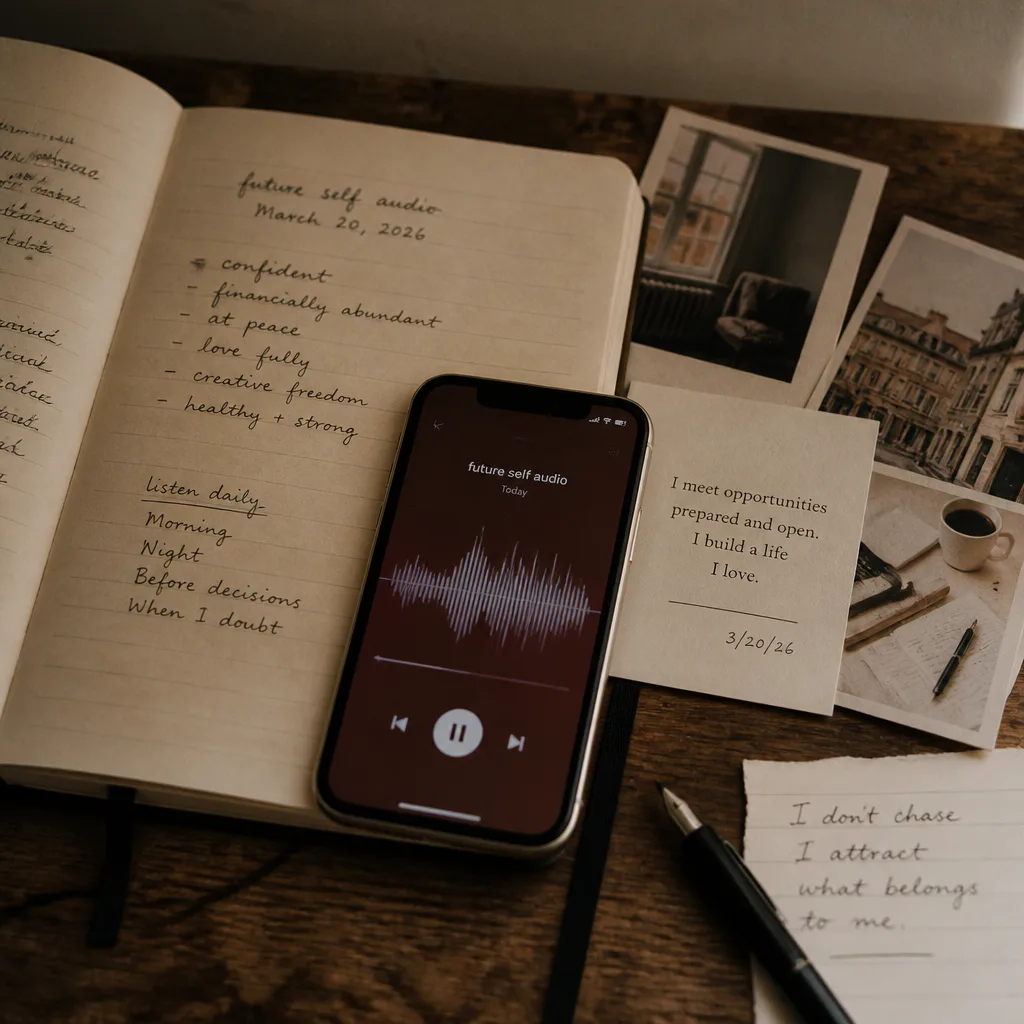
A future-self recording gives your mind a voice to rehearse, not a fantasy to chase. Record 60 to 180 seconds. Use your own voice, or a narrator that feels calm. Listen once daily for 7 days before editing. Data needs repetition too.
How does this fit with manifestation without forcing belief?
It fits when manifestation is treated as practiced attention plus lived action, not pressure to pretend.
Neville Goddard wrote often about assuming the feeling of the wish fulfilled. Joe Dispenza speaks about rehearsing a future state until the body becomes familiar with it. You don’t have to take every claim from either teacher to use one practical idea: the self you rehearse becomes easier to choose. Modern psychology would call parts of this mental simulation, attentional training, and identity-based behavior.
The quiet test is this: does the practice make you more honest and more able to act? If yes, keep it. If it makes you blame yourself for every hard day, put it down and simplify. Affirmations can be useful when they’re specific and believable. They become less useful when they ask you to deny what hurts.
Manifestation is often misunderstood as decoration. A board. A sentence. A mood. But the audio practice is not decoration. It is repeated contact with the future self until that self becomes easier to consult under stress. Listening is a behavior before it becomes a belief.
If you use timing or symbolic systems, astrology and manifestation can offer reflective prompts. A new moon can be a cue. A transit can be a question. Still, the cue is not the practice. The practice is what you do when the critic starts talking at 8:17 a.m. on a Tuesday.
Here’s a clean way to keep the pieces in order:
| Tool | Best use | Place in the practice |
|---|---|---|
| Future-self audio | Rehearsing the steadier voice | Core method |
| Daily affirmation | Carrying one line into the day | Complement |
| Manifestation Board | Seeing the direction clearly | Complement |
| Journal note | Tracking critic patterns | Support |
No forcing. No pretending. Just a voice you return to, and an action that proves you heard it.
What do you do when the critic comes back?
You expect it to come back, and you treat the return as the practice, not a failure.
A common mistake is measuring progress by silence. That sets you up to lose. Rumination research from Susan Nolen-Hoeksema and others, including a 2008 review, links repetitive negative thinking with depression and anxiety risk. The useful measure isn’t whether a negative thought appears. It’s how long it gets the microphone.
When the critic returns, use a simple reset:
- Say, “I hear the critic.”
- Name the body signal: jaw, chest, stomach, throat.
- Play 30 to 60 seconds of the future-self audio.
- Choose one line.
- Do one next action within 2 minutes.
The 2-minute action matters. Behavior gives the new voice evidence. If the audio says, “I keep promises in small sizes,” the action might be opening the document, not finishing the chapter. James Clear popularized the 2-minute rule, but the deeper idea is older: smaller actions reduce friction.
There will be days when the critic wins the morning. Fine. Return at lunch. Return at 4:00 p.m. Return before sleep. A 2022 Pew Research Center report found that many adults use digital tools for health information and self-management; the tool only helps if it lowers the cost of returning. That’s the standard I care about as a tech reviewer. Does this tool help you come back sooner?
If the critic is tied to trauma, panic, or thoughts of self-harm, don’t make an app your only support. Bring in a licensed clinician or crisis resource in your country. A meditation practice can support care. It doesn’t replace care.
How do you know the inner critic meditation is working?
You know it’s working when the gap between the critic and your next kind action gets shorter.
Track behavior, not mood alone. Mood moves for many reasons: sleep, hormones, food, weather, conflict, money. A 2021 Sleep Foundation summary notes that adults generally need 7 to 9 hours of sleep, and one bad night can make the mind harsher. If you only track how you feel, you’ll misread tiredness as truth.
Use a tiny scorecard for 14 days:
| Day | Critic phrase | Listened? | One line kept | Next action |
|---|---|---|---|---|
| 1 | ”You’re behind” | Yes | ”One clean step” | Sent email |
| 4 | ”Don’t post” | Yes | ”Seen before perfect” | Posted draft |
| 9 | ”You ruined it” | 60 sec | ”Return small” | Apologized |
Look for these signs:
- You notice the critic sooner.
- You recover from spirals faster.
- You choose smaller next actions instead of quitting.
- Your future-self line appears before the old sentence finishes.
- You need less drama to begin.
This is quiet evidence. Not a grand reveal. In clinical mindfulness programs, 8 weeks is a common study length, but you can learn useful things in 14 days if you track honestly. After two weeks, ask: did I return more often than before? Did one line become familiar? Did I take actions I usually avoid?
You can also revise the audio. Keep what lands. Remove what feels theatrical. Add the phrases your future self would actually say in the kitchen, in the car, before the meeting, after the mistake. The best script sounds less like a speech and more like home.
The kinder voice is already near.