manifestation 101
Law of Detachment: Listen Before Checking Signs
A quiet law of detachment practice: listen to your future-self audio first, then decide whether signs need your attention at all.

Your phone is face down. That is the first practice. The law of detachment means you listen to the state you are choosing before you search the day for proof. Use a short audio practice, wait 10 minutes, then decide whether checking for signs is still needed.
What does the law of detachment actually ask of you?
The law of detachment asks you to stop using immediate evidence as the judge of your intention.
It is often misunderstood as indifference. It is not that. You still care. You still choose. You still send the email, drink the water, make the call, apply, rest, apologize, try again. What changes is the order. You do not hand the first vote to the notification, the number on the clock, or the silence from another person.
In behavior research, this matters. A 2010 meta-analysis by Gollwitzer and Sheeran found that implementation intentions, simple if-then plans, improved goal achievement across 94 independent tests. Detachment needs that kind of structure. Not a mood. A small rule. If I want to check for signs, then I listen first.
Neville Goddard called attention the beginning of creation. Joe Dispenza speaks often about rehearsing an inner state until the body stops living only from the past. You do not have to accept every claim either teacher makes to see the practical point. Repetition trains what feels familiar. Familiar things are easier to return to.
Detachment is not not caring. Detachment is caring without asking panic to lead.
The nervous system learns by sequence. Check first, and you train the urge. Listen first, and you train return. Dr. Andrew Huberman has often pointed to the role of breath, attention, and visual focus in state regulation; even 1 to 3 minutes can change arousal enough to make a different choice. That is the opening.
If you are new to manifestation, keep the definition plain. You are rehearsing the inner posture of the life you intend, then acting from that posture. The result is not controlled by force. The practice is controlled by repetition.
Why listen before you check for signs?
Listening first gives your body a steadier reference point than the outside world can give on command.
Sign-checking looks innocent. A card pulled twice. A repeated number. A song in a cafe. A text that arrives or does not. The mind is built to detect patterns. The problem is not pattern. The problem is making every pattern responsible for your peace. Pew Research Center reported in 2024 that 90 percent of U.S. adults own a smartphone. That means the checking device is usually within reach.
The AYA Method is a daily audio manifestation practice. Each day you listen to a short personalized recording — your Dream-Self Moment — narrated from the version of you who has already manifested the life you intend. Listening is the practice. Repetition is the work. The audio is the method. You can read the full practice here: the AYA Method.
That paragraph is not decoration. It names the order. Audio first. Meaning later. The daily affirmation and Manifestation Board can support the practice, but they are complements. They are not the main thing. The main thing is listening to the future-self state before the day teaches you fear again.
A sign can be sweet. It can be comforting. It can also become a slot machine. Behavioral psychology has studied variable rewards for decades; B. F. Skinner described how unpredictable reinforcement can make behavior harder to stop. Checking signs works the same way when you do it compulsively. Sometimes you feel soothed. Sometimes you spiral. The unpredictability keeps you reaching.
Try this order for 7 days:
- Put the phone face down.
- Listen to your Dream-Self Moment once.
- Name what you wanted to check.
- Wait 10 minutes.
- Choose one action that belongs to the self you just heard.
A sign check can become a ritual of doubt wearing spiritual clothes.

How do you practice detachment in 7 minutes?
You practice detachment by creating one repeatable pause between desire and checking.
Seven minutes is long enough to interrupt the loop. It is short enough that you cannot use time as an excuse. A 2009 study in the European Journal of Social Psychology by Lally and colleagues found that habit formation took 66 days on average, with wide variation from 18 to 254 days. The lesson is not that you must be perfect for 66 days. The lesson is that context plus repetition matters.
Use this small frame:
| Minute | What you do | What it trains |
|---|---|---|
| 0-1 | Put the phone away | Space before reaction |
| 1-4 | Listen to the audio | Future-self familiarity |
| 4-5 | Name the urge | Honest awareness |
| 5-6 | Choose one action | Direction without grasping |
| 6-7 | Delay the check | Detachment in the body |
The one-minute naming step is important. Say it without drama. I want to see if they viewed my story. I want to know if the number appears again. I want proof that this is working. Naming the urge does not make you weak. It makes the pattern visible.
In small mindfulness studies, even brief labeling of emotion has been associated with reduced amygdala response; UCLA researcher Matthew Lieberman has published on affect labeling and emotional regulation. You are not trying to become blank. You are giving the fear a name so it does not become the whole room.
Then choose one grounded action. If your intention is love, the action may be sending a kind message without fishing. If it is work, it may be updating one paragraph of a proposal. If it is health, it may be walking for 12 minutes. The action should be small enough to finish today.
The practice works best when your nervous system gets first vote.
If you want language after the audio, keep it spare. Affirmations can help when they are believable. One line is enough: I can want this and still stay here. More words are not always more trust.
What counts as checking for signs?
Checking for signs is any repeated search for proof that leaves you less steady afterward.
Not every glance is a problem. You can notice a song. You can smile at a number. You can feel the strange timing of a call. The test is what happens next. If the sign makes you softer and then you return to your life, fine. If it makes you scan for the next sign within 5 minutes, you are not being guided. You are being pulled.
Here are common forms:
- Refreshing messages to see whether someone has responded.
- Reading repeated numbers as daily approval or rejection.
- Pulling one more card after the first answer made you uneasy.
- Searching social media for hidden meaning.
- Asking friends to interpret silence for the third time.
- Treating a bad mood as proof that the desire is gone.
The Princeton Engineering Anomalies Research lab and the later Global Consciousness Project studied mind-matter questions for years, including random event generator data. Their findings have been debated, and they should be treated carefully. Still, the public interest tells you something clear: people want evidence that inner life and outer events speak to each other.
The law of detachment does not require you to settle that debate. It asks a simpler question. Does this check return you to yourself, or does it make you bargain with the day?
If you like symbolic systems, hold them gently. Astrology and manifestation can be used as timing language or reflection, but it should not become surveillance. A transit, a moon phase, or a repeated sign can support attention. It should not replace your ability to choose.
A true sign does not need you to chase it until your body feels unsafe.
What should you do when the urge to check gets loud?
When the urge gets loud, reduce the practice to one breath, one sentence, and one delay.
There will be days when 7 minutes feels like too much. That is not failure. It is information. Stress narrows attention. The American Psychological Association has reported for years that stress affects decision-making, sleep, and emotional control; in the 2023 Stress in America report, many adults described ongoing stress tied to money, health, and uncertainty. A grasping mind is often a tired mind.
Use the shorter version:
- Take one slow exhale that is longer than the inhale.
- Say: I am checking because I want to feel safe.
- Wait 90 seconds before touching the phone.
The 90-second number is not magic. It comes from the way many emotion waves rise and fall when they are not fed by new thoughts. Neuroanatomist Jill Bolte Taylor has popularized this idea; the exact timing varies, but the practice is useful. Do not argue with the urge during the wave. Let the body have a moment.
Then listen if you can. Even one minute of your Dream-Self Moment can change the question from Is it here yet? to Who am I being while it comes closer? That is a better question because it gives you something to do now.
If you still check after the delay, do it cleanly. No punishment. No speech about how you ruined the practice. Just notice the result. Did your body soften, or did it ask for another check? Track that for 14 days. Patterns become harder to deny when they are written down.
You do not detach by shaming the part of you that wants proof. You detach by giving that part a safer job.
How do you know the practice is working?
You know it is working when you check less, recover faster, and act more cleanly.
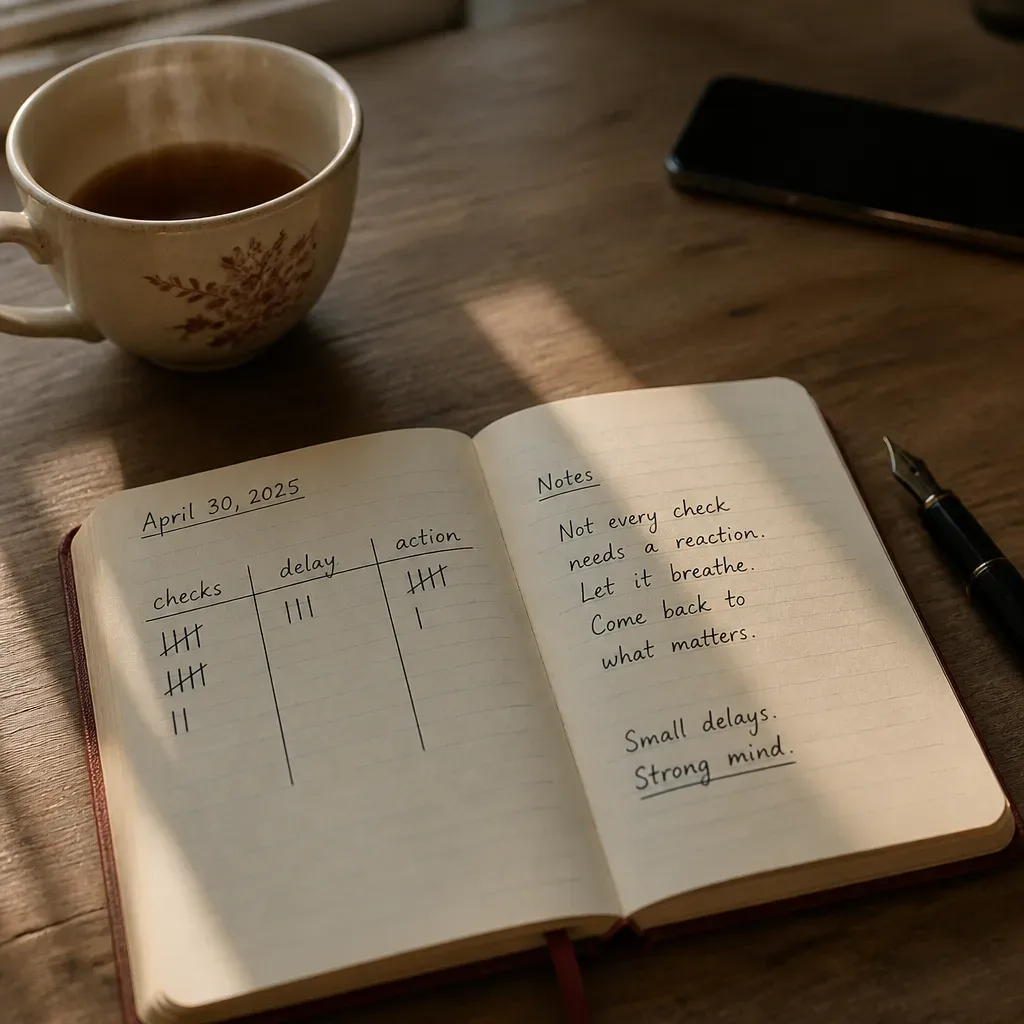
Do not measure detachment by whether your desire arrives on your preferred date. That will tempt you back into control. Measure the behavior. How many times did you check today? How long did it take to return after a wobble? Did you still take the next honest action? These are trackable. A simple tally for 10 days will tell you more than a dramatic sign.
Use three numbers:
- Checks per day.
- Minutes between urge and check.
- One completed future-self action.
If checks drop from 12 to 7 in a week, that is movement. If the delay grows from 0 minutes to 10, that is movement. If you send the proposal before looking for proof, that is movement. Small numbers tell the truth without making a performance out of it.
Research on mental contrasting by Gabriele Oettingen, often paired with WOOP planning, shows that naming both the wish and the obstacle can improve follow-through. In one body of studies across school, health, and work goals, people did better when desire was paired with practical planning. Detachment is similar. You name the wish. You name the checking loop. You choose the next step.
This is also where the AYA Method becomes useful as a daily container. You do not have to invent the state from scratch each morning. You listen. You repeat. The app also includes a daily affirmation and Manifestation Board, but the audio remains the practice. That distinction saves time.
If you want a wider frame for how intention and action work together, keep manifestation close to the ground. The clearest practice is not louder belief. It is repeated return.
What is the quiet rule for today?
The quiet rule is simple: listen before you look.
Write it somewhere you will see it. Not as a command. As a kindness. Listen before the inbox. Listen before the card pull. Listen before the search bar. Listen before asking one more person what they think the silence means. The rule is small enough to keep, which is why it can matter.
A 2022 review in Nature Reviews Psychology noted that habits depend heavily on stable cues and repeated context. Your cue is the urge to check. Your context is the phone, the app, the morning, the bed, the train, the pause before sleep. You are not waiting to become someone with perfect faith. You are building a cleaner sequence.
Here is the whole practice again, stripped down:
- Notice the urge.
- Put the phone face down.
- Listen once.
- Wait 10 minutes.
- Act once.
- Check only if it still feels clear.
You may still look. You may still wobble. You may still want the sign. Fine. The practice is not purity. It is return. One return counts. Three returns count. A week of returns changes what your body expects from you.
If symbols help, let them be gentle. If affirmations help, let one sentence be enough. If timing language helps, read astrology and manifestation without handing it your authority. The center stays the same. Audio first. Proof second. Sometimes proof not at all.
The sign can wait while you come home to yourself.