manifestation 101
Gratitude Manifestation When You Don’t Feel Grateful
Gratitude manifestation can start before you feel grateful. Use a 3-minute audio practice to tell the nervous system what is already safe.

A phone lies face down beside the bed. You don’t feel thankful. That’s allowed. Gratitude manifestation can begin before the feeling arrives: choose one true detail, listen to a 3-minute future-self audio, and let repetition teach your attention where to rest.
What is gratitude manifestation when you don’t feel grateful yet?
Gratitude manifestation is the practice of using specific, believable appreciation to make your intended self feel more real now.
Not big gratitude. Not the glossy kind. The useful kind is smaller. A glass of water. A text answered. Ten minutes without being interrupted. If your mind rejects the sentence, “I’m grateful for my life,” start with, “I can notice one thing that is not hurting me right now.” That counts.
Robert Emmons and Michael McCullough’s 2003 study in the Journal of Personality and Social Psychology found that people who wrote weekly gratitude lists reported higher well-being than people who tracked hassles or neutral events across 10 weeks. The study didn’t ask people to pretend. It asked them to notice. That difference matters.
Manifestation is often misunderstood as wanting harder. A quieter definition is attention plus repetition plus identity. If you’re new to that frame, the wider Manifestation pillar explains how intention becomes practice instead of pressure. Gratitude is not decoration on top. It’s a way of telling the mind, “Some part of this is already safe.”
You don’t have to feel grateful to practice gratitude. You only have to stop abandoning the smallest true thing.
When gratitude is used for manifestation, it points in two directions at once. It names what is here. It also rehearses the version of you who can receive what’s next without flinching. In cognitive psychology, mental rehearsal has been studied for decades; athletes have used imagery practice since at least the 1970s, and performance studies often show that imagined rehearsal can support physical rehearsal when used together.
The point isn’t to overwrite grief, anger, numbness, or debt with a prettier sentence. The point is to make one honest opening. Three minutes is enough for that.
Why does a 3-minute audio help more than forcing a gratitude list?
A 3-minute audio helps because it removes decision-making and gives your nervous system a voice to follow.
Writing can be good. Lists can be good. But when you don’t feel grateful, a blank page can become another small courtroom. You sit there trying to produce the correct feeling. Then you judge yourself for failing. Audio is different. You press play. The practice starts before your resistance can build a full argument.
In habit design, this is called reducing friction. BJ Fogg’s behavior model, published in 2009, describes behavior as the meeting point of motivation, ability, and a prompt. When motivation is low, ability has to be high. A 3-minute audio is easy enough to repeat on a bad day, and bad days are where a practice proves itself.
Here is the simple structure:
- Minute 1: name what is safe now. One breath. One surface. One fact.
- Minute 2: hear from the future self. Not a fantasy self. A steadier self.
- Minute 3: return to one next action. Stand up. Wash the cup. Send the note.
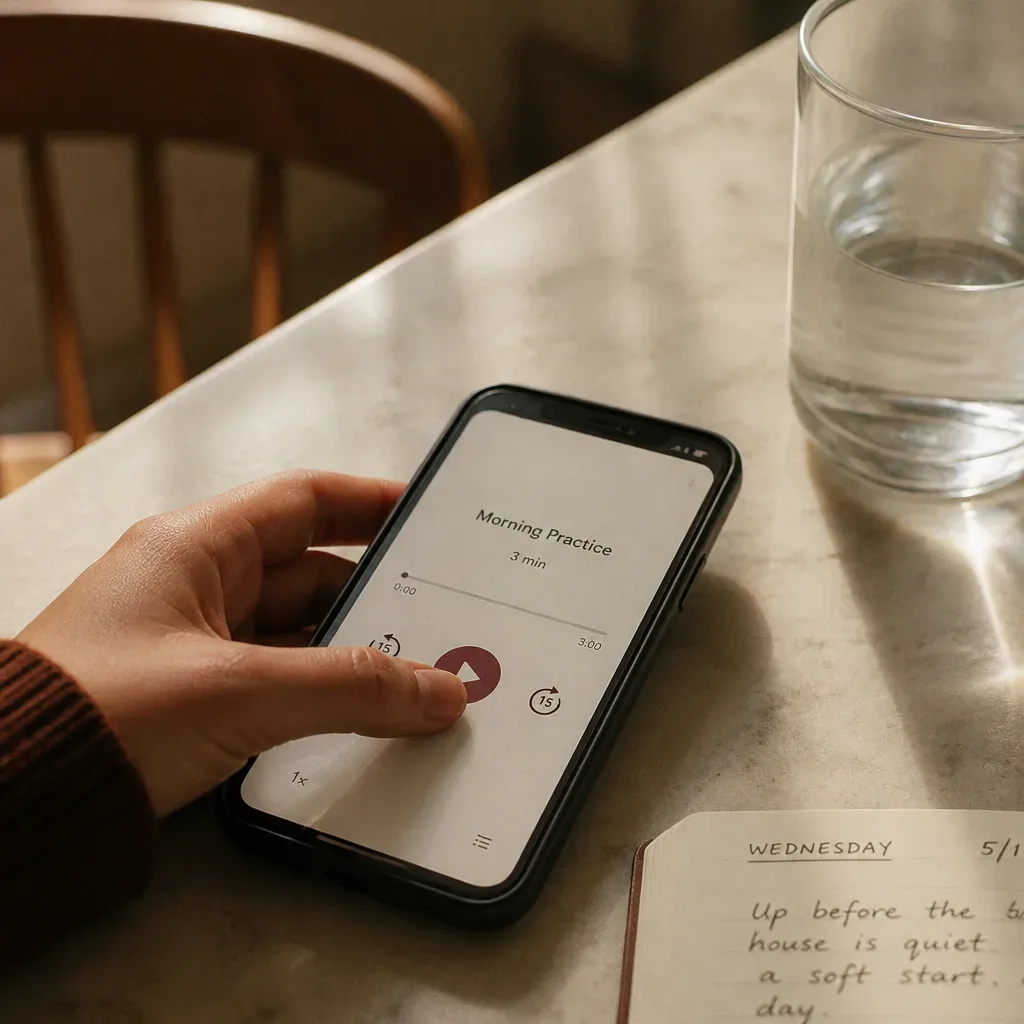
This is where the AYA Method comes in. The AYA Method is a daily audio manifestation practice. Each day you listen to a short personalized recording — your Dream-Self Moment — narrated from the version of you who has already manifested the life you intend. Listening is the practice. Repetition is the work. The audio is the method.
A 2022 review in Nature Reviews Psychology noted that habit formation depends heavily on stable cues and repeated context. That’s why the audio works best when attached to something ordinary: after brushing teeth, before coffee, after closing a laptop. Not a sacred hour. A small door.
How do you make gratitude believable instead of fake?
You make gratitude believable by lowering the claim until your body stops arguing with it.
Most fake gratitude fails because it’s too broad. “I’m grateful for everything” may be spiritually tidy, but it’s often unusable at 7:12 a.m. when you slept badly. Specificity is kinder. “I’m grateful the room is quiet for 30 seconds” gives the mind something it can verify.
The brain likes evidence. Dr. Andrew Huberman has often discussed how attention and emotion shape learning through neuromodulators like dopamine and norepinephrine. You don’t need to turn that into a science costume. Just remember this: attention marks what the system should learn. If you repeatedly attend to one small safe thing, the mind gets more fluent at finding safe things.
Use this table when a gratitude sentence feels false:
| If this feels fake | Try this instead |
|---|---|
| “I’m grateful for my life.” | “I can notice one part of today I don’t have to fight.” |
| “Everything is working out.” | “One thing is working well enough right now.” |
| “I already have what I want.” | “I can practice receiving one small sign of it.” |
| “I’m so happy.” | “I’m willing to feel one degree softer.” |
Neville Goddard wrote often about assuming the feeling of the wish fulfilled. The phrase gets repeated a lot. But “feeling” doesn’t have to mean a dramatic emotion. It can mean posture. It can mean tone. It can mean how you breathe when you stop bracing for bad news for 10 seconds.
Believable gratitude is not smaller than real gratitude. It’s the doorway to it.
If you use Affirmations pillar practices, keep the same rule. One sentence. Present tense. No strain. The daily affirmation can support the audio, but it doesn’t replace listening. The practice is not to win an argument with your doubt. The practice is to give your attention a more honest place to return.
What should the 3-minute gratitude manifestation audio include?
The audio should include present-tense safety, future-self narration, and one grounded next step.
A good script is plain. It doesn’t flatter you. It doesn’t shout certainty. It speaks as if the future self is sitting near you, not performing from a stage. For a 3-minute recording, aim for about 350 to 420 spoken words. Most narration sits near 130 to 150 words per minute, according to common voiceover pacing standards, so shorter is usually better than crowded.
Try this outline:
- Opening cue: “You’re here. Feel the surface under you.”
- Gratitude detail: “One thing is already holding.”
- Dream-self voice: “I remember when receiving felt unsafe. Now I let good things be ordinary.”
- Manifestation frame: “This life is becoming familiar because I practice it daily.”
- Return: “Take one quiet action from this steadier place.”
Notice what is missing. No demand to be happy. No command to erase the past. No promise that every result will arrive by a date. The best manifestation audio is specific enough to be felt and open enough to be lived.
Joe Dispenza often speaks about rehearsing elevated states before the outer event changes. You can take the useful part without adopting every claim: the body learns through repetition. In a 2012 study in the Journal of Behavioral Medicine, gratitude interventions were associated with improvements in psychological well-being, though effects varied by person and method. Small, repeatable practice is the safer bet.
Here is a short sample you can record in your own voice:
“I’m here. I don’t have to force gratitude. I can notice one true thing. This breath came without being earned. This room is holding me for another minute. I’m listening from the self who has learned to receive without apology. I let small good things count. I let steadiness become normal. I take one next step from here.”
That is enough. Your voice may shake. That is also enough.
When is the best time to listen if mornings feel hard?
The best time is the time already attached to a daily cue you rarely miss.
Morning gets all the attention because it’s clean in theory. But many people wake into childcare, alarms, pain, dread, or messages from work. If morning makes the practice feel like another failure, choose a better cue. Habit researchers often call this anchoring: pairing a new behavior with an existing one. The existing behavior carries the new one.
Good cues include:
- after you plug in your phone at night
- before the first sip of coffee or tea
- after brushing your teeth
- when you sit in the parked car
- after closing your laptop
- before opening a banking app or email
A 2010 study by Phillippa Lally and colleagues at University College London found that habit automaticity took a median of 66 days to form, with wide variation from 18 to 254 days. That number is useful because it softens the myth that 21 days is magic. If you miss a day, you haven’t ruined the practice. You return.
If you’re someone who follows timing, cycles, or symbolic dates, you may enjoy reading Astrology and manifestation. Use timing as a support, not a verdict. A moon phase can be a cue. It is not permission to begin.
The right time for practice is the time you’ll actually meet.
Three minutes at lunch can be more honest than 30 minutes you keep postponing. Put the audio where your life already bends. Let the cue do some of the remembering for you.
How do you know gratitude manifestation is working?
You know it’s working when your recovery time shortens and your next actions become less dramatic.
This is the part product design taught me to respect. Don’t only measure feelings. Feelings move. Track behavior. Did you return faster after spiraling? Did you send the email without rewriting it 14 times? Did you notice one good thing without immediately dismissing it? That is data.
Use a 7-day check instead of a daily verdict. Once a week, ask:
- Did I listen at least 4 out of 7 days?
- Did one phrase feel believable?
- Did I take one small action after listening?
- Did I recover from stress any faster than usual?
- Did gratitude feel less like a performance?
This is not clinical treatment. If you’re depressed, grieving, or unsafe, a 3-minute audio is support, not a substitute for care. The National Institute of Mental Health reported in 2021 that about 21 million U.S. adults had at least one major depressive episode. If numbness is persistent, you deserve help that includes another human being.
Still, small practices can matter. In small studies, gratitude exercises have been linked with better sleep, improved mood, and more prosocial behavior. The effect is not identical for everyone. It tends to depend on fit, repetition, and whether the practice feels authentic rather than forced.
For manifestation, the signal is not, “I feel grateful all day.” The signal is, “I’m becoming the person who can stay with what I asked for.” If you want the wider frame again, return to Manifestation pillar and notice how much of the work is attention repeated, not wishing repeated.
A practice is working when it changes what you do after the feeling passes.
How do you keep the practice quiet enough to repeat?
You keep it quiet by making the practice smaller than your resistance.
That is the whole system. Three minutes. Same cue. Same place if possible. No public announcement. No perfect mood required. The quieter the ritual, the less it asks your ego to manage it. You don’t need a new identity around being grateful. You need one daily return.
A simple 3-minute setup looks like this:
| Part | Time | What to do |
|---|---|---|
| Arrive | 30 seconds | Feel the chair, bed, floor, or breath. |
| Listen | 2 minutes | Play your Dream-Self Moment or recorded script. |
| Seal | 30 seconds | Name one next action you can do now. |
The app can hold the structure for you. The daily affirmation and Manifestation Board can help you remember the language and image of what you’re practicing, but they’re complements. If you only do one thing, listen. Audio is the method because listening is the lowest-friction way to meet the future self every day.
There is also the matter of attention hygiene. Pew Research Center reported in 2024 that a large majority of U.S. adults use smartphones daily, and many check them often. That means your phone can scatter you or return you. A 3-minute audio gives the device a different job for a moment.
If gratitude still feels far away, use this sentence for a week: “I’m not ready to feel grateful for everything, but I can let one true thing count.” Record it. Listen once a day. Don’t improve it. Don’t decorate it. Let it become familiar.
The practice is not asking you to become bright. It is asking you to become available to what is already quietly true.
Stay near the one small thing that doesn’t ask you to pretend.