love manifestation
Manifest Emotional Availability With Future-Self Audio
Manifest emotional availability with a daily future-self audio practice that helps you rehearse safer love, steadier responses, and clearer repair.

October 1st. The kettle clicked off while my phone was still face down on the counter. To manifest emotional availability, I practice hearing myself as someone who can stay present in love: I listen to future-self audio daily, rehearse one available response, and track whether my body learns safety through repetition.
What does it mean to manifest emotional availability?
To manifest emotional availability means I practice becoming someone who can receive care, tell the truth, and stay reachable without abandoning myself.
I am writing that plainly because I used to make the phrase too pretty. Emotional availability is not being endlessly open. It is not answering every text in 30 seconds or letting someone walk through the house with muddy shoes. In attachment research, John Bowlby described attachment as a system shaped by safety and threat, and Mary Ainsworth’s Strange Situation studies in the 1970s gave language to secure, anxious, and avoidant patterns. I think of emotional availability as the daily evidence that my attachment system does not have to run the whole room.
This morning, my evidence was small. I noticed the urge to draft a careful, charming answer to someone I like. Then I put the phone down and listened first. That is the order I am trying to keep: listen, breathe, answer. The gap was 6 minutes. Six minutes is not dramatic, but a nervous system often changes through repeats, not speeches.
The Manifestation pillar says a named desire becomes more workable when I connect it to identity, attention, and action. I like that because it keeps me honest. If I say I want available love, the next question is not whether someone arrives. The next question is whether I can practice being findable.
Emotional availability is not the absence of fear. It is the decision not to let fear write every reply.
For me, this practice has three parts:
- I notice the protective move: withdrawing, overexplaining, testing, pleasing, or pretending I do not care.
- I choose one available response that is small enough to repeat today.
- I listen to future-self audio until the response feels less foreign.
A 2022 Pew Research Center report found that 30% of U.S. adults had used a dating site or app, which means many of us are practicing intimacy through tiny signals on glass. That makes availability easy to fake and easy to miss. Audio helps me return to the body before the message leaves my hands.
Why does future-self audio help me practice being available?
Future-self audio helps because it lets me rehearse a felt identity before I have to perform it under relational pressure.
The version I listen to is not a fantasy stranger. She sounds like me after I have slept enough, eaten lunch, and stopped treating uncertainty as a courtroom. In the AYA Method, the practice is specific: each day I listen to a short personalized recording, my Dream-Self Moment, narrated from the version of me who has already manifested the life I intend. Listening is the practice. Repetition is the work. The audio is the method.
I come from software, so I distrust any intervention I cannot observe at least a little. But I also work in healthcare software, where the first lesson is that human data is never the whole human. Hal Hershfield’s future-self research, including studies published around 2011 on future self-continuity and saving behavior, found that people make different choices when the future self feels more vivid and connected. I borrow that principle for love. If the emotionally available version of me feels like a real person, I am less likely to betray her for a quick defense.
There is also the attention piece. Dr. Andrew Huberman often speaks about neuroplasticity as requiring focus, repetition, and a state that supports learning. I do not treat a podcast quote as a prescription, but the principle tracks with my log: on days I listen before opening messages, I respond more slowly and more truthfully. My sample size is one person and 64 logged mornings, so I hold it humbly.
Future-self audio works best when it is concrete. I do not say, “I am open to love” and leave it there. I hear: “I pause before I disappear. I say, I liked hearing from you. I need tonight quiet, and I will answer tomorrow.” That sentence gives my body a route.
| Protective pattern | Future-self audio scene | Available action today |
|---|---|---|
| I go quiet when I feel wanted | I hear myself saying I need one hour, not one week | Send a clear time boundary |
| I overperform to be chosen | I hear myself answering simply | Remove the extra paragraph |
| I test whether they care | I hear myself asking directly | Ask one honest question |
| I assume care will cost me | I hear myself receiving without debt | Say thank you and stop there |
The body trusts what it has rehearsed more than what I have promised at midnight.
How do I write a future-self audio script for emotional availability?
I write the script as a dated scene where I am already practicing steady love in ordinary conditions.
I start with a place. Kitchen. Bus. Bathroom mirror. The blue chair near the window. Then I give the future self a behavior I can recognize. I do not write, “I am healed.” I write, “I notice the tightening in my chest, and I do not punish myself for it.” In James Pennebaker’s expressive writing studies, often using 15 to 20 minutes of writing over several days, naming emotional material was linked with shifts in health and meaning-making for some participants. I am not doing expressive writing exactly, but I respect the same door: language gives shape to what was fog.
Here is the structure I used today before recording:
- Date the scene. “Thursday morning. The kettle is loud.”
- Name the old protection kindly. “I used to leave before I could be left.”
- Let the future self speak from evidence. “Now I tell the truth sooner.”
- Include one body cue. “My shoulders drop before I answer.”
- Include one relational cue. “I can receive a kind message without making a debt out of it.”
- Close with today’s smallest action. “I answer one message honestly.”
The script should be short enough to hear when I am not in the mood. BJ Fogg’s behavior design work at Stanford has long argued that tiny behaviors attach more reliably to existing prompts than large ones that depend on motivation. I take that seriously. My Dream-Self Moment is 4 minutes and 38 seconds. I know because I checked the file after three listens and wrote it next to my sleep score.
I keep Affirmations pillar bookmarked because sometimes a single sentence steadies me after the audio. But I do not confuse the tools. My daily affirmation is a complement. The audio carries the practice because it gives timing, tone, and scene.
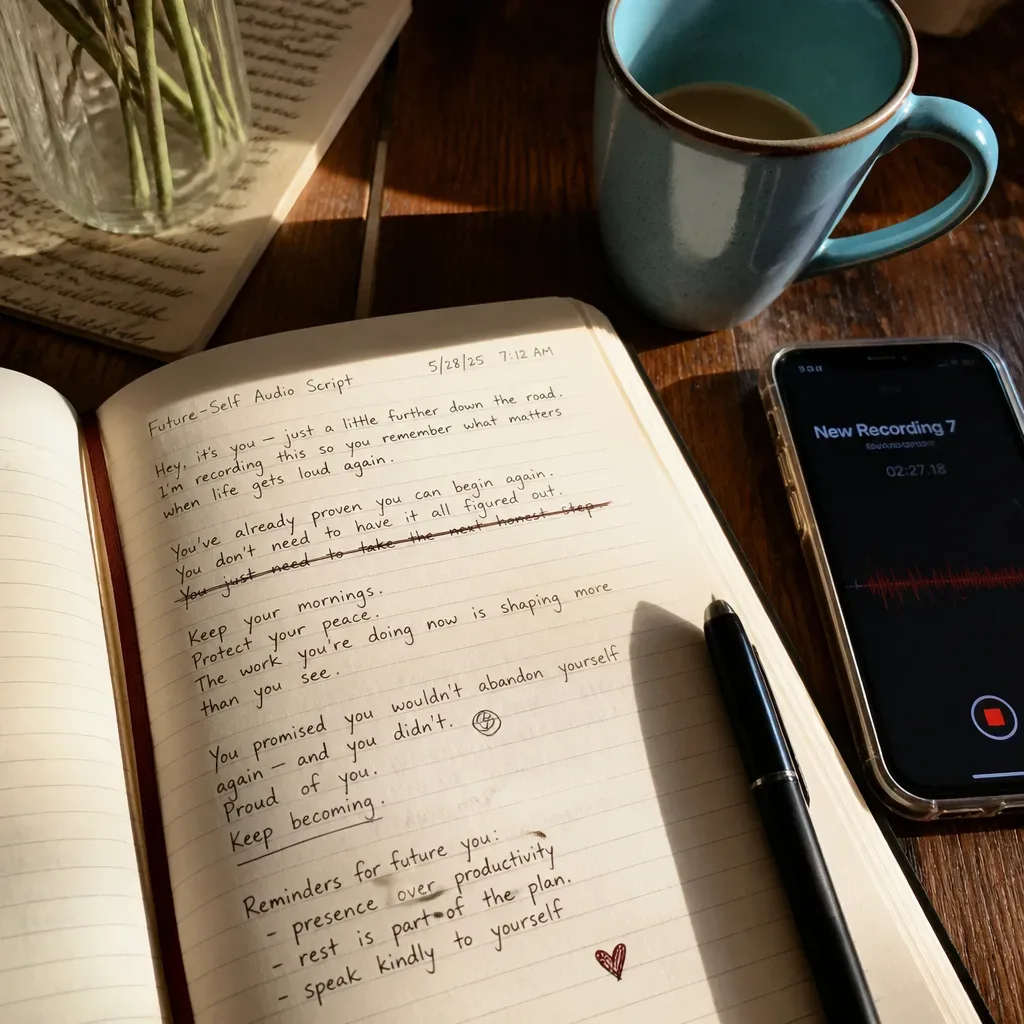
A line I used this week: “I can be honest without making honesty a performance.” That one stayed. I heard it while washing my mug and realized I had been making vulnerability look elegant before I let it be true.
What should I do each day after I listen?
After I listen, I take one available action before my defensive story has time to become law.
This is the part I used to skip. I liked the feeling of the audio, then I behaved exactly the same by lunch. Now I connect the listen to one observable behavior. In the Journal of Behavioral Medicine, studies of self-monitoring have often shown that tracking a behavior can improve adherence, especially when the behavior is specific. I track only one thing for this practice: did I speak to myself decently today? Boolean. True or false.
I chose that metric because shame makes my availability worse. If I miss a text and then call myself broken, I am less likely to repair. If I say, “I disappeared for two hours because I got scared,” I can send a cleaner message. The repair may take 19 words. “I went quiet. I am here now. I liked what you said, and I needed a minute.” Nineteen words is enough data for the other person to know I have returned.
My daily sequence takes about 12 minutes:
- Put the phone on the counter, not in my hand.
- Listen to the Dream-Self Moment once.
- Write the old protective move in one sentence.
- Choose one available response.
- Do it within the next hour if possible.
- Log the kindness metric at night.
The order matters. If I open messages first, I am already reacting. If I listen first, I have one quiet vote from the self I am practicing. In habit research, context stability matters; a 2009 study by Phillippa Lally and colleagues found habit formation took a median of 66 days, with wide variation. I do not use 66 as a rule. I use it as permission not to demand a new heart by Friday.
I also read Astrology and manifestation when I want a reflective timing lens, especially during weeks when I am more tender than usual. I do not let timing replace action. A moon note may help me notice the day. It cannot send the honest text for me.
A practice becomes real when it survives an ordinary Tuesday.
How do I know whether I am becoming more emotionally available?
I know by looking for repeated evidence: clearer repair, less testing, kinder pauses, and the ability to receive care without making it unsafe.
The first week, I wanted fireworks. I got fewer drafts. That was the change. I used to write five versions of a message before sending the version that sounded least needy. This week, on 4 of 7 days, I sent the first honest version after one edit. That is not a clinical outcome. It is a home measurement. It still counts.
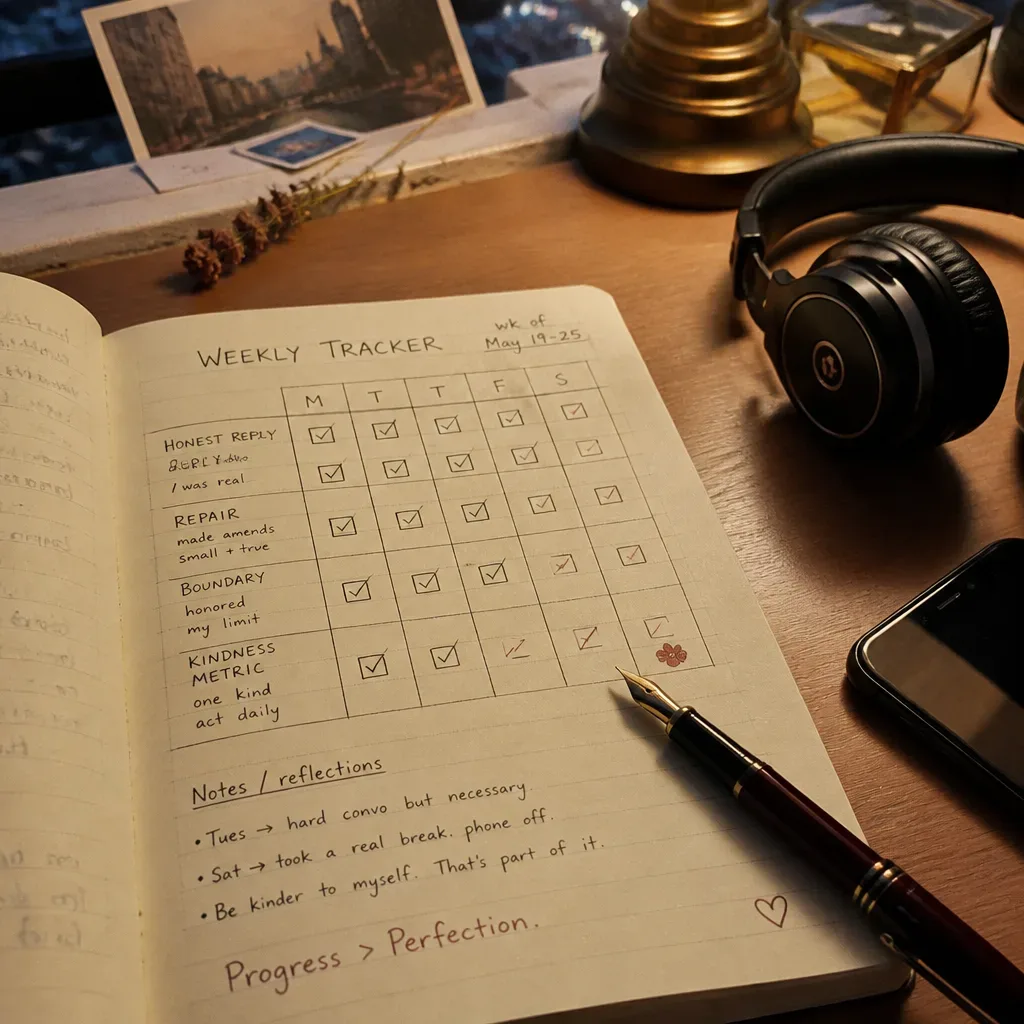
Here are the signs I log on Sunday nights:
- Did I answer from truth rather than strategy at least once?
- Did I ask for time instead of disappearing?
- Did I let a compliment land without correcting it?
- Did I repair within 24 hours when I withdrew?
- Did I keep a boundary without becoming cold?
- Did I avoid turning uncertainty into a test?
I keep the numbers simple because complex dashboards can become hiding places. In my work, I have seen dashboards lie by omission more often than by arithmetic. A chart can show 91% completion and still hide the 9% of people harmed by the workflow. My emotional availability log can do the same if I track only wins. So I track the misses too, gently.
Small studies on implementation intentions, the “if X, then Y” plans associated with psychologist Peter Gollwitzer, have found improved goal follow-through across many contexts. I use that format for intimacy. If I want to pull away, then I will name one true thing. If I want to overexplain, then I will remove one paragraph. If I want to test, then I will ask.
The Manifestation pillar helped me see that evidence changes belief more reliably than pressure does. I do not need to convince myself I am available. I need to collect days where I behaved like someone who could be reached.
What if future-self audio brings up grief or resistance?
If the audio brings up grief or resistance, I slow the practice down and treat the resistance as information, not failure.
Some mornings, the future-self voice makes me cry. Not because it is sad exactly. Because she receives love as if it is allowed. My body sometimes hears that as danger. Trauma researchers and clinicians often describe the nervous system as predictive: it prepares for what has happened before. I am careful here. If listening makes me flooded, numb, or unable to function, that is not a sign to push harder. That is a sign to add support.
I keep a scale from 1 to 5 in my notes. One means calm. Three means stirred but steady. Five means I need to stop and come back later. If I hit a 4, I shorten the audio or listen while doing something grounding, like folding towels. If I hit a 5, I do not listen that day. I text my therapist or take a walk. There is no prize for overriding the body in the name of love.
Neville Goddard wrote often about assuming the feeling of the wish fulfilled. I understand the appeal. Still, I have learned that assumption without consent from the body can become another mask. Joe Dispenza’s work also speaks about rehearsing a future state, though some claims are debated and should be read with discernment. I take the practical piece: rehearsal matters. I leave the certainty alone.
I also use one sentence from Affirmations pillar when the audio feels like too much: “I can be here for one breath.” One breath is not a romance plot. It is enough for the next second.
Resistance is not proof that love is wrong. Sometimes it is proof that love is near an old bruise.
How do I keep this practice honest instead of using it to chase someone?
I keep it honest by making my availability the subject, not another person’s response.
This matters. I can use any practice to avoid reality if I am determined enough. I can listen to future-self audio and secretly turn it into a campaign to make one person text back. That is not emotional availability. That is control wearing soft clothes. The cleaner question is: who am I becoming in the presence of uncertainty?
I set three guardrails:
- No scripting another person’s feelings. My audio names my behavior, not their surrender.
- No bypassing incompatibility. Availability includes noticing when someone cannot meet me.
- No measuring success by a reply. I measure whether I stayed honest and kind.
The Princeton Engineering Anomalies Research program, often called PEAR, studied mind-matter questions for decades and remains controversial; I mention it only because manifestation spaces sometimes overclaim certainty. I prefer humility. My practice does not prove I can bend another person’s will. It helps me become less defended, and that alone changes the relational field I participate in.
I keep one more link close: Astrology and manifestation, not because I want the sky to excuse me, but because reflection can slow my urgency. Then I return to the audio. In the AYA Method, repetition is the work, and repetition has a way of revealing motives. If I cannot listen without checking for a reply, I write that down.
The most honest data point this week was not romantic. It was my mother calling while I was tired. I wanted to rush her off the phone. Instead, I said, “I have 10 minutes, and I want to hear the important part.” Boundary and warmth in the same sentence. I logged true that night.
Thursday now. The mug is empty, and I have not picked up the phone yet.