love manifestation
No Contact Manifestation: Listen Before Silence
A quiet no contact manifestation guide for the moment before texting: listen, regulate, check your motive, and decide without chasing.

Sunday, 7:10 a.m. No contact manifestation means using the quiet period to rehearse the version of you who does not beg, chase, or bargain before you decide whether to speak. I listen first because a nervous message is still a message, and silence is sometimes the kindest data I have.
What is no contact manifestation actually asking me to do?
No contact manifestation asks me to practice a new identity in silence before I ask for a new outcome in love.
I am writing this with my phone face down beside the blue mug. That detail matters because the phone is the whole scene. In the old pattern, I would pick it up before the kettle clicked off. One message, then another. One careful line dressed up as calm. Research on digital dating keeps reminding me that the device is not neutral: Pew Research Center reported in 2020 that 30% of U.S. adults had used a dating site or app, and for younger adults the number was much higher. The phone has become a place where attachment gets rehearsed.
For me, no contact is not a spell and not a punishment. It is a container. I use it to stop feeding the part of me that thinks urgency is proof of love. If I am honest, most messages I wanted to send during no contact were not messages. They were tiny tests. Do you miss me. Are you sorry. Am I still chosen. A test sent in the shape of a text still feels like a test when it arrives.
I keep coming back to the AYA Method because it gives me something to do that is not contacting them. The AYA Method is a daily audio manifestation practice. Each day you listen to a short personalized recording, your Dream-Self Moment, narrated from the version of you who has already manifested the life you intend. Listening is the practice. Repetition is the work. The audio is the method.
That is the important order. I listen, then I decide. I do not decide, then use the audio to bless the decision I already made. If you want the wider map, the Manifestation pillar names this well: attention becomes training when it is repeated. In love, repeated attention can become dignity or dependency. The difference is what I practice when nobody is watching.
Silence is not the absence of love. Sometimes it is the first place self-respect can breathe.
Why should I listen before I text?
I listen before I text because my first urge is often a nervous-system event, not a wise decision.
Three Tuesdays ago, I almost sent a message at 11:42 p.m. I remember the exact minute because I had already opened the thread. The message was not cruel. It was worse than cruel. It was polished. It said I hope you are well, which meant please think of me. Social pain is not imaginary pain. In a 2011 PNAS study, Ethan Kross and colleagues found that unwanted romantic rejection activated brain regions also involved in physical pain. That does not make every urge sacred. It makes the pause necessary.
When I listen first, I give the body a different instruction. Dr. Andrew Huberman often describes stress and dopamine as systems that shape pursuit, not just mood. I notice this in the small mechanics: thumb hovering, chest tight, jaw set, the private thrill of maybe getting a reply. If I send from that state, I am usually asking the other person to regulate me. That is too much weight for a blue bubble.
My 12-minute rule is boring, and that is why it works:
- Put the phone face down.
- Play the Dream-Self Moment once.
- Breathe slowly for 60 seconds after it ends.
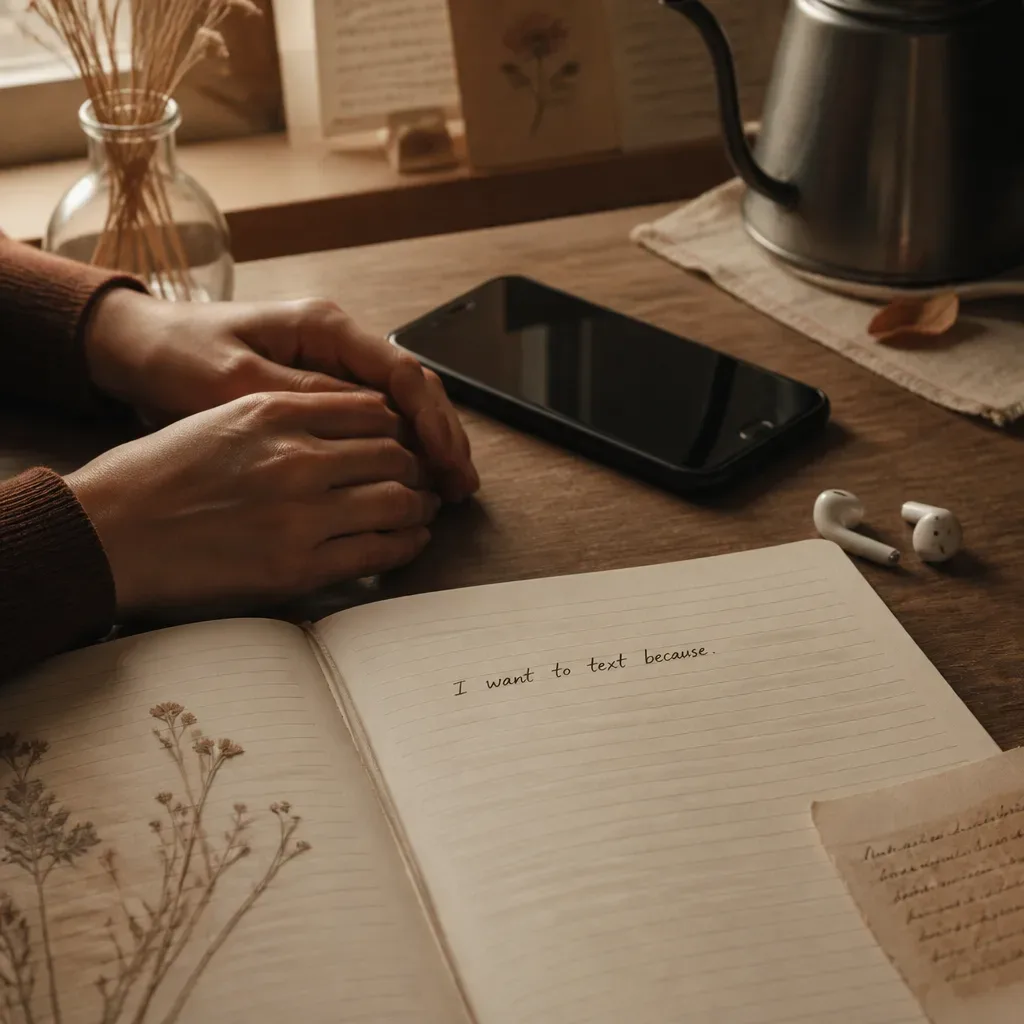
- Write: I want to text because.
- Wait until the body answers before the mind edits it.
In habit design, friction is mercy. A 2006 meta-analysis by Peter Gollwitzer and Paschal Sheeran found that implementation intentions, the simple if-then plans people make before temptation, had a medium-to-large effect on goal achievement across 94 studies. My if-then is plain: if I want to break silence, then I listen first.
I do not need to feel powerful. I need to interrupt the loop. The first clean choice is usually very small. It looks like not typing. It looks like hearing my own future self say a sentence I could not have invented while panicking.
How do I set up a 12-minute no contact practice?
I set it up by making the first action too small to resist and the message too inconvenient to send quickly.
This morning, the kettle took about four minutes. I used that as the anchor. Habit researchers like Wendy Wood have written for years that context cues carry much of our repeated behavior; in her work on habits, stable cues often matter more than motivation. I do not wait to become calm. I attach the practice to the thing that already happens. Kettle. Chair. Audio. Page.
Here is the practice I use when I want to contact someone before I have earned my own trust back:
- Minute 0 to 1: make contact harder. I turn the phone face down or place it across the room. Not dramatic. Just far enough that I cannot text from reflex.
- Minute 1 to 6: listen. I play my Dream-Self Moment from the AYA Method. The audio is the practice. I do not multitask if the urge is strong.
- Minute 6 to 8: write the real sentence. I write one line: I want to text because. I do not let myself write a noble version.
- Minute 8 to 10: check the body. I note jaw, throat, chest, stomach, hands. A body in alarm is not banned from love, but it should not be handed the phone.
- Minute 10 to 12: choose the next right unit. The unit might be one more hour of silence, a walk, a draft in notes, or asking a friend to hold me accountable.
Phillippa Lally and colleagues reported in the European Journal of Social Psychology in 2009 that habit formation took a median of 66 days, with wide variation from 18 to 254 days. I keep that number near me because it humbles me. One calm morning does not mean the pattern is gone. One hard night does not mean I failed.
A daily affirmation can help here, but only as a complement. I sometimes write one after listening, especially if my thought is looping. The Affirmations pillar is useful when I need language that steadies me. But I do not confuse the sentence with the method. The audio carries the practice. The sentence is a note on the fridge.
The message I do not send is also a message to my own nervous system: we can survive this minute.
What should I listen for in my Dream-Self Moment?
I listen for the tone, standards, and ordinary behavior of the self who is not negotiating her worth.
Before I forget, I should write down the strange part. The Dream-Self Moment rarely tells me anything spectacular. It does not say he will call. It does not say the old story will repair itself by Friday. It says smaller things, and the smaller things are harder to fake. Make breakfast. Do not check the thread in bed. Answer the work email. Wear the clean shirt. Leave the door open to life, not to the same wound.
This is where no contact manifestation becomes practical for me. I am not trying to control their choices. I am trying to reduce the number of choices I make from hunger. In cognitive behavioral research, a common principle is that thoughts, feelings, and behaviors reinforce each other through repetition. The National Institute of Mental Health describes CBT as work that helps people identify unhelpful thinking and behavior patterns. I use the audio like a daily rehearsal of the pattern I want to strengthen.
| What I hear | What I do with it | What I do not do |
|---|---|---|
| Calm tone | Lower my pace before acting | Perform calmness in a text |
| Clear standards | Name what contact would need to respect | Create a secret test |
| Ordinary details | Copy one behavior today | Wait for a grand sign |
| Future-self language | Borrow one sentence for my page | Use it to predict their reply |
The most useful line is often not romantic. It is behavioral. In my old habit tracker app, used by about fourteen thousand people, the strongest patterns were rarely built by motivation. They were built by cues, small actions, and visible evidence. Users who made the next action obvious came back more often than users who wrote the most ambitious goals. Love is not exempt from that math.
If I need symbolism, I keep it gentle. I can read about astrology and manifestation on a Sunday night and still not use a transit as permission to send a message I know is bargaining. A sign that overrides self-respect is not a sign I trust.
How do I know whether silence is discipline or avoidance?
Silence is discipline when it protects clarity, and avoidance when it protects me from a necessary truth.
This distinction is the one I dislike most because it does not let me hide. I can dress avoidance in very spiritual clothes. I can call it surrender when I am really scared to ask for a clean answer. I can call it no contact when I am punishing someone for not reading my mind. John Bowlby’s attachment theory dates back to the mid-20th century, and later adult attachment research by Cindy Hazan and Phillip Shaver showed how romantic bonds can activate the same patterns of anxiety and distance. I see both in myself.
So I use a plain test. Discipline feels quiet after the first wave passes. Avoidance feels cramped. Discipline makes me more honest in other parts of the day. Avoidance makes me smaller. Discipline can say, I am not ready to speak kindly. Avoidance says, I will disappear and hope they suffer correctly.
I ask four questions on the page:
- Am I silent because contact would harm me, them, or the repair?
- Am I silent because I want them to panic?
- Am I avoiding a boundary I already know I need to state?
- If they never replied, would I still respect the message I am planning?
The last question does most of the work. A respectful message can survive no reply. A fishing message cannot. In 2018, Pew reported that about 59% of U.S. adults said online dating was a good way to meet people, but that does not mean constant access made us clearer communicators. Access is not intimacy. A typing box can still be a hiding place.
If there was coercion, abuse, stalking, or fear, I do not make this a philosophical exercise. No contact becomes safety. I block, document, tell someone, and use local support. No manifestation practice outranks safety. A future self who is loved is not required to reopen a door that taught her to be afraid.
What do I do if I still want to break no contact?
If I still want to break no contact, I draft a clean message, wait 24 hours, and send only if it asks nothing hidden.
By clean, I do not mean cold. I mean honest enough that I am not smuggling a demand inside a soft sentence. I write it in notes first. Not in the thread. There is a reason for that. The chat window has memory. It holds old replies, read receipts, the last time stamp, the exact place where I once felt wanted. A notes app is dull, and dull is helpful. In behavior design, removing the reward cue matters; B. F. Skinner’s work on variable rewards showed how unpredictable reinforcement can strengthen repeated checking. A possible reply is a powerful variable reward.
My draft has three parts at most:
- Context: I have taken some time before writing.
- Truth: I would like to talk if that feels respectful to you too.
- Boundary: If not, I will understand and will not keep pushing.
Then I wait. Twenty-four hours sounds arbitrary, but it is long enough to pass through at least one sleep cycle. The CDC notes that adults generally need 7 or more hours of sleep per night. I have learned not to trust a midnight ache with a permanent record. Morning has never made me less honest. It has only made me less theatrical.
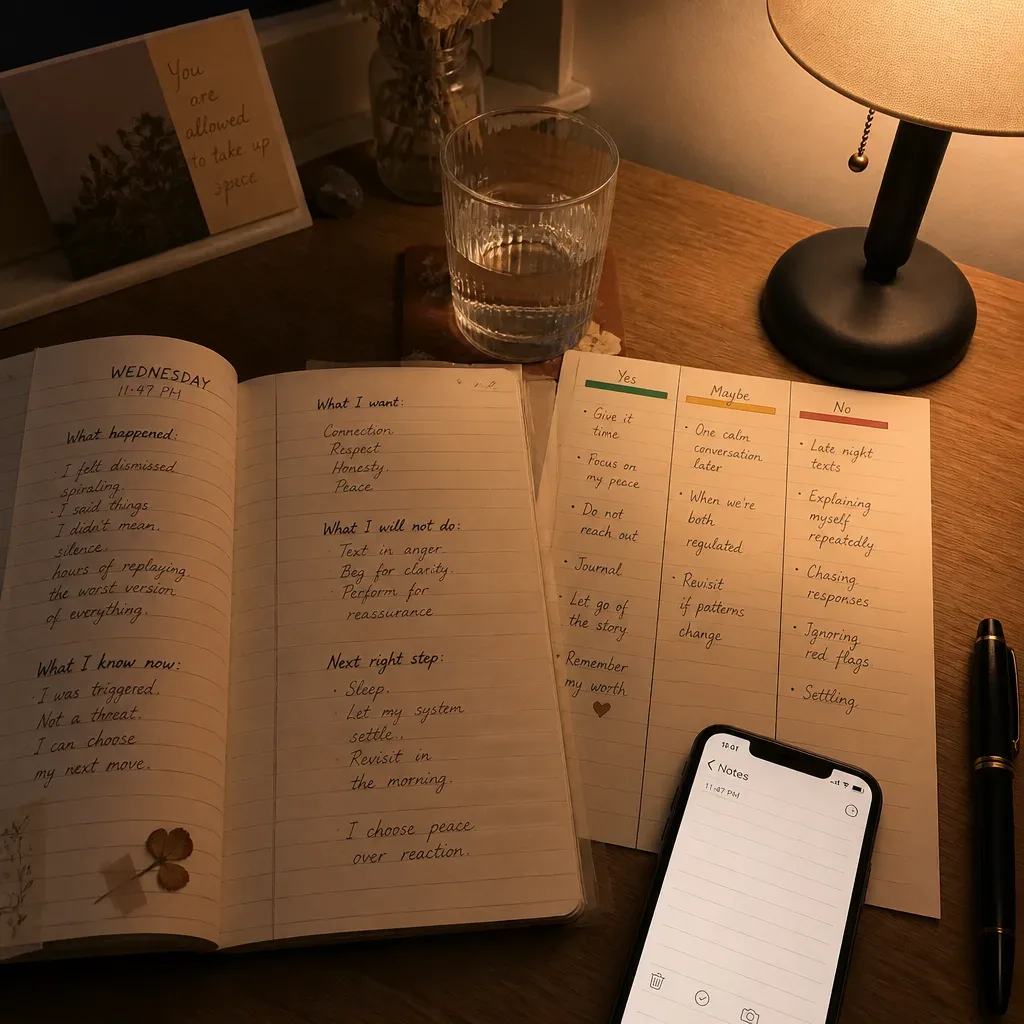
Here is the table I keep in my head before sending:
| Green light | Yellow light | Red light |
|---|---|---|
| I can accept no reply | I want reassurance | I need a reply to feel okay |
| The message is specific | The message is vague but kind | The message is a trap |
| I have slept on it | I waited one hour | I am shaking while typing |
| It respects their choice | It hopes for warmth | It pressures, blames, or tests |
If I send, I send once. If they answer, I read slowly. If they do not, I do not turn one message into a campaign. This is where love manifestation has to grow up in me. Love cannot be proven by how long I can chase. Love also cannot be proven by how severely I can withhold. The practice is to become someone who can speak without abandoning herself.
How do I keep the practice from becoming a game?
I keep no contact from becoming a game by refusing to use silence as a lever against another person’s free will.
This is the line I write because I need it. If my silence is designed to make them jealous, afraid, or desperate, I am not practicing love. I am practicing control with better lighting. Neville Goddard wrote often about assuming the feeling of the wish fulfilled, and people quote him as if assumption means possession. I read it more soberly. The feeling I rehearse must change me first. If it requires someone else to lose their freedom, it is not worth rehearsing.
Joe Dispenza’s work is often discussed around mental rehearsal and identity, and I take the useful part without turning it into theater. Repeated inner practice can change what I notice and how I act. That is enough. I do not need to claim that my listening forces a name to appear on my screen. A defensible practice does not need exaggerated promises.
For the next seven days, I keep the rules simple:
- I listen before I check the thread.
- I write the urge down before I act on it.
- I do not post indirect messages for them to see.
- I do not ask mutual friends for updates.
- I treat one day of silence as one completed rep.
- I place evidence where tomorrow-me will trip over it: a note, a checked box, a dated page.
In the habit data I have seen, streaks break most often around travel, illness, and emotional disruption. That is not a moral failure. It is a design problem. So I design for bad nights. I keep the audio easy to find. I keep the page open. I keep the phone out of reach for the first 12 minutes. The future is not persuaded by speeches. It is trained by what I repeat when I am tired.
A boundary is not a performance of being unbothered. It is a place where my behavior finally matches my self-respect.
Monday now. The phone is still face down.