affirmations
Morning Affirmations Confidence as Dream-Self Audio
Use morning affirmations confidence practice as short Dream-Self audio: quiet lines, repetition, and a kinder way to meet the day.

The cup is warm in your hand. Morning affirmations confidence practice works best when it becomes something you hear, not something you have to perform. A short Dream-Self audio can give your nervous system one clear cue: this is how you speak to yourself before the day speaks first.
Why make morning affirmations for confidence audio instead of text?
Audio works because it removes friction from the first minutes of the day.
Text asks you to read, decide, and sometimes argue with the sentence. Audio asks you to listen. That difference is small, but small is where daily practice lives. In a 2009 study in the European Journal of Social Psychology, Phillippa Lally and colleagues found that habit automaticity took a median of 66 days to form, with a wide range from 18 to 254 days. The cue matters. The same room. The same time. The same voice.
A confidence affirmation on paper can become another task. A confidence affirmation in your ears can become a place to return. You do not need to feel brave before pressing play. You only need to press play. That is why the AYA Method begins with audio: The AYA Method is a daily audio manifestation practice. Each day you listen to a short personalized recording — your Dream-Self Moment — narrated from the version of you who has already manifested the life you intend. Listening is the practice. Repetition is the work. The audio is the method.
Self-affirmation theory, first shaped by Claude Steele in 1988, says people protect a sense of self-integrity when they remember what they value. Later reviews, including Cohen and Sherman in 2014, found that affirming core values can reduce defensiveness under threat. This is not about pretending you never doubt yourself. It is about hearing a steadier version of you before the old pattern gets loud.
Confidence is not a mood you chase. It is a tone you practice returning to.
Audio also carries timing. A pause can say as much as a word. A softer voice can make the line easier to believe. If you have ever reread an affirmation and felt nothing, it may not mean the line failed. It may mean your morning needed sound.
What should a Dream-Self confidence affirmation actually sound like?
It should sound specific, calm, and close enough to believe.
The most useful morning affirmations confidence lines do not shout. They do not try to erase doubt in one sentence. They name a behavior you can practice today. For example: I speak slowly before I answer. I can take one clear step. I let my work be seen before it is perfect. Each line has a place to land. Each line tells the body what to do next.
The Journal of Behavioral Medicine has published multiple studies on self-affirmation and health behavior, including work showing that affirmed participants can become more open to difficult information. The mechanism is modest, not magical. When the self feels less under attack, the mind has more room to choose. In the morning, that may look like sending the email, speaking in the meeting, or not apologizing for taking up normal space.
Here are 11 quiet lines that work well in Dream-Self audio:
- I wake as someone who can stay with herself.
- I do not need to rush to be real.
- I can speak clearly and still be kind.
- My pace is allowed.
- I know the next honest step.
- I let my voice arrive before it is perfect.
- I can be seen in small ways today.
- I remember what I have already carried.
- I do not abandon myself to be liked.
- I can begin before I feel certain.
- I am allowed to take up the room I need.
Notice the scale. None of these lines asks you to become a different person by breakfast. They ask you to behave like someone who is already on your side. Pew Research Center reported in 2023 that roughly 41 percent of U.S. adults had used some form of digital health or wellness tool; the ones that last tend to ask for less, not more. A two-minute audio can survive a real morning.

How do you choose affirmations that do not feel fake?
Choose the line your body can almost accept.
A false-sounding affirmation often jumps too far. If you feel terrified of speaking up, I am the most confident person in every room may create resistance. A truer line might be, I can say one sentence and breathe after it. That sentence does not insult your fear. It gives fear a smaller job. In clinical language, this resembles graded exposure: a change is easier when the step is sized to the person taking it.
Neville Goddard often wrote about living from the state of the wish fulfilled. The quiet version is not theatrical. It is a small rehearsal of identity. You ask: if I were already someone who trusts my voice, how would I move through this next minute? The answer may be as ordinary as sitting upright, drinking water, or opening the calendar without dread. Manifestation is most useful when it changes your next action, not just your private mood.
A helpful test is the 70 percent rule. If a line feels at least 70 percent believable, use it. If it feels like 10 percent, soften it. Research on implementation intentions by Peter Gollwitzer, first published in the 1990s, found that if-then plans can improve follow-through because they connect a cue to an action. Your affirmation can do the same.
| If the line feels false | Try this instead |
|---|---|
| I am fearless | I can act while fear is here |
| Everyone respects me | I respect the way I speak today |
| I never doubt myself | I can return after doubt appears |
| I am always confident | I can practice one confident behavior |
A believable affirmation does not flatter you. It recognizes you.
You can also borrow from your own history. Think of 3 moments when you were steady. A hard conversation. A repair after a mistake. A day you kept going without applause. Confidence grows faster when it has evidence. Your audio should not invent a stranger. It should remember you back to yourself.
When is the best morning moment to listen?
The best moment is the one you can repeat for 14 days without negotiating.
Some people listen before getting out of bed. Some listen while washing their face. Some listen after coffee, before opening messages. The exact time matters less than the cue. Wendy Wood and David Neal, in their 2007 work on habits, describe habit as behavior repeated in stable contexts until the context begins to cue the behavior. That is why a bathroom mirror can be more useful than a perfect schedule.
Dr. Andrew Huberman has often discussed the cortisol awakening response, a normal rise in cortisol that tends to happen in the first 30 to 45 minutes after waking. You do not need to turn that into pressure. It simply means the morning is already a sensitive window. A short audio practice can meet the body while it is coming online, before your phone gives you 40 other identities to wear.
Try this simple order for one week:
- Wake and place both feet on the floor.
- Drink water before checking messages.
- Put on the same 2 to 5 minute Dream-Self audio.
- Let one line repeat after the audio ends.
- Take the smallest visible action that matches it.
If your line is I can speak clearly and still be kind, the action may be writing the first sentence of a message. If your line is I let my work be seen before it is perfect, the action may be attaching the file. Stanford behavior scientist BJ Fogg has written that tiny habits work because they attach to existing routines and feel easy enough to repeat. Confidence behaves the same way.
The app may also include a daily affirmation or a Manifestation Board, but those are complements. The audio is the method. A visual cue can help you remember. A written line can help you name it. But the repeated listening is what gives the morning its groove.
How can you make a 3-minute confidence audio feel personal?
Make it personal by naming your real day, your real voice, and your real next step.
Generic confidence content often fails because it could belong to anyone. Your Dream-Self audio should know the shape of your morning. The school run. The 9:30 call. The studio desk. The shop opening. The mother you are caring for. The interview. The quiet work of trying again. Personal detail gives the mind a hook. In memory research, the self-reference effect has been observed for decades: people tend to remember information better when it relates to themselves.
A simple structure works:
- 20 seconds: arrive in the body.
- 40 seconds: name who you are becoming in present tense.
- 60 seconds: repeat 3 to 5 confidence lines.
- 40 seconds: picture one ordinary action.
- 20 seconds: close with a sentence you can carry.
This does not need drama. It needs truth. Joe Dispenza often speaks about rehearsing a future self through repeated inner practice. You do not have to adopt every claim around that work to see the design logic: repetition changes familiarity. The more often you hear yourself speak from steadiness, the less strange steadiness feels.
Here is a short sample script:
I am here. My body is waking. I do not need to rush. Today, I speak from the part of me that already knows. I can pause before I answer. I can be kind without disappearing. I can let my work be seen before it is perfect. In the first conversation of the day, I stay with myself. One breath. One clear sentence. I am allowed to begin.
The future self is not far away. She is the voice you practice until it sounds like home.
If you are curious about the wider frame, start with the Affirmations pillar. It keeps the practice grounded: words matter most when they are repeated, believable, and connected to action.
What mistakes make morning confidence affirmations weaker?
They become weaker when they are too grand, too random, or too disconnected from behavior.
The first mistake is overclaiming. If your audio says, I am completely certain at all times, your nervous system may quietly answer, no you are not. That inner no is not failure. It is feedback. A better line leaves room for being human: I can move with some uncertainty and still choose well. In acceptance and commitment therapy, values-based action often matters more than symptom removal. You can act with doubt still in the room.
The second mistake is changing the line every morning. Novelty feels nice, but habit needs sameness. Lally’s 2009 habit study did not find overnight automaticity; it found repetition over weeks. For confidence, that means the same 3 to 5 anchor lines should stay in rotation long enough to become familiar. You can adjust the wording after 7 days, not after 7 minutes.
The third mistake is using affirmations as a way to avoid repair. Confidence is not pretending nothing hurt you. It is being able to tell the truth without collapsing. If a workplace, relationship, or health issue needs action, the affirmation should point you toward that action. Astrology and manifestation can be a reflective layer for timing and meaning, but it should not replace the next honest step.
Watch for these signs your lines need softening:
- You feel pressure in your chest every time you listen.
- You roll your eyes at the wording.
- The audio makes you compare yourself to a fantasy version of you.
- You finish listening but avoid the action it names.
- You keep adding more lines instead of repeating the few that matter.
Confidence is quiet when it is real. It does not need to prove itself all morning.
A clean practice protects your attention. A 2019 report from RescueTime suggested many knowledge workers check digital tools dozens of times per day, often shifting focus before deep work begins. Your morning audio is not there to compete with every signal. It is there to give you one true one first.
How do you know the practice is working?
You know it is working when your next action changes before your self-image fully catches up.
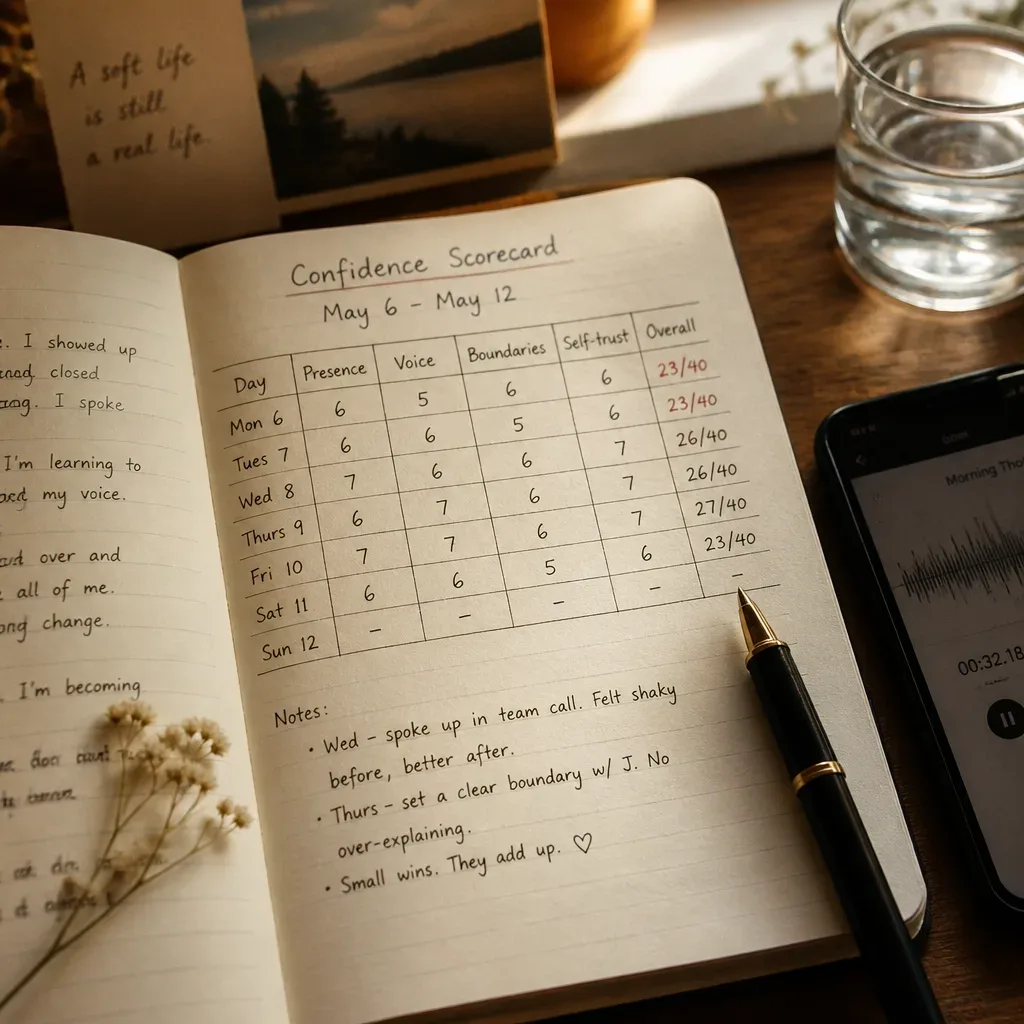
Do not measure only by how inspired you feel. Feelings move. Instead, track behavior for 14 mornings. Did you start the task 5 minutes sooner? Did you speak one sentence more clearly? Did you recover faster after a mistake? Did you check your phone after listening instead of before? Small measures tell the truth better than big declarations.
Use a simple scorecard:
| Morning marker | Yes or no |
|---|---|
| I listened before messages | |
| I repeated one line after audio | |
| I took one matching action | |
| I noticed less self-attack | |
| I returned after doubt |
Cohen and Sherman noted in 2014 that self-affirmation effects are often context-sensitive. That matters. Your practice may work best before social risk, performance review, creative work, dating, exams, or any moment where being seen feels tender. It may not change every part of the day. It does not have to. One clean doorway is enough.
If you want a broader frame for seeing and shaping your intention, the Manifestation pillar can help. If you want the language side, return to the Affirmations pillar. If you want the daily form, come back to the AYA Method, where the Dream-Self Moment keeps the practice simple enough to live with.
There is one more sign. You may start to hear the line before you press play. While brushing your teeth. While opening the laptop. While pausing before a reply. That is not performance. That is memory. The voice has become available.
Let the first voice of the day be yours.