morning rituals
Night Shift Morning Routine: 5-Minute Audio
A night shift morning routine for coming home, protecting sleep, and using a 5-minute Dream-Self audio without adding another hard task.

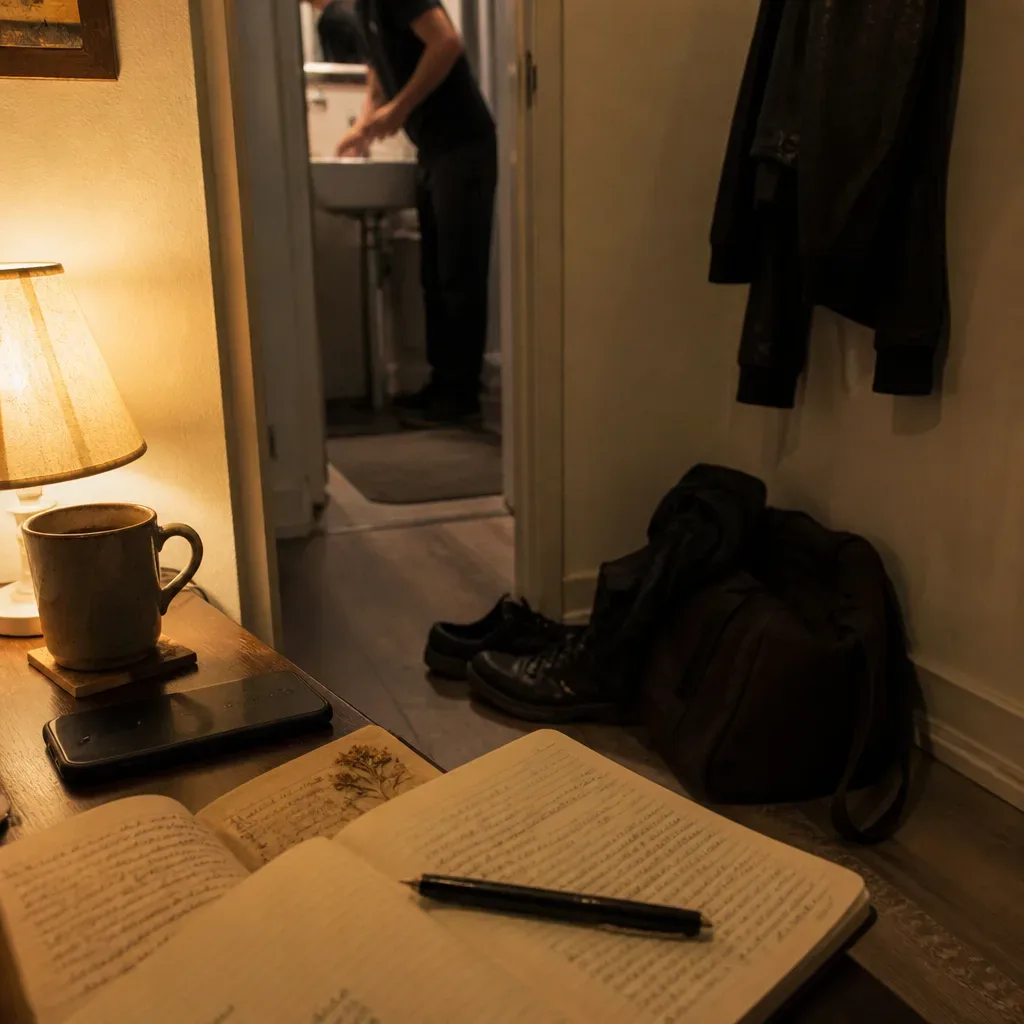
September 20. The kettle clicked off while my work shirt was still damp at the collar. A night shift morning routine should help the body come down, protect daytime sleep, and make one small identity promise before bed. Mine uses a 5-minute Dream-Self audio after I wash my hands.
What counts as morning when I work nights?
Morning is the first quiet transition after work, not the number printed on the kitchen clock.
I had to learn this in the least romantic way: standing in my socks at 6:42 a.m., too tired to cook and too wired to sleep. People who work standard hours say morning as if it belongs to sunlight. Night workers know better. Morning is the place where the shift stops following you into the house.
The U.S. Bureau of Labor Statistics has reported that about 16% of wage and salary workers follow non-daytime schedules, including evenings, nights, rotating shifts, and split shifts. That is not a tiny exception. It is millions of bodies trying to sleep while delivery trucks start, children leave for school, and neighbors decide the vacuum is reasonable.
So I define my morning by sequence, not sunlight:
- I arrive home.
- I reduce light and noise.
- I listen to the 5-minute audio.
- I write one line.
- I go toward bed.
This matters because routines fail when the label is wrong. If I call 7 a.m. my night, I behave as if I have already missed the day. If I call it my morning, I know what job it has. It is not for ambition. It is for landing.
The American Academy of Sleep Medicine recommends at least 7 hours of sleep for adults, and shift workers are often the ones asked to perform on less. I keep that number visible because it corrects my ego. A routine that steals 45 minutes from sleep is not discipline. It is bad accounting.
The clock does not get to decide whether I kept my promise. The sequence does.
I keep my night shift morning routine under 12 minutes. Five minutes belong to the audio. Two belong to water and washing my face. One belongs to lowering the room. One belongs to writing. The rest is margin, because tired people need margin more than they need advice.
If I want more context for the larger practice, I keep returning to the Manifestation pillar, but I read it differently on night shift. I am not trying to ask for a cinematic life at 7 a.m. I am trying to become the person who does the next true thing while exhausted.
Why do I start with light before the audio?
I start with light because the brain treats brightness as instruction, and I do not want to instruct myself to wake up.
Dr. Andrew Huberman often explains that light exposure is one of the strongest signals for the circadian system. For day workers, morning light can help set the clock. For night workers coming home after a shift, bright outdoor light can be the wrong message at the wrong time. I do not make this complicated. If it is safe, I wear sunglasses on the commute. At home, I use the small lamp near the shoe rack, not the ceiling light.
The National Institute for Occupational Safety and Health has warned that shift work can disrupt sleep, digestion, alertness, and family life. The warning sounds broad because the disruption is broad. A bright kitchen can become a supervisor. A phone can become a second shift. A group chat can take the nervous system by the collar.
My first three minutes look like this:
| Minute | Action | Why I keep it |
|---|---|---|
| 0-1 | Shoes off, work bag down | Signals the shift is over |
| 1-2 | Wash hands, dim light | Moves the body from work to home |
| 2-3 | Water in the blue mug | Gives the routine a physical start |
That table looks almost too plain. Good. Plain survives fatigue. In the habit app I built, about fourteen thousand people taught me the same lesson in different data: the action users can do on a bad day beats the action they admire on a good day.
I do not start with the audio while standing in the hallway. I tried. I wandered. I checked messages. I opened the refrigerator and forgot what I wanted. Now I sit in the same chair, the one by the small window. The chair matters. BJ Fogg’s Tiny Habits model says behavior becomes easier when it is attached to an existing prompt. My prompt is not a mood. My prompt is hands washed, water poured, chair.
A tired mind does not need a bigger promise. It needs a smaller door.
I keep the AYA Method here because it is a daily audio manifestation practice. Each day I listen to a short personalized recording, my Dream-Self Moment, narrated from the version of me who has already named the life I intend. Listening is the practice. Repetition is the work. The audio is the method.
How do I use a 5-minute Dream-Self audio without waking myself up?
I listen seated, in low light, at low volume, with no extra task attached.
The temptation is to make the audio do too much. I know that temptation. I have opened notes apps after listening and written plans that looked brave at 7:10 a.m. and cruel by 3 p.m. Night shift humbled that out of me. The audio is not the start of a productivity block. It is a soft identity cue before sleep.
In psychology, implementation intentions are the if-then plans studied by Peter Gollwitzer and others. A 2006 meta-analysis found medium-to-large effects across many goal settings, with an average effect size often reported around d = 0.65. I use the simplest version: after I wash my hands and pour water, I sit down and press play.
The audio is five minutes because five minutes is short enough to repeat after a hard shift. It is also long enough for the body to stop rushing. I keep the volume around the lowest setting where I can still understand every word. If I have to strain, I become alert. If it is too loud, I become irritated. The middle is boring and useful.
Here is the exact order I kept this week:
- Put the phone on Do Not Disturb.
- Open the audio before opening any message.
- Sit with both feet on the floor.
- Listen once, without fixing the wording.
- Put the phone face down when it ends.
Joe Dispenza writes often about rehearsing a future self until the nervous system recognizes the pattern. Neville Goddard used the language of feeling the wish fulfilled. I translate both into something less theatrical: I practice the identity I want my tired body to remember.
Identity is not a speech I give myself. It is the instruction I repeat when nobody is watching.
The Affirmations pillar helped me separate a sentence from a practice. I may keep one daily affirmation on the page beside my bed, but it is not the center. The audio is the method. The sentence is a small handle I can hold when I am too tired for a paragraph.
What should I do in the first 12 minutes after the shift?
I should remove decisions, lower stimulation, listen once, and make sleep the obvious next step.
I am going to write the routine in minutes because night shift turns vague advice into fog. The body asks, what now. The routine answers before I can negotiate. I learned this from product design more than from spirituality. Defaults win because they remove the cost of choosing.
A practical night shift morning routine can look like this:
| Time | Practice | Keep it this small |
|---|---|---|
| 0:00 | Enter, shoes off, bag in one place | No unpacking beyond food safety |
| 1:00 | Bathroom, wash hands, brush teeth if ready | No mirror inspection |
| 3:00 | Water or tea without caffeine | Same mug if possible |
| 4:00 | Dim room, phone on Do Not Disturb | No social feed |
| 5:00 | Dream-Self audio | One listen only |
| 10:00 | One line in notebook | Evidence, not essay |
| 11:00 | Bedroom cue | Mask, curtains, alarm |
The Centers for Disease Control and Prevention notes that adults who sleep less than 7 hours are more likely to report chronic health conditions such as heart disease, diabetes, and depression. That does not mean one short sleep ruins a person. It means the routine should serve sleep before it serves self-improvement.
My one-line note is deliberately dull. Yesterday it said, “Listened after washing hands, did not open email.” That was enough. In behavior data, binary evidence is powerful because it leaves less room for storytelling. Kept or not kept. Heard or not heard.
I do not use the Manifestation Board at this hour unless it is already open to one image and one sentence. If I start rearranging pictures after shift, I lose sleep. The board can be useful in the afternoon after I wake. Before bed, I need fewer doors, not more.
This is also where Astrology and manifestation can stay gentle if you use it. I may notice the moon or a transit later, but I do not let it complicate the sleep gate. Night shift already has enough moving parts.
What if I am too wired, hungry, or sad after work?
I adjust the routine by state, not by shame.
Some mornings I come home with my jaw tight. Some mornings I am hungry in a way that feels personal. Some mornings, especially after difficult customers or hospital corridors or warehouse alarms, I feel sad before I can name why. A rigid routine breaks there. A small menu holds.
Shift work research often describes circadian misalignment as a mismatch between the body’s internal clock and required activity. The International Agency for Research on Cancer classified night shift work involving circadian disruption as probably carcinogenic to humans, Group 2A. I do not carry that sentence as fear. I carry it as permission to take the routine seriously.
Here is my state menu:
- Too wired: shower first, audio second, no writing beyond one checkmark.
- Too hungry: eat the same small meal, then audio in the chair.
- Too sad: audio first, blanket over legs, write one true sentence.
- Too angry: put bag away, wash face with cool water, then listen.
- Too sleepy: skip tea, set alarm first, listen lying down if needed.
The rule is that the audio stays, but the posture can change. Five minutes in a chair is ideal. Five minutes lying down is acceptable. Five minutes with tears is still five minutes. The practice is not invalid because the morning is ugly.
Consistency is not sameness. Consistency is returning without making a ceremony out of the return.
The Journal of Behavioral Medicine has published work linking self-monitoring with better health behavior outcomes, especially when tracking is immediate and simple. That is why I do not score my mood with ten categories after shift. I mark one thing: listened, yes or no. If I want a second mark, I add sleep start time.
For the wider frame, I keep a bookmark to the Manifestation pillar. It reminds me that asking for a life is not the same as performing certainty. Some mornings I am uncertain and still press play. That counts.
How do I keep the routine when my schedule rotates?
I keep the anchor stable and let the clock move around it.
Rotating schedules are where beautiful routines go to be humbled. A nurse on three twelves, a parent on split shifts, a warehouse worker moved from nights to early mornings for two weeks: the clock cannot be trusted. The anchor can.
My anchor is not 7 a.m. It is arrival plus handwashing. If I wake for a 5 p.m. shift, I do not call that part the night shift morning routine. That is a separate wake-up routine. This one belongs after work, before sleep. Two different doors. Two different jobs.
Sleep researchers often recommend consistency in wake time and light timing, but shift workers may not fully control either. In small occupational studies, even modest schedule regularity is associated with better sleep duration and lower fatigue. When full regularity is impossible, I protect the first controllable cue.
I use a three-version rule:
- Full version, 12 minutes: light down, water, audio, one line, bed setup.
- Short version, 6 minutes: audio, alarm, curtains.
- Emergency version, 90 seconds: press play, hear the first minute, phone down, sleep.
The emergency version looks like cheating until you need it. Then it looks like wisdom. A streak should not require a perfect day. In my habit-tracking app, travel days and schedule changes were the two most common places people broke patterns. The users who recovered fastest had a minimum version ready.
I also keep my Dream-Self audio downloaded. No searching. No update. No dependence on a signal in a train tunnel. The fewer technical steps between me and listening, the less likely fatigue gets a vote.
If I want one written sentence, I borrow from the Affirmations pillar and keep it plain: “I am becoming someone who keeps small promises after hard nights.” I do not need ten lines. I need the one I will still believe when my eyes hurt.
How will I know the routine is working?
I know it is working when it becomes easier to start, easier to sleep, and easier to respect myself after imperfect shifts.
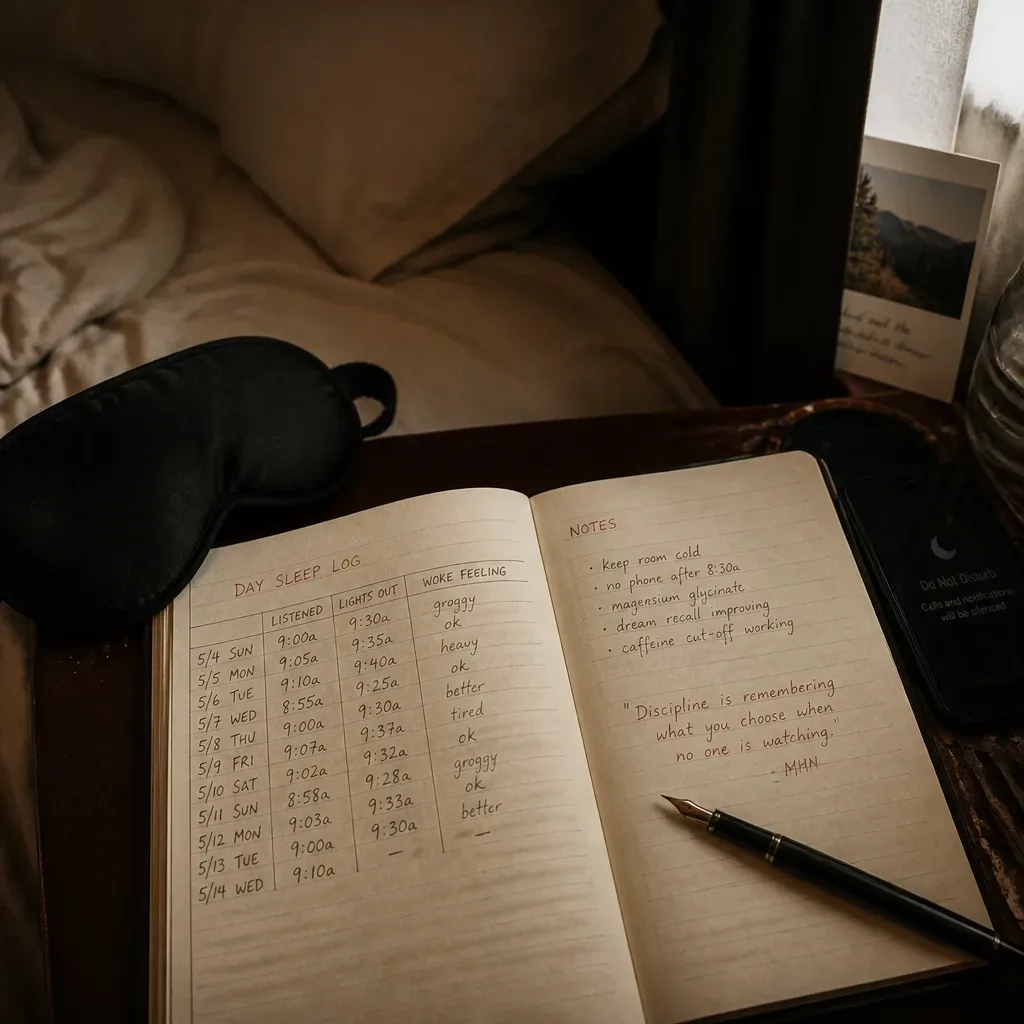
I track only three measures for seven shifts. Not forever. Seven shifts. That is enough to see friction without turning my bedroom into a lab. The measures are simple: Did I listen? How long until lights out? What was the first feeling after waking?
The American Psychological Association has written for years about habits forming through repeated context cues, not through one heroic decision. Popular culture likes 21 days, but habit research is less tidy. A 2009 study in the European Journal of Social Psychology found an average of 66 days for a behavior to become automatic, with wide variation by person and behavior.
So I do not ask the routine to feel natural on day three. I ask it to be small enough to repeat while unnatural. That is the contract.
My tracking page looks like this:
| Shift | Listened? | Lights out after arrival | Woke feeling |
|---|---|---|---|
| 1 | Yes | 28 min | Heavy, calmer |
| 2 | Yes | 21 min | Neutral |
| 3 | No | 54 min | Irritated |
| 4 | Yes | 19 min | Quiet |
The missed day is useful. I can see what happened. I opened email while taking off my shoes. That single breach cost me almost half an hour. No moral drama. Just data.
I also watch for identity evidence. Did I speak to myself less harshly? Did I stop treating daytime sleep as laziness? Did I feel the Dream-Self audio becoming familiar instead of impressive? Familiar is good. Familiar means the nervous system is no longer surprised by care.
For a wider daily structure, I sometimes return to the AYA Method page and remind myself of the definition. Listening is the practice. Repetition is the work. The audio is the method. That sentence keeps me from adding decorations when what I need is repetition.
The proof of a routine is not how inspired I feel starting it. The proof is whether I can keep it when I am ordinary.
What is the simplest version I can try tomorrow morning?
The simplest version is wash hands, dim light, listen for five minutes, write one line, and go to bed.
I would not start with a perfect bedroom, a new notebook, a meal plan, blue-light glasses, blackout curtains, and a rewritten life. Some of those may help. None of them should become the entry fee. The entry fee is five minutes and a place to sit.
Here is the version I would hand to myself on a tired paper receipt:
- Put your work bag in the same place.
- Wash your hands.
- Turn on one low light only.
- Sit down before checking messages.
- Listen to the 5-minute Dream-Self audio.
- Write: “I kept this today.”
- Set the alarm and leave the room alone.
That is all. If caffeine timing matters for you, the Sleep Foundation commonly notes that caffeine has a half-life of around 5 hours, though it varies by person. I stop pretending I can drink strong coffee near the end of shift and still sleep like a saint. Biology does not care about my argument.
If you want to place this inside a broader practice, use Astrology and manifestation as weather, not law, and use affirmations as a handle, not the whole door. The night shift morning routine has one center. The audio. Everything else should make listening and sleeping easier.
I am writing this at the kitchen table now. The city outside is starting its regular day. Mine is ending. The blue mug is empty. The chair is still warm.
Sunday morning, though the calendar disagrees.