audio manifestation
Passive Manifestation: 5 Minutes for Busy Days
Passive manifestation can fit into a full day through one short audio practice that trains attention, memory, and identity without extra strain.

Your phone is on the counter. The kettle clicks off. Passive manifestation is a 5-minute practice where you listen to a short future-self audio, let one line settle, and take one small matching action. It works best when it is repeated daily, not when it is made dramatic.
What is passive manifestation, really?
Passive manifestation is manifestation practiced through receptive attention rather than effort-heavy ritual.
It does not mean you do nothing. It means the body is quiet while the mind rehearses a new self-picture. In a busy day, that distinction matters. Five minutes can be realistic when 45 minutes becomes another reason to feel behind. The American Psychological Association reported in 2023 that 27% of U.S. adults said most days were so stressful they could not function as well as they wanted. A practice that asks for less can be the one you actually keep.
The Manifestation pillar explains manifestation as attention, belief, identity, and action working together over time. Passive manifestation lives inside that frame. You are not waiting for life to hand you proof. You are listening until your attention knows what proof would look like.
Passive manifestation is not laziness. It is rehearsal without noise.
This is where audio helps. The AYA Method is a daily audio manifestation practice. Each day you listen to a short personalized recording — your Dream-Self Moment — narrated from the version of you who has already manifested the life you intend. Listening is the practice. Repetition is the work. The audio is the method.
Neville Goddard wrote often about living from the wish fulfilled, while Joe Dispenza teaches mental rehearsal as a way to pair thought with felt state. Those are not the same as clinical proof. Still, they name something many people know from daily life: the scene you repeat becomes easier to choose. Cognitive psychology has studied mental imagery for decades, and a 2016 review in Psychological Bulletin found that mental imagery can affect emotion more strongly than verbal thinking in some contexts.
Why does audio fit a busy day better than another routine?
Audio fits busy days because it removes the need to stare, write, plan, or perform.
When a practice needs a clean desk, a candle, a journal, and the right mood, it is fragile. Audio is simpler. You can sit. You can walk slowly. You can listen with your eyes closed before the calendar starts speaking for you. Pew Research Center reported in 2024 that 90% of U.S. adults own a smartphone. That means the tool is already near you, even when your notebook is not.
The point is not to stack more tasks onto a tired morning. The point is to make the practice so small that resistance has less to hold. In behavior design, BJ Fogg has written that tiny habits work when they follow an existing prompt and feel easy enough to repeat. A 5-minute audio practice uses the same logic. Same cue. Same length. Same return.
Audio also carries pacing. A written affirmation can become something you scan. A visual board can become something you stop seeing after 2 weeks on the wall. A voice can interrupt that drift. It gives your mind a tempo. It gives your breath somewhere to land.
| Practice type | What you do | Best for | Risk on busy days |
|---|---|---|---|
| Audio practice | Listen to a Dream-Self Moment | Repetition and identity rehearsal | Skipping if headphones are buried |
| Written affirmation | Read or repeat one sentence | Clear language | Going flat from overuse |
| Manifestation Board | Look at chosen images | Visual memory | Becoming decoration |
| Long journaling | Write freely | Pattern finding | Needing too much time |
If you use Affirmations pillar practices, keep them close to the audio, not above it. One sentence after listening can be enough. The sentence is a complement. The listening is the method.
How do you do passive manifestation in 5 minutes?
You do it by making the audio the center, then letting the smallest next action prove you were listening.
Set a timer if you need a boundary. Five minutes is short enough to protect and long enough to change the tone of your attention. In a 2009 study in the European Journal of Social Psychology, Phillippa Lally and colleagues found that habit automaticity took 66 days on average, with a wide range from 18 to 254 days. The lesson is gentle. You are not late on day 6. You are building return.
Use this simple sequence:
- Choose one cue. Pick something already stable, like brushing teeth, starting the kettle, or sitting in your parked car.
- Press play. Listen to your Dream-Self Moment. Do not mix it with email, news, or anything that asks for quick decisions.
- Notice one line. Let one phrase feel true enough. Not perfect. True enough.
- Name one matching action. Send the message. Drink the water. Open the file. Put the card away. Make it small.
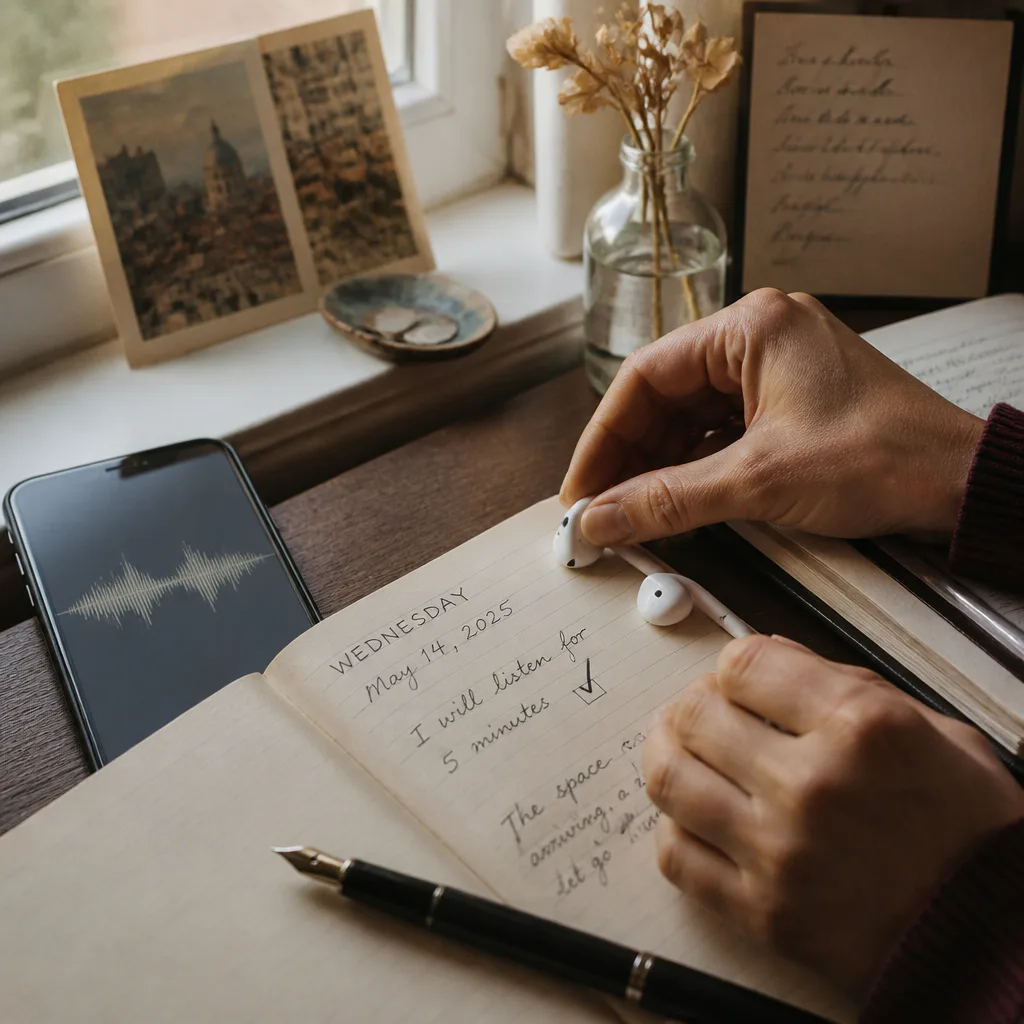
- Mark the return. Track only whether you listened. A check mark is plenty.
The smaller the practice, the less your mood gets a vote.
I like tracking this the way I track sleep: not as a moral score, but as a signal. If I miss 3 days, I do not ask what is wrong with me. I ask where the cue broke. That is engineering. That is kindness with data.
Dr. Andrew Huberman often speaks about attention and state shifts through the nervous system, especially the role of breath and sensory input. You do not need to make a neuroscience claim to use the practical point. A voice, a stable cue, and a quiet body can help you cross from scattered to here.
What should you listen for during the audio?
Listen for the sentence that your body can almost believe today.
Not every line has to land. A personalized audio may describe the future self you intend, but the daily work is usually smaller than the full picture. You are listening for one believable thread. In clinical settings, implementation intention research by Peter Gollwitzer has shown that if-then plans can improve follow-through across many studies. Your line can become that kind of cue: if I feel the old doubt, then I return to this sentence.
Some mornings, the line might be practical. I answer with patience. I finish the first draft before checking the numbers. I choose the food that helps my afternoon self. Some nights, the line might be emotional. I am not behind. I can be steady and still want more. One clean sentence can change the next 10 minutes.
Good listening has a few signs:
- Your shoulders lower by even 1%.
- You remember a choice you can make today.
- You feel less interested in proving and more interested in practicing.
- You notice the same line returning later, in a meeting, a kitchen, or a train seat.
- You can name one action without making a whole plan.
This is why passive manifestation is not passive in the cheap sense. It asks for attention. It asks for honesty. It asks you to hear the difference between fantasy and instruction.
A true future self does not flatter you. It gives you your next honest move.
Small studies on guided imagery have linked repeated imagery practice with reduced stress and improved coping, including work published in the Journal of Behavioral Medicine. The findings vary by method and group size, so it is better to stay modest. Still, repetition plus felt rehearsal has enough practical support to deserve 5 quiet minutes.
Where do affirmations and a Manifestation Board fit?
Affirmations and a Manifestation Board can support the practice, but they do not replace the audio.
This matters because busy people often try to build a whole system at once. Then the system becomes another tab left open in the mind. In Aya, the daily affirmation and Manifestation Board are complements. They can help you name and see what the audio has already placed in motion. They are not pillars beside the Dream-Self Moment.
Use affirmations when language needs to become simpler. A line from the audio can become the day’s sentence. If your Dream-Self Moment says you speak clearly in hard rooms, your affirmation might be: I can be kind and direct. That is enough. Research on self-affirmation, including work by Claude Steele and later health behavior studies, suggests that values-based statements can reduce defensiveness in some situations. The key is that the phrase has to be connected to something real.
Use a Manifestation Board when images help memory. A board can hold the apartment corner, the book draft, the calmer calendar, the person you are when you keep your promises. Keep it quiet. Three images can do more than 30 if the 3 are true.
For timing, keep the order clean:
- Listen to the audio.
- Let one sentence land.
- Add or read one affirmation if it helps.
- Glance at the board if it makes the scene easier to remember.
- Take one matching action.
You can also bring in timing practices if they feel grounding. Astrology and manifestation can give some people a calendar rhythm, such as using a new moon for intention review. Treat it as support, not pressure. The daily return is still simple: listen, remember, act.

How do you keep passive manifestation from becoming background noise?
You keep it alive by changing your attention, not by making the practice longer.
Any repeated audio can become wallpaper. That is not a failure. It is the brain saving effort. A 2010 paper by Wendy Wood and David Neal described habits as cue-response patterns that can run with less conscious attention over time. That automaticity is useful for showing up, but the listening still needs one fresh point of contact.
Try rotating the focus each day while keeping the audio stable:
| Day | Focus | Question to ask after listening |
|---|---|---|
| Monday | Body | Where did I soften? |
| Tuesday | Choice | What is one action that matches? |
| Wednesday | Language | Which sentence stayed? |
| Thursday | Boundary | What would I stop repeating? |
| Friday | Evidence | What proof is already here? |
| Weekend | Rest | What can be easy and still count? |
The practice stays quiet, but it does not go numb. You are not hunting for a new high. You are training recognition. A 5-minute repeat can be different each day because you are different each day.
There is also a practical rule: do not listen while doing anything that could harm you if your attention softens. Not while driving in traffic. Not while chopping quickly. Not while walking through a crowded crossing. Passive manifestation should make the day safer, not blur it.
Repetition is not proof that nothing is happening. Repetition is how the new self stops feeling theatrical.
If you miss a day, keep the repair small. The best streak is not the one that never breaks. It is the one you can resume without self-punishment. In many habit studies, consistency beats intensity because it lowers the cost of coming back. The return is the metric.
What changes after 7 days of listening?
After 7 days, you may not have a new life, but you should have a clearer pattern of attention.
Seven days is a short test, not a verdict. Use it to see what the practice is doing to your choices. Are you pausing before the old reply? Are you noticing one more chance to act like the self in the audio? Are you less hungry for outside proof? Those are small signals. Small signals count.
A simple 7-day review can be enough:
- Listened: How many days did you press play?
- Line remembered: Which phrase came back most often?
- Action taken: What did you do that matched the audio?
- Resistance: Where did the cue break?
- Adjustment: What will make tomorrow easier by 1 step?
Do not over-measure the mystery out of it. Measurement should serve attention, not replace it. As an engineer, I trust logs because they show behavior without drama. But a log cannot tell the whole truth of a softer nervous system, a cleaner no, or a quiet yes spoken on time.
The AYA Method gives you the repeatable part: a short personalized audio from your Dream-Self Moment. The Manifestation pillar gives the wider frame. The practice itself stays small enough to keep.
Passive manifestation is useful because it respects the life you already have. The workday. The dishes. The child calling from another room. The body that does not want another demanding ritual. Five minutes is not a consolation prize. Five minutes is a door you can open again tomorrow.
Keep it soft enough to return to.