mindset
Raise Your Vibration in 5 Minutes With Dream-Self Audio
Learn how to raise your vibration in 5 minutes with Dream-Self Audio, a quiet daily practice that uses breath, repetition, and one next action.

October 24th. To raise your vibration in 5 minutes, I use Dream-Self Audio as a brief state-change practice: sit down, listen once, breathe slower, and let one future-self sentence become the next small action. It is not a mood cure. It is a nervous-system cue.
What does it mean to raise your vibration in five minutes?
To raise your vibration in five minutes means changing your felt state quickly enough that your next choice comes from steadier ground.
I know the phrase can sound too bright for a gray morning. I use it anyway, carefully. This morning the kettle clicked off at 7:12, and I was standing in the kitchen with my phone in my hand, already half-lost in other people’s noise. I did not need a new personality. I needed a lower pulse, a kinder sentence, and one next thing I could do.
In the research language I live with, this is closer to affect regulation than magic. A 2014 review by Cohen and Sherman in the Annual Review of Psychology described self-affirmation as a process that can reduce defensiveness and help people act from a wider view of themselves. That is a modest claim, and I like modest claims. They are easier to keep.
Five minutes can matter because the body changes faster than belief does. Slow breathing studies often use windows as short as 5 minutes and measure shifts in heart-rate variability, a marker related to parasympathetic activity. Dr. Andrew Huberman has also popularized the physiological sigh, a short breathing pattern studied in respiratory science, as a fast way to downshift arousal. I do not treat one breath as salvation. I treat it as a door handle.
A state shift is not the whole change. It is the room where change becomes possible.
When I write about manifestation, I try to keep the word close to behavior. Naming what I want is not enough. I need my nervous system to tolerate the version of me who acts on it.
Why does Dream-Self Audio work faster than trying to think positive?
Dream-Self Audio works faster because the voice, timing, and personal language reduce the work of inventing better thoughts on command.
Trying to think positive can become another task I fail at before breakfast. Audio is different. I press play. The sentence arrives from outside my immediate mood, even though it was made from my own intention. In the AYA Method, the practice is daily audio: each day you listen to a short personalized recording, your Dream-Self Moment, narrated from the version of you who has already manifested the life you intend. Listening is the practice. Repetition is the work. The audio is the method.
The mechanism I trust most is repetition plus self-reference. Neuroimaging studies on self-referential processing often implicate midline cortical regions, including the medial prefrontal cortex, when people evaluate information about themselves. A 2016 paper in Social Cognitive and Affective Neuroscience linked self-affirmation to reward-related and self-processing regions during health-message tasks. That does not prove a dream-self recording changes destiny. It suggests self-relevant language has a different weight in the brain than generic advice.
I notice this in my hands before I notice it in my thoughts. When the recording says, in my own chosen words, that I answer the message calmly, I stop clenching the mug. The sentence is specific. It gives my mind less room to argue.
Generic affirmation: “Everything is working out.”
Dream-Self sentence: “I send the clear reply before 9, and I do not apologize for needing time.”
The second one has a clock in it. It asks something of me. That is why I also keep the affirmations I use plain and testable. A sentence becomes stronger when Tuesday can verify it.
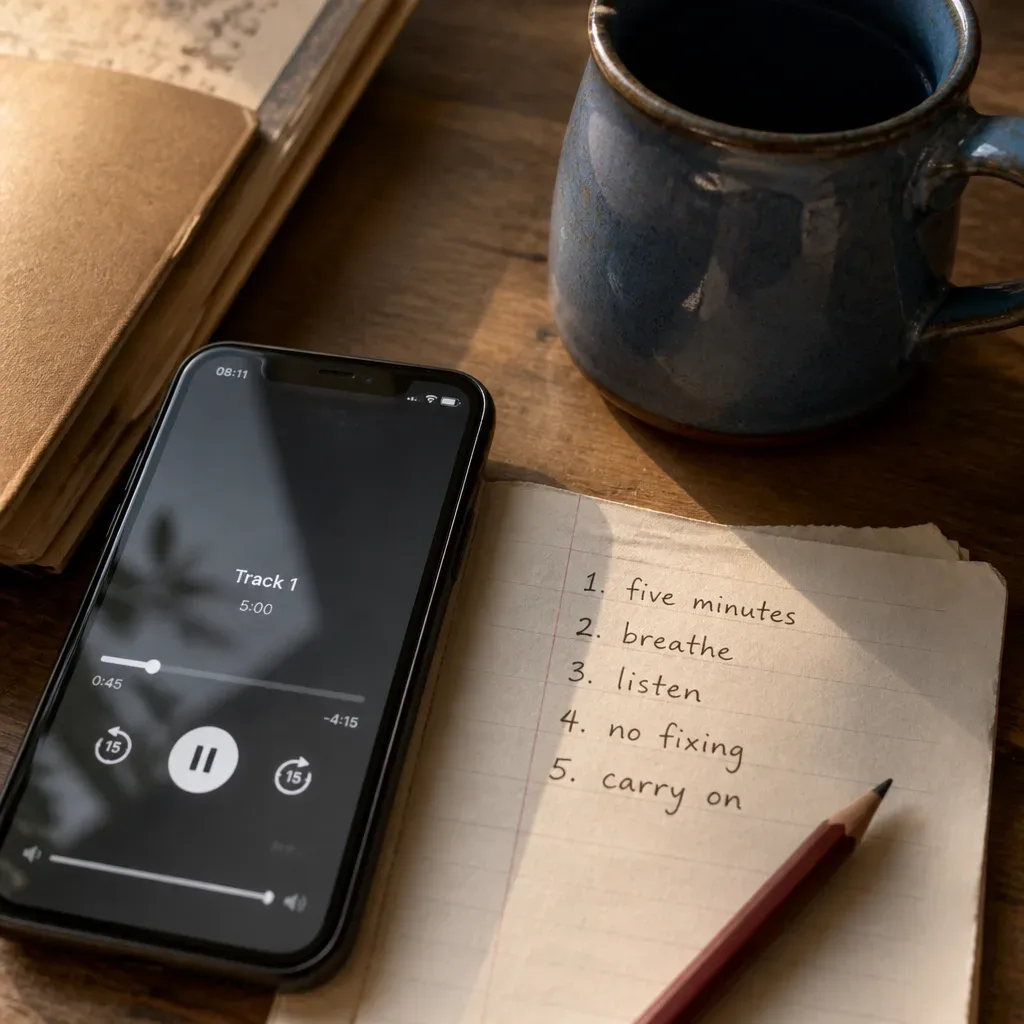
How do I do the five-minute Dream-Self Audio practice?
I do the practice by pairing one short audio with breath, attention, and a single action before my mind negotiates its way out.
Here is the version I used today. It took 5 minutes and 18 seconds because I sat for a few extra breaths after the recording ended. The number matters to me. I have made many practices too large to keep. Five minutes is small enough to repeat even when the sink is full.
- Minute 0:00 to 0:30, sit down. I put both feet on the floor and turn the phone face down. A 2023 Pew Research Center report found that 97% of U.S. adults own a cellphone, which means the distraction is usually already in the room with us.
- Minute 0:30 to 1:00, press play. I start the Dream-Self Audio before checking messages. The order matters. Attention is cleanest before I spend it.
- Minute 1:00 to 3:30, breathe with the recording. I let the exhale lengthen. I do not count perfectly. I just make the body a little less braced.
- Minute 3:30 to 4:30, choose one sentence. I listen for the line that feels both kind and possible.
- Minute 4:30 to 5:00, move. I take one action that matches the sentence.
I learned this from habit research more than from hope. In a 2009 study in the European Journal of Social Psychology, Phillippa Lally and colleagues found that habit formation took a median of 66 days, with wide variation from 18 to 254 days. The lesson was not that 66 is a sacred number. The lesson was that automaticity grows through repeated context.
So I keep the context boring. Same chair. Same blue mug. Same time if I can. The practice becomes less dramatic and more dependable.
| Minute | What I do | Why it matters |
|---|---|---|
| 0 to 1 | Sit, silence alerts, press play | Reduces decision load |
| 1 to 3 | Listen and slow the exhale | Gives the body a safety cue |
| 3 to 4 | Notice one sentence | Selects the identity cue |
| 4 to 5 | Take one small action | Turns state into evidence |
The brain trusts repetition more than intensity.
That sentence has saved me from many elaborate plans.
What should I listen for in the recording?
I listen for the sentence that is emotionally warmer than my current thought but still believable enough to act on today.
Believability is the hinge. If the recording says something so far from my lived evidence that my whole body says no, I do not force it. I look for the next sentence down, the one with a handle. In clinical and health psychology, this is part of why specific, value-linked statements often work better than inflated claims. A 2015 review in Health Psychology Review noted that mental imagery and self-regulation techniques tend to help most when tied to concrete goals and behaviors.
This week, my sentence was not “I am fearless.” I am not fearless. My sentence was, “I can feel the fear and still write the first paragraph.” That was true enough to use. I wrote 212 words after listening, which is not a miracle. It is a receipt.
I keep a small checklist in the notes app, not because the checklist is sacred, but because memory edits itself. After the audio, I ask:
- Which sentence did my body soften around?
- Which sentence made me sit taller?
- Which sentence asked for a real action in the next hour?
- Which sentence felt too false today?
- What did I do within 10 minutes of listening?
There is an old Neville Goddard idea about living from the wish fulfilled. I read it as a practice of identity rehearsal, not as permission to ignore rent, grief, or other people. Joe Dispenza writes about rehearsing future states too. I am more cautious than his strongest claims, but I recognize the common thread: repeated inner rehearsal can change what feels available.
The useful sentence is not always the prettiest one. The useful sentence is the one that gets your shoes on.
How can I keep raising my vibration grounded instead of drifting into magical thinking?
I keep it grounded by asking the practice to change my state and behavior, not to control other people or physics.
This is where I become strict with myself. I have seen manifestation language become a way to blame the tired, the sick, or the unlucky. I do not want that in my kitchen. If raising my vibration means I am never allowed to be sad, then the practice has become another performance. If it means I can meet sadness with steadier breath and a cleaner next step, I can stay.
The American Psychological Association has repeatedly noted that chronic stress affects attention, sleep, and health behavior. That is enough reason to practice state regulation without pretending state regulation fixes everything. A five-minute audio can help me send the email. It cannot guarantee the reply.
I use three rules:
- No blaming. A hard day is not proof that I failed the practice.
- No bargaining with reality. I name what I want, then I act where I have agency.
- No replacing care. Therapy, medical support, rest, and honest conversation still count.
The astrology and manifestation notes I keep are similar. Sometimes timing gives me language for reflection. It does not remove responsibility. The moon can mark a page. It cannot write the email for me.
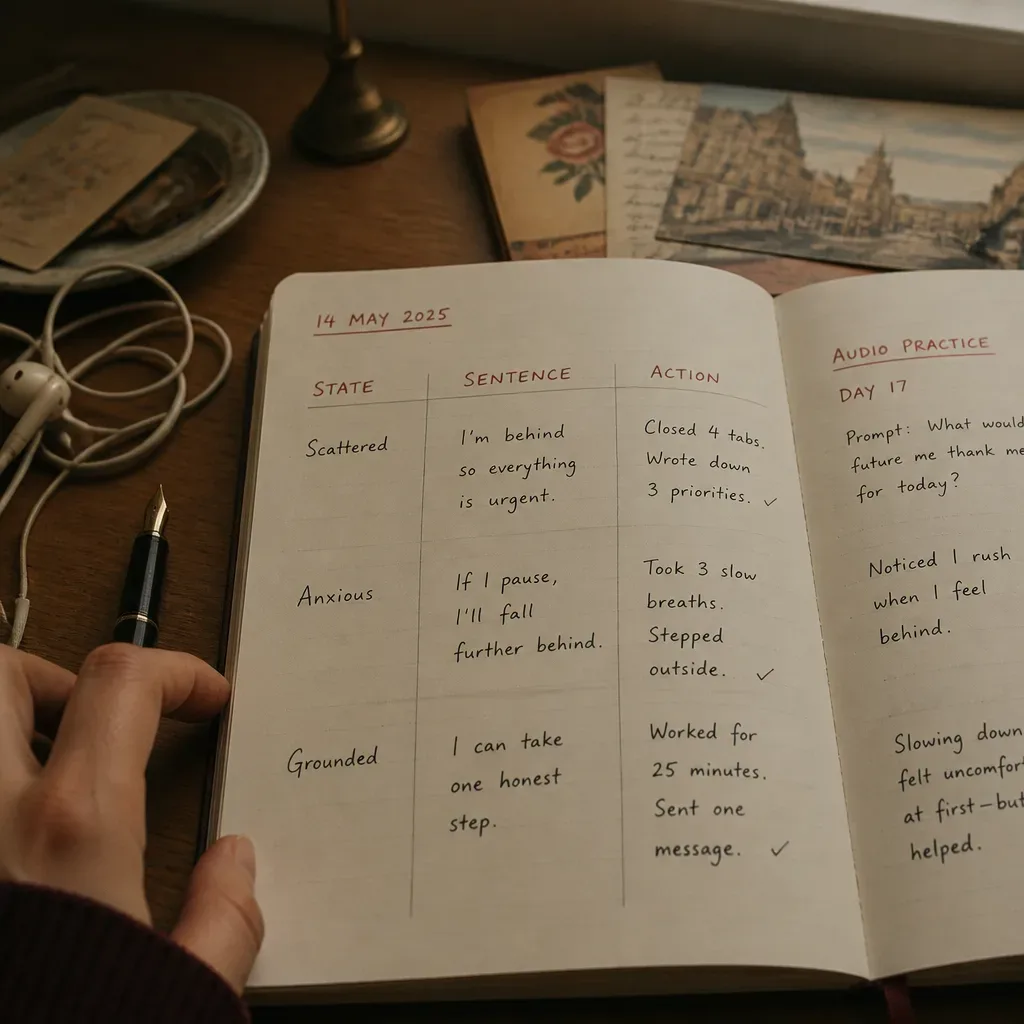
In research terms, I am separating mechanism from claim. The plausible mechanism is repeated, emotionally salient, self-relevant audio paired with action. The larger claim, that my private state directly arranges the outside world, is not something I can verify in a lab. Princeton’s Global Consciousness Project has reported correlations around major world events, but its interpretation remains debated and is not a basis for daily decision-making.
Calibrated belief is not cold. It is how I keep a practice tender without making it false.
What changes should I notice after one week?
After one week, I would look for small changes in recovery time, self-talk, and follow-through, not a completely different life.
Seven days is enough to collect signals. It is not enough to demand a new identity. When I listen daily, the first change is usually friction. I start the thing with less argument. On Monday, I may avoid the document for 40 minutes. By Friday, I may avoid it for 12. That counts. The nervous system often changes by inches.
In behavior science, measurement protects me from fantasy and despair. Gollwitzer’s work on implementation intentions, often summarized as “if-then” planning, has shown across many studies that linking a cue to a behavior can improve follow-through. Dream-Self Audio can become the cue. “After I listen, I open the draft.” That is plain enough to test.
I track only 3 things because more than 3 becomes a second job:
- State before listening, 1 to 10. Not a moral score. Just weather.
- Sentence kept. The one line I carried.
- Action taken within 10 minutes. Evidence, not mood.
A week later, I read the notes. If the numbers did not change but the actions happened, I trust the actions. If the mood improved but nothing moved, I adjust the recording. The practice is not meant to make me float above my life. It is meant to help me enter it more honestly.
I also return to the larger Manifestation pillar when I need definitions, because words get slippery when I am tired. For me, manifestation practice has to include attention, identity, and behavior. Leave out behavior, and the whole thing becomes incense over avoidance.
What if I feel nothing during the five minutes?
If I feel nothing, I still finish the audio and take the smallest matching action, because repetition often works below the level of drama.
This is the part I wish someone had told me earlier. A quiet practice may feel like nothing while it is working. I have had mornings where my Dream-Self Audio sounded flat. I sat there with cold coffee and no glow at all. Then I washed the cup, opened the document, and answered the message I had been avoiding for two days. That was the result.
A 2012 paper in Nature Reviews Neuroscience on habit and automaticity described how repeated actions in stable contexts can become less dependent on immediate motivation. That is why I do not ask the five minutes to feel special. I ask them to become familiar. Familiar is underrated.
If nothing shifts, I check four ordinary things before I decide the practice failed:
- Did I listen while multitasking?
- Was the audio too vague?
- Did I skip the action afterward?
- Am I exhausted enough that rest is the real next step?
Sometimes the most honest way to raise your vibration is to go to bed at 9:30. Sometimes it is water. Sometimes it is apologizing. A practice that cannot include the body will eventually become a story the body refuses to believe.
I kept listening today. Five minutes. One sentence. One email sent before the kettle went cold.
Saturday, and the cup is clean.