mindset
Decision Fatigue Reset With 5-Minute Audio
A quiet decision fatigue reset using a 5-minute Dream-Self audio, written as a practical daily practice for choosing with less strain.
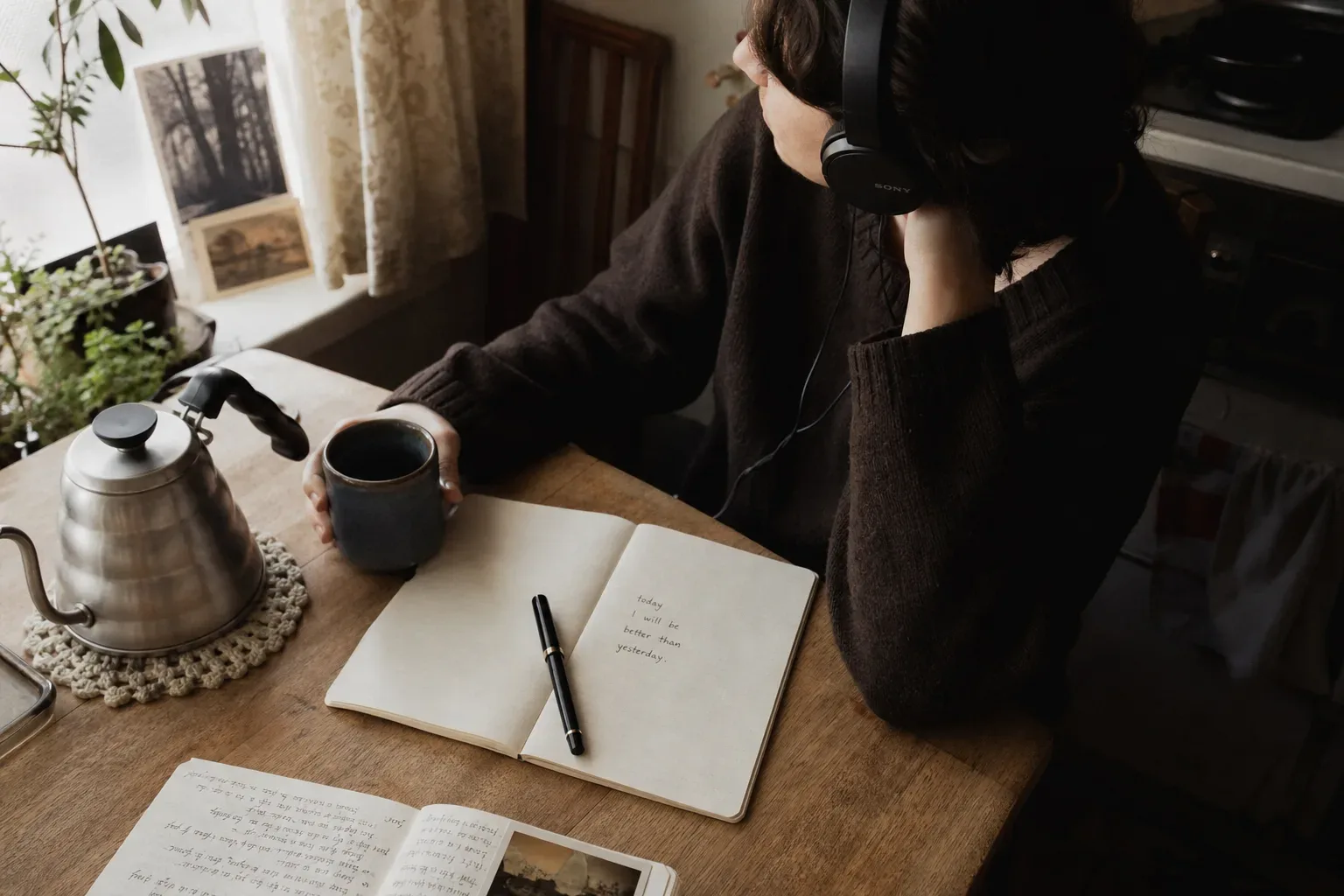
October 7th. The kettle clicked off before I had chosen a shirt. A 5-minute Dream-Self audio helps with decision fatigue by reducing inputs, giving the mind one remembered identity, and turning the next choice into one small action. I use it before the day starts asking for too much.
What is decision fatigue actually costing me by breakfast?
Decision fatigue costs me clarity before it costs me time.
I used to think the tiredness came from doing too much. Some mornings that was true. But often I had barely done anything measurable. I had checked the weather in São Paulo, chosen between two invoices, answered a message from my mother, considered whether to cancel a call, and stood in the kitchen with the blue mug while six tabs waited. By 9:17, I had spent more attention than the calendar admitted.
The phrase decision fatigue became popular after Roy Baumeister’s work on self-control in the late 1990s, including a 1998 study on ego depletion. Later replication attempts complicated the theory, and I am careful with that. Still, the everyday pattern remains familiar: repeated choices feel more expensive when stress, hunger, and uncertainty are present. The American Psychological Association has reported for years that money, work, and health remain top stressors for adults, and those categories produce choices, not just feelings.
A famous 2011 PNAS study by Shai Danziger and colleagues found that parole judges were more likely to grant favorable rulings earlier in decision sessions, with approval rates dropping before breaks and rising after food. The study has been debated, but the number stayed with me: decisions were not floating above the body. They seemed to move with timing, depletion, and recovery.
A tired mind does not always need a better answer. Sometimes it needs fewer doors open.
I notice decision fatigue most when the choice is small but sticky. Which message should I answer first. Whether to buy the notebook. Whether to say yes to a dinner I do not want. These are not dramatic decisions, but they create open loops. Open loops accumulate. By noon, the day feels crowded even if the task list has only 7 lines.
I keep a private rule now: if I revisit the same minor choice 3 times, I do not keep thinking. I reset.
Why use a 5-minute Dream-Self audio instead of more advice?
I use a 5-minute Dream-Self audio because advice adds input, while listening can remove input.
This distinction matters. When I am tired from choosing, I do not need 14 more frameworks. I do not need another saved post about discipline. I need one quiet channel. The AYA Method is a daily audio manifestation practice. Each day I listen to a short personalized recording, my Dream-Self Moment, narrated from the version of me who has already manifested the life I intend. Listening is the practice. Repetition is the work. The audio is the method.
I was suspicious of that at first, because I have tested too many wellness apps that turn every human ache into a dashboard. My bar is plain: after the design is removed, what behavior remains. Here, what remained was a few minutes of listening. Not a course. Not 37 prompts. Not a personality quiz pretending to be a map.
The reason audio helps me is partly practical. Working memory is limited. George Miller’s old 1956 paper suggested people could hold about 7 items, plus or minus 2, though later research often argues for fewer usable chunks. When I am comparing options, I am filling that small space with fragments: price, tone, guilt, timing, imagined replies. A single audio track gives the mind a temporary rail.
I also think identity matters. In Manifestation pillar, manifestation is treated less like wishing and more like repeated attention, emotion, and behavior. That matches my experience. I do not become calmer because a sentence is pretty. I become calmer when the same sentence meets the same morning often enough to become familiar.
The audio is not magic to me. It is a constraint. And a kind constraint can save a day.
How do I do the 5-minute decision fatigue reset?
I do it by removing inputs, listening once, naming one choice, and taking one visible action.
Here is the version I used this morning, while the kettle cooled and the chair by the window held yesterday’s shirt. The whole thing took 5 minutes and 40 seconds because I wrote slowly. On better days, it takes exactly 5.
- Stop adding information for 60 seconds. I close the shopping tab, the inbox, or the group chat. If I keep collecting opinions, I am not resetting. I am feeding the loop.
- Listen to the Dream-Self Moment for 5 minutes. I sit or stand. I do not clean the counter. I do not check the timer. Dr. Andrew Huberman often talks about attention as a trainable state, and whether or not I follow every protocol, I agree with this part: attention changes with what it repeatedly practices.
- Write the decision in one sentence. Not a paragraph. One line. “I will send the draft before 11.” “I will not buy the jacket today.” “I will ask for Thursday instead.”
- Move something physical. I open the draft. I put the card back in my wallet. I place the running shoes by the door. The body needs evidence.
- Stop reviewing the decision for 10 minutes. This is the hardest part. Review is often fear wearing a sensible coat.
I keep the steps short because decision fatigue feeds on elaborate recovery plans. A reset that requires 12 decisions is not a reset. In a 2000 study often associated with choice overload, Sheena Iyengar and Mark Lepper found that shoppers who saw 24 jam varieties were more interested, but those who saw 6 were more likely to buy. The exact retail setting is not my kitchen, but the lesson has followed me for 26 years of modern life: more options can look like freedom and feel like fog.
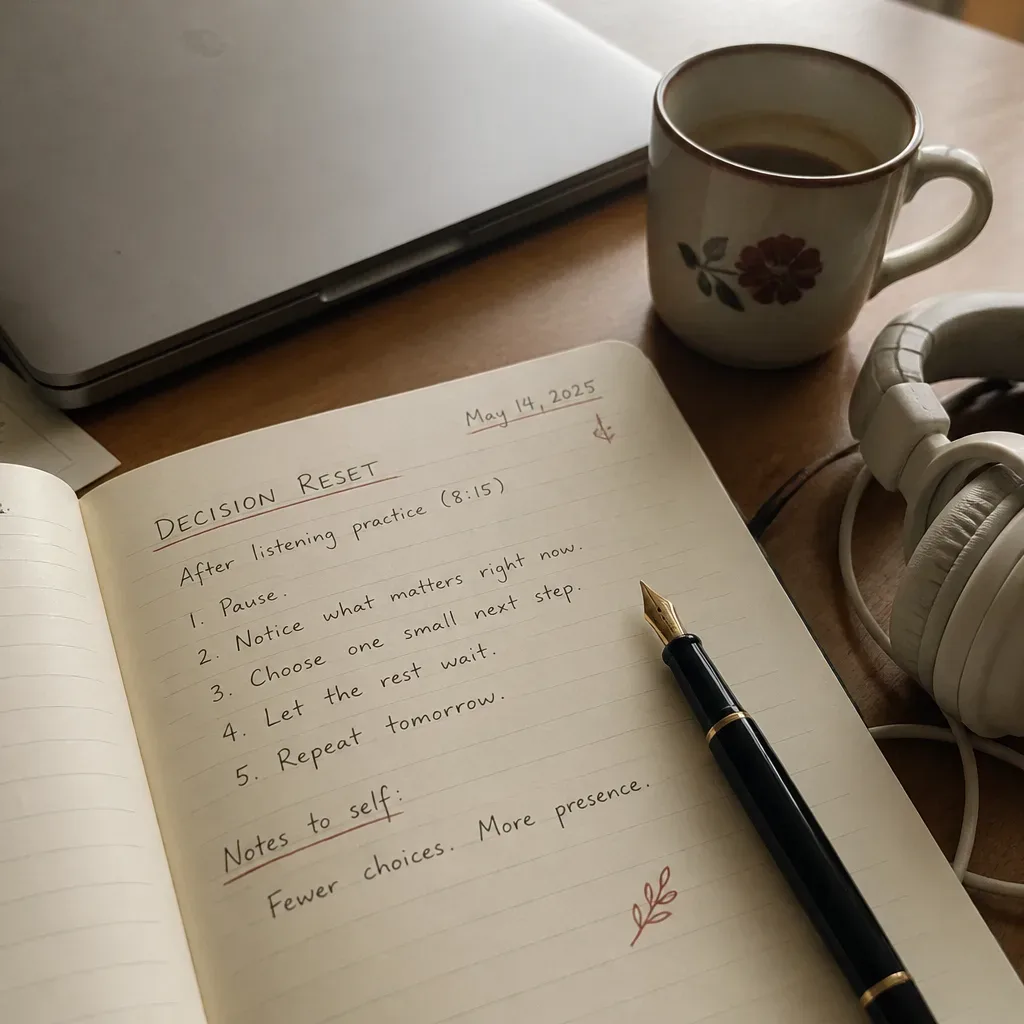
Here is the small table I keep in my notebook, dated last Tuesday.
| Moment I notice | What I used to do | 5-minute reset choice |
|---|---|---|
| Rereading one email 4 times | Rewrite the reply for 20 minutes | Listen once, send 3 plain sentences |
| Comparing two purchases | Open 9 reviews | Listen once, wait 24 hours |
| Avoiding a calendar answer | Ask another person what they think | Listen once, offer 2 times |
| Feeling guilty about saying no | Draft an essay of apology | Listen once, write one kind no |
A decision is not complete because I suffered over it. A decision is complete when my next action changes.
What should I listen for during the audio?
I listen for the sentence that makes the next right action feel ordinary.
That is the part I did not expect. I thought the useful sentence would feel dramatic. It rarely does. It sounds more like someone opening a drawer. “I answer before lunch.” “I keep my promises smaller.” “I do not negotiate with every passing mood.” These lines are not decorative. They are handles.
Neville Goddard wrote often about assuming the feeling of the wish fulfilled. I read him carefully and with some distance, because older manifestation language can become too grand for an ordinary Tuesday. But there is a practical point inside it: the nervous system behaves differently when a future self feels rehearsed rather than hypothetical. In small visualization studies, athletes and patients have sometimes shown performance or coping benefits when mental rehearsal is paired with action. The effect is not infinite. It is also not nothing.
I pair the audio with one daily affirmation only when a line keeps returning. I do not make the affirmation a second practice that competes for attention. Affirmations pillar is useful when I need language short enough to carry on the bus. But for me, the audio stays central. If I turn the complement into another pillar, I have made more decisions again.
I listen for 3 things:
- A quieter identity. Not the fantasy version. The version who has already stopped arguing with the same choice.
- A time boundary. Before lunch. After coffee. Tonight. Specific time reduces mental rehearsal.
- A physical cue. Shoes by the door. Laptop open. Phone face down. The cue makes the sentence visible.
The brain likes unfinished business. Psychologist Bluma Zeigarnik described the Zeigarnik effect in the 1920s: incomplete tasks can stay more active in memory than completed ones. I feel that in my hands. A choice I have not closed follows me from kitchen to desk. The audio helps me close one loop without pretending to close my whole life.
How can I tell whether the reset worked?
I know the reset worked if one decision becomes smaller within the next 10 minutes.
I do not measure it by mood. Mood is weather. Behavior is the receipt. After the audio, I ask one question: did I do the next small thing, or did I return to comparing? If I answered the message, closed the cart, put the appointment in the calendar, or chose the first draft title, the reset worked enough.
This is where my productivity scar tissue helps. I have seen apps reward streaks while the user’s actual day becomes heavier. I do not care if a practice looks serene. I care whether there are fewer open loops at noon than there were at nine. That is the metric I trust.
The Journal of Behavioral Medicine has published many studies over the years on stress reduction practices, including mindfulness-based interventions; effects vary, but brief practices often help when they are repeated and attached to a clear cue. I treat the Dream-Self audio that way. Same chair when possible. Same headphones. Same morning threshold. Repetition lowers the setup cost.
I use this check after listening:
| Question | Good sign | Warning sign |
|---|---|---|
| Did I stop gathering inputs? | I closed tabs or paused replies | I searched for more opinions |
| Did I choose one action? | The action fits in 2 minutes | The action is a life overhaul |
| Did my body move? | I sent, placed, opened, deleted | I only thought more clearly |
| Did I stop reviewing? | I let 10 minutes pass | I asked 3 people to bless it |
There is a quiet dignity in making one decision and not asking it to become a personality test.
I also watch for overuse. If I need the reset 6 times in one day, the issue may not be mindset. It may be workload, sleep, conflict, or an environment with too many demands. A 5-minute audio can help me return to myself. It cannot make an overfilled life humane by itself.
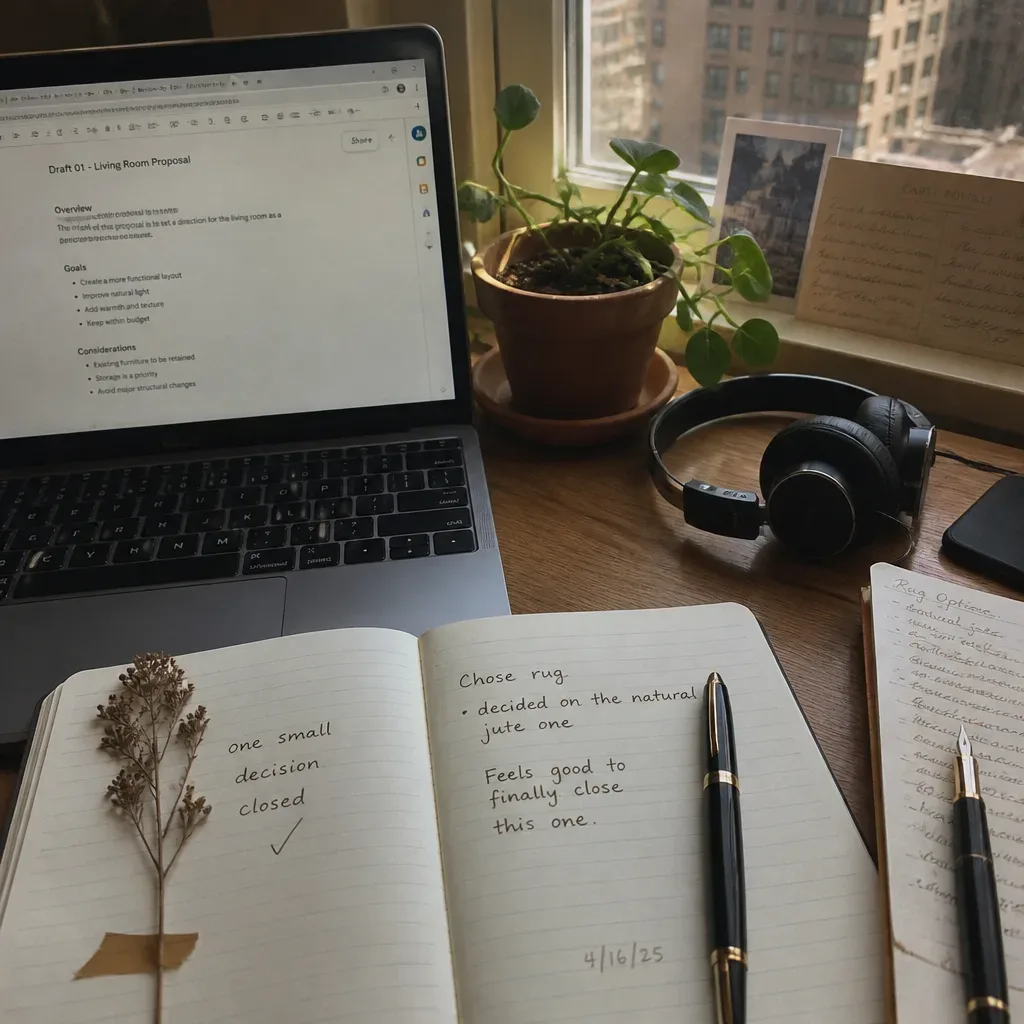
Where does this fit with manifestation, astrology, and the rest of my practice?
It fits as a daily audio practice, not as another system to manage.
I keep a Manifestation Board, but I treat it like a quiet wall, not a cockpit. It reminds me what I said mattered when I was not tired. Some Sundays I look at it for 2 minutes. Some weeks I forget. The Dream-Self audio is different because it has a time and a behavior: I listen. That is why it survived my testing.
I also read Astrology and manifestation when I want timing language that feels reflective rather than controlling. I know people who plan decisions around moon phases or transits. I am not strict that way. But I understand the need for rhythm. A ritual can reduce decision fatigue if it removes a recurring choice. It becomes harmful when it adds 11 more things to check before sending an email.
Research on implementation intentions by Peter Gollwitzer, first developed in the 1990s, found that “if-then” plans can increase follow-through across many settings. That is how I hold the audio. If I catch myself circling, then I listen once. If the audio ends, then I write one sentence. If I write the sentence, then I move one object. The structure is small enough to keep.
I keep returning to the AYA Method because it asks less from me than most methods and somehow gives me more back. The repetition is not glamorous. That is why I trust it. A practice that needs constant novelty is usually selling relief from the practice itself.
For a wider frame, I sometimes reread the Manifestation pillar, especially when I start treating desire like a spreadsheet. Desire needs form, but not bureaucracy. The 5-minute reset gives it form without turning the morning into administration.
What should I do tomorrow morning when the choices start again?
Tomorrow morning, I should make the reset easier than the spiral.
Tonight, before I close the laptop, I put the headphones on the chair. I choose the morning cue now because morning Kenji should not have to design a practice before coffee. The fewer decisions required to begin, the more likely the reset will happen. In habit research popularized by BJ Fogg and others, making a behavior tiny and attaching it to an existing prompt increases follow-through. I have found that embarrassingly true.
My cue is the kettle. Yours might be the bathroom light, the first bus stop, the office elevator, or the moment after school drop-off. The cue should already exist. Do not invent a fragile ceremony. Put the audio beside a thing that already happens.
Tomorrow’s version can be this plain:
- Kettle on.
- Headphones in.
- Dream-Self Moment plays.
- One decision sentence on the page.
- One visible action before the coffee cools.
If the decision is large, I do not force false certainty. I use the reset to choose the next responsible step: call the accountant, sleep before replying, ask for the document, wait 24 hours. Big choices often need time. Decision fatigue makes them feel urgent because the mind wants escape. A reset gives me enough room not to confuse relief with wisdom.
Pew Research Center reported in 2024 that many adults feel worn down by information and public stressors, though the exact causes differ by country and age. I think of that when I blame myself for being tired before lunch. We are not weak because the inputs are many. We are responsible for building fewer doors where we can.
Decision fatigue is not solved by becoming a better machine. It is softened by becoming harder to interrupt.
Wednesday now. The headphones are already on the chair.