manifestation 101
777 Manifestation Method With Future-Self Audio
A practical 777 manifestation method using a 5-minute future-self audio, seven written lines, and a seven-day tracking rhythm for quiet daily focus.
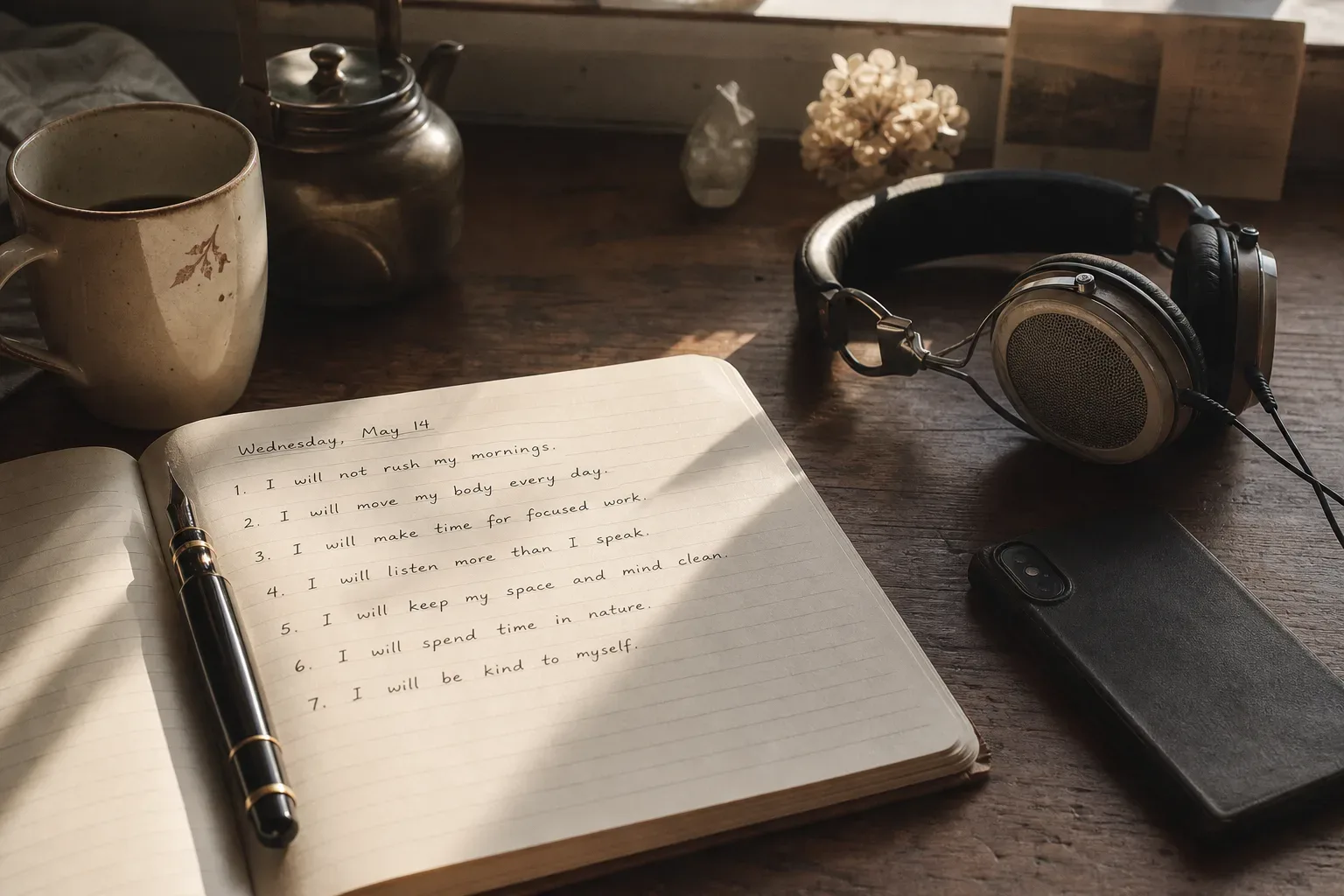
Tuesday, kettle on. The 777 manifestation method can be done in 5 minutes by listening to a future-self audio, writing one chosen sentence seven times, and repeating that rhythm for seven days. I keep it small on purpose: one audio, one page, one honest mark in the log.
What is the 777 manifestation method when I add future-self audio?
The 777 manifestation method is a seven-day repetition practice, and the future-self audio gives the written sentence a voice before I copy it.
I have seen the 777 method described in several ways: write an intention 7 times in the morning, 7 times in the afternoon, and 7 times at night, or write one sentence 7 times for 7 days. I use the second version because I can finish it before my coffee cools. The number is not a law of physics. It is a small container. Seven days is long enough to notice resistance and short enough that I do not start negotiating with myself.
This week, I paired it with the AYA Method: The AYA Method is a daily audio manifestation practice. Each day you listen to a short personalized recording, your Dream-Self Moment, narrated from the version of you who has already manifested the life you intend. Listening is the practice. Repetition is the work. The audio is the method. I listened before brushing my teeth. That is the order I do them in.
I like numbers, so I also like knowing where numbers stop being proof. A 5-minute audio is 300 seconds. Seven written repetitions take me about 90 seconds. My whole practice fits inside the time my kettle takes to boil and sit. Research on habit formation by Phillippa Lally and colleagues in 2009 found an average of 66 days for automaticity, with a wide range from 18 to 254 days. Seven days does not install a whole new life. It begins a trace.
A method is only useful if I can return to it on an ordinary morning.
If you are new to this, I would read the Manifestation pillar first, then come back with one sentence. I needed the plain version before I needed the numbered one.
How do I set up the 5-minute version before I begin?
I set up the practice by choosing one sentence, one audio, one time of day, and one place to record completion.
I did this at the kitchen table, because the table already knows my habits. The chair faces the window. My notebook lives beside the blue mug. I opened a notes app only to log the data, not to make the practice more impressive. In behavior design, BJ Fogg has written for years that tiny habits work because they attach to existing routines. I do not need a new personality at 7:10 a.m. I need a repeatable cue.
Here is the setup I use before day 1:
- I choose one sentence in the present tense.
- I make sure it names a real desired state, not a performance for the page.
- I listen to the same 5-minute future-self audio each day.
- I write the sentence 7 times without changing it.
- I log completion with the date, time, and mood from 1 to 5.
- I take one small matching action within 24 hours.
- I stop after day 7 and review what actually happened.
The mood score matters more than I expected. In my own tracking, a 1-to-5 scale is crude, but crude can still be kind. A Pew Research Center report in 2022 found that 31% of U.S. adults reported using health apps, and many people now track sleep, steps, or mood with imperfect tools. My notebook is less fancy than a wearable, but it tells the truth if I do not decorate it.
I do not make my daily affirmation and Manifestation Board carry the practice. They are complements. Some mornings I write one affirmation below the seven lines. Some Sundays I look at the board. But the audio comes first, because listening changes the room before writing asks me to agree.
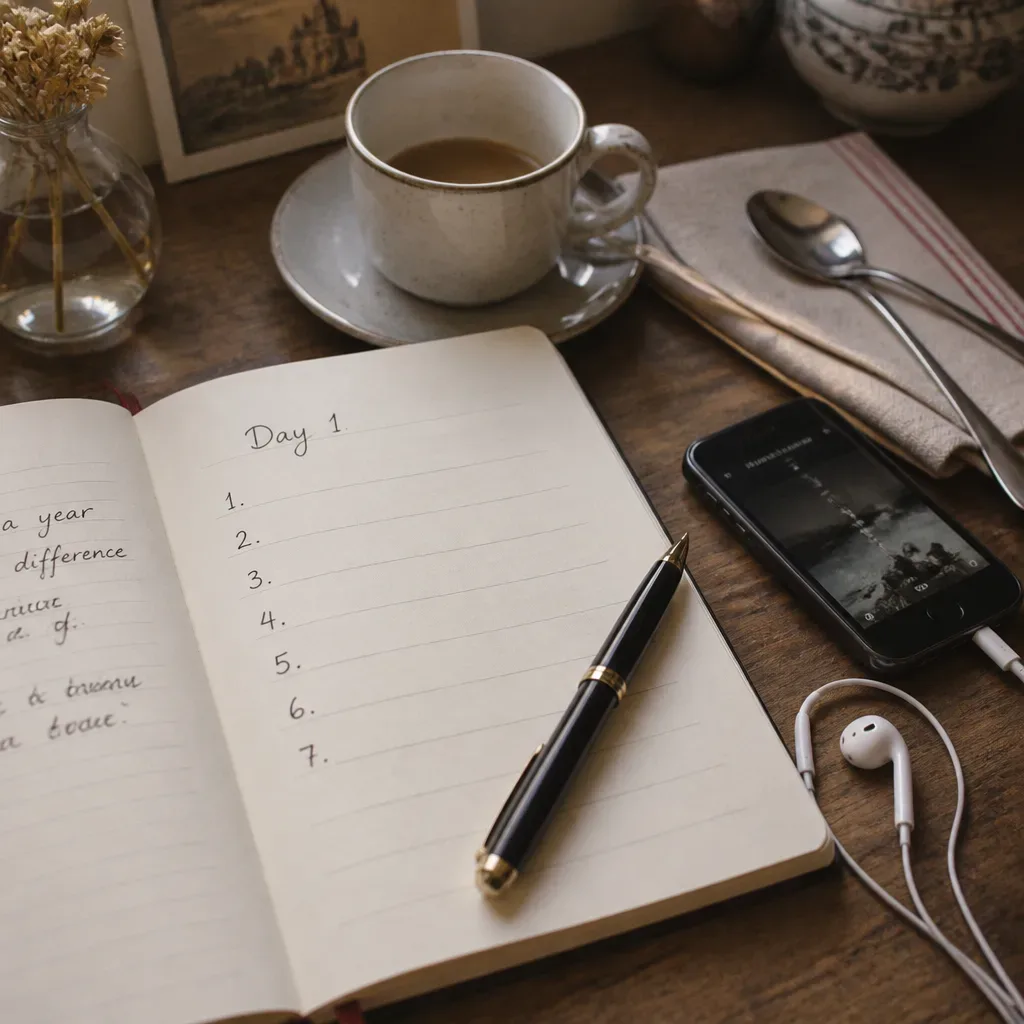
What should my seven written lines actually say?
The seven lines should say one specific, believable sentence that your nervous system can repeat without flinching.
I learned this the annoying way. When I wrote sentences that sounded too polished, my hand slowed down by line 3. I could feel my body arguing with the page. Neville Goddard wrote often about assuming the feeling of the wish fulfilled, but even that can become theater if I choose language that has no bridge to my day. I need a sentence I can inhabit while standing in the kitchen in socks.
Here are examples I would use and examples I would soften:
| Too far from my body | Easier to repeat for 7 lines |
|---|---|
| I am wildly successful overnight. | I prepare clearly and receive fitting opportunities. |
| Money is never a concern again. | I meet money with steadiness and make one wise choice today. |
| Everyone sees my brilliance. | I speak accurately and let my work be seen. |
| My relationship is perfect. | I show up honestly and receive honest love. |
A good sentence has three parts: it names the desire, it names the self-state, and it leaves room for action. Dr. Andrew Huberman has often spoken about visualization working better when paired with effort and concrete behavior, not passive fantasy. I take that seriously. My sentence cannot only be a pretty room in my head. It has to leave a key on the table.
The Affirmations pillar is useful here because it explains why wording matters. I treat each 777 line as an affirmation under stricter conditions: same sentence, same count, same seven-day window. The limit helps. A sentence repeated seven times has nowhere to hide.
The page believes repetition, but the body believes precision.
My current sentence is not dramatic. It is dated in the margin: August 25. I wrote, “I build calmly, communicate clearly, and let the right work meet me.” By line 7, I knew which email I had been avoiding.
How do I do the 777 manifestation method in 5 minutes each day?
I do it by giving the first five minutes to audio and writing, then letting the day provide one small proof of participation.
The timing is simple. I press play. I listen. I write seven lines. I mark the log. On days when I have a 9 a.m. standup, I do not add candles or a second notebook or a special playlist. The cleaner the protocol, the less likely I am to bargain with it. In software, a process with too many dependencies fails in boring ways. So does a morning practice.
My 5-minute version looks like this:
- 0:00 to 5:00: listen to the future-self audio.
- 5:00 to 6:30: write the sentence seven times.
- 6:30 to 7:00: mark the tracker.
- Later that day: take one matching action.
Yes, this is a little over 5 minutes if I count the writing. But the audio is the fixed 5-minute core, and the writing is the short tail. I keep the name because it reminds me not to expand the ritual until it collapses. In a 2012 paper in the British Journal of General Practice, researchers noted that simple action planning can improve follow-through across health behaviors. The plan needs a when, where, and what. Mine is morning, kitchen table, seven lines.
The matching action can be tiny:
- send the message
- open the document
- check the account balance
- walk for 10 minutes
- rehearse the conversation once
- put the application in draft
I keep one rule: the action must be visible in the world. Not large. Visible. If my sentence says I communicate clearly, I send one clear note. If it says I care for my body, I drink water before coffee. Joe Dispenza often writes about rehearsing a future state until it becomes familiar; I add a smaller engineer’s note beside it: familiarity still needs a commit.
How do I track seven days without making it cold?
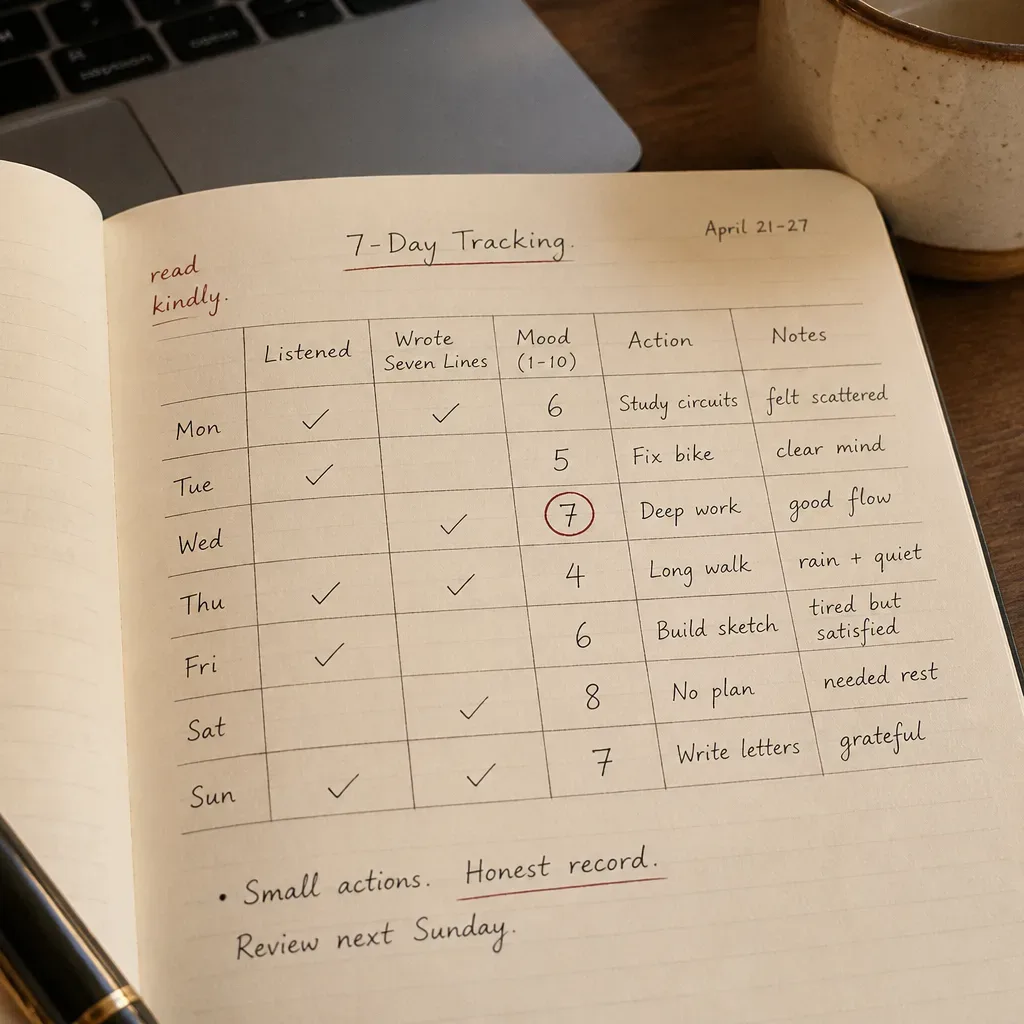
I track the seven days with a small table, because data collected kindly keeps me honest without turning my life into a performance review.
This is the part that feels most like me. Pris at the kitchen table. Pris with the pen. Pris trying not to make a dashboard out of a tender thing. I work in healthcare software, and it has taught me that numbers about human beings are only useful when they are collected kindly and read humbly. A missed day is data. A flat mood is data. A sentence I resent by day 4 is very good data.
My tracker is plain:
| Day | Listened? | Wrote 7 lines? | Mood 1-5 | One matching action | Note |
|---|---|---|---|---|---|
| 1 | yes | yes | 3 | sent email | resisted line 6 |
| 2 | yes | yes | 4 | drafted plan | easier after sleep |
| 3 | yes | yes | 2 | drank water | late deploy |
| 4 | yes | yes | 3 | made call | hands shaking |
| 5 | yes | yes | 4 | revised CV | quiet focus |
| 6 | yes | yes | 4 | asked question | less hiding |
| 7 | yes | yes | 5 | submitted | cried after |
The sample size is one person for seven days, which would make any statistician sigh into her coffee. I still write it down. In small self-tracking experiments, the point is not universal proof. The point is pattern recognition. If three skipped practices cluster after nights with less than 6 hours of sleep, I have learned something useful. If the practice feels fake only when I am hungry, I have learned something even more useful.
I sometimes compare the notes with lunar or seasonal timing, not because timing is a substitute for action, but because I like noticing cycles. If you use timing too, the piece on Astrology and manifestation keeps it grounded. The moon can be a calendar. It does not have to be an excuse.
Rigor and gentleness are not opposites; they are how I keep the promise readable.
What mistakes make the 777 method feel hollow?
The method feels hollow when I use vague language, skip the listening, chase signs, or make the seven days too heavy to repeat.
The first mistake is writing a sentence that is not mine. I know it is not mine when it sounds like a caption from someone else’s life. The second mistake is changing the sentence every day. That turns the practice into mood shopping. The third is asking the number 777 to do the work my attention will not do. A number can hold a rhythm. It cannot live my Tuesday for me.
I keep this short list on the inside cover of my notebook:
- Do not change the sentence after day 1 unless it is actively unkind.
- Do not add more repetitions because I feel anxious.
- Do not use the practice to avoid a necessary conversation.
- Do not call a missed day failure.
- Do not confuse intensity with sincerity.
There is some research that keeps me careful here. The Princeton Engineering Anomalies Research lab, often called PEAR, studied mind-matter questions for nearly 28 years and reported small effects, while critics disputed methods and interpretation. I do not use that history as proof that my notebook controls outcomes. I use it as a reminder to be humble when desire meets measurement. Strange things may happen. Also, I may be noticing more because I practiced noticing.
I return often to the broader Manifestation pillar when I feel myself getting superstitious. The clearest practices do not make me passive. They make me more available to the next honest action. If I write seven lines about work and then refuse to send the proposal, the page has become decoration.
Repetition is not begging. Repetition is returning.
The most common hollow feeling, for me, comes on day 3. The shine is gone. The result has not arrived with flags. This is where the audio helps. I can borrow the future-self voice for 300 seconds and come back to the same small page.
What do I do after the seven days are complete?
After seven days, I review the notes, keep any useful action, and let the sentence either rest or become a new seven-day cycle.
I do not immediately begin another round. I wait one morning. I read the seven entries with coffee and no courtroom voice. I look for three things: completion, resistance, and evidence. Completion means how many days I actually listened and wrote. Resistance means where my body argued, delayed, or got foggy. Evidence means any visible action or response that met the sentence in real life.
My review questions are simple:
- Did I complete all 7 days?
- Which line felt most true by day 7?
- Which day had the most resistance?
- What action did I take that I would not have taken otherwise?
- What would I keep if I removed the number 777?
That last question matters. In the AYA practice, listening is the daily work; the written line is a complement I add for this method. If the seven-day experiment teaches me that the audio steadies my morning, I keep listening. If the sentence becomes useful, I may carry it into a daily affirmation. If the board on my wall suddenly feels outdated, I change one image, not the whole room.
The research part of me wants a clean result. The human part of me knows seven days is messy. In Lally’s 2009 habit study, missing one opportunity did not automatically destroy habit formation, which comforts me more than any perfect streak ever has. I am not building a shrine to completion. I am building a way back.
If you want the audio-first version, start with the AYA Method, then add the 777 writing container for one week. If you want to refine the sentence, read the Affirmations pillar and choose language your hands can copy without shame.
Tuesday night. The kettle is clean.