manifestation 101
Manifestation for Beginners: Start With Future-Self Audio
Manifestation for beginners works best when it starts small: a future-self audio you can repeat daily before belief has fully arrived.
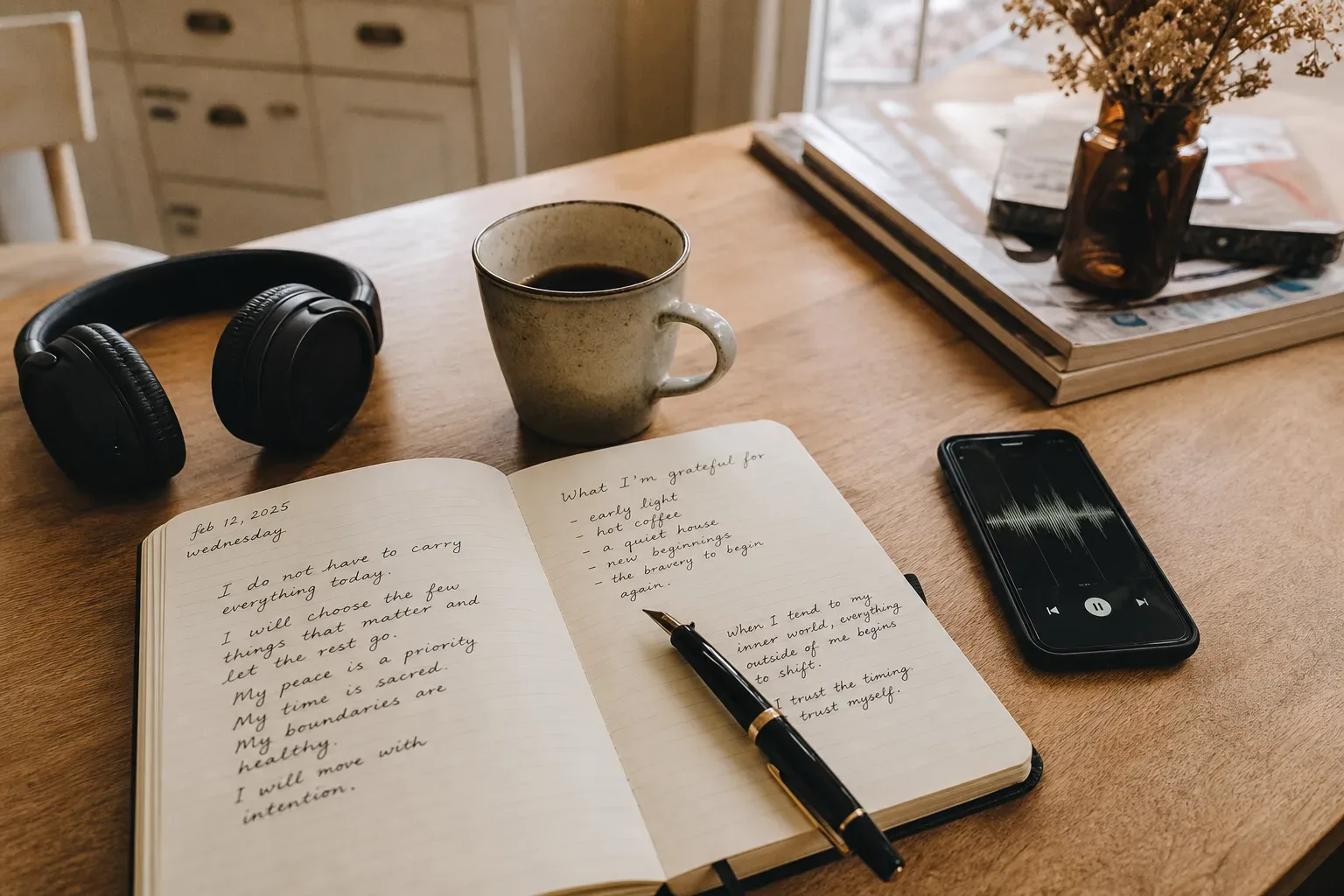
Monday, 6:40 a.m. Manifestation for beginners works best when it begins with one repeatable cue: a short future-self audio you listen to every day. The point is not to force belief. The point is to rehearse attention, identity, and next actions until the future feels less abstract.
What should manifestation for beginners actually mean?
Manifestation for beginners should mean a daily practice of attention, identity, and action, not a demand that I believe harder by breakfast.
I am writing this at the kitchen table with my coffee cooling too fast. I have tested enough wellness apps to distrust anything that asks for a new personality before 8 a.m. Pew’s 2024 mobile fact sheet puts U.S. smartphone ownership at 91% of American adults, which means most manifestation advice now arrives through the same object that also gives us bank alerts, weather warnings, and five different ways to avoid ourselves. Attention is not free just because nobody sends you an invoice.
So I keep my definition plain. Manifestation is the practice of naming a future with enough specificity that today can answer it. If I want a calmer work life, I do not only picture the calmer calendar. I notice whether I answer email at 10 p.m. If I want a body that trusts me, I notice whether I speak to it like an employee I am trying to fire. The Manifestation pillar says this more broadly, but my beginner version is smaller: name, listen, act, repeat.
There is some psychology under this smallness. A 2010 paper by Killingsworth and Gilbert in Science found that people’s minds wandered 46.9% of the time in their sample, and mind-wandering was often linked with lower happiness. Beginners do not need a bigger belief; they need a smaller repeatable act. The mind leaves. The practice brings it back.
Neville Goddard called imagination a kind of inner reality, and Joe Dispenza writes often about rehearsing a future state before the outer proof arrives. I read both with a pencil and a raised eyebrow. My rule is simple: if the idea cannot survive Tuesday, it is too expensive. The practice that survives Tuesday is worth more than the plan that looks holy on Sunday.
Why do I start with future-self audio instead of visualization?
I start with future-self audio because it gives the mind a guided cue when my own focus is too tired to hold a picture.
Visualization is useful, but it can be oddly demanding. Some mornings I can see the room, the email, the face, the bank balance, the softer breath. Other mornings I see the inside of my eyelids and a list of chores. Future-self audio takes one decision off the table. I press play. That matters more than it sounds like it should.
The AYA Method is a daily audio manifestation practice. Each day you listen to a short personalized recording, your Dream-Self Moment, narrated from the version of you who has already manifested the life you intend. Listening is the practice. Repetition is the work. The audio is the method.
That definition is why I recommend audio first for beginners. It does not ask me to generate the whole scene from scratch. It lets me borrow structure until my attention catches up. In habit research, context matters. Lally, van Jaarsveld, Potts, and Wardle found in 2009 that habit automaticity took 66 days on average in their sample, with wide variation from 18 to 254 days. The point was not magic timing. The point was repeated pairing: same cue, same behavior, enough returns.
Audio also fits the unglamorous parts of a day. I have listened while brushing my teeth, on the bus, in the bath, and once in a parking lot before a meeting I did not want to attend. Dr. Andrew Huberman often talks about state shifts through physiology, light, breath, and focus. I am not pretending one audio track is a lab protocol. I am saying the ear is a practical doorway. Listening counts because the nervous system learns by returning.
How does future-self audio work when I do not believe it yet?
Future-self audio works before belief because it asks for contact and repetition, not instant certainty.
This is the part I wish someone had told me earlier. Beginners often think doubt means the practice is failing. I think doubt is just the weather at the beginning. The first time I listened to my Dream-Self Moment, a part of me made notes like a venture analyst. Too polished. Too intimate. Too optimistic. By day eight, I had stopped testing every sentence. I was listening while looking for my socks. That is when I trusted it more.
There is a useful distinction here between fantasy and rehearsal. Fantasy ends at the feeling. Rehearsal changes the next move. Gabriele Oettingen’s research on mental contrasting, often paired with Peter Gollwitzer’s implementation intentions, suggests that positive future thinking works better when it is connected to obstacles and plans. Gollwitzer and Sheeran’s 2006 meta-analysis reviewed 94 independent tests and found medium-to-large effects for implementation intentions on goal achievement. The future needs a bridge back to the chair.
For me, the audio becomes that bridge when I use it this way:
- I listen at the same time each morning when I can.
- I notice one line that feels hard to accept.
- I write one ordinary action that would make that line slightly truer.
- I do the action before the day gets dramatic.
If the audio says I handle money with steadiness, I might open the banking app without punishment. If it says I speak clearly in meetings, I might ask the one question I usually swallow. A future self is useful only when it changes the next ordinary choice.
Princeton’s Global Consciousness Project has published years of data exploring correlations between random event generators and major collective events. I treat that work carefully because interpretations are contested, but I mention it because it reminds me that attention has always tempted researchers. My beginner practice does not require proving the outer edge of consciousness. It requires keeping one promise before lunch.

What should my first future-self audio include?
My first future-self audio should include one specific identity, one lived scene, and one next action I can recognize today.
Specific beats polished. I learned this after sitting through six years of startup pitches where every deck promised scale and very few could explain Tuesday. A beginner audio should not sound like a billboard. It should sound like someone who knows where you keep the mugs. The more concrete the cue, the less work your tired mind has to do.
Here is the small table I keep in my notebook when I review a future-self script:
| Audio element | What I listen for | Beginner example |
|---|---|---|
| Identity | Who am I practicing being? | I am someone who finishes the hard email before noon. |
| Scene | Where does this future live? | I sit at the kitchen table with the blue mug and an open calendar. |
| Emotion | What does my body learn? | My chest feels open, not braced. |
| Evidence | What changed in ordinary life? | I close the laptop by 6:30 three nights this week. |
| Next action | What can I do today? | I send the first draft before I edit it ten times. |
The sentence length matters too. Cognitive load theory, first developed by John Sweller in the late 1980s, reminds me that working memory has limits. Beginners do not need fifteen goals inside one recording. They need one clear track. If a script tries to fix money, love, sleep, work, family, and posture in three minutes, I assume the product team never used it on a bad morning.
I also keep the recording short. Two to six minutes is enough for me. Long enough to settle. Short enough to repeat. In app retention, day-one drop-off is often brutal; public benchmarks from mobile analytics firms have often placed average day-30 retention for many app categories below 10%, though the exact number changes by category and year. The lesson is not that people are lazy. The lesson is that a practice must respect friction.
This is where the daily affirmation can help, but only as a small note after the audio. I sometimes write one line from the recording on the page. For a deeper look at that piece, I keep returning to the Affirmations pillar. The affirmation is a matchbook. The audio is the fire I sit beside.
How do I make manifestation a daily practice without making it heavy?
I make manifestation daily by attaching it to something already happening and keeping the first promise almost too small to resist.
The kettle is my cue when I am home. When I travel, brushing my teeth is the cue. I learned not to rely on mood. Mood is a poor operations manager. In the 2009 habit study by Lally and colleagues, missing one opportunity did not erase the habit curve, but consistency still mattered. I like that mercy. It means one missed morning is data, not a verdict.
Here is the beginner routine I would give a friend, and I have given it to a friend:
- Choose one future-self audio that speaks to one area of life for 30 days.
- Listen once a day, preferably tied to a fixed cue like coffee, teeth, or shoes.
- After listening, write one sentence beginning with Today I can.
- Do the smallest honest action before noon if possible.
- Mark the day with a plain check, not a performance review.
- On day seven, adjust only the cue or timing, not the whole practice.
- On day thirty, look for behavior evidence, not fireworks.
I like 30 days because it is long enough to reveal pattern and short enough to feel human. The Journal of Behavioral Medicine has published multiple studies over the years connecting self-regulation practices with health behavior change, though effects depend heavily on design and adherence. That word adherence is not romantic. It is the whole game.
I keep a Manifestation Board in the app, but I do not treat it as the main event. It is a place where I pin images and phrases after listening, the way I might place a receipt in a diary. The audio leads. The board remembers. When I want a wider frame for timing and symbolic reflection, I sometimes read Astrology and manifestation, but I still come back to the morning cue.
What makes the practice light is permission to be boring. The same chair. The same headphones. The same line written badly. A good practice does not need to impress me; it needs to be there when I reach for it.
What mistakes did I make when I first tried manifestation?
My early mistakes were trying to do too much, changing the practice too often, and measuring feelings instead of behavior.
I have a founder-brain problem. I want a dashboard. I want a clean graph. I want proof by Friday. Manifestation does not reward that kind of pressure. The first week I tested future-self audio, I almost ruined it by comparing three recordings, two notebooks, and a spreadsheet with color codes. By day four, I was managing a system instead of practicing. That is usually the moment a wellness tool starts billing me in time.
The first mistake was scope. I put too many desires into one container. The second was novelty. I kept adjusting the script before the old one had a chance to mark me. The third was outcome chasing. I wanted signs, numbers, messages, and dramatic evidence. Meanwhile, the real evidence was quieter: I answered the email, went to bed earlier, did not reopen the argument, and asked for the fee without apologizing.
A 2018 American Psychological Association Stress in America report found that money and work are recurring major stressors for many adults, often ranking near the top year after year. That matters because beginners often bring manifestation to the sore places. We are not neutral when we begin. We are tender, impatient, and sometimes embarrassed by wanting what we want.
Here is what helped me correct the mistakes:
- I chose one area for one month.
- I stopped editing the audio after every mood change.
- I tracked actions, not omens.
- I treated doubt as normal background noise.
- I used the page for one sentence, not a trial transcript.
There is a line I wrote in my notebook three Tuesdays ago: The future does not need me to stare at it; it needs me to answer it. I still like that. It keeps the practice from becoming another place to perform certainty. The AYA Method helped because it reduced the number of choices. Press play. Listen. Return tomorrow.
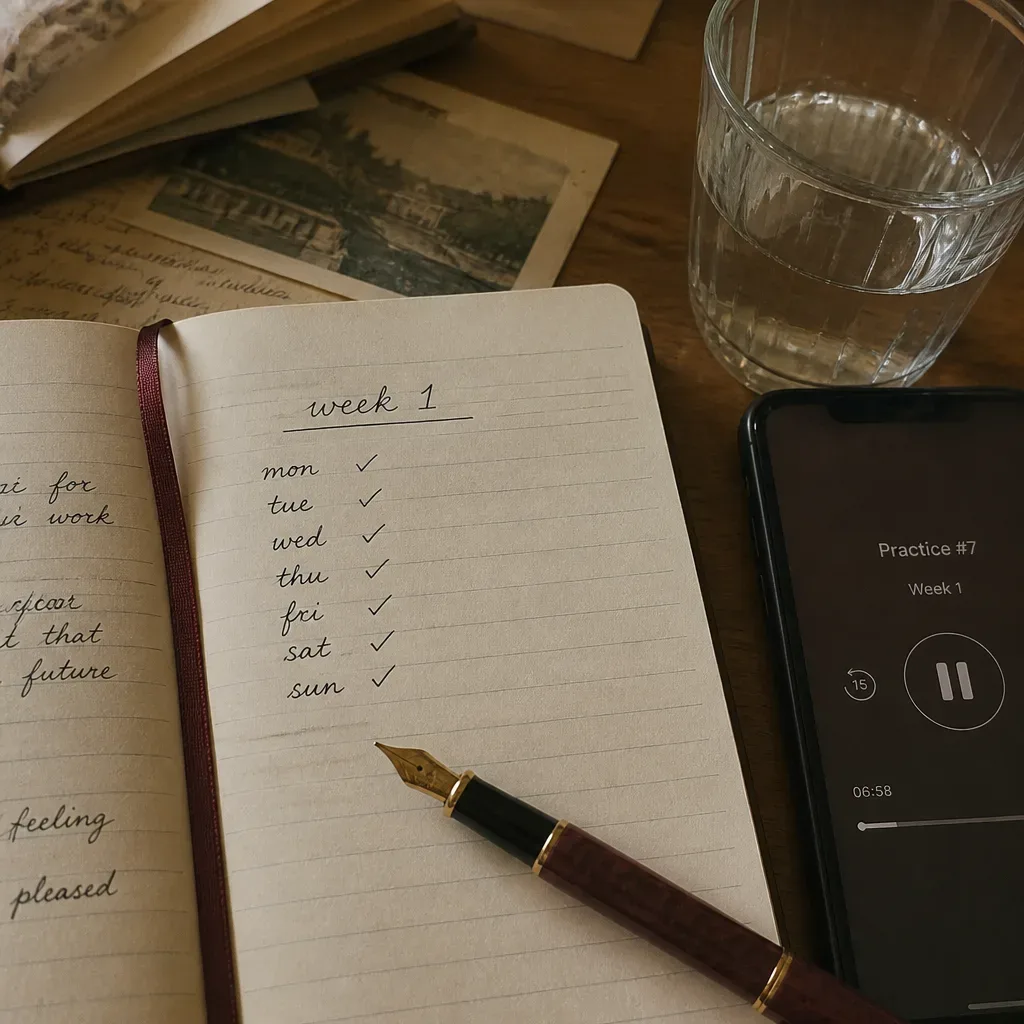
How do I know if future-self audio is working?
I know future-self audio is working when my ordinary choices begin to resemble the person I have been hearing.
I do not measure it by whether every desire arrives on schedule. I measure it by the small behavioral residue. Do I recover faster after a bad call? Do I speak more directly? Do I choose the useful discomfort before the familiar delay? After seven days, I look for a shift in attention. After thirty days, I look for a shift in behavior. After sixty days, I look for identity evidence. That timing is mine, not law, but it borrows from habit research enough to keep me honest.
The 66-day average from Lally’s 2009 study is often misused as a guarantee. It is not. The range in that study was wide, and the behaviors were simple, like drinking water or eating fruit. Still, it gives beginners a helpful warning: automaticity is built, not summoned. If I quit after three days because the feeling faded, I have only tested novelty.
I use three questions on Sundays:
- What line from the audio stayed with me this week?
- What action did I take that matched it?
- What became slightly easier to do again?
If the answers are tiny, I keep them. Tiny is data. One week I wrote: I paused before replying. That was all. But in a conflict-heavy month, that pause was not small. It changed the room.
There is also a body signal. I do not mean a mystical certainty. I mean less bracing. The first listens can feel awkward because the future self sounds unfamiliar. Later, the same sentences may feel less like a costume and more like a coat already hanging by the door. This is not proof. It is practice evidence.
If you want the broader theory around attention, desire, and action, the Manifestation pillar is the shelf I would pull from. If you want the beginner version, I would say it this way: listen until the future has a voice, then let the day ask what that voice would do next.
What is the simplest way to begin today?
The simplest way to begin today is to choose one future-self audio, listen once, and take one action that makes the recording less theoretical.
I would not buy ten notebooks. I would not announce a new identity online. I would not spend two hours choosing the perfect morning routine. Beginners lose so much time preparing to become the kind of person who practices. Start before the setup becomes a hiding place.
Here is my five-minute version. Put on headphones if you have them. Sit somewhere ordinary. The chair is enough. Listen to one Dream-Self Moment all the way through without grading it. When it ends, write one sentence: Today I can act like this by. Finish the sentence with a visible action. Send the note. Wash the cup. Open the document. Take the walk. Say the honest thing gently.
The World Health Organization has reported that anxiety and depressive disorders rose sharply during the first year of the COVID-19 pandemic, with a 2022 brief estimating a 25% increase globally. I mention this carefully because manifestation is not a substitute for medical or mental health care. It is a daily attention practice. For many of us, the nervous system is already carrying too much. That is why the beginner version must be kind and small.
I also think tools should ask for less. Less setup. Fewer notifications. No demand that I become a brand ambassador for my own healing. If an app needs me to maintain a relationship with its dashboard, I lose interest. The reason I kept using future-self audio was plain: it met me while the kettle came on.
For a beginner, one month is a fair test. Thirty listens. Thirty small actions. No courtroom drama. No demand that every day feel sacred. If you want language support after listening, use a daily affirmation from the Affirmations pillar. If symbols and timing help you reflect, keep Astrology and manifestation nearby. But do not confuse the complements for the practice.
Press play tomorrow too. That is the part that counts.
Monday now. The coffee has gone cold.