manifestation 101
Water Manifestation Method: 3-Minute Audio Ritual
Try the water manifestation method with a three-minute Dream-Self audio before you drink. A quiet guide for attention, repetition, and belief.
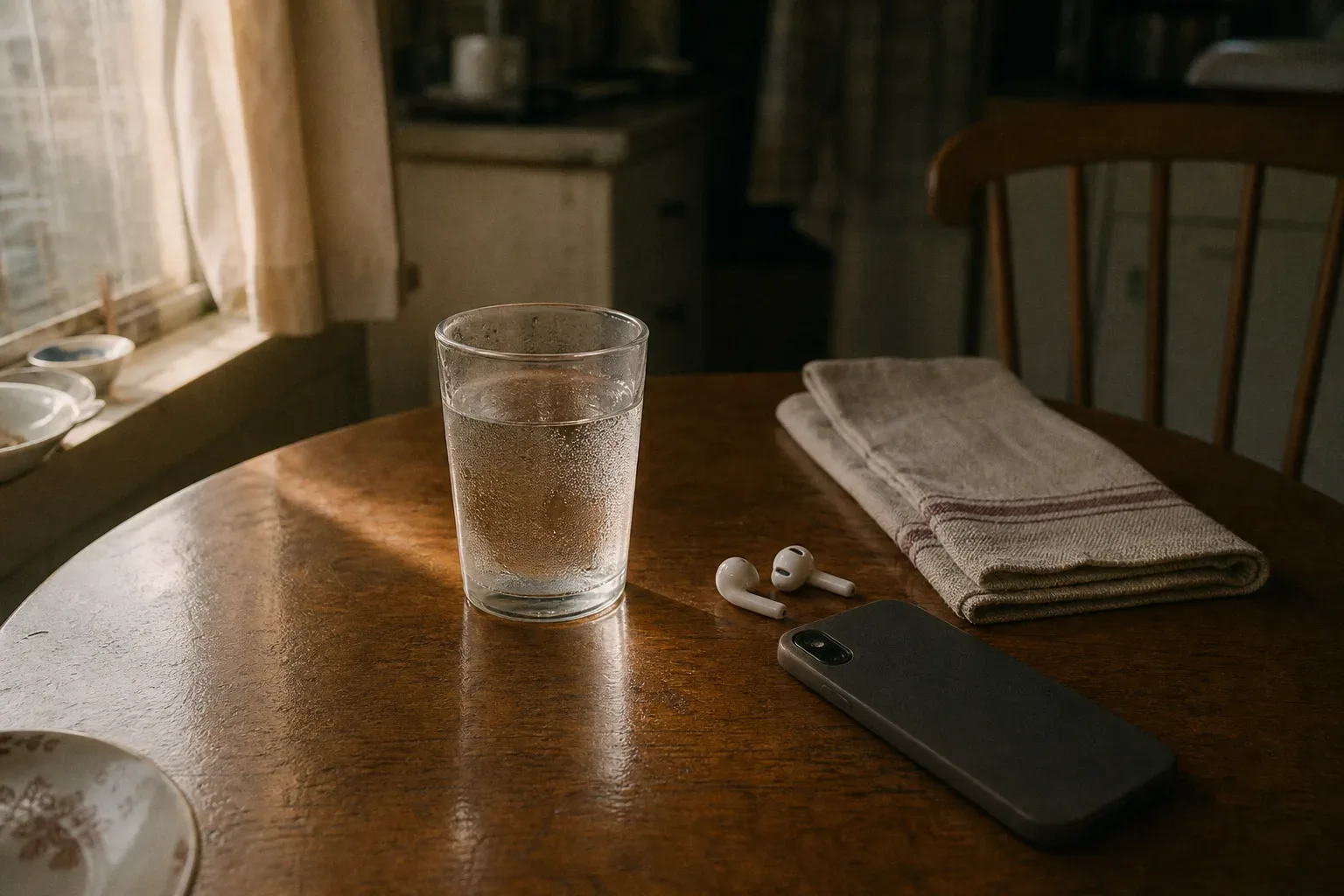
Friday. The kettle was loud this morning, and the glass beside it looked almost too ordinary for a ritual. The water manifestation method is simple: choose one intention, listen to three minutes of Dream-Self audio, then drink slowly. The water is the cue. The audio is the practice. Repetition is the work.
What is the water manifestation method, really?
The water manifestation method is a short attention ritual that pairs drinking water with a clear inner statement and, in this version, a three-minute audio practice.
I used to make these things too complicated. A candle, a notebook, a playlist, a special time, and then one missed morning would knock the whole thing over. This week I kept one glass on the left side of the sink. I filled it before coffee. I listened before I drank. That was all. According to the National Academies of Sciences, Engineering, and Medicine, the commonly cited adequate daily fluid intake is about 2.7 liters for women and 3.7 liters for men from all beverages and foods, though needs vary. Water already repeats through the day. That is what makes it useful.
I do not treat the water as proof that something outside me has agreed. I treat it as a tiny piece of interface design. The glass is the cue. The listening is the action. The calm after the sip is the reward. BJ Fogg’s behavior model, published through Stanford’s Behavior Design Lab, says behavior happens when motivation, ability, and a prompt meet at the same time. A glass of water is a prompt I do not need to download, charge, or remember.
If you are new to manifestation, I would keep the language plain. Not grand. Not shiny. I used the sentence, “I speak clearly before I agree,” because I needed it for a meeting at 11:30. A good intention can fit inside one breath. A vague wish usually asks the nervous system to do too much at once.
Water gives the hand something to do while the mind learns a sentence.
Why add three minutes of audio before drinking?
Three minutes of audio makes the ritual easier to repeat because listening carries the practice when willpower is thin.
This is where the AYA Method has changed the way I think about manifestation practice. The AYA Method is a daily audio manifestation practice. Each day you listen to a short personalized recording, your Dream-Self Moment, narrated from the version of you who has already manifested the life you intend. Listening is the practice. Repetition is the work. The audio is the method. I like that because it does not ask me to become a better person before breakfast. It asks me to press play.
Three minutes is also long enough to interrupt the morning drift. Dr. Andrew Huberman has often discussed the role of attention and repetition in neuroplasticity, and while a water ritual itself has not been proven as a clinical intervention, the broader point is modest and useful: what we repeatedly attend to becomes easier to access. The American Psychological Association has reported that stress affects decision-making and attention, which I feel most in the first hour after waking. Audio gives my attention a rail.
There is an old manifestation habit of speaking into water. Some people call it charging water. I write that down carefully because evidence for water holding intention in a measurable way is not established. Princeton Engineering Anomalies Research, which ran from 1979 to 2007, studied mind-machine interactions and reported small statistical anomalies, but the work remains debated. I do not build my morning on that claim. I build it on the repeatable parts I can see: cue, attention, sentence, sip.
Here is the small comparison I kept in my notebook:
| Practice choice | What it asks of me | Why I keep or skip it |
|---|---|---|
| Silent intention over water | 30 seconds | Good on busy days, easy to drift |
| Written intention beside water | 2 minutes | Clear, but needs pen and surface |
| Three-minute audio before water | 3 minutes | Best when I need to feel the sentence |
| Long morning ritual | 20 minutes or more | Beautiful sometimes, fragile in real life |
A ritual is easier to keep when the reward arrives inside the ritual, not after it.
How do I do the water manifestation method in three minutes?
You do it by pouring water, choosing one intention, listening to a short audio, then drinking slowly enough that your body registers the choice.
I set a three-minute timer the first few days, then stopped needing it. The World Health Organization notes that adult hydration needs vary by climate, activity, health, and diet, so I do not make the amount of water symbolic. Some mornings it is half a glass. Some evenings it is the bottle on my desk. The ritual is not in the volume. It is in the attention.
- Pour one glass of water. Use the same glass for seven days if you can. Repetition makes the cue easier to recognize.
- Put the phone face down after pressing play. I learned this after checking a message halfway through on day 2.
- Listen to your Dream-Self audio for three minutes. If you do not have one yet, record your own voice reading one present-tense paragraph.
- Hold the glass with both hands for one breath. Not because both hands are required, but because it stops rushing.
- Drink in three slow sips. Let each sip carry the same sentence, not three different requests.
- Leave the glass somewhere visible. The empty glass becomes a receipt for the practice.
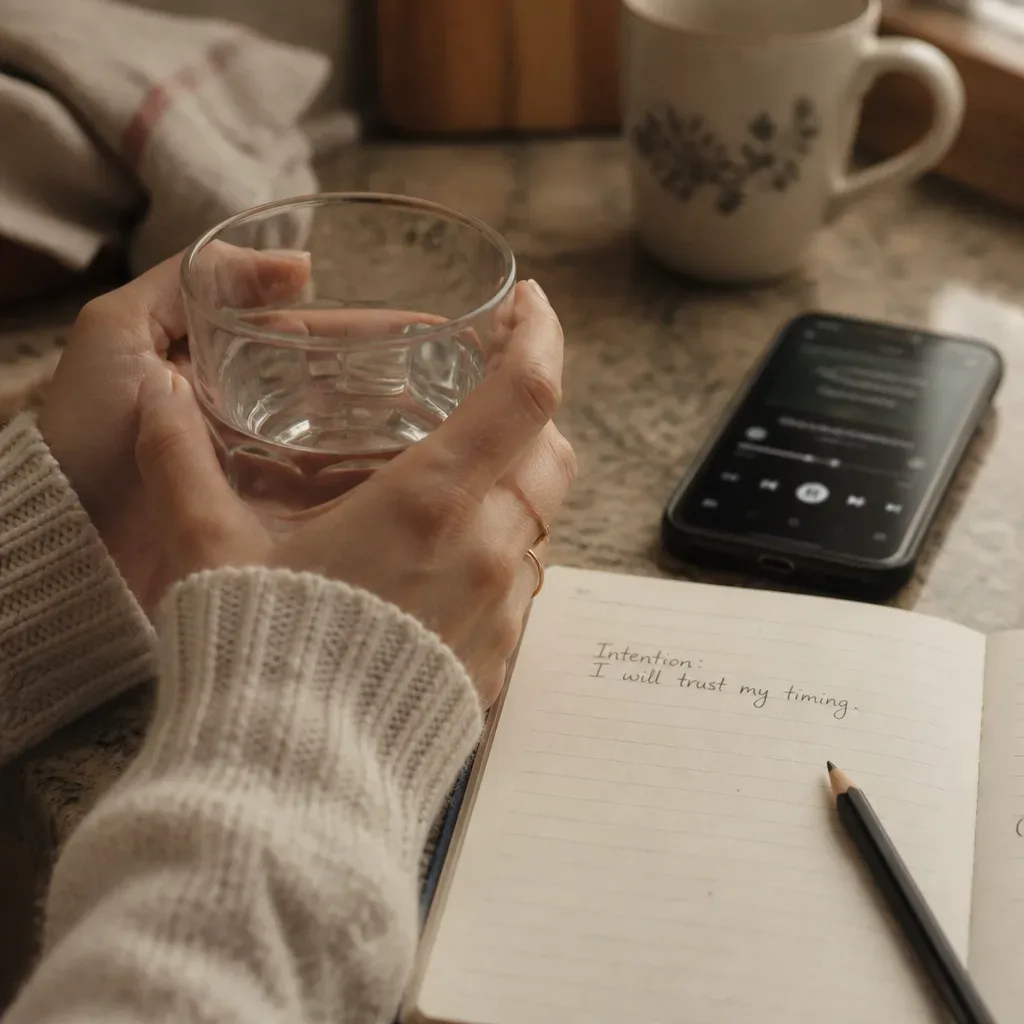
I keep my sentence specific enough to meet the day. On Monday it was about money, but not “more money.” It was, “I answer the invoice email before lunch.” On Tuesday it was about health, but not perfect health. It was, “I take the walk after dinner.” In habit research, Lally, van Jaarsveld, Potts, and Wardle found in the European Journal of Social Psychology in 2009 that daily repetition in a stable context helped behavior become more automatic. Their often-quoted average was 66 days, but the range was wide. That range matters. It means slow is normal.
If you already use affirmations, you can place one sentence after the audio. I would not turn it into a speech. One line is enough. The daily affirmation is a complement for me, like writing the date at the top of a page. The listening remains the method.
What should I say or listen to before the first sip?
Use words that describe a lived scene, not a fantasy slogan, and keep them close to your actual day.
I learned this from design work before I learned it from spiritual practice. A button label works when it tells the user what happens next. “Submit” is weaker than “Send invoice.” My intention works the same way. “I am successful” can feel too smooth to hold. “I send the proposal by 4 p.m.” gives the mind a door handle. Research on implementation intentions by psychologist Peter Gollwitzer, developed in the 1990s, found that if-then plans can improve goal follow-through across many studies. The useful pattern is concrete: if it is morning water, then I listen and name the next honest action.
For the audio, I prefer second-person or first-person future memory. It sounds like someone remembering me kindly. Not a command. Not pressure. A three-minute recording might include 250 to 450 spoken words, depending on pace. Mine is slower, closer to 330 words, because I need room to breathe between sentences. The National Center for Voice and Speech often places conversational speech around 150 words per minute, though it varies by speaker and language. Slow audio changes the body of the ritual.
A few lines that have worked for me:
- “I choose the small action that proves I am available to my own life.”
- “I answer clearly, and I do not abandon myself to be liked.”
- “I keep the promise I made before the day became noisy.”
- “I let this be ordinary enough to repeat.”
The sentence that works is the sentence you can still believe when the sink is full.
I sometimes write one line on my Manifestation Board after I drink, but I do not make that the center. The board helps me see patterns over a month. The water and audio help me begin today.
When is the best time to practice it?
The best time is the time already attached to drinking water, because an existing cue makes the ritual easier to keep.
For me, that is before coffee. Not because morning is morally better, but because the kettle gives me a dependable sound. A 2022 Statista survey on wellness app use reported that many people stop using wellness apps after short periods when routines feel demanding, which matches what I see in my own abandoned folders. The ritual that survives is the one with fewer doors. Water before coffee has one door.
You could also use lunch, the end of work, or the glass beside the bed. I would avoid attaching it to a time you regularly resent. If 5:30 a.m. makes you feel punished, the practice will inherit that feeling. In James Clear’s writing on habit stacking, the formula is simple: after I do an existing habit, I do the new one. The academic version is cue-dependent repetition. The kitchen version is easier: after I pour water, I press play.
Here is how I would choose:
| If your day feels like this | Use this cue | Keep the audio here |
|---|---|---|
| Mornings are stable | First glass after waking | Kitchen counter |
| Mornings are rushed | Water bottle on commute | Downloaded audio |
| Work drains attention | First glass after lunch | Desk drawer headphones |
| Evenings are tender | Water before brushing teeth | Bathroom shelf |
I like the morning because it gives the day a first vote. Still, the best ritual is not the earliest one. It is the one you can repeat when you are not in the mood.
If you follow astrology and manifestation, you might choose new moon mornings for naming a fresh intention, or full moon evenings for releasing a sentence that has gone stale. I keep a moon calendar in Notion, and yes, it is load-bearing. But I still drink water on plain Wednesdays. The calendar adds meaning. It does not replace practice.
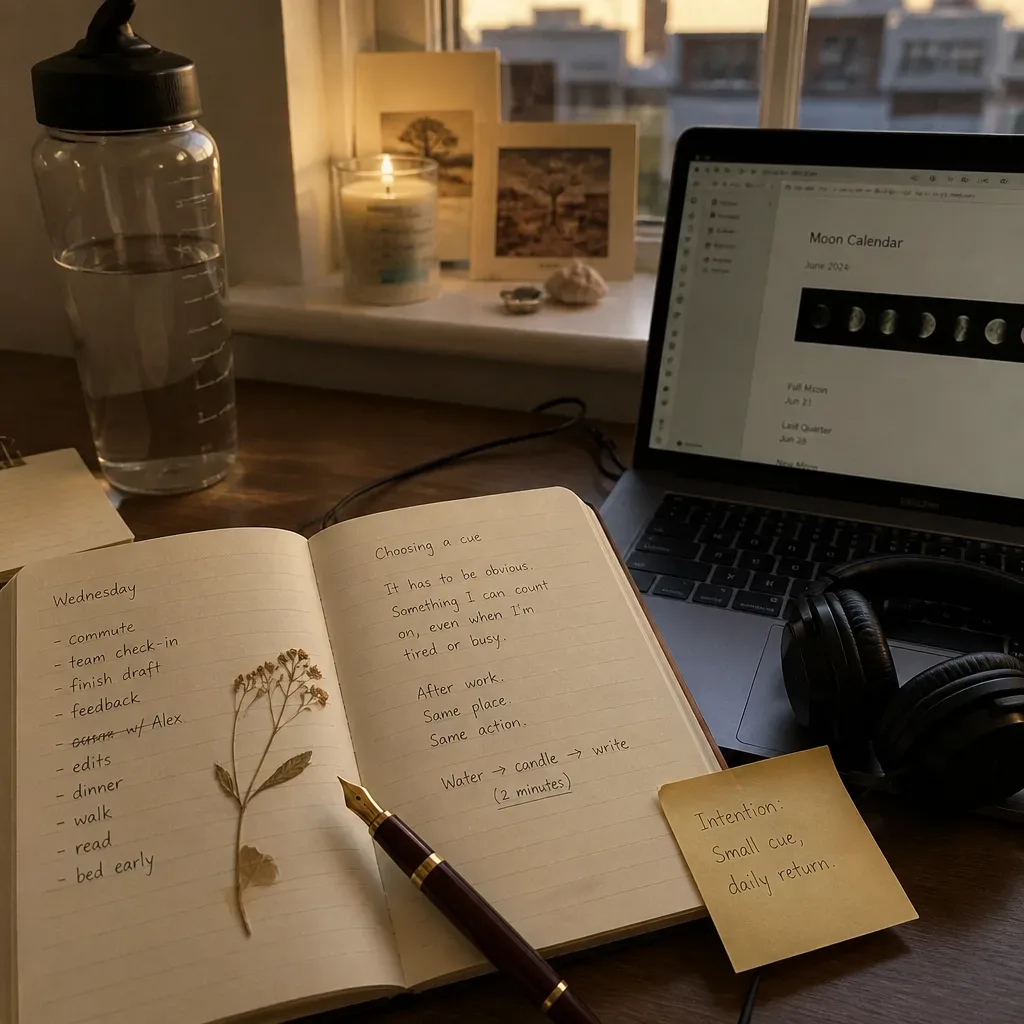
What if I feel silly, distracted, or unsure it is working?
Feeling silly does not mean the ritual is false; it usually means the body has noticed you are doing something new.
I felt foolish on day 1. I was standing barefoot in the kitchen, headphones in, holding a glass like it had become a formal object. Then the audio said a sentence about speaking slowly, and I noticed my jaw unclench. That was not mystical proof. It was a small nervous system event. The Journal of Behavioral Medicine has published studies linking relaxation and guided imagery practices with stress-related outcomes, though results vary by design and population. I do not need every sip to be dramatic. I need the practice to make room.
Distraction is not failure either. In mindfulness research, a common instruction is to notice wandering and return. A 2010 Harvard study by Killingsworth and Gilbert used experience sampling and found that people’s minds wandered about 47 percent of the time. I think about that number when my mind leaves the glass and goes to email. Almost half the time is a lot of leaving. Returning is not a repair. Returning is the rep.
When I am unsure it is working, I track one observable thing for seven days. Not my whole life. One thing. Did I send the message? Did I eat lunch sitting down? Did I pause before saying yes? The Manifestation pillar helped me separate intention from spectacle. If the practice makes one honest action easier to take, I count that as evidence worth keeping.
Try these corrections without scolding yourself:
- If you forget the audio, drink the water and listen later.
- If the sentence feels fake, make it smaller by half.
- If you cry, slow down and let the glass be ordinary.
- If you rush, take one final sip without fixing anything.
Belief is not always a lightning strike. Some mornings it is just not arguing with the next small step.
How do I keep the ritual gentle for seven days?
Keep the same cue, the same audio, and the same glass for seven days before editing anything.
Seven days is long enough to see friction and short enough not to turn the practice into a performance. I write a tiny mark in my notebook after I drink. Not a paragraph. Just the date and one word. Tuesday: clear. Wednesday: tired. Thursday: softer. In product design, I would call this a low-burden feedback loop. In real life, it is a pencil beside the kettle. The Centers for Disease Control and Prevention has often noted that small, repeated health behaviors are easier to maintain when they fit existing routines. That is the whole design brief here.
Do not optimize too soon. I know the itch. New glass. New recording. New moon timing. New notebook. But changing the container every day makes it harder to know what is helping. For seven days, I keep the same three-minute Dream-Self Moment, even if one line bothers me. Especially then. Sometimes the line that bothers me is the one touching the old agreement.
Here is my seven-day version:
- Day 1: Choose one sentence and record or select the audio.
- Day 2: Notice where you get distracted.
- Day 3: Keep going without improving the ritual.
- Day 4: Write one observable action after drinking.
- Day 5: Repeat the same words, even if they feel familiar.
- Day 6: Drink more slowly than usual.
- Day 7: Decide whether to keep, shrink, or retire the sentence.
If you want a wider map of practice, I would read the Affirmations pillar and then come back to the glass. Words matter, but words need a place to land. For me, this week, they landed in water before coffee.
Friday evening now. The glass is drying beside the sink.