astrology manifestation
Aries Season Manifestation With 5-Minute Audio
A quiet, practical Aries season manifestation guide using a 5-minute Dream-Self audio, one clear aim, and daily repetition without pressure or rush.
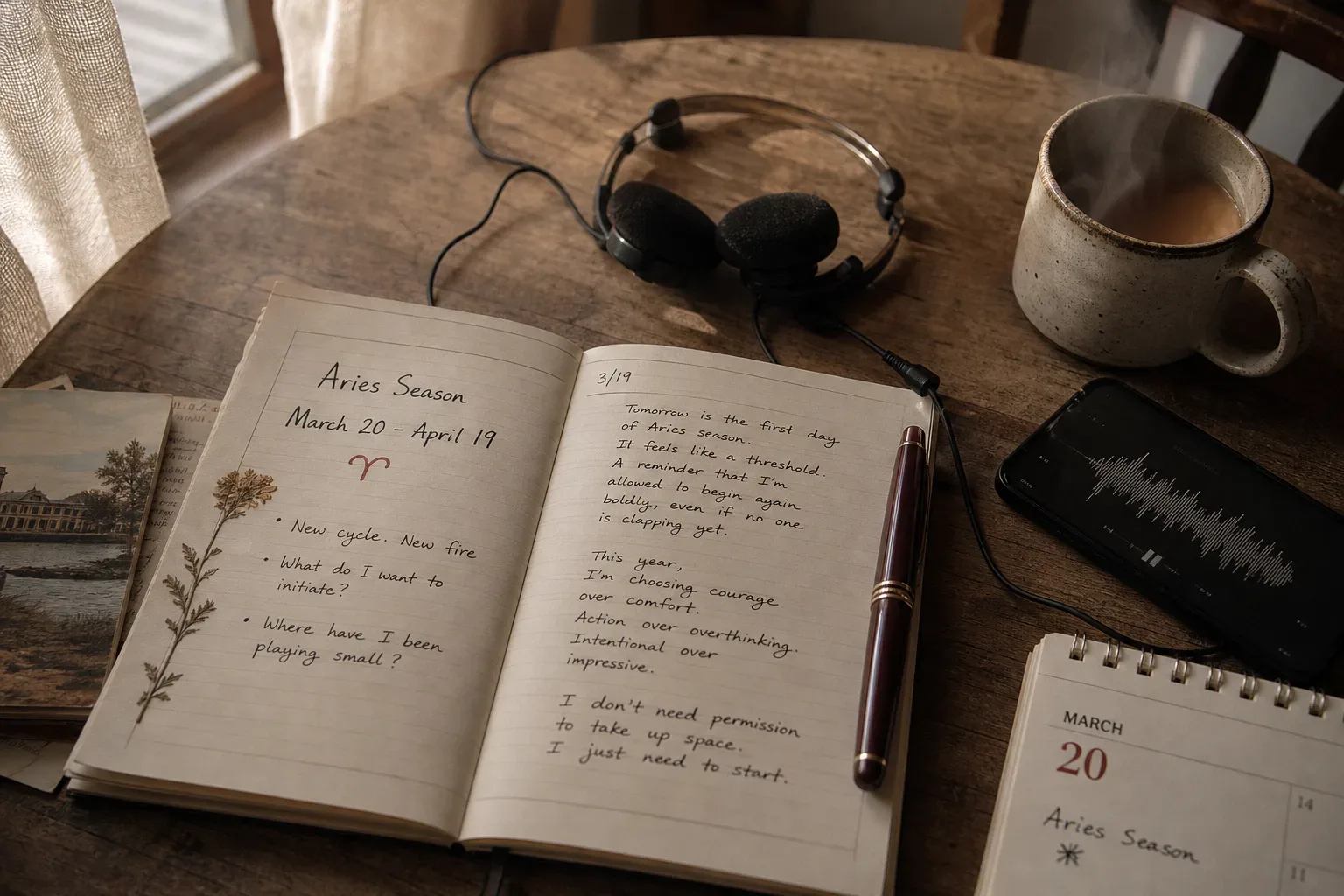
November 2. The kettle clicked off while I wrote March 20 to April 19 in the margin. Aries season manifestation works best when I choose one brave, specific aim, record it as a 5-minute Dream-Self audio, and listen daily before the day starts making its own requests.
What makes Aries season manifestation different from any other month?
Aries season is useful because it gives me a clean beginning, a visible calendar cue, and permission to choose one first step.
I am careful with astrology because my research life has made me allergic to confident claims without good measures. Pew Research Center reported in 2018 that 29 percent of U.S. adults say they believe in astrology, which is enough people to make the practice culturally real even when the mechanism is symbolic. Aries season, usually dated from about March 20 to April 19 in tropical astrology, sits at the start of the zodiac year. I use that fact as a ritual container, not as proof that the sky is doing my work for me.
The practical value is the beginning. Behavioral science has known for decades that cues matter. A date, a chair, a song, a mug, a calendar square with a red circle around it. In a 2009 study by Phillippa Lally and colleagues, habit automaticity took a median of 66 days to form, but the early repetitions mattered because they tied behavior to context. Aries season gives me about 30 days. That is not magic. It is enough time to notice whether I return.
There is a sentence I wrote on an index card last spring: a season is not a spell; it is a container. That still feels true. When I write about astrology and manifestation, I keep returning to this: the useful question is not whether Aries forces an outcome, but whether Aries helps me begin cleanly.
I like Aries symbolism because it is blunt. It asks what I will start before I have made the perfect plan. Neville Goddard wrote often about occupying the state of the wish fulfilled, but even his work depended on repeated inner rehearsal. In my kitchen, that becomes very plain. I choose the sentence. I listen. I do one small thing.
How do I choose one Aries-season aim without making it too big?
I choose one aim by making it brave enough to matter and small enough to practice today.
This is where I have ruined many notebooks. I used to write three pages of wants, and by the third page I could not tell whether I wanted the thing or wanted to be the kind of person who wanted the thing. Now I use one rule for Aries season manifestation: one season, one aim, one daily proof. The aim can be private. It can be professional. It can be as small as answering messages honestly for 30 days.
The brain likes specificity. In a large body of goal-setting research, Edwin Locke and Gary Latham found that specific, difficult goals tend to improve performance more than vague goals, across more than 400 studies summarized in their 2002 review. I do not take that as an order to become harsh with myself. I take it as a reason to stop writing foggy sentences.
Here is the page I use before I make the audio:
- I write the thing I want in one sentence.
- I ask what behavior would make it believable today.
- I remove any sentence that depends on another person changing first.
- I choose one daily action that takes 2 to 20 minutes.
- I write the identity sentence that would support it.
A clear aim has bones. A vague aim has weather.
For example, I do not write: I want my work to be seen. I write: I submit the paper, send the proposal, or publish the piece before Friday at 3 p.m. If I am working with love, I do not write: I want someone to choose me. I write: I speak the honest sentence and stop auditioning for warmth. The second version gives the audio something to hold.
I keep the broader manifestation practice nearby as a reference, but I do not let it become a shelf of theories. Aries season asks for the first match struck in the dark, not a lecture on fire.
What is the 5-minute Dream-Self audio actually doing?
The 5-minute Dream-Self audio gives my attention a repeated, self-relevant cue before my ordinary self-talk takes over.
In the AYA Method, the definition is precise: The AYA Method is a daily audio manifestation practice. Each day you listen to a short personalized recording, your Dream-Self Moment, narrated from the version of you who has already manifested the life you intend. Listening is the practice. Repetition is the work. The audio is the method. I like that last line because it does not hide the mechanism under decoration.
Five minutes is not a sacred number, but it is a usable one. In attention research, shorter practices are often easier to repeat than longer ones, and repetition is the part that changes the odds. A 2014 review by Cohen and Sherman on self-affirmation theory described how self-relevant statements can protect the sense of self under threat, especially when they connect to values. The audio works best when it sounds like a future self with a nervous system, not a slogan.
In the lab, we talk about self-referential processing because the brain treats information about the self differently from neutral information. Medial prefrontal regions are often involved when people evaluate traits as self-descriptive; this has been shown across many fMRI studies since the early 2000s. I am not saying a 5-minute recording rewires a life by itself. I am saying repeated self-relevant language is a plausible way to change what feels familiar.
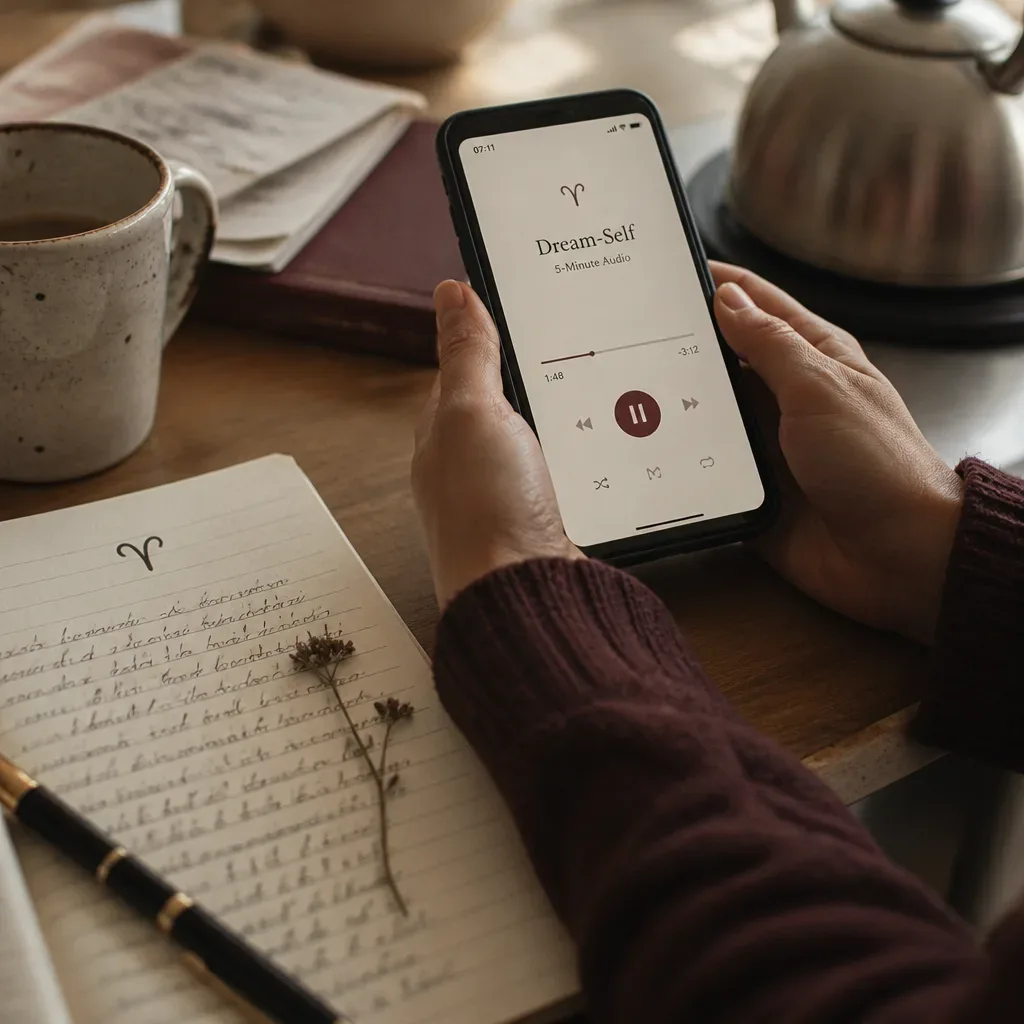
My own Aries audio last year was 4 minutes and 42 seconds. I listened before brushing my teeth. That is the order I did them in. The words were not grand. They said: I send the work while it is still warm. I ask directly. I do not wait to feel like a different person before I behave like one.
How do I make the 5-minute practice fit into an ordinary morning?
I make it fit by attaching the audio to a cue that already exists, then refusing to negotiate with the morning.
The cue matters more than the mood. BJ Fogg has written about tiny habits and anchoring new behaviors to existing routines; the principle is simple enough to test before breakfast. If the kettle comes on every morning, the audio can begin there. If I sit in the same chair to put on socks, the audio can begin there. I do not need a new life. I need one reliable hook.
Here is the version I use when Aries season starts and the days still feel thin with early spring:
| Minute | What I do | Why it matters |
|---|---|---|
| 0:00-0:30 | Sit, press play, put both feet on the floor | The body learns the cue |
| 0:30-3:30 | Listen without editing the words | Repetition does the work |
| 3:30-4:30 | Let one sentence land | Attention narrows |
| 4:30-5:00 | Write the next action | The aim enters the day |
The small action after listening is important. A 2021 review in Nature Reviews Psychology noted that behavior change is more durable when intention is paired with context and action, not left as intention alone. I think of the action as the receipt. Not proof to anyone else. Proof to my own attention that I meant the sentence enough to move.
Some mornings I also write a daily affirmation in the margin. I keep it as a complement, not the center. If you use affirmations, I would make them plainer than the internet often makes them. One line is enough: I begin before I am fully ready. Then I press play again the next morning.
The practice is not there to make me impressive. It is there to make one chosen identity less strange.
What should the Aries-season audio say?
The audio should say who I am becoming, what I do daily, and how I act when the old pattern asks for the chair back.
I write the script in first person because the self hears first-person language differently than distant advice. In cognitive therapy research, repeated alternative statements are often used to challenge automatic thoughts, but they only help when they are believable enough to practice. A sentence that makes the body roll its eyes is too far away. A sentence that makes the body sit up is close enough.
For Aries season, I use verbs with edges. Not because I want to become hard, but because Aries symbolism is about initiation. Begin. Send. Ask. Choose. Leave. Enter. Say. The recording does not need to be poetic. It needs to be dated enough that I know what to do after breakfast.
I keep these lines in the script:
- I name the aim in one sentence.
- I describe the version of me who already practices it.
- I include one specific daily action.
- I name the old pattern without shaming it.
- I end with the next brave step, not a perfect future.
A good Dream-Self sentence does not flatter me. It recognizes me ahead of schedule.
One of my scripts began like this: I am the version of Vera who sends the draft before the fear has finished speaking. I check the data once, not seven times. I write the email in the morning and let the work meet the world by noon. That script was not glamorous. It was useful. It gave my nervous system a rehearsal track.
Joe Dispenza often speaks about rehearsing future states, and I think the careful version of that claim is worth keeping: mental rehearsal can support behavior when it is paired with action and repeated cues. The overblown version says the brain cannot tell imagination from reality. That is false as stated. The interesting version says imagined, self-relevant rehearsal can influence prediction, attention, and readiness.
How do I keep Aries season from becoming pressure?
I keep it from becoming pressure by measuring return, not intensity.
Aries language can become too sharp in me if I am not careful. Start now. Be bold. Do the thing. By day 6, that can sound less like courage and more like an old school bell. So I set one gentler metric before I begin: did I return to the audio today? Not did I feel fearless. Not did the outcome arrive. Did I return?
This is where the neuroscience helps me soften. Dopamine is often discussed as pleasure, but researchers including Wolfram Schultz have shown for decades that dopamine neurons are deeply involved in prediction and learning signals. The small win after the audio matters because it teaches the system what follows the cue. A crossed-off 10-minute action can be more instructive than a dramatic promise.
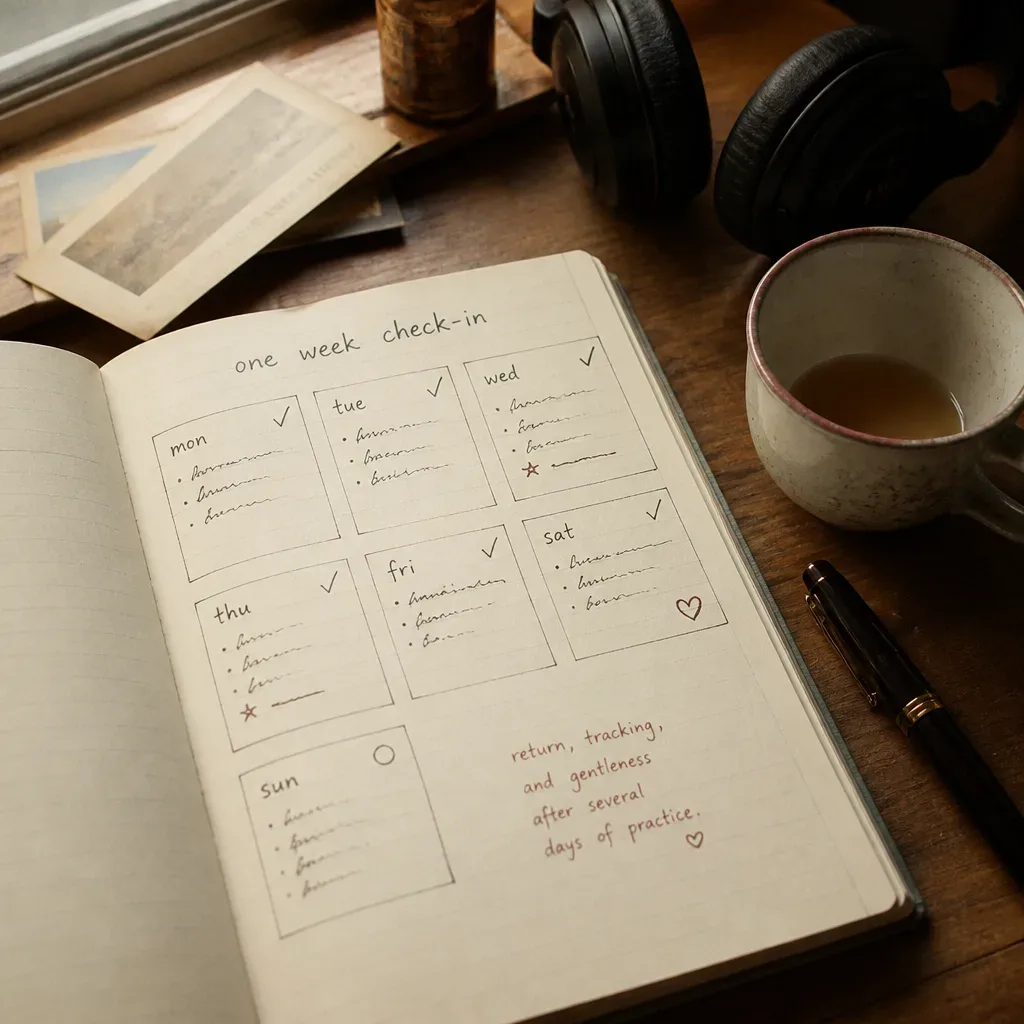
I also use a 7-day check because a week is long enough to reveal friction and short enough not to become a verdict. If I miss a day, I do not restart the season in shame. I listen the next morning. Missing once is data. Quitting because I missed once is the old pattern wearing a judge’s coat.
There are a few signs that I have made the practice too heavy:
- I keep rewriting the audio instead of listening to it.
- I choose actions that require someone else’s approval.
- I make the aim so large that no daily proof is possible.
- I treat one missed morning as evidence against myself.
- I use astrology as a deadline for panic.
When that happens, I shorten the script. I return to 5 minutes. I put the phone by the mug. I let astrology and manifestation be a language of timing, not a courtroom.
How will I know if the practice is working after one week?
I know it is working when the chosen action becomes easier to start, even if the outcome is still unfinished.
Seven days is too short to judge a life. It is long enough to judge a cue. I use three measures, all plain enough to write on the back of a receipt: did I listen, did I take the action, did the sentence feel more familiar by day 7? Familiarity is not the same as truth, but it matters. The mere exposure effect, first described by Robert Zajonc in 1968, shows that repeated exposure can increase liking or ease. I see a cousin of that in self-talk. What I repeat becomes less foreign.
Here is my one-week audit:
- Count the number of listens out of 7.
- Count the number of daily actions completed.
- Write the sentence that stayed with me.
- Name the point where I resisted.
- Adjust only the action, not the whole aim, unless the aim was never mine.
If I listened 5 out of 7 mornings, I call that useful data. If I took 3 small actions, I look at what blocked the other 4. If the audio made me feel tense, I edit the sentence toward truth. I do not make it prettier. I make it more honest.
The Manifestation Board sometimes helps me after the audio, especially if I need a visual reminder of the one aim. I keep it secondary. The sound comes first. The daily listening is the practice, and the board is just a small note pinned where my eyes can find it.
I return to the AYA Method because it keeps the practice narrow enough to repeat. I return to manifestation as a wider language for naming desire and action. For Aries season, I need both less theory and more morning.
Monday night. The page is dated, and my cup is empty.