astrology manifestation
New Year Manifestation Ritual With Dream-Self Audio
A quiet new year manifestation ritual using Dream-Self audio, a page, and one honest next action, made for people who want less noise.

January 1. The kettle clicked off before the room was warm. A new year manifestation ritual works best when it is short, repeated, and tied to one honest action. I use Dream-Self audio first, then write one page, then choose the smallest next step I can take today.
What makes a new year manifestation ritual actually work?
It works when the ritual turns attention into a repeatable cue, not when it makes the first morning feel dramatic.
I learned this the unromantic way. I used to make January lists that looked like pitch decks: twelve categories, color codes, and enough ambition to bankrupt an afternoon. By February 3, most of it had become furniture. Lally and colleagues, in a 2009 study in the European Journal of Social Psychology, found that habit automaticity took anywhere from 18 to 254 days, with an average of 66 days. That number cooled me down. A new year is not a spell cast once. It is a cue you can return to.
So I keep the ritual small enough to survive a bad Tuesday. That is the old venture filter in me, maybe. A tool is not good because it photographs well on launch day. It is good if people still use it when their coffee is cold and their inbox has 47 unread messages. A ritual that cannot survive an ordinary morning is not a ritual yet; it is theater.
The strongest rituals usually have 3 parts: a cue, an embodied practice, and a next behavior. Researchers Edwin Locke and Gary Latham reviewed decades of goal-setting research in 2002 and found that specific, challenging goals tend to improve performance more than vague goals. But the word specific matters. “Be better with money” floats away. “Open the savings account before lunch” has a door handle.
For me, the cue is the kitchen chair. The embodied practice is the audio. The next behavior is one thing I can do before the day gets crowded. I do not ask the ritual to carry the whole year. I ask it to point my hands in the right direction for the next 24 hours.
How do I prepare without turning it into a project?
Prepare by removing friction: one chair, one page, one audio, one candle if you like, and nothing that requires a second trip to the store.
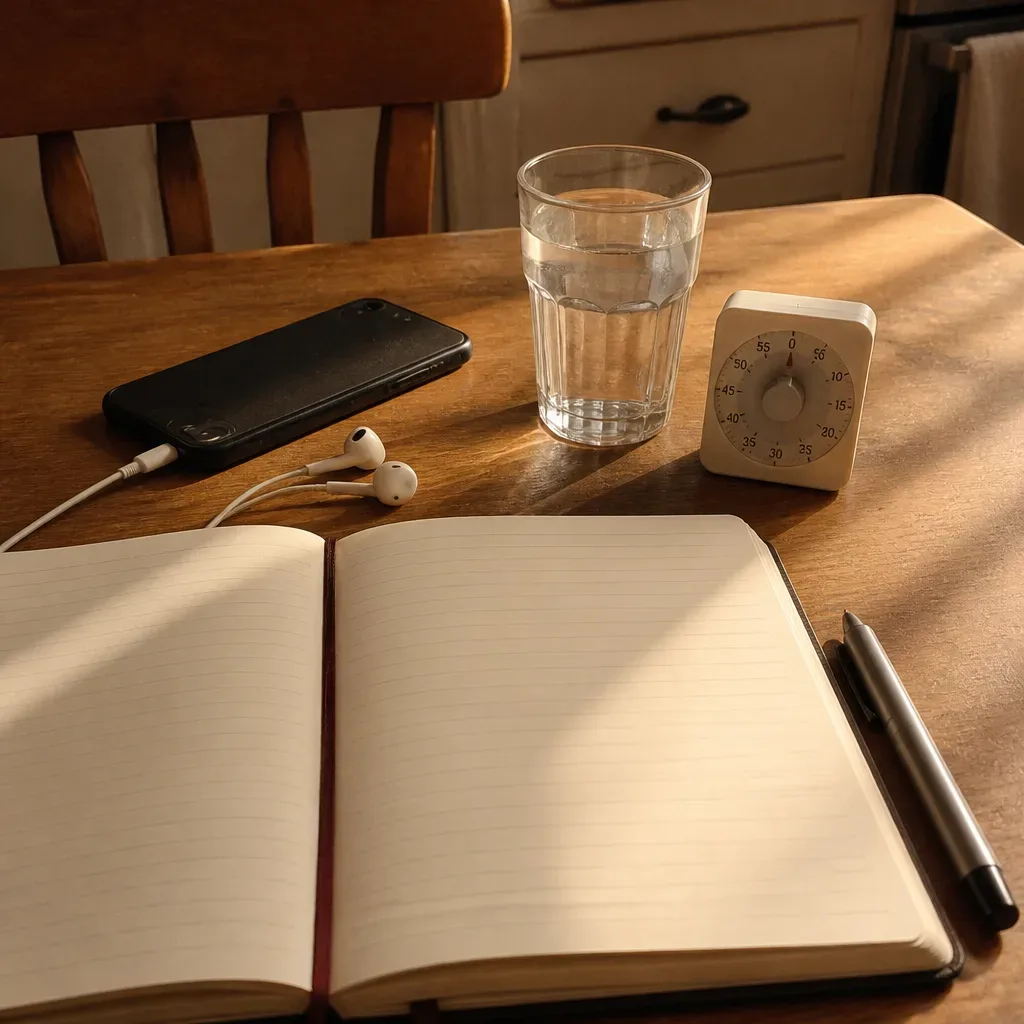
Last night I put my notebook on the table before bed. That was the whole preparation. No special pen. No glass bowl. No twelve-step ceremony. I have tested too many wellness tools that start by making you build a small administrative department around yourself. The American Psychological Association has reported for years that stress rises when people feel low control and high demand; adding 9 decorative requirements to a ritual does not help the nervous system settle.
Here is the setup I use, written plainly because I need plain things in January:
| Item | Why it is there | Time cost |
|---|---|---|
| Headphones | To make the audio private | 10 seconds |
| Notebook | To catch what I heard | 30 seconds |
| Water or coffee | To keep the body in the room | 1 minute |
| Timer | To stop the ritual becoming a fog | 5 seconds |
| One open tab only | To prevent wandering | 15 seconds |
I also decide what I am not doing. I am not reviewing the whole past year unless I have already eaten. I am not making a 100-line plan. I am not opening social media before the ritual. A 2023 Pew Research Center report found that 31% of U.S. adults say they are online almost constantly; I do not need to invite that crowd into the first 20 minutes of the year.
A quiet practice has boundaries. That sounds stiff, but it feels kind. I write the date at the top of the page. I put my phone face down after the audio is ready. I sit in the same chair. The point is not aesthetic. The point is repeatability.
What should I listen for in the Dream-Self audio?
Listen for identity, evidence, and tone, because those are the parts you will need after the New Year mood fades.
I use the AYA Method here because the audio is the method. The AYA Method is a daily audio manifestation practice. Each day you listen to a short personalized recording, your Dream-Self Moment, narrated from the version of you who has already manifested the life you intend. Listening is the practice. Repetition is the work. The audio is the method. I listened before brushing my teeth this morning. That is the order I do them in.
The useful thing about audio is that it gets under the performance layer. Written goals can become a courtroom. Audio, when it is made well, becomes a remembered conversation. Neuroscientist Dr. Andrew Huberman often points to repetition and state as central to learning; the exact protocols vary, but the basic principle is old: the brain rehearses what it repeatedly attends to. A 5-minute recording, played daily for 7 days, gives you 35 minutes of identity rehearsal in the first week of the year.
I listen for three things. First, what does this version of me treat as normal? Second, what evidence does she mention that I can begin creating now? Third, what is the tone of her life? Calm is different from passive. Clear is different from harsh. The future self is not a fantasy character; she is a decision pattern you practice hearing.
Sometimes one sentence lands and the rest slips away. That is enough. This morning the line was, “I answer the important thing before I feed the noise.” I wrote it down because I knew I would forget by noon. The page is not there to capture everything. The page is there to keep one true sentence from dissolving.
If you are new to this kind of practice, read the broader Manifestation pillar later, not during the ritual. During the ritual, keep the room simple. The year does not need your research brain first. It needs your attention.
What do I write before and after the audio?
Write one sentence before listening and three grounded notes after listening, so the ritual becomes measurable without becoming mechanical.
Before the audio, I write one sentence only: “This year, I am asking for…” Then I finish it in language I would not be embarrassed to say to my mother at the sink. That test helps. If the sentence sounds like a slogan, I rewrite it. In goal-setting research, specificity improves follow-through, but specificity does not have to be corporate. “I want a steadier body and cleaner workdays” is more useful to me than “optimize my entire life.”
After the audio, I use this 5-minute page:
- One image I noticed: a place, object, person, or ordinary scene.
- One behavior I heard: something the Dream-Self version of me does regularly.
- One action for today: a step that can be finished in 24 hours.
- One sentence to repeat: not as a pillar, just as a handle for the day.
The sentence to repeat can sit near the Affirmations pillar, but I keep it in its place. Affirmations help me remember. The audio does the deeper daily work. When I confuse the two, I end up polishing language instead of practicing attention.
Gabriele Oettingen’s work on mental contrasting, developed over more than 20 years, is useful here. Her WOOP framework pairs a wish with an outcome, obstacle, and plan. I borrow the spirit of that without making the morning too busy. If the Dream-Self audio shows me steadiness, I ask: what blocks steadiness by 10 a.m.? Usually the answer is not mysterious. It is the phone. It is the tab I open before I have chosen my first task.
The page is not proof that the ritual worked. The page is a receipt for what I agreed to practice. That sentence has saved me from over-reading my own mood. Some mornings feel charged. Some feel dull. Both count if I listened and wrote the next true action.
How can astrology help without taking over the ritual?
Astrology can give the ritual timing and symbolism, but it should not become the authority you hand your agency to.
I like a dated sky. I like knowing whether the year begins near a new moon, a full moon, or the start of Capricorn season. I like the old habit of placing human intention inside a larger calendar. But I do not ask astrology to excuse me from action. The best use of Astrology and manifestation, for me, is as a timing lens: What is this season asking me to notice? What kind of structure would fit this month? What part of my life needs a cleaner boundary?
There is a difference between using a symbol and outsourcing a decision. Pew Research Center reported in 2018 that about 29% of U.S. adults believe in astrology. That number explains why the language is common, but it does not prove every interpretation should run your day. I treat astrology the way I treat weather. I may bring a coat. I still choose where to walk.
For a new year manifestation ritual, I use astrology in one of three light ways:
- If the moon is new, I write what I am beginning.
- If the moon is full, I write what is already too heavy to carry.
- If I know the sign of the season, I borrow one grounded question from it.
Capricorn season asks about structure. Aquarius asks about belonging and the future we build with others. Pisces asks what needs softness before it can move. These are prompts, not verdicts. The ritual remains the same: listen, write, act.
The Princeton Global Consciousness Project, begun in 1998 by Roger Nelson after earlier PEAR research, has reported small statistical deviations in random event generators during major collective events. The interpretation is debated, and I hold it lightly. Still, it reminds me that human attention gathers around dates. January 1 is one of those dates. I do not need to make it mystical to respect that millions of people are pausing at once.
How do I keep the ritual going after January 1?
Keep it going by shrinking the daily version until it is almost impossible to skip.
On January 2, I do not repeat the full ritual. I listen to the Dream-Self audio again. I write one line. I take one action. That is it. If I make the maintenance version too ceremonial, I will start negotiating with it by the fourth morning. The Lally habit study’s 66-day average is a useful warning here: the first week is not the finish line. It is the wet cement.
I use a 7-day bridge because a year is too large for the nervous system to hold. Seven days is small enough to count on one hand plus two fingers. It also gives me data. By day 7, I can usually tell whether my stated intention belongs to me or to the person I perform when a calendar turns over. The honest ritual is the one you still want when nobody is watching you begin again.
Here is my quiet maintenance rule:
- Listen before consuming other people’s opinions.
- Write no more than 3 lines.
- Choose one action that takes under 15 minutes.
- Track completion with a mark, not a paragraph.
- Miss one day without making a story out of it.
That last one matters. Behavior researchers often warn against all-or-nothing thinking because it turns a small miss into identity evidence. I have done this. I missed a day and decided the whole thing was false. That was not discernment. That was drama wearing glasses.
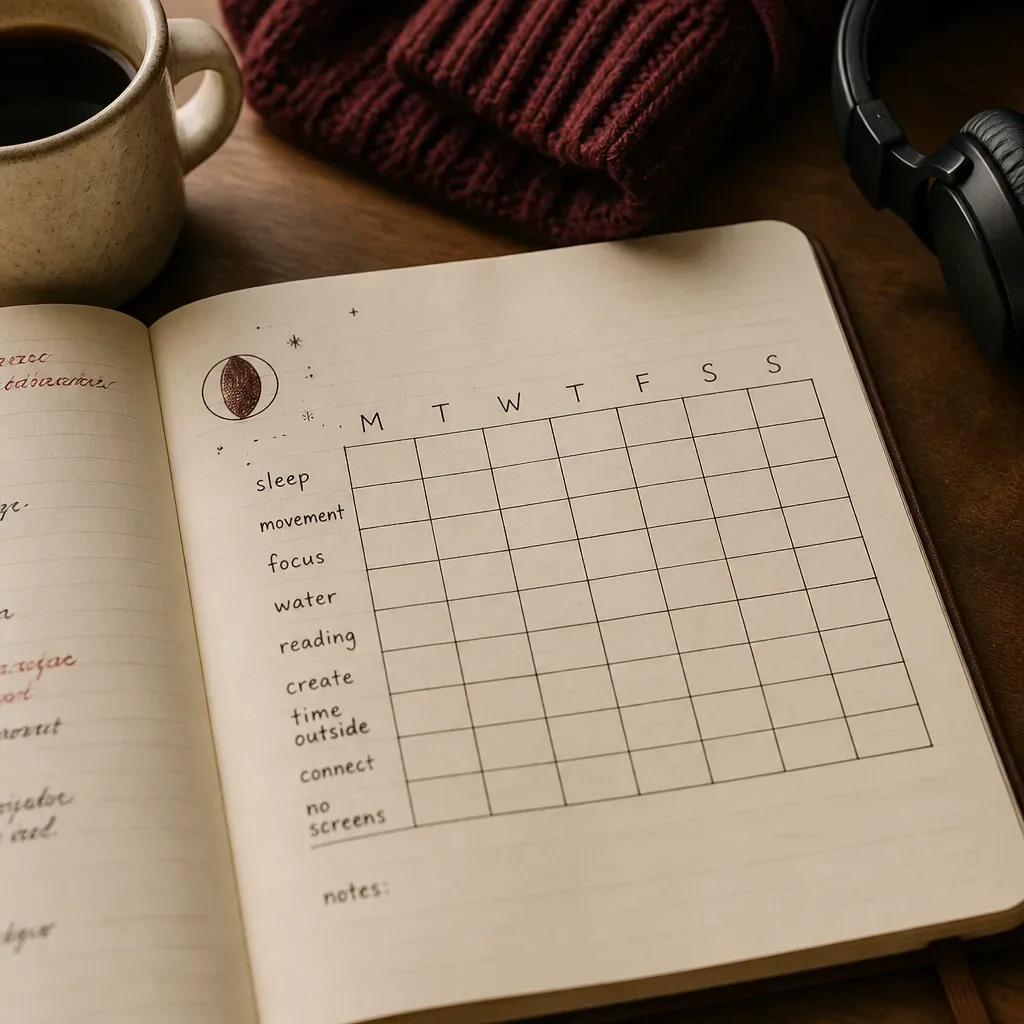
I keep a simple scorecard in the notebook:
| Day | Listened? | One line written? | One action taken? |
|---|---|---|---|
| 1 | ✓ | ✓ | ✓ |
| 2 | |||
| 3 | |||
| 4 | |||
| 5 | |||
| 6 | |||
| 7 |
No rating system. No mood graph. No productivity theater. If you want a fuller map of the practice behind this, the Manifestation pillar and the AYA Method explain the frame more cleanly than I can before coffee. If your ritual includes a short affirmation, keep it as a complement. If you use a board, let it support the audio rather than replace it.
A new year manifestation ritual is not a promise that the year will obey you. It is a promise that you will meet the year with a practiced ear. The audio gives me the voice. The page gives me the trace. The action gives the morning somewhere to go.
January 1, still cold, and the chair is waiting.