astrology manifestation
Birthday Manifestation Ritual With Dream-Self Audio
A birthday manifestation ritual using Dream-Self audio, reflection, and one clear next step for the year ahead without forcing a bigger mood.
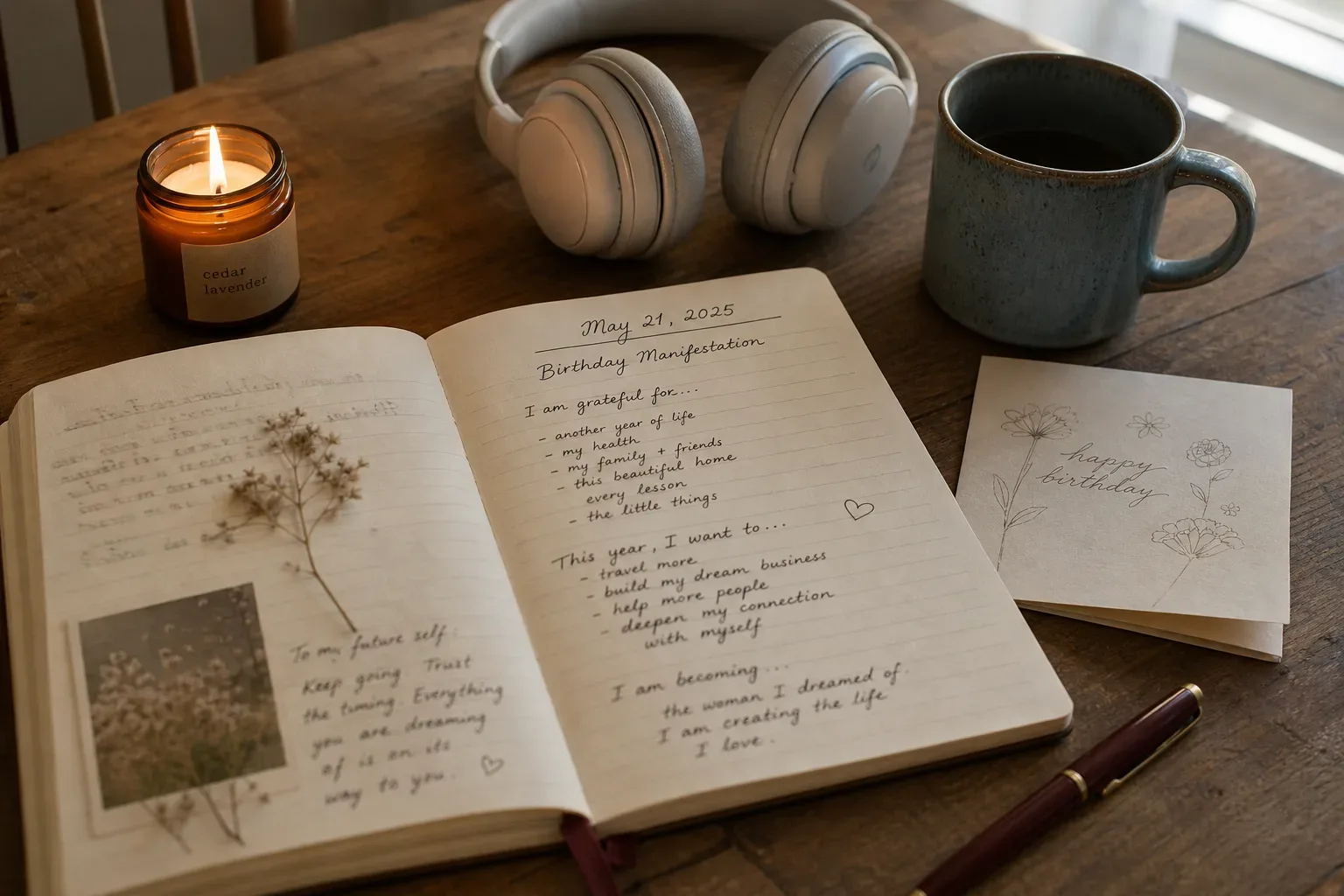
October 25th. The kettle clicked off while I wrote my age at the top of the page. A birthday manifestation ritual works best when it turns the birthday into a clear temporal marker: review the year, choose one intention, listen to Dream-Self audio, then take one ordinary next step.
Why does a birthday manifestation ritual feel different from any other ritual?
A birthday manifestation ritual feels different because the date gives the mind a clean line between the self you have been practicing and the self you are asking to practice next.
I do not mean clean in a magical sense. I mean psychologically clean. Katy Milkman, Hengchen Dai, and Jason Riis described the fresh-start effect in a 2014 Management Science paper, showing that temporal landmarks such as birthdays, holidays, and the start of a week can increase aspirational behavior. Their field data included Google searches for the word diet and gym attendance patterns, both rising around meaningful dates. The date does not do the work for us. It helps us notice the work.
That is why I like birthdays for intention setting. The body already knows the day is marked. Someone texts. A candle appears. My mother leaves a voice note. I feel the strangeness of being one year older before I have had coffee. A ritual can use that tenderness without making it loud.
I keep the frame simple because elaborate rituals often become avoidance with better lighting. My birthday page has four lines: what I kept, what I am done carrying, what I am asking for, and what I will do by tomorrow night. If I cannot name the wish in one sentence, I am probably trying to name five wishes at once.
A birthday is not proof that life has changed. It is permission to measure what I have been practicing.
I also keep a science note in the margin. In habit research, context matters. Wendy Wood and Dennis Rünger wrote in 2016 that habits are cue-response patterns shaped by stable settings and repetition. A birthday is not stable in the daily sense, but it is memorable. That makes it useful as a yearly cue, especially when paired with something repeatable afterward.
How do I prepare without turning it into a performance?
I prepare by making the room plain, choosing one object, and deciding in advance that the ritual is allowed to feel small.
This morning, I used the kitchen chair because it is where I tell the truth most easily. I put my phone on airplane mode for 35 minutes, except for the audio I planned to play. Research on attention is not romantic. Gloria Mark and colleagues have reported that people often switch computer tasks within minutes, and one widely cited workplace study found an average of about 3 minutes on a task before interruption. A ritual needs fewer doors open.
Here is the preparation I actually use:
- I write the date and my age at the top of the page.
- I choose one object: a candle, a mug, a stone from a walk, or a birthday card.
- I set a timer for 35 minutes.
- I put the Dream-Self audio ready before I begin.
- I decide the ritual is complete when I have one next action.
There is no need to buy anything. If astrology is part of your language, you might read your solar return chart or sit with the sun sign symbolism of the day. I keep a small note on astrology and manifestation nearby because symbols can focus attention. But symbols are containers, not substitutes. The work is still listening, naming, and repeating.
I also avoid making a list of twenty desires. A 2006 meta-analysis by Gollwitzer and Sheeran found that implementation intentions, the if-then plans that connect a goal to a cue, had medium-to-large effects on goal attainment across studies. One intention with a cue is more useful than a page of wishes with no doorway into Tuesday.
What should I write before I listen to the Dream-Self audio?
I write a brief review first because the future self needs to know what the present self has actually lived through.
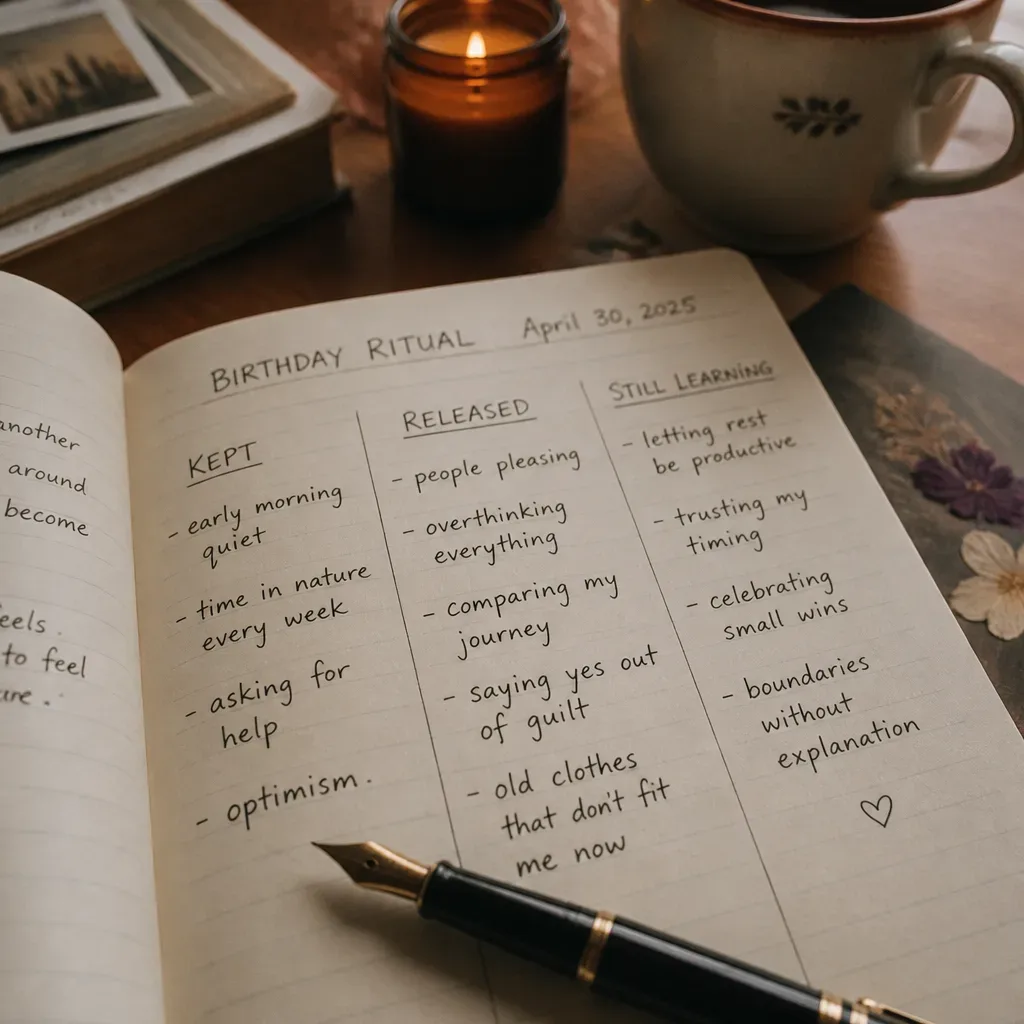
I divide the page into three columns. The first column is kept. The second is released. The third is still learning. I give myself 9 minutes, because otherwise I begin decorating the truth. In clinical and health psychology, expressive writing studies often use 15 to 20 minutes across several days, following James Pennebaker’s early protocols. I am not trying to replicate therapy at the kitchen table. I am borrowing the honesty of timed writing.
| Page prompt | Time | What I am listening for |
|---|---|---|
| What did I keep this year? | 3 minutes | Values that survived ordinary life |
| What am I done carrying? | 3 minutes | Old roles, stale promises, borrowed fears |
| What am I still learning? | 3 minutes | The honest edge, not the polished lesson |
The kept column matters most. The brain learns identity partly through evidence. Self-perception theory, first proposed by Daryl Bem in 1972, is a plain idea I return to often: we infer who we are by observing what we do. If I write, I kept showing up for my work even when I was tired, I am giving my next intention a floor.
Then I choose one sentence for the birthday year. Not a slogan. Not a demand. A sentence I can live near. For example: I am becoming someone who asks directly for the work she wants. Or: I am becoming someone who rests before resentment teaches her.
If you already use affirmations, this is the place to make them precise. I keep my longer notes on affirmations close because wording matters. An affirmation that argues with the nervous system can create resistance. A sentence that feels slightly ahead of me, but not false, is easier to repeat.
The future self does not need a theatrical promise. She needs a sentence the present self can bear hearing every morning.
How do I use Dream-Self audio inside the ritual?
I use Dream-Self audio as the center of the ritual, because repeated personalized listening gives the intention a voice and a body.
In the AYA Method, the AYA Method is a daily audio manifestation practice. Each day you listen to a short personalized recording, your Dream-Self Moment, narrated from the version of you who has already manifested the life you intend. Listening is the practice. Repetition is the work. The audio is the method.
I listen once during the birthday ritual without doing anything else. No notes. No correcting the sentence. No checking whether I feel enough. The brain has systems for self-referential processing, and neuroimaging reviews by Georg Northoff and colleagues in 2006 linked midline cortical structures with thinking about the self. I am careful with this research. It does not prove that listening to future-self audio causes a new life. It does suggest that self-relevant language is not neutral material.
Personalization matters here. A generic recording can be calming, but a recording that uses my real intention has a different weight. It catches on details. It says the thing I am practicing in language I recognize. In memory research, self-reference effects have been reported for decades, with Rogers, Kuiper, and Kirker’s 1977 study showing better recall for words processed in relation to the self. Again, the claim is modest. Self-related material tends to stick.
I like to listen sitting down, feet on the floor, one hand around the mug. If I cry, fine. If I feel nothing, also fine. Emotional volume is not the measure. Return is the measure.
After the audio ends, I write exactly three lines:
- The sentence I heard most clearly.
- The behavior it asks of me.
- The first place I will practice it.
For the broader map, I sometimes reread my own notes on manifestation, mostly to remind myself that naming is only the beginning. A ritual without repetition becomes a pretty memory. A ritual with repetition becomes instruction.
What should I do in the first 24 hours after the ritual?
I take one action within 24 hours because the birthday intention needs contact with ordinary time before the mood fades.
This is the part I used to skip. I loved the page. I loved the candle. Then I would close the notebook and ask the next year to carry the whole thing for me. Behavior change research is not kind to that pattern. Lally and colleagues reported in a 2010 European Journal of Social Psychology study that habit automaticity took a median of 66 days to form, with wide variation from 18 to 254 days. One birthday feeling is not a habit.
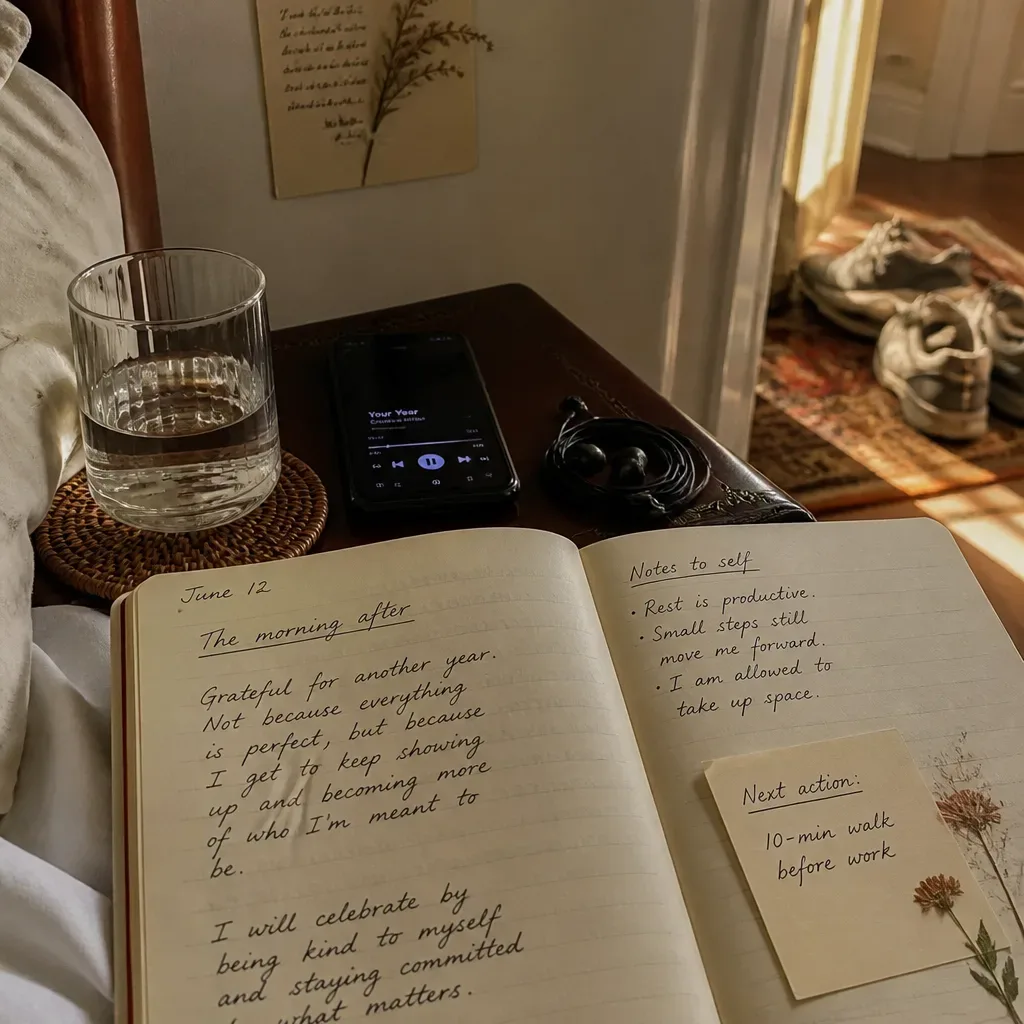
The first action should be almost embarrassingly concrete. Send the email. Book the appointment. Put the walking shoes by the door. Delete the app for one week. Ask the friend for the introduction. Open the savings account. The size is less important than the timestamp.
Here is the rule I use:
| If my birthday intention is about… | My 24-hour action is… |
|---|---|
| Work | Send one clear message before noon tomorrow |
| Love | Tell the truth once without rehearsing it ten times |
| Health | Prepare the next meal or book the appointment |
| Money | Look at the number, then choose one small repair |
| Creativity | Make for 20 minutes before consuming anything |
Peter Gollwitzer’s implementation intention research from 1999 is useful here because it joins a desired behavior to a specific cue. I write: If it is 9:00 tomorrow morning, then I send the proposal. Not I will be braver this year. Bravery needs a calendar invite.
How can astrology support the birthday ritual without taking it over?
Astrology can support the ritual by giving me symbolic language for the year, as long as I do not hand my agency to the chart.
I like solar return season because it gives shape to reflection. I notice the house themes, the moon placement, or the transits that feel personally resonant. Then I translate them into behavior. A tenth-house emphasis might become one professional ask per week. A fourth-house emphasis might become repairing home rhythms. Symbol first, behavior second. I have written more about this balance in astrology and manifestation, because it is easy to confuse a symbol with an instruction.
There is also a research-adjacent reason I keep symbolism gentle. Humans are pattern-making creatures. In cognitive psychology, apophenia describes perceiving meaningful connections in unrelated data, and it can increase under uncertainty. That does not mean all symbolic practice is foolish. It means I need a boundary. My boundary is simple: if the interpretation makes me passive or afraid, I put it down.
A birthday chart can be a mirror. It should not become a cage.
This is where Neville Goddard sometimes enters the conversation, because his work emphasized living from the assumed state. I read him as a historical manifestation teacher, not as a neuroscientist. Joe Dispenza uses brain-based language more directly, and some readers find his meditations useful, but I separate practice value from evidence strength. As a researcher, I am comfortable saying repeated self-relevant audio is plausible. I am not comfortable pretending every claim attached to it has the same support.
The birthday ritual works best when the chart, the candle, the page, and the audio all point to the same sentence. Too many meanings make a fog. One meaning can become a practice.
How do I keep the birthday intention alive for the next week?
I keep it alive by repeating the Dream-Self audio for seven mornings and pairing it with one visible cue.
Seven days is not a magic number. It is a week, and a week is easy to remember. In behavior design, the first repetition window matters because the old routine is still stronger than the new one. BJ Fogg’s Tiny Habits model, published in book form in 2019 and used widely in behavior design, emphasizes making the action small enough to complete after an existing prompt. I use brushing my teeth. I listen to my Dream-Self Moment before brushing my teeth. That is the order I do them in.
My seven-day plan is plain:
- Morning 1: listen and write the sentence once.
- Morning 2: listen and do one 5-minute action.
- Morning 3: listen while sitting, not while scrolling.
- Morning 4: listen and notice resistance without arguing.
- Morning 5: listen and repeat the 24-hour action in a new form.
- Morning 6: listen and tell one trusted person the intention if it helps.
- Morning 7: listen and choose the next week’s cue.
I sometimes add a daily affirmation below the page, but I treat it as a complement. The audio remains the practice. If I make a small Manifestation Board, it is usually one image and one phrase, not a collage demanding a new personality by Monday.
Self-affirmation research offers a useful caution. Cohen and Sherman reviewed the field in 2014 and noted that affirming core values can reduce defensiveness in some contexts, but effects depend on timing, threat, and fit. This is why I do not force a phrase that makes my body tense. A good birthday sentence should feel like a door I can open, not a costume I have to wear.
Repetition is not glamorous. It is how a sentence becomes available when the old self-talk gets loud.
By the seventh morning, I do not ask whether the whole year has changed. I ask whether the sentence is easier to hear. That is enough data for one week.
Sunday evening. The candle is out.