astrology manifestation
Winter Solstice Manifestation With Dream-Self Audio
A quiet winter solstice manifestation ritual using Dream-Self audio, reflection, one clear intention, and a short evening practice.
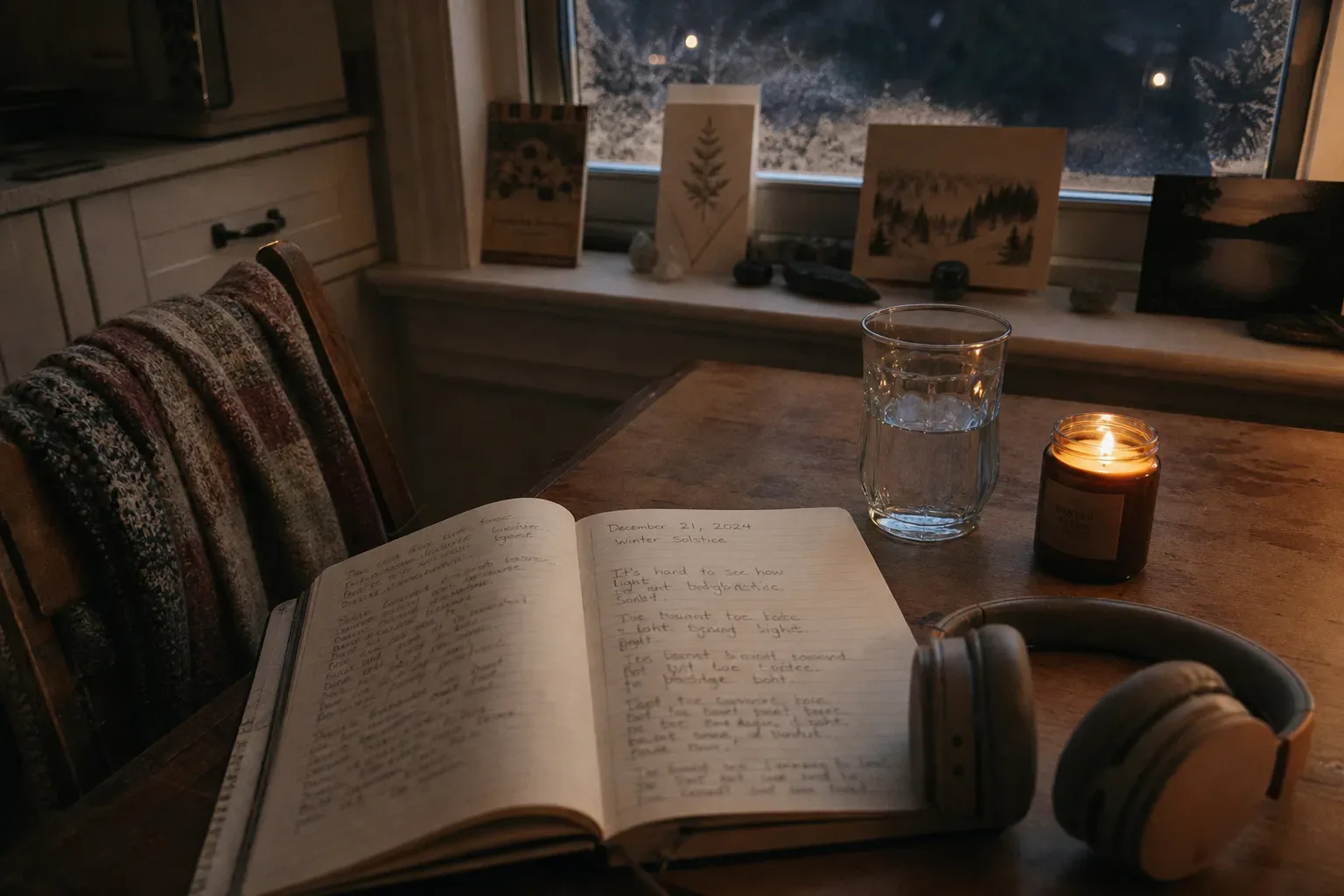
December 21. I use a winter solstice manifestation ritual to mark the longest night, choose one clear intention, and listen to Dream-Self audio as the repeated cue. The ritual is simple: reflect, name the future self, listen, and choose one small action for tomorrow.
What makes the winter solstice a useful time for manifestation?
The winter solstice is useful because it gives the body and the calendar the same message: pause, notice, and begin again slowly.
I wrote that in the kitchen this morning while the kettle clicked off. In the Northern Hemisphere, the winter solstice usually falls on December 21 or 22, when the sun reaches its most southerly point in the sky and daylight is at its shortest. NASA describes it as an astronomical event caused by Earth’s 23.5-degree axial tilt, not by mood or meaning. The meaning is what we bring to it.
That distinction helps me. I do not need the sky to promise anything. I only need a clean marker. The solstice is a line on the page, and some years I badly need a line. The Astrology and manifestation page says this gently too: timing can support attention, but timing does not do the work for us.
A ritual works best when it is small enough for a tired person to keep. That is the sentence I keep returning to. Research on habits says context matters because repeated behavior becomes easier when it is tied to a stable cue. In a well-known 2009 study in the European Journal of Social Psychology, Phillippa Lally and colleagues found that habit formation took a median of 66 days, with wide variation from 18 to 254 days.
The solstice gives me the cue. The dark afternoon, the cold window, the early lamp. I do not treat it as a magic switch. I treat it as a dated page in the year where I can ask, plainly, what kind of person I am practicing being next.
How do I prepare without making the ritual too elaborate?
I prepare by removing decisions before the ritual begins, because too many choices make the night feel like work.
At 5:10 p.m., I put four things on the table: a candle, a notebook, my headphones, and a glass of water. That is enough. I have learned not to add crystals, playlists, ten prompts, three pens, and a second notebook. There is nothing wrong with any of those things. I only know myself. If the setup takes more than five minutes, I begin performing the ritual instead of practicing it.
Here is the version I keep taped inside my notebook:
- Put the phone across the room, unless I need it for audio.
- Light one candle or turn on one small lamp.
- Write the date at the top of the page.
- Take three slow breaths, counted normally, not dramatically.
- Start with what is true, not what sounds impressive.
A 2010 review in Health Psychology Review on implementation intentions, often associated with Peter Gollwitzer’s work, found that “if-then” planning can improve goal follow-through across many behaviors. My version is not fancy: if it is solstice evening, then I sit at the kitchen table after dinner. The ritual begins because the place tells me what to do.
I also avoid asking for ten different outcomes. Attention is limited. Cognitive control research, including work summarized by Miller and Cohen in 2001, treats goal maintenance as a demanding process. I feel that in ordinary life. When I write five intentions, I obey none of them. When I write one, my body has a chance to remember.
The room does not have to be beautiful. It only has to be honest. A chipped mug can hold a serious promise.
What do I write before listening to Dream-Self audio?
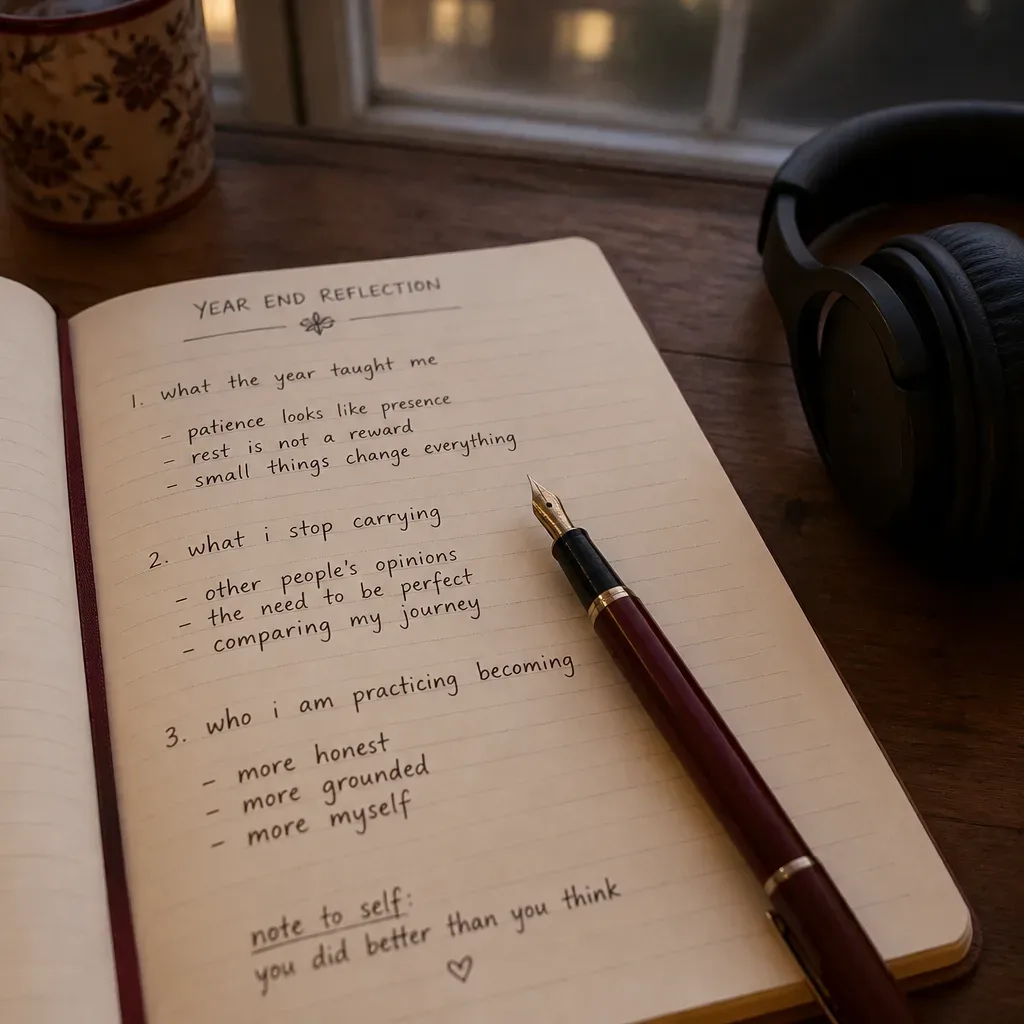
I write three short notes before listening: what the year taught me, what I am no longer feeding, and who I am practicing becoming.
The first note is evidence. Not a grand life review. Just five lines. Today mine said: I kept showing up to the lab when I was tired. I answered fewer messages at night. I missed my mother. I became less afraid of being slow. I noticed that my body believes repeated words before it believes rare speeches.
The second note is release, but I keep it behavioral. I do not write, “I release fear,” because my nervous system does not understand that as an instruction. I write, “I stop checking my email after 8 p.m. three nights a week.” In clinical and behavioral research, specificity matters. A 2006 meta-analysis by Webb and Sheeran found that intentions have a moderate effect on behavior, but the effect is stronger when intentions are clear and supported by plans.
The third note is the Dream-Self note. This is where the AYA Method fits into my solstice night. The AYA Method is a daily audio manifestation practice. Each day you listen to a short personalized recording, your Dream-Self Moment, narrated from the version of you who has already manifested the life you intend. Listening is the practice. Repetition is the work. The audio is the method.
I write one sentence for that future self before I press play. Not a fantasy. A sentence with hands and shoes on it. “I am the kind of person who protects her mornings.” “I am the kind of person who tells the truth sooner.” “I am the kind of person who finishes the paper by working in 45-minute blocks.”
Self-affirmation research is useful here, though it is often overstated online. Claude Steele’s self-affirmation theory began in the 1980s, and later reviews by Cohen and Sherman, including a 2014 Annual Review of Psychology paper, suggest that reflecting on valued identity can reduce defensiveness under threat. That is not the same as getting every outcome we name. It is still something.
How should I use Dream-Self audio during the ritual?
I use Dream-Self audio as the center of the ritual, not as background sound.
I put my headphones on and sit in the chair without doing anything else. No dishes. No stretching. No fixing the candle. If I am restless, I let the restlessness be there. The point is not to enter a special state. The point is to hear the same self-relevant language often enough that it becomes easier to choose from it tomorrow.
This matters to me as a neuroscience researcher because repetition is not decoration. Repeated cues help the brain predict what comes next. Studies of self-referential processing repeatedly implicate midline cortical regions, including the medial prefrontal cortex, when people evaluate information in relation to themselves. A 2006 paper by Northoff and colleagues reviewed this literature and helped make self-related processing a serious topic rather than a soft one.
I am careful with the popular claim that “the brain cannot tell imagination from reality.” Stated that way, it is false. If it were true, we could not function. But mental imagery does recruit some overlapping neural systems with perception, depending on the task. Reviews by Guillot and Collet in the 2000s on motor imagery show measurable overlap in motor-related networks, which is why athletes have used imagery practice for decades.
So I listen with calibrated belief. I do not pretend the audio is a command to the world. I let it become a rehearsal of identity. Rehearsal is quieter than certainty, and often more useful.
For this winter solstice manifestation ritual, I listen once. If the recording is short, I may listen twice, but I do not chase a feeling. Some nights the audio feels warm. Some nights it feels ordinary. Ordinary still counts. The nervous system learns through returns, not through fireworks.
What should the ritual include, step by step?
The ritual should include a brief setup, a written review, one intention, Dream-Self audio, and one next action within 24 hours.
I keep the whole practice around 25 minutes. The duration matters because I want to trust myself to repeat the next morning. The Centers for Disease Control and Prevention has reported that about 1 in 3 U.S. adults sleep less than the recommended 7 hours, and I think about that when rituals become too long. Tired people need kind structures.
| Part | Time | What I do | Why it helps |
|---|---|---|---|
| Set the room | 3 minutes | Candle, notebook, headphones, water | Reduces decisions |
| Review the year | 7 minutes | Five true lines, no performance | Builds evidence |
| Name intention | 3 minutes | One identity sentence | Focuses attention |
| Listen to audio | 5 to 8 minutes | Dream-Self Moment, no multitasking | Repeats self-relevant language |
| Choose action | 4 minutes | One step for tomorrow | Links ritual to behavior |
My numbered version is even plainer:
- Date the page: “December 21.”
- Write five things the year taught you.
- Write one thing you are no longer practicing.
- Write one identity sentence for the coming season.
- Listen to your Dream-Self audio once.
- Write one action you can take in the next 24 hours.
- Put the notebook somewhere you will see it tomorrow.
If I want a daily affirmation, I add it after the audio, not before. The Affirmations pillar is helpful for wording, especially when a sentence feels too glossy. But for me, on solstice night, the audio stays central. The affirmation is a small note in the margin.
This is also where I check my intention against the wider practice of manifestation. I ask whether I have named something I can participate in. “I become impossible to reject” is not useful. “I send the application by January 12 and practice speaking about my work without apologizing” gives me a door handle.
How do I choose an intention that is grounded enough to keep?
I choose an intention by turning a desired outcome into an identity I can practice in observable ways.
I learned this the hard way. One winter I wrote, “I am ready for a different life,” and then closed the notebook with great seriousness. Nothing was wrong with the sentence, except that it did not tell me what to do on Tuesday. The next week still had laundry, grant edits, bus delays, and my old habit of shrinking when I needed to ask directly.
Now I use three filters:
- Can I practice it tomorrow? If not, I make it smaller.
- Can I observe it in behavior? If not, I make it more concrete.
- Can I believe it at least 10 percent? If not, I soften the wording.
The 10 percent number is not from a formal scale. It is my practical threshold. In therapy research, credibility and expectancy are often measured because belief in a treatment rationale can affect engagement. A 2018 paper by Constantino and colleagues in Psychotherapy discusses expectancy as one contributor to outcomes, though not a magic ingredient. I borrow the spirit of that: the sentence must be believable enough that I do not roll my eyes at myself.
Here are examples from my own pages:
| Too vague | More grounded |
|---|---|
| I am successful | I send my work before I over-edit it |
| I am loved | I answer honestly when people ask how I am |
| I am disciplined | I begin with 20 minutes before checking messages |
| I am healed | I book the appointment I keep postponing |
The best intention is not the biggest one. It is the one that changes your next ordinary hour.
What do I do the morning after the solstice?
The morning after, I repeat the audio and complete the smallest action I wrote the night before.
This is the part I used to skip. I liked the candle. I liked the page. I liked the feeling of being sincere at night. Then morning came with coffee grounds on the counter and a message I did not want to answer. The ritual became real only when I gave it a next-day behavior.
At 7:20 a.m., before brushing my teeth, I listened again. That is the order I do them in when I am practicing the AYA Method: audio first, teeth second. The order is small, almost silly, which is why it works for me. In behavior design, stable cues reduce negotiation. BJ Fogg’s Tiny Habits model also uses anchoring, placing a new behavior after an existing one, as a way to lower friction.
I do not try to keep the solstice feeling alive. Feelings change too quickly to be a reliable calendar. I try to keep the cue alive. Same chair if possible. Same headphones. Same first sentence in the notebook. Repetition makes an intention less theatrical and more domestic.
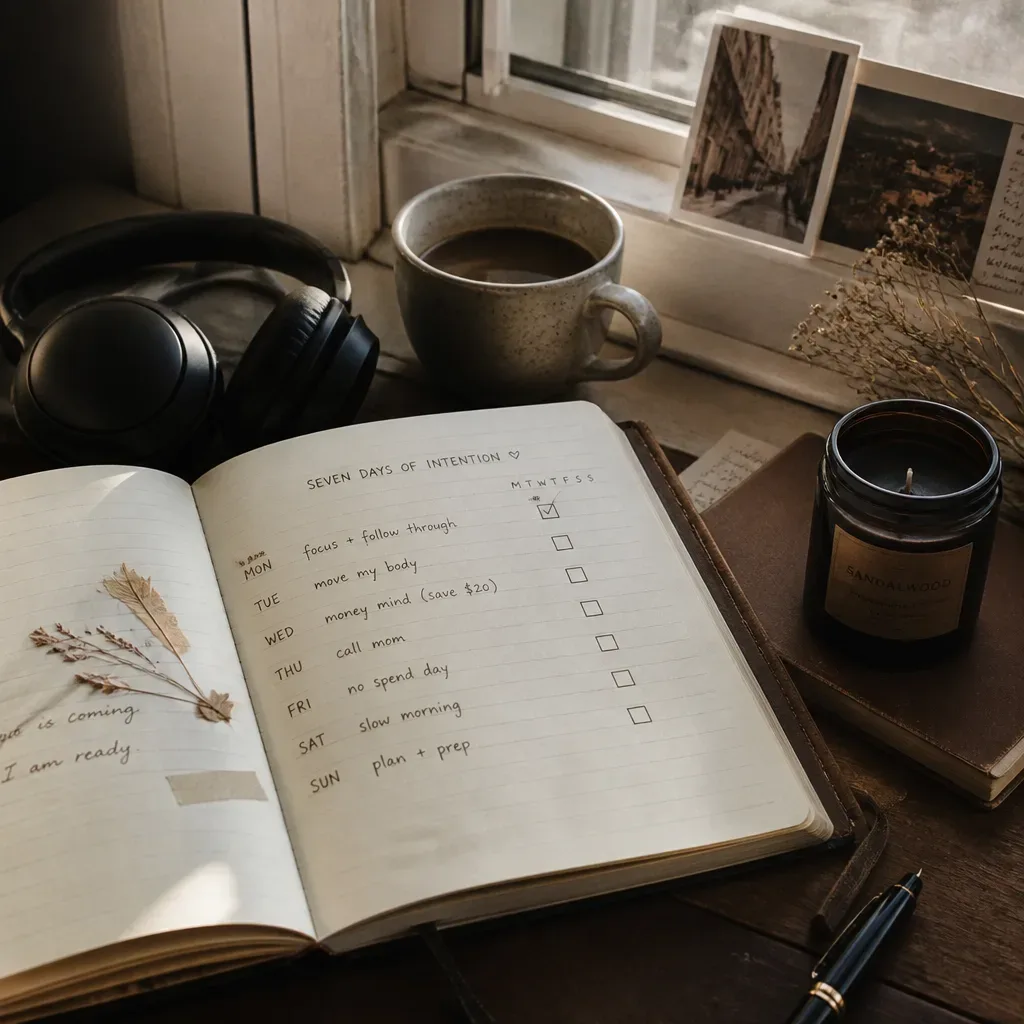
I also write one line at night for seven days after the solstice. Not a full entry. One line:
- Day 1: I sent the email.
- Day 2: I avoided the hard paragraph.
- Day 3: I listened anyway.
- Day 4: I asked for the meeting.
- Day 5: I was tired and did the smallest version.
- Day 6: I noticed less apology in my voice.
- Day 7: I kept the promise small enough to keep.
Tracking works partly because it gives feedback. A 2015 meta-analysis in Psychological Bulletin by Harkin and colleagues found that monitoring progress toward goals was associated with better goal attainment, especially when progress was physically recorded or publicly reported. My notebook is not public. It is physical, and that is enough.
The solstice is one night. The practice is what I do when the candle is out.
December 22, 8:06 a.m. The kettle is on again.