mindset
Body Confidence Manifestation Before Body-Checking
Body confidence manifestation works best when I listen before body-checking, using one small audio cue to interrupt the mirror loop.

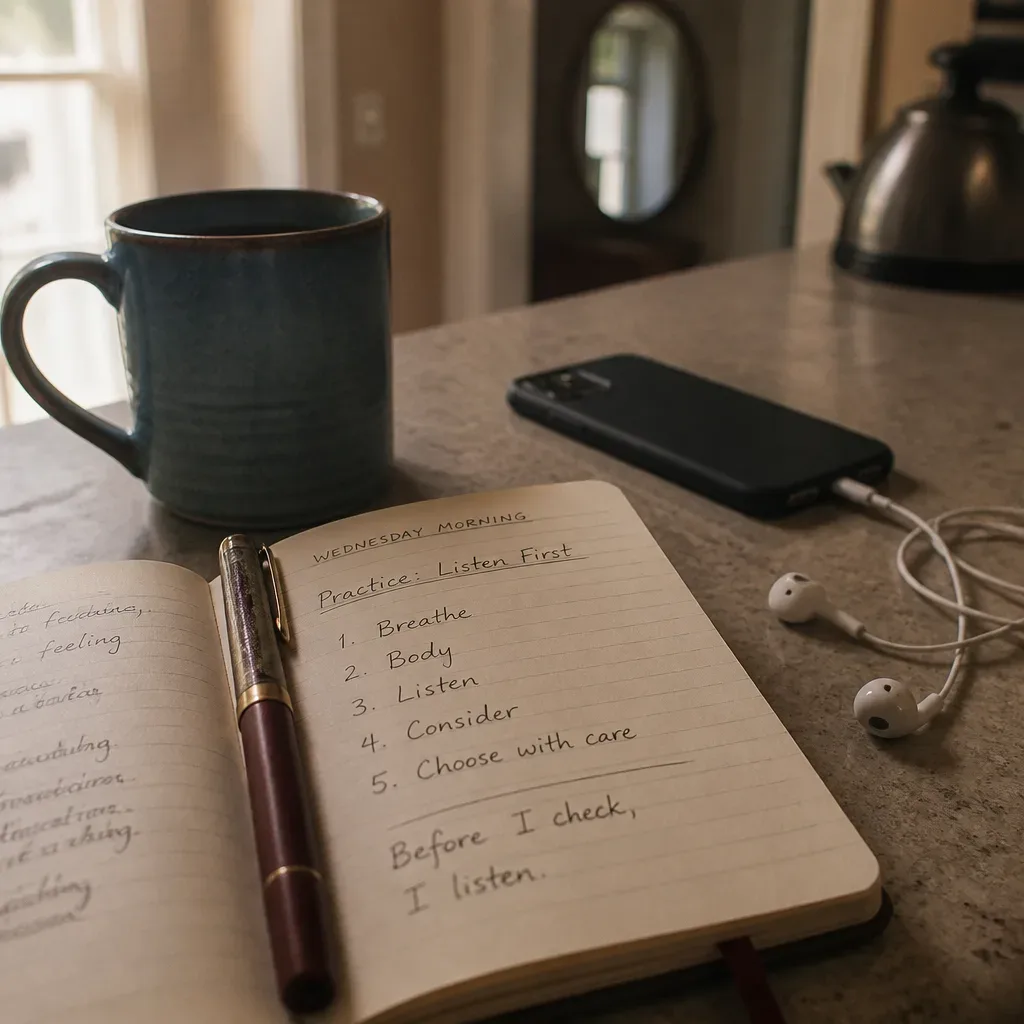
Wednesday. The kettle clicked off before I touched the mirror. Body confidence manifestation, for me, means listening to a short self-relevant audio before body-checking so the first story my brain hears is not criticism. I use it as a seven-minute interruption: pause, listen, name the urge, choose one body-respecting action.
What am I actually doing when I practice body confidence manifestation?
I am rehearsing a body identity before the checking habit gets the first vote.
This morning I stood in the kitchen in socks, phone face down beside the blue mug. I wanted to check my stomach in the hall mirror. Not because anything new had happened. Because the old loop was available. Body-checking can be quick: a glance, a pinch, a weigh-in, a photo zoom. In cognitive behavioral models of eating disorders, including Fairburn’s CBT-E work from 2008, body-checking is named as a maintaining behavior, not a neutral measurement.
I do not use body confidence manifestation as a claim that my thoughts will rewrite my body by force. I use it as a way to place a different sentence before the automatic one. That distinction matters. Research on self-referential processing shows that personally relevant words recruit midline brain regions more than random words; a 2016 review by Northoff and colleagues describes this network as central to how we tag information as “me.” The word “me” is not small in the brain.
The practice I return to is the AYA Method: The AYA Method is a daily audio manifestation practice. Each day you listen to a short personalized recording — your Dream-Self Moment — narrated from the version of you who has already manifested the life you intend. Listening is the practice. Repetition is the work. The audio is the method.
A kinder body story does not become believable because I shout it. It becomes familiar because I keep meeting it at the same doorway.
If you are new to this language, I would pair this page with the broader Manifestation pillar, especially if you want the practice without inflated promises. When I teach my own students about repeated cues, I often use ordinary examples first: brushing teeth, checking the stove, reaching for the phone. The body mirror can become that automatic too. In Lally’s 2009 habit study, the average time to automaticity was 66 days, with a wide range from 18 to 254 days. So I do not panic on day three.
Why do I need to listen before I check my body?
I listen first because body-checking often strengthens the anxiety it pretends to solve.
I used to think the mirror would give me closure. It rarely did. I checked, felt a small spike of relief or distress, then checked again later. In the eating disorder literature, checking is often grouped with avoidance, reassurance-seeking, and comparison. One study by Shafran, Fairburn, Robinson, and Lask in 2004 described body-checking as a behavior that can keep preoccupation alive by directing attention back to feared features.
The timing is the whole point. If I listen after the check, the old evidence has already been gathered. If I listen before, I make a little gap. Dr. Andrew Huberman often describes behavior change in terms of state and timing: the nervous system learns from repeated pairings. I would say it more plainly in my notebook. The cue I repeat before the mirror becomes part of what the mirror means.
Here is the version I kept on the fridge for two weeks:
- I notice the urge to check.
- I put one hand on the counter.
- I listen to my Dream-Self Moment once.
- I name the check I was about to do.
- I leave the room or do one caring thing.
This takes less than seven minutes. A 2022 Pew Research Center report found that 97% of U.S. adults owned a cellphone, which means the cue is usually already within reach. That is not romantic. It is useful. I do not need a candle, a new notebook, or a better morning. I need the first 60 seconds to belong to something other than inspection.
The mirror is not the enemy. The old question I bring to it is the problem.
How do I set up the seven-minute practice?
I set it up by making the listening step easier than the checking step.
I write this because the brain loves friction math. If the mirror is clear, the scale is visible, and the phone camera is open, the old habit wins by speed. Wendy Wood’s habit research has shown for years that context and ease shape behavior more than intention alone. In her 2019 book Good Habits, Bad Habits, she points to repetition in stable contexts as the machinery beneath many daily actions.
My setup is plain. I do it before brushing my teeth because that is when I used to check the side view of my body. I keep the audio on my phone’s first screen. I do not open the camera. I do not weigh myself. I do not negotiate with the mirror while half-awake. The AYA audio is not background music for criticism. It is the first cue.
| Minute | What I do | Why it helps |
|---|---|---|
| 0:00-1:00 | Notice the urge | Naming reduces the blur of the habit |
| 1:00-3:30 | Listen to the audio | Repeats a self-relevant identity cue |
| 3:30-4:30 | Name the exact check | Turns “I feel bad” into a behavior I can choose |
| 4:30-7:00 | Do one body-respecting action | Gives the brain evidence from action, not inspection |
I keep the action small. I drink water. I put on the clothes I chose last night. I make toast. I open the blinds. In a 2018 paper in Health Psychology Review, Gardner and colleagues noted that small, repeatable actions are more likely to become habits than actions requiring high motivation. This is why I do not ask myself to love my body at 7:06 a.m. I ask myself to stop interrogating it before breakfast.
If I want a sentence, I borrow from the Affirmations pillar, but I keep it believable: “I can care for this body before I approve of how it looks.” That sentence has carried me through more mornings than the louder ones.
What should I say when the mirror urge is loud?
I say something specific, present-tense, and behavior-facing, because vague praise does not interrupt a precise habit.
The phrase “I am beautiful” can be tender for some people. For me, on hard mornings, it can bounce off. The mirror urge is usually not vague. It says, “Check your waist.” “Check the angle.” “Compare today’s face to yesterday’s photo.” A useful response needs the same level of specificity. In clinical exposure work, the response is often planned before the trigger appears; that planning reduces the need to invent courage under stress.
I keep a small list in the notes app. It has 6 lines, not 60. Too many choices become another way to spiral. Studies on choice overload are mixed, but classic work by Iyengar and Lepper in 2000 found that more options can reduce follow-through in some settings. I take that seriously in the bathroom.
The phrases I use most:
- “I am not collecting evidence against myself this morning.”
- “I can dress this body without cross-examining it.”
- “The check is an urge, not an instruction.”
- “I listen first. Then I choose.”
- “Care is allowed before confidence arrives.”
A sentence can be a handrail. It does not need to be a courtroom argument.
Neville Goddard wrote often about living from the state of the wish fulfilled. I read him carefully, not literally in every claim. What I keep is the rehearsal principle: practice the state before the world confirms it. Joe Dispenza uses similar language around mental rehearsal, and while some of his stronger claims deserve caution, the basic idea that repeated imagery and emotion can influence behavior is not strange to neuroscience.
For a wider map of practices, I sometimes read Astrology and manifestation on quiet evenings, not as proof, but as a way people have always dated their hopes and rituals. My own morning stays more clinical. I listen. I name the check. I do the next ordinary thing.
How do I stop turning this into another way to monitor myself?
I stop by tracking the practice, not the body.
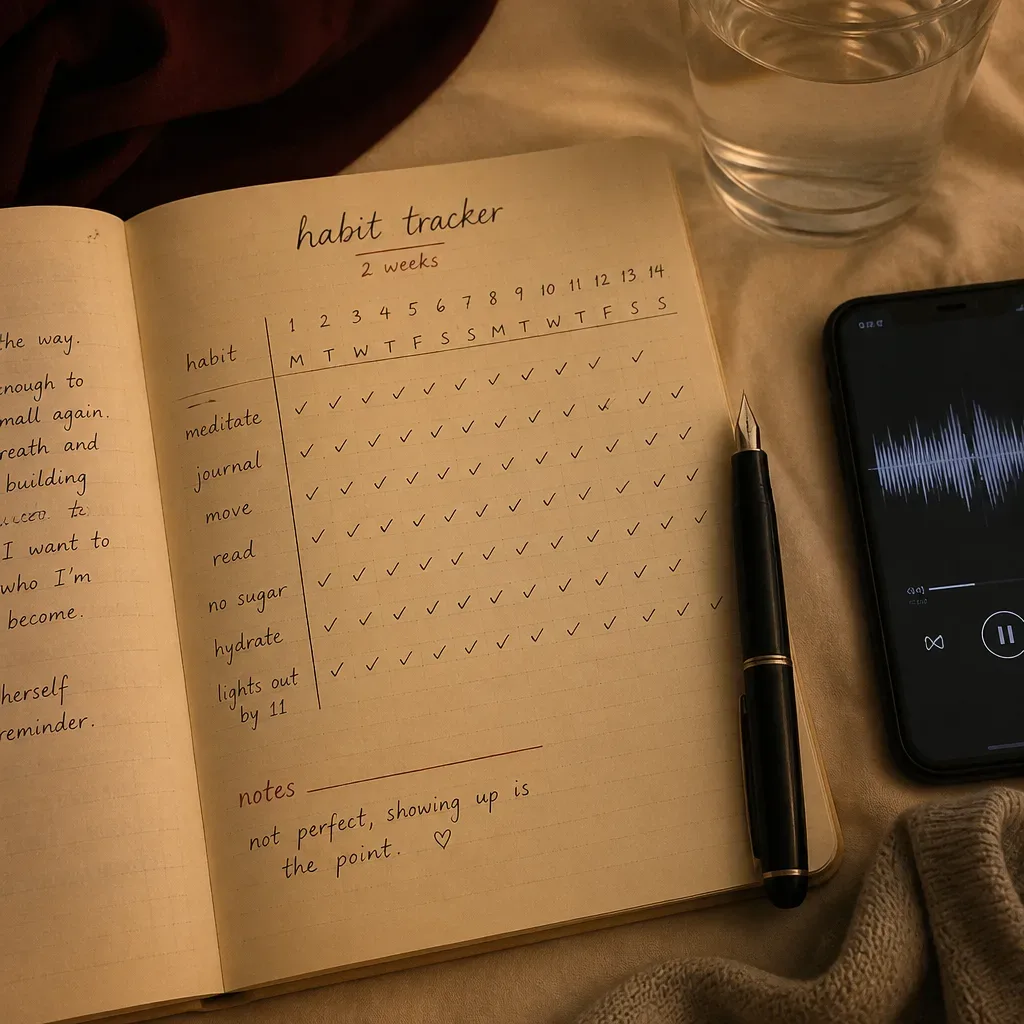
This is the part I have had to learn twice. If I make a chart of how confident I feel, I start checking the feeling the way I checked the mirror. If I rate my body every morning, I have built a prettier cage. So the only mark I make is binary: listened before checking, yes or no. In behavior research, implementation intentions often use simple if-then plans; Gollwitzer’s 1999 review found that specifying when and where a behavior happens improves follow-through across many goals.
My if-then plan is dated in the back of my notebook: “If I reach for the mirror before breakfast, then I listen once.” Not twice. Not until I feel pure. Once. Then I do one body-respecting action. The restraint matters because reassurance can disguise itself as practice.
I also keep a small “do not track” list:
- weight changes
- waist photos
- body angles
- how long confidence lasted
- whether the audio felt powerful
- whether I believed every word
Belief is not the first measurement. Return is.
There is a reason I avoid making mood the whole score. Emotions vary with sleep, cycle phase, stress, illness, and food. The National Sleep Foundation recommends 7 to 9 hours of sleep for most adults; missing that can change appetite, irritability, and threat sensitivity the next day. I do not want a tired brain grading my worth at 6:40 a.m.
A daily affirmation and a Manifestation Board can sit nearby if they help. I use them like margin notes, not pillars. The audio remains the method because it reaches me when my hands are busy and my arguing mind is not yet fully awake. For more grounding, I return to the AYA Method page when I need to remember the order: listening first, repetition as the work.
What if body-checking is tied to eating, exercise, or shame?
I treat that as a sign to add support, not as a personal failure.
I want to write this carefully. Body confidence manifestation can be a gentle daily cue, but it is not medical or psychological treatment. If checking changes how you eat, makes you avoid people, drives compulsive exercise, or takes up large parts of the day, it deserves skilled care. The National Eating Disorders Association notes that eating disorders affect people across body sizes, genders, races, and ages, and early support can matter.
I have seen the shame that comes when a wellness practice is sold as enough. It is not always enough. CBT-E, developed by Christopher Fairburn and colleagues, has evidence for eating disorder treatment. Exposure and response prevention may be used when checking has a compulsive quality. A registered dietitian, physician, or therapist can help when body fear has become tangled with food, health markers, or safety.
The listening practice can still have a place. I think of it as a bridge behavior. It helps me pause before the symptom behavior and choose a response I discussed with a clinician or wrote down on a steadier day. That is different from asking an audio to carry the whole weight of recovery.
If I were writing a safety card for my younger self, it would say:
- If I skip meals because of a check, I tell someone.
- If I weigh myself more than planned, I move the scale out of reach.
- If I cancel plans because of my body, I send one honest text.
- If I feel unable to stop, I contact a professional.
The body does not need to become an emergency before it is allowed to receive help.
The broader Manifestation pillar is useful when I want language for intention and identity, but treatment is treatment. I keep those categories clean. Warmth is good. Accuracy is kinder.
How will I know the practice is working?
I know it is working when there is more space between the urge and the check, even before confidence feels natural.
This is not a dramatic metric. It is the most honest one I have. In week one, I might still check after listening. In week two, I may check less intensely. In week three, I may leave the bathroom sooner. Small studies on self-affirmation suggest that values-based statements can reduce defensiveness under threat; for example, Cohen and Sherman’s 2014 review in Annual Review of Psychology describes affirmation effects as context-dependent but meaningful in some stress settings.
I look for behavioral signs:
- I listen before opening the camera.
- I get dressed with fewer outfit changes.
- I eat breakfast without negotiating with the mirror.
- I compare less on the bus or in shop windows.
- I recover faster after a hard body thought.
These are modest outcomes. Modest is not weak. A practice that gives me back ten minutes of the morning has changed the morning.
After 14 days, I read the checkmarks, not my body. Did I listen before checking on at least 10 mornings? Did I name the urge more quickly? Did one phrase begin to arrive on its own? If yes, I keep going for another 14. If no, I lower friction. I move the audio. I cover the mirror. I ask for help. Habit design is allowed to be practical.
For language support, the Affirmations pillar helps me choose sentences that are not cruelly far from belief. For timing support, the AYA Method keeps the practice simple: listen daily to the Dream-Self Moment and let repetition do its quiet work.
Tonight, the mirror is still in the hall. I am still here too. Wednesday now. The kettle is clean.