vision boards
Canva Vision Board: Add a Dream-Self Audio Layer
Make a Canva vision board you actually return to by adding a short Dream-Self audio layer, then using it as a daily listening ritual.
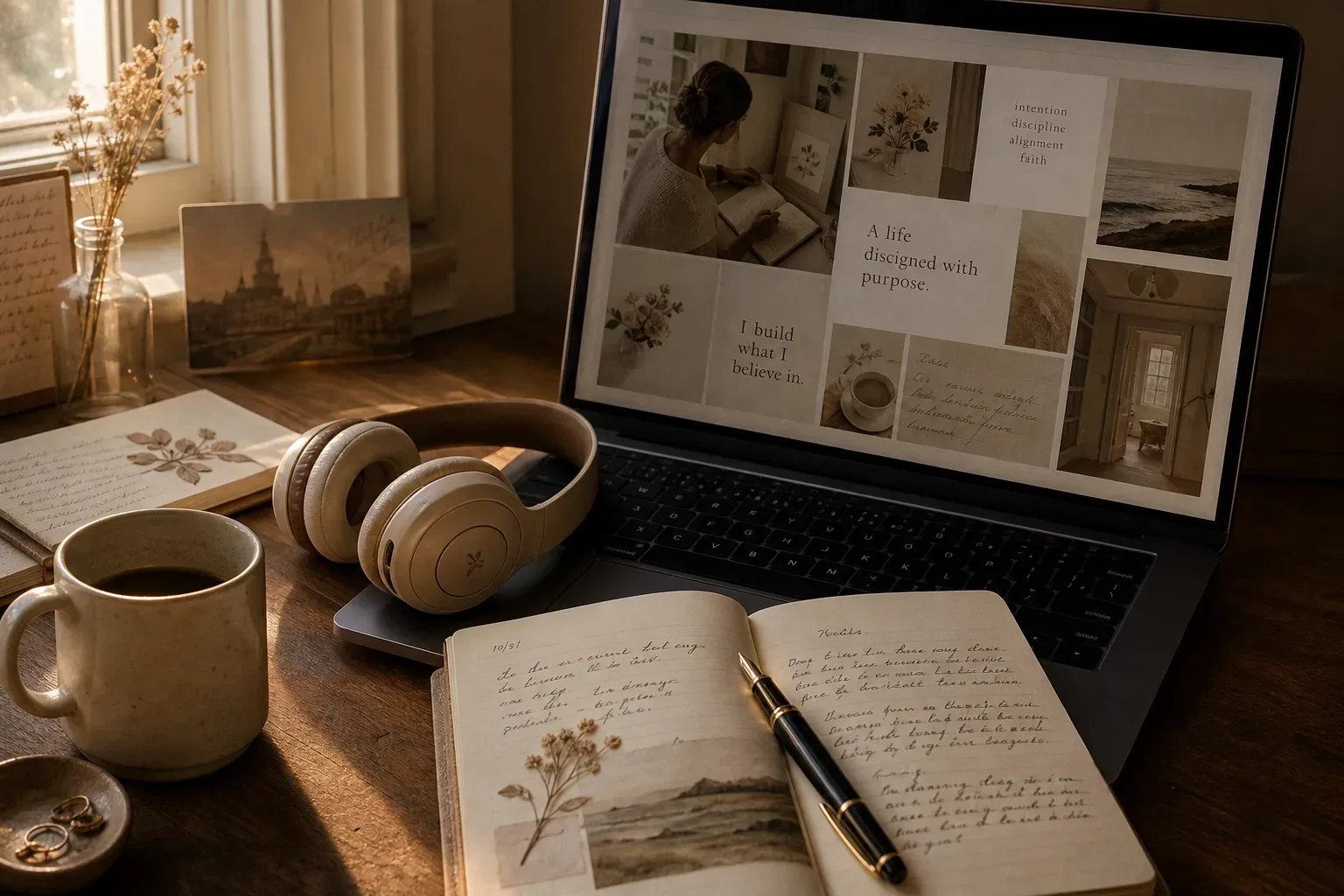
Thursday morning. The kettle clicked off before I finished arranging the last photo. A Canva vision board becomes more useful when I add a short Dream-Self audio layer to it: I design the images, record a future-self script, place the audio in Canva, and listen daily instead of only looking.
Why add audio to a Canva vision board at all?
Audio makes a Canva vision board easier to return to because listening asks less of me than staring at a screen.
I learned this the ordinary way, not the elegant way. I had made boards before. They looked considered. They had linen bedrooms, a small studio desk, a bowl of oranges, one sentence in a serif font. I would look at them for three days, then forget them behind seventeen browser tabs. Canva was not the problem. The problem was that the board stayed visual, and my mornings were not.
The first time I added audio, the board changed shape in my day. I could listen while washing the blue mug. I could listen with my face still half-asleep. Research on habit formation helps explain why this mattered to me: in a 2009 study in the European Journal of Social Psychology, Phillippa Lally and colleagues found that new behaviors took a median of 66 days to feel automatic, with wide variation from 18 to 254 days. A ritual that wants 66 mornings has to be gentle.
The visual board gives the mind a map. The audio gives the body a way to rehearse the map without effort. That is the part I kept writing in the margin. A picture can remind me what I want, but a voice can remind me who I am practicing becoming.
This is also why I keep returning to the AYA Method. The AYA Method is a daily audio manifestation practice. Each day you listen to a short personalized recording, your Dream-Self Moment, narrated from the version of you who has already manifested the life you intend. Listening is the practice. Repetition is the work. The audio is the method.
For a Canva board, that means the board is not the whole practice. It is the room the practice sits in. The listening is where the change gets repeated.
What should I put on the Canva vision board before recording?
I put fewer images on the board than I think I need, because clarity is kinder than clutter.
Before I record anything, I make the Canva vision board quiet enough to listen to. My rule this week was 6 to 12 images, 3 to 7 words, and one central feeling. Not a mood in the decorative sense. A felt instruction. Steady work. Honest love. Paid creative time. A body that trusts the morning.
Canva’s own product pages describe millions of templates and stock elements, which is useful, but it can also make the board sprawl. I give myself 20 minutes for the first pass. If I cannot choose the images in 20 minutes, I write the intention at the top of the page and remove half the search terms. Design taught me that too many options can feel like freedom while quietly becoming avoidance.
I use this small checklist before I record:
- One image of place, such as a kitchen, room, desk, street, or garden.
- One image of body, such as hands, walking shoes, a face in soft light.
- One image of action, not only outcome.
- One phrase I would still believe on a tired Wednesday.
- One blank area where the eye can rest.
I also keep the board tied to a larger intention. If I am naming money, work, love, or health, I check whether the board matches the way I think about Manifestation: not as decoration, but as repeated attention plus chosen action. Psychologist Gabriele Oettingen’s work on mental contrasting, developed over several decades and summarized in her WOOP method, keeps me honest here. Positive imagery alone can soothe. Pairing the desired future with the real obstacle tends to produce stronger follow-through.
So I do not only place a finished book cover. I place the chair where I write. I do not only place a calm relationship. I place two cups on a table. The board should not flatter me. It should remind me of the next livable scene.
How do I write a Dream-Self script that does not sound fake?
I write the script like a voice note from a future Tuesday, not like a speech trying to convince me.
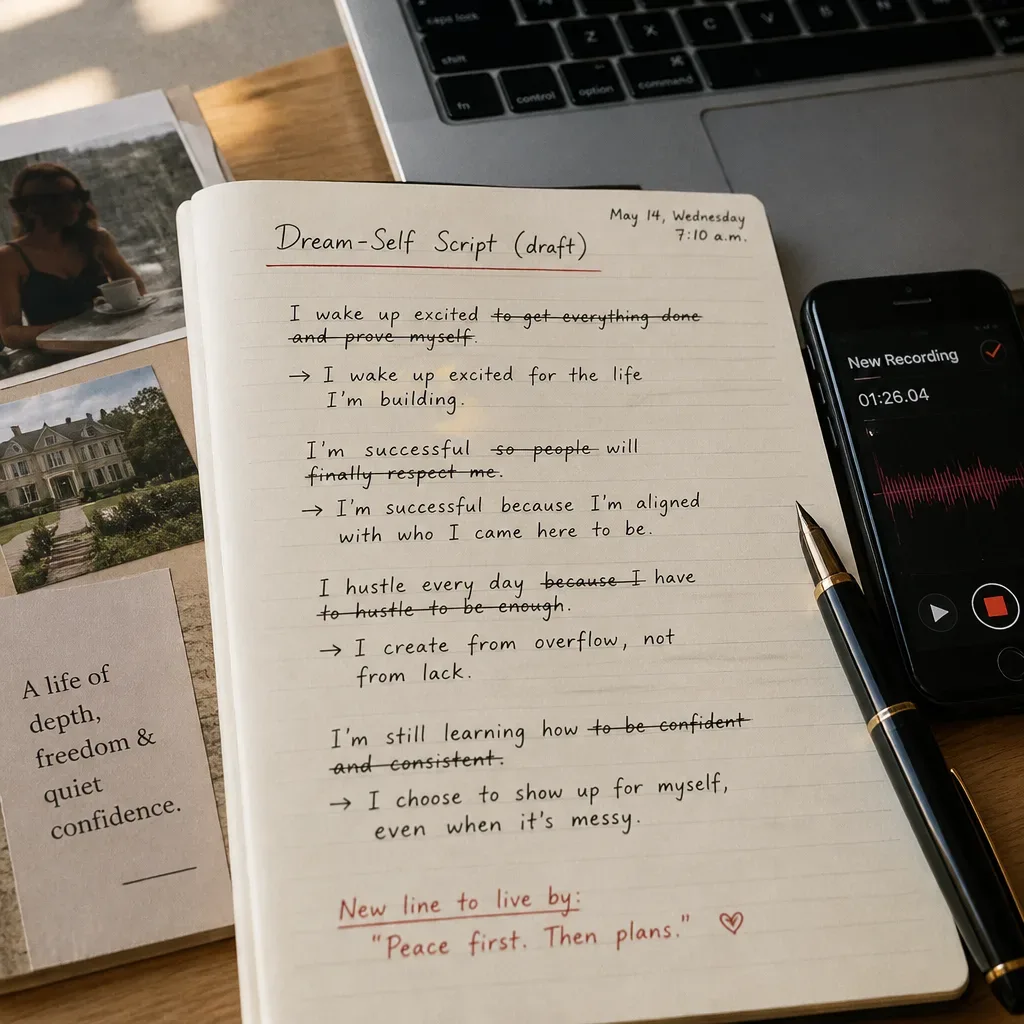
The script is the part I used to overwork. I would make it too bright, too polished, too certain. Then I would press play and feel my body reject it. Now I draft 120 to 250 words and keep it close to the kitchen. A Dream-Self audio layer works best when it sounds like a real person with a real morning, not a poster pretending to be wise.
A useful structure has 4 parts:
- Date the scene. I start with “It is morning” or “I am at the desk before 9.” Specific time makes the mind settle.
- Name the evidence. I include 2 or 3 concrete signs that the intention is now lived.
- Speak from the identity. I say what I choose, keep, answer, or stop doing.
- End with the next small action. I give myself one ordinary behavior I can do today.
I borrow some of the plainness of Affirmations, but I do not make the whole script a list of statements. Affirmations can be useful when they are believable and repeated. In a 2016 review in Social Cognitive and Affective Neuroscience, self-affirmation was linked with activity in brain systems related to self-processing and valuation. I take that seriously, but I also keep my claims modest enough to enter the body.
Here is the difference I noticed on the page:
| Flat line | Dream-Self line |
|---|---|
| I am successful. | I answer the first email before coffee because the work no longer scares me. |
| I have my dream home. | The morning light reaches the small table, and I keep it clear. |
| I am loved. | I do not audition for care anymore; I receive it and answer honestly. |
The sentence has to give the nervous system somewhere to stand. If it sounds false at 7:10 a.m., I soften it until it can be listened to again.
How do I add the audio layer inside Canva?
I add audio by turning the board into a simple Canva presentation or video, then uploading the recording and placing it across the pages.
This is the practical part I did at the dining table, with my headphones next to the plate. A static poster can hold a vision, but audio needs time. So I usually duplicate the board into 3 to 5 pages. Page one is the whole board. Page two is the body or place image. Page three is the action image. Page four is the phrase. If I need a fifth page, I use a blank or almost-blank page for the ending.
My steps look like this:
- Open the Canva vision board.
- Choose Resize or copy the design into a presentation or video format if needed.
- Duplicate the main page 3 to 5 times.
- On each page, enlarge one part of the board so the video moves slowly.
- Record the Dream-Self script on my phone, or record inside Canva if that is available on the format.
- Upload the audio file to Canva.
- Drag the audio onto the timeline and stretch or trim the pages to match it.
- Export as an MP4, or keep the Canva link if I only need private playback.
Canva changes its interface often, but the principle stays the same: the visuals need duration, and the audio needs a place to sit. A 90-second recording across 4 pages gives each page about 22 seconds. That is slow enough for my eyes to land without making the file feel ceremonial.
I keep one design note taped in my head: motion should not compete with the voice. No frantic animations. No ten transitions because they are there. Attention is a finite material. Dr. Andrew Huberman has often described attention as a limited neural resource in public education episodes, and even without turning that into a strict rule, I feel it. If the board shouts, I stop listening.
The best version I made this month had almost no movement. It had a room, a hand on a notebook, a pale green title, and my own voice saying, “I have stopped treating focus as proof of worth. I sit down because this is what I do.” That line kept me company for 9 mornings.
Where should I save it so I actually use it?
I save the audio-board in the place where my morning already begins, because a ritual hidden in a folder is almost the same as no ritual.
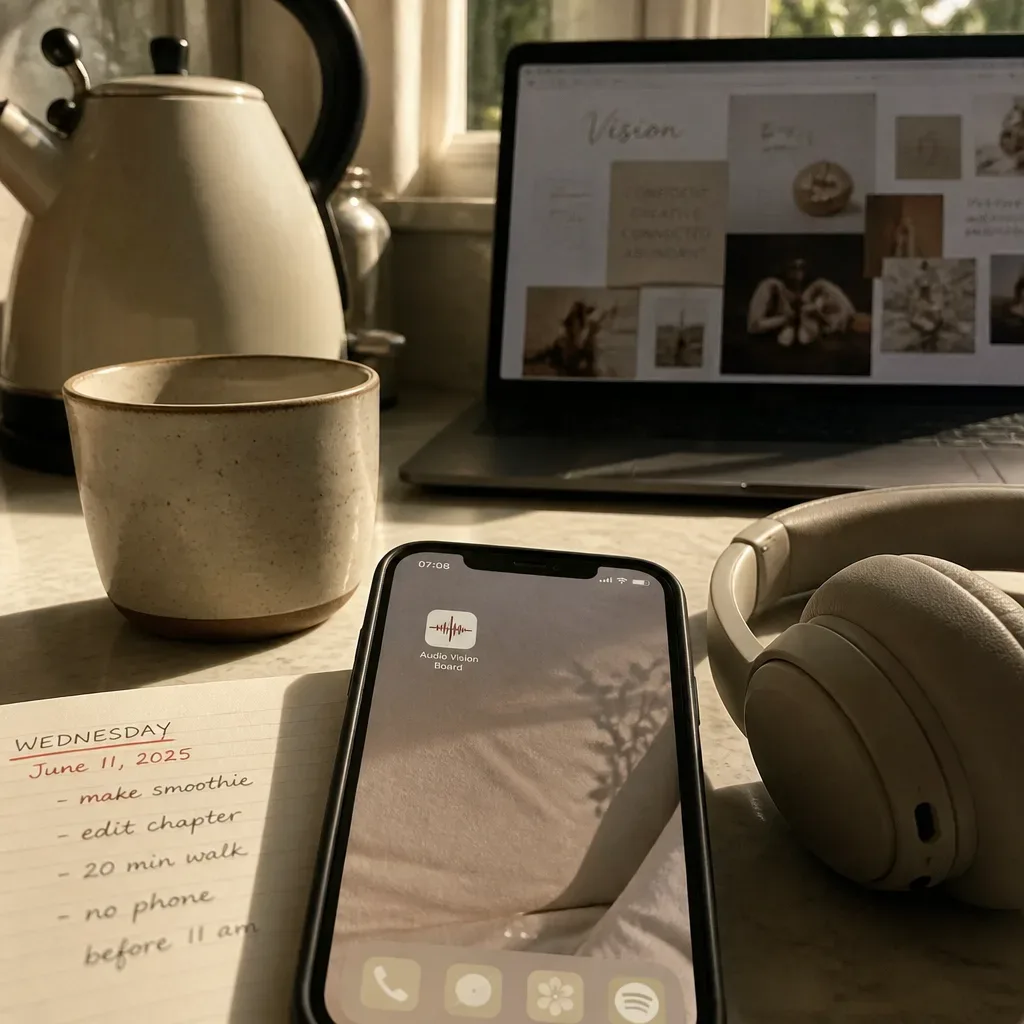
For me, that place is my phone. I tried keeping the file in a beautiful Notion page. I admired the page and did not open it. I tried a desktop folder with a careful name. I saw it mostly when searching for invoices. The version that worked was plain: the MP4 saved to my phone, a shortcut on the first screen, and the original Canva link pinned in my notes app.
Behavior design research keeps pointing me back to friction. BJ Fogg’s behavior model, published and taught through the Stanford Behavior Design Lab, says behavior happens when motivation, ability, and prompt meet at the same moment. I do not need to become a more disciplined person at 6:50 a.m. I need the file within reach while the kettle is loud.
Here is the storage test I use now:
| Storage place | Good for | Risk |
|---|---|---|
| Phone home screen shortcut | Daily listening | Can become invisible beside other icons |
| Notes app pin | Quick access and edits | Easy to bury under errands |
| Canva link | Revising the board | Requires internet and login |
| MP4 in photos | Offline playback | Mixed with ordinary photos |
| Laptop desktop | Workday use | Weak for weekends and travel |
I also put one sentence in my calendar for 7 days, not forever: “Listen before coffee.” A week feels honest. The American Psychological Association’s 2023 stress reporting found many adults describe stress as affecting daily functioning, and I think about that whenever I design a practice. The practice has to meet the week I have, not the imaginary week where I become a different person.
Sometimes I also place the phrase from the board beside my daily affirmation, if I am already using one. I keep that as a complement, not the main thing. The audio is the method I return to. The board is the visual door.
How do I make the practice last longer than the first week?
I make the first version small, then revise after 7 listens instead of rebuilding it every time my mood changes.
The temptation with Canva is to keep editing. A new photo, a cleaner font, a more accurate shade of blue. I know this temptation intimately because design work can disguise hesitation as refinement. For this practice, I give myself a rule: listen for 7 days before changing the board, unless a line feels actively wrong in my body.
Seven days is not magic. It is just long enough to notice friction. Lally’s 2009 habit study did not say habits form in one week; it suggested the average was much longer, with 66 days as the median. But one week gives me data. Did I skip because the audio was too long? Did the script sound false? Did the storage place fail? Did I avoid the board because it was about someone else’s version of success?
I keep a tiny log, no more than 30 seconds:
- Day listened.
- Time of day.
- One word for how it landed.
- One action I took after, if any.
This is where I sometimes bring in timing from Astrology and manifestation, especially if a new moon helps me mark a clean beginning. I do not need the moon to do the work for me. I use dates because dates help me remember. A lunar cycle is about 29.5 days, which makes it a useful container for reviewing a board without touching it every afternoon.
I revise in small ways. I lower the music if I added any. I cut lines that sound like performance. I replace images that make me compare. I add one obstacle if the board has become too smooth to be useful. A practice that cannot survive an ordinary Tuesday is not a practice yet.
The quiet sign that it is working is not that life suddenly rearranges itself. It is that I begin to make one less argument with the next right action. I send the message. I sit in the chair. I close the tab. I save the receipt. The board has done its job when it disappears into behavior.
What mistakes should I avoid when adding Dream-Self audio?
I avoid making the audio too long, too grand, or too separate from what I can do today.
The first mistake is length. Three minutes is usually enough. I know there are longer practices, and some people love them. I am not arguing with that. I am only noting that my own consistency drops when a practice crosses the line from “I can do this while the kettle works” to “I need a special pocket of time.” The kettle in my kitchen takes about 4 minutes from fill to click. That is my design constraint.
The second mistake is using language I would never say. If the script sounds like a caption written for strangers, I rewrite it. Neville Goddard often wrote and lectured about assuming the feeling of the wish fulfilled, especially through imaginal scenes. The part I take from that is scene, not spectacle. I ask, “What would be different in my hands?” Not, “How can I sound impressive?”
The third mistake is confusing evidence with control. A Canva vision board can focus attention, but it cannot replace choices, conversations, rest, skill, or time. Princeton’s PEAR lab studied mind-machine interaction from 1979 to 2007, and its findings remain debated rather than settled science. I mention that because manifestation writing can sometimes pretend every question is already proven. I would rather keep the mystery and keep my feet.
My final guardrails are simple:
- Do not add music that makes the words harder to hear.
- Do not use images that make you feel smaller.
- Do not change the board every bad day.
- Do not mistake a beautiful file for a repeated practice.
- Do not let the board become a private place to scold yourself.
A vision board is not a verdict on the life I have. It is a small rehearsal space for the life I am willing to practice.
Tonight, I left the file on my first phone screen and washed the mug before bed.