vision boards
Notion Vision Board With a Dream-Self Audio Layer
Build a notion vision board that includes images, written cues, and a Dream-Self audio layer so your future self becomes easier to rehearse daily.
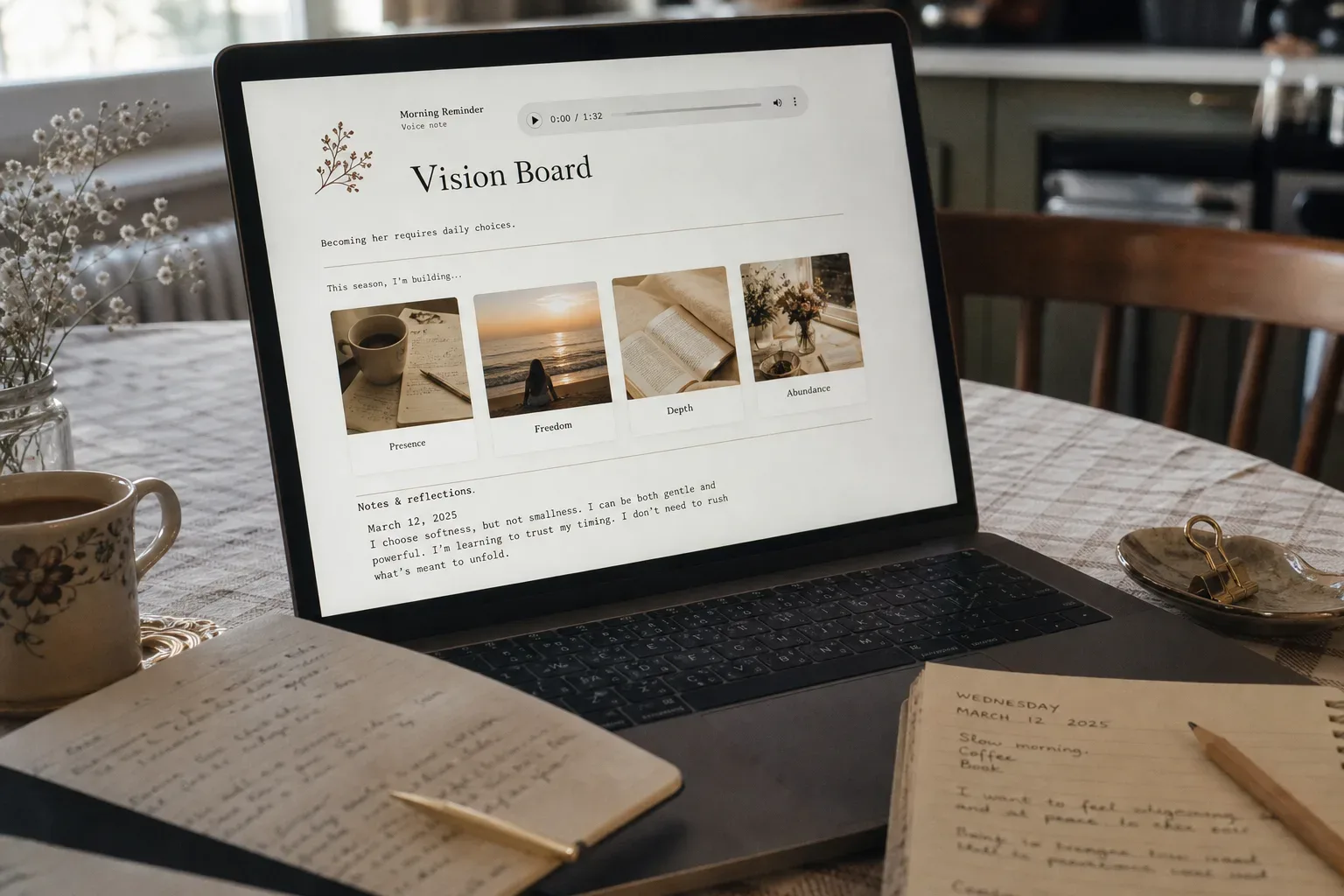
August 19. A notion vision board works better when it holds more than pictures: add a short Dream-Self audio, place it near the top of the page, and listen daily before editing anything else. The images remind me what I named; the audio rehearses who I am becoming in ordinary minutes.
I am writing this at the kitchen table with my coffee cooling beside the laptop. My Notion page is open in another tab. It has six images, one small checklist, and a recording I listen to before I let myself rearrange anything. I learned, slowly, that a board can become a way to avoid the practice. Pretty pages are easy. Repetition is less glamorous and more useful.
The neuroscience part of me likes that distinction. A visual cue can catch attention in under 200 milliseconds in many perception tasks, but identity-related change usually asks for repetition across days, not one beautiful afternoon. In Lally and colleagues’ 2009 study in the European Journal of Social Psychology, habit automaticity took a median of 66 days to form, with wide variation from 18 to 254 days. I keep that number close when I want the board to do everything by Friday.
What should a notion vision board actually do?
A notion vision board should help me return to a chosen identity and behavior, not simply store attractive images.
The first one I made looked like a magazine spread. I had a linen bedroom, a writing desk, a black coat, and a woman holding coffee on a balcony. None of it was wrong. But when I opened it on a hard Tuesday, I did not know what to do next. The page was pretty and mute. It did not ask anything of me.
So I began treating the board as a cue system. Each image had to answer one question: what choice does this help me practice? If an image of a calm desk helped me sit for 25 minutes before checking messages, it stayed. If it only made me compare my apartment to someone else’s, it went. In attention research, clutter competes. A 2011 Princeton Neuroscience Institute study found that multiple objects in the visual field can compete for neural representation, which is a formal way of saying my crowded board was asking my brain to hold too much at once.
A useful Notion board has fewer signals and clearer returns. Mine now has 6 to 12 visual cues, not 60. It has one audio at the top. It has one dated note field. It has a weekly review, because daily redesigning is often procrastination wearing good stationery.
A vision board is not proof that I want something. It is a place where I practice recognizing the person who would choose it.
I still use the broader language of Manifestation pillar when I need a map, but the page itself stays practical. It asks: what did I listen to, what did I choose, what did I notice?
Why add a Dream-Self audio layer instead of only using images?
A Dream-Self audio layer gives the board a repeated verbal cue, which can shape self-talk more directly than images alone.
This is the part I care about most, probably because of my research. The brain treats self-relevant words differently from random words. In cognitive neuroscience, self-referential processing reliably engages midline brain regions, including the medial prefrontal cortex. A 2016 paper by Cascio and colleagues in Social Cognitive and Affective Neuroscience found that self-affirmation activated valuation and self-related processing regions and predicted later health-message behavior. That does not mean every sentence changes a life. It means personal language is not neutral.
Images work quickly. They set tone. They help me remember. But audio asks me to inhabit a sentence over time. I hear a future version of my own life described in the first person: I answer the email before noon. I keep my hands soft when I talk to my mother. I walk for 20 minutes after dinner. These are not fireworks. They are instructions my nervous system can meet.
This is where I use the AYA Method carefully and plainly. The AYA Method is a daily audio manifestation practice. Each day I listen to a short personalized recording, my Dream-Self Moment, narrated from the version of me who has already manifested the life I intend. Listening is the practice. Repetition is the work. The audio is the method.
The Notion board is not the method. It is the chair I leave beside the door. My daily affirmation, when I write one, is a small complement. The board is another complement. The audio is what I return to while the kettle clicks off.
How do I build the Notion page without overworking it?
I build the Notion page as a simple listening station first and a visual archive second.
Here is the order I use, written before I forget it:
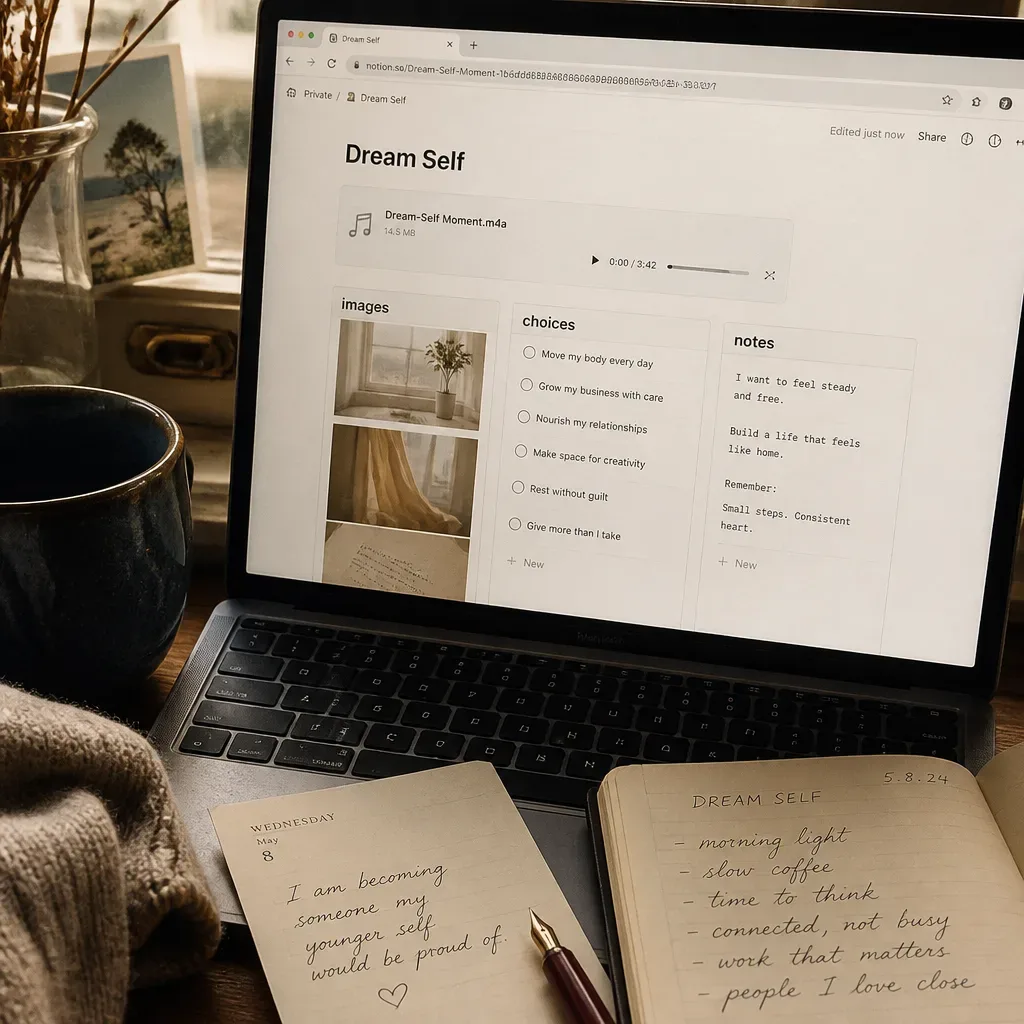
- Create one blank Notion page and name it after a life area, not a mood. Mine says “Steady Research Life,” not “Dream Everything.”
- Add a callout or heading at the top called “Listen first.” This is where the Dream-Self audio goes.
- Make 3 columns: images, choices, notes.
- Add 6 to 12 images maximum. Notion can hold hundreds, but my attention cannot.
- Under each image, write one behavior it points to in 12 words or fewer.
- Add a weekly dated note section at the bottom.
I time-box this to 25 minutes. That number is not sacred, but it is useful. The Pomodoro technique popularized 25-minute focus intervals, and while the exact number is not magic, it is long enough to build a page and short enough to stop me from making it a whole afternoon. When I spend 2 hours designing, I usually feel less likely to listen the next day.
My page has a small table like this:
| Board element | What it does | My rule |
|---|---|---|
| Dream-Self audio | Rehearses identity language | Stays at the top |
| 6 to 12 images | Gives visual cues | Each image needs a behavior |
| Weekly note | Tracks friction and ease | Dated, 3 sentences maximum |
| Daily affirmation | Adds one sentence if needed | Complement, not the practice |
The best board is the one I can open on a low-motivation morning and still understand in 10 seconds. If I have to decode my own aesthetic, I made a puzzle, not a practice.
What should I say in the Dream-Self recording?
I say the ordinary things my future self would notice, choose, and repeat.
I do not start with giant claims. I start with the morning. The chair. The email. The body. A useful script has concrete evidence inside it. Instead of “I am successful,” I might record, “I open the document before I open messages. I write for 30 minutes. I send the draft while it is still morning.” The second version gives me something to do before lunch.
There is a reason this matters. Research on implementation intentions, especially work by Peter Gollwitzer, shows that if-then plans can increase follow-through across many behavior domains. A 2006 meta-analysis by Gollwitzer and Sheeran reported medium-to-large effects for implementation intentions. I do not turn my audio into a list of commands, but I do include cues: when coffee is poured, I listen. When the recording ends, I open the next right task.
A simple structure:
- Opening: “I am here in the life I once practiced hearing.”
- Identity: “I am the kind of person who returns gently and keeps promises in small units.”
- Evidence: “This morning, I answer the important message before 10.”
- Body cue: “My jaw is softer. My breath is lower.”
- Choice: “I choose the next ordinary action.”
- Closing: “I have done this enough times that it feels familiar.”
I keep the recording between 60 seconds and 5 minutes. Short recordings respect real mornings. A 2022 review on habit formation noted that repetition in stable contexts is central; length matters less than returning. That fits what I have observed in myself. I can avoid a 20-minute ritual. I rarely avoid 3 minutes.
The sentence that changes me is usually not the grandest one. It is the one I can bear to repeat.
If you are building this alongside written cues, the Affirmations pillar is useful background. I still keep the audio primary. Writing one sentence can help. Listening daily is the practice I do not negotiate with.
How do I embed or link the audio inside Notion?
I put the audio at the top of the Notion page, either as an uploaded file, an embed, or a private link I can open in one tap.
The technical part is simple, which is good because my mind likes to make a ceremony out of avoiding the actual repetition. In Notion, I can type /audio or drag in an audio file if my plan allows it. I can also paste a private link from a storage service or audio host. The rule is that the audio must be reachable in under 2 clicks. If I need to search for it, the practice will leak out of the morning.
I name the file plainly: dream-self-moment-august.mp3. I add the date because versions matter. I do not rerecord every day. I let a recording work for at least 7 days, usually 30. Repetition needs sameness. In memory research, repeated retrieval and repeated cues strengthen access over time; the spacing effect has been studied since Ebbinghaus in the 1880s and supported across more than a century of learning research.
My small setup looks like this:
- A top heading: “Listen before editing.”
- The audio file or link directly underneath.
- A checkbox called “Heard today.”
- Three image cues below it.
- A weekly note area, dated every Sunday.
I also keep one link to Astrology and manifestation on a separate reference page, not because I want the board to become crowded, but because timing rituals can be comforting when they do not replace action. The board itself stays lean.
A practice that needs twelve perfect conditions is not daily. It is occasional.
How do I use the board each day without turning it into another task?
I use the board by listening first, choosing one behavior, and leaving before I start rearranging the page.
This is the part that changed the most for me. I used to open Notion and begin improving the board. New cover image. Better icon. Cleaner spacing. Thirty minutes later, I had not listened to the recording or answered the email I was avoiding. Now I use a 4-step rule:
- Open the board.
- Press play on the Dream-Self audio.
- Choose one behavior from the page.
- Close the page.
The whole thing takes 3 to 6 minutes. That range matters. In a 2018 Pew Research Center report, 77 percent of U.S. adults said they owned a smartphone; by 2024, smartphone access was woven into most daily routines in many countries. The problem is not access to tools. The problem is the number of tools asking to become the center of the morning.
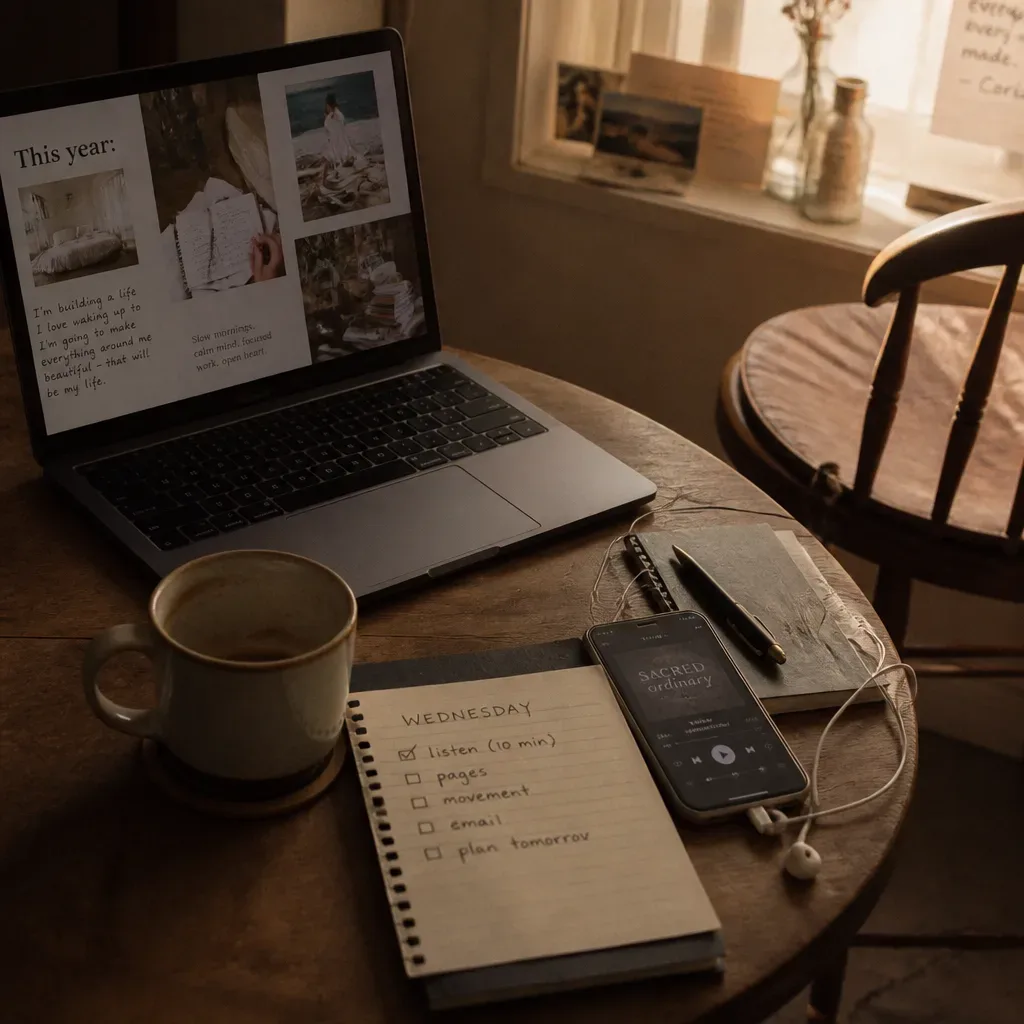
The board earns its place by being brief. I do not need a perfect mood. I need a repeatable cue. On the bus, I listen with one earbud. In the bath, I do not open Notion because wet hands and databases are a bad pair. At the kitchen table, I listen before the coffee is finished.
A weekly review is enough. I write three sentences:
- What felt easier this week?
- What did I resist?
- What sentence in the audio needs to be softened or made more concrete?
This is where the Manifestation pillar and Affirmations pillar can support the thinking around the practice. But I try not to read more when what I need is to repeat the cue I already chose.
How will I know the audio layer is working?
I know the audio layer is working when small choices begin to feel more familiar before they feel dramatic.
I watch for behavior before mood. Did I open the document sooner? Did I pause before answering sharply? Did I walk after dinner twice this week instead of zero times? These are modest data points, but they are data. In behavior change research, self-monitoring is one of the most consistently useful techniques; Michie and colleagues’ behavior change taxonomy lists self-monitoring of behavior as a common active ingredient across interventions.
I do not expect the board to make life frictionless. Friction is information. If a sentence in the audio makes me tense every morning, I edit it. If an image makes me feel behind, I remove it. If a goal has no behavior attached, I either find the behavior or admit I am collecting symbols.
Here is the weekly scorecard I use:
| Question | Green signal | Edit signal |
|---|---|---|
| Did I listen at least 5 days? | The cue is placed well | Move the audio higher or shorten it |
| Did one behavior repeat? | The board is specific enough | Add a clearer next action |
| Did the script feel believable? | Keep it for another week | Soften one sentence |
| Did I redesign instead of practice? | No issue | Set a 10-minute edit limit |
I like 5 listening days as a weekly threshold because it leaves room for being human. Seven out of seven becomes brittle for me. Five is still repeated exposure. Five still teaches the morning where to go.
The Princeton Engineering Anomalies Research program is sometimes mentioned in manifestation spaces because it studied mind-machine interaction across decades, with controversial small effects. I note it carefully, then come back to stronger ground: attention, repetition, self-relevant language, and habit cues. Those are enough to justify a quiet practice without making claims the evidence cannot carry.
I do not need the board to prove magic. I need it to help me keep a promise in the same room as my real life.
Tuesday now. The kettle is empty, and the page is still open.