vision boards
Update Vision Board With Dream-Self Audio
Update vision board choices with Dream-Self audio so your images match what you hear, want, and repeat in a quiet daily practice.

Your board is on the desk. Some images still feel true. Some went quiet. To update vision board choices with Dream-Self audio, listen first, then edit what you see so the board reflects the life your future-self recording names, repeats, and makes more believable.
Why should you listen before you update the board?
You listen first because the audio gives your board a living reference point.
A vision board can become a collage of old wants if you edit it from mood alone. One hard morning can make everything look false. One good afternoon can make every shiny image look useful. Listening first steadies the edit. It reminds you what you’re practicing before you start rearranging proof.
The AYA Method is a daily audio manifestation practice. Each day you listen to a short personalized recording — your Dream-Self Moment — narrated from the version of you who has already manifested the life you intend. Listening is the practice. Repetition is the work. The audio is the method.
The board is not the method. It is a visible companion. That distinction matters. In habit research, context cues are useful because they reduce how much deciding a person has to do. In a 2010 study by Phillippa Lally and colleagues in the European Journal of Social Psychology, habit formation took a median of 66 days across 96 people. Repetition did the work, not intensity.
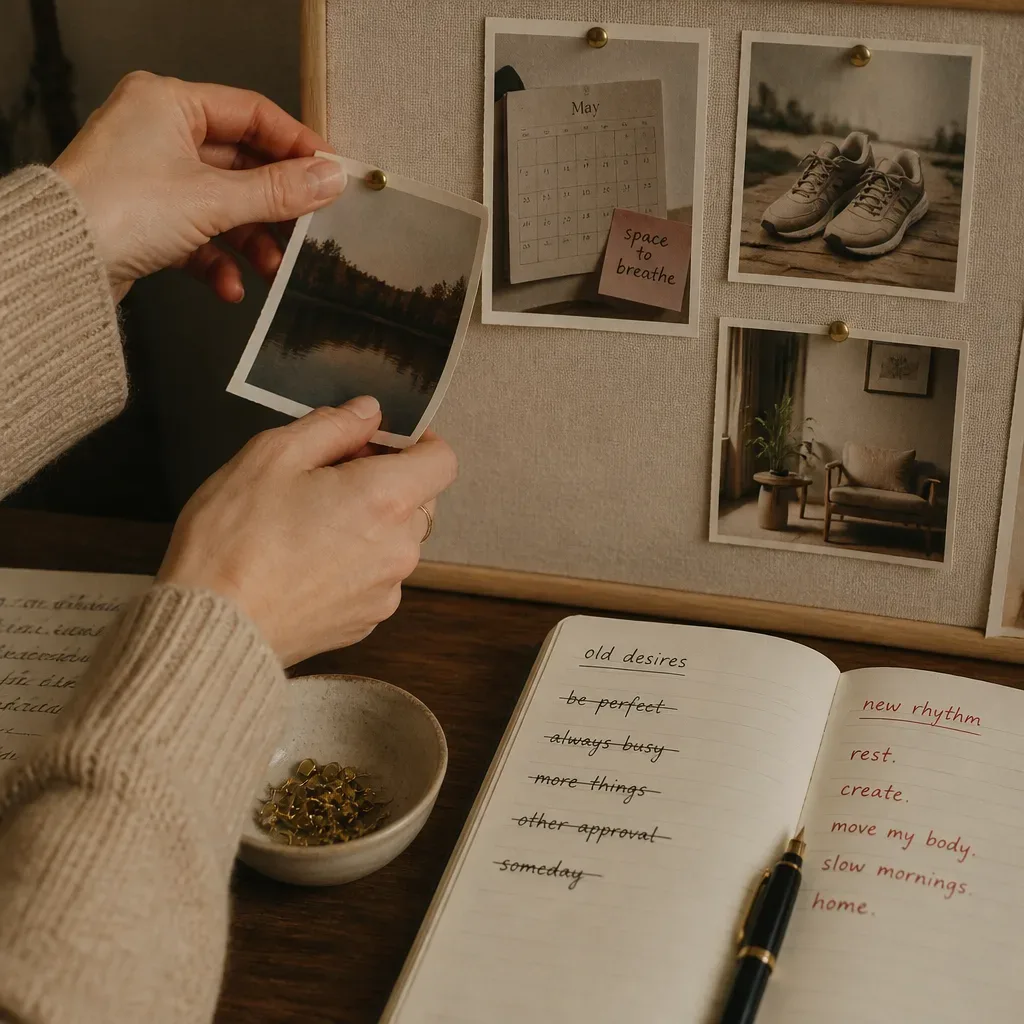
Your Dream-Self audio gives you the sentence underneath the image. If the audio says, “I wake with enough time to move slowly,” the board might need fewer luxury morning photos and one honest image of your shoes by the door. A board becomes useful when it stops performing and starts remembering.
Use this order:
- Listen to your Dream-Self Moment once.
- Sit for 30 seconds without editing.
- Look at the board from left to right.
- Ask what still feels true.
- Remove one thing before adding anything new.
That last step saves you from visual noise. Cognitive load theory, first described by John Sweller in 1988, showed that working memory is limited. A crowded board can ask too much of your attention. A quieter board can point more clearly.
What should you remove from a vision board first?
Remove anything that feels borrowed, vague, stale, or disconnected from what you actually hear in your future-self audio.
Start with the borrowed image. You know it when you see it. The kitchen you saved because someone else wanted it. The body photo that makes you contract. The city view that signals status, not home. A vision board can hold desire, but it should not hold pressure disguised as taste.
Research on goal imagery has a useful warning here. In studies by Lien Pham and Shelley Taylor published in 1999, students who mentally rehearsed the process of studying performed better than students who only pictured the desired grade. Outcome images can soothe the mind too early. Process cues help behavior move.
So remove images that only say, “Look, I made it.” Keep or add images that say, “This is how I live now.” A receipt paid on time. A quiet inbox. A calendar with white space. A suitcase packed the night before. The future gets easier to meet when it has ordinary details.
A simple removal test helps:
| Board item | Ask this | Keep it if |
|---|---|---|
| Image | Does this match my audio or my envy? | It feels like proof, not performance |
| Word | Would I say this in my own voice? | It sounds clean and true |
| Goal | Is there a next action inside it? | You can name one behavior within 7 days |
| Symbol | Does my body soften when I see it? | It gives direction without pressure |
You don’t need to delete the whole board. In product work, the better edit is often a smaller edit. Remove the feature nobody uses. Keep the thing people return to. As a former VC associate, I watched teams waste 6 months polishing features that users opened once. Your board can do the same. Pretty is not the metric. Return is the metric.
How do you translate Dream-Self audio into board images?
You translate the audio by pulling out repeated phrases, then choosing images that show those phrases in real life.
Play the recording and write down 3 to 5 lines that catch. Not the most poetic lines. The ones your body recognizes. Maybe the audio says, “I trust my pace.” Maybe it says, “My work is paid for clearly.” Maybe it says, “My home feels soft when I walk in.” Each line can become a visual cue.
This is where Manifestation becomes practical. It is not just wanting. It is attention, repetition, feeling, and behavior meeting in the same small place. Neuroscientist Dr. Andrew Huberman has often described attention as a gate for neuroplasticity in public lectures and podcast teaching; the exact mechanisms are complex, but the simple takeaway is sound: what you repeatedly attend to is more likely to shape what you notice next.
Use this translation map:
- “I trust my pace” becomes a photo of a slow breakfast, a walking route, or a calendar with fewer stacked blocks.
- “My work is paid for clearly” becomes an invoice, a contract folder, or a bank app screenshot with private details hidden.
- “My home feels soft” becomes your own lamp, folded sheets, or the corner you actually sit in.
- “I speak with ease” becomes a microphone, a notes app draft, or a table where the conversation happens.
The best images are not always aspirational. Sometimes they’re documentary. A 2020 review in Current Directions in Psychological Science noted that mental imagery can affect emotion because imagined events use some of the same systems involved in perception. Your board adds a visible layer. Your audio adds the voice. Together, they make the future less abstract.
Keep the ratio simple: for every 1 dream image, include 2 proof images. A dream image might be the apartment. A proof image might be the savings tracker and the Saturday viewing appointment. If the board can’t show a next step, it may be asking you to worship a finish line.
What is the 18-minute method for updating your board?
The 18-minute method is a short edit that keeps the audio central and the board clear.
Set a timer. Not because this has to be strict, but because open-ended editing invites overthinking. The point is not to make the perfect board. The point is to make the board honest enough to return to tomorrow. In user testing, shorter tasks often get completed more reliably; the Nielsen Norman Group has reported for years that attention on digital pages drops when people can’t see clear structure. Your inner practice deserves the same mercy.
Here is the full 18-minute flow:
- Minute 0 to 3: Listen. Play your Dream-Self Moment without touching the board.
- Minute 3 to 5: Name the signal. Write the 3 phrases that feel most alive.
- Minute 5 to 8: Remove. Take down 1 to 3 items that feel stale, borrowed, or loud.
- Minute 8 to 13: Replace. Add 1 to 3 images that show proof of the phrases.
- Minute 13 to 16: Add one behavior cue. Choose one action you can repeat this week.
- Minute 16 to 18: Listen again. Look at the board while the last minute of audio plays, or replay the opening.
If you use a digital board, the same timing works. The only rule is no scrolling for inspiration until after the first listen. Scrolling before listening can turn the board into a market of other people’s symbols. Your audio returns you to your own.
For the behavior cue, be almost plain. If your future self is healthy, the cue might be a water glass by the bed, not a marathon photo. If your future self is financially steady, the cue might be Friday money review, not a penthouse. The American Psychological Association has reported that specific, measurable intentions make behavior change more likely than broad wishes. Specific can be tender. It doesn’t have to be cold.
This is also where Affirmations can support the edit. One sentence from the board can become a daily affirmation in the app. But keep the order clear: the audio leads, the board shows, the affirmation repeats one clean thread.
How do you know an updated vision board is working?
You know it’s working when it changes what you notice, choose, and repeat in ordinary hours.
Do not measure the board by how dramatic it looks. Measure it by return. Do you look at it without bracing? Do you remember your Dream-Self audio when you pass it? Do you take one small action more often because the cue is visible? That is the signal.
In the 2006 meta-analysis by Peter Gollwitzer and Paschal Sheeran, implementation intentions showed medium-to-large effects across 94 independent studies. The format was simple: if situation X happens, then I will do Y. Your board can hold these quiet if-then cues. If I finish coffee, I open the proposal. If I close my laptop, I walk for 10 minutes. If I feel the old fear, I listen before I decide.
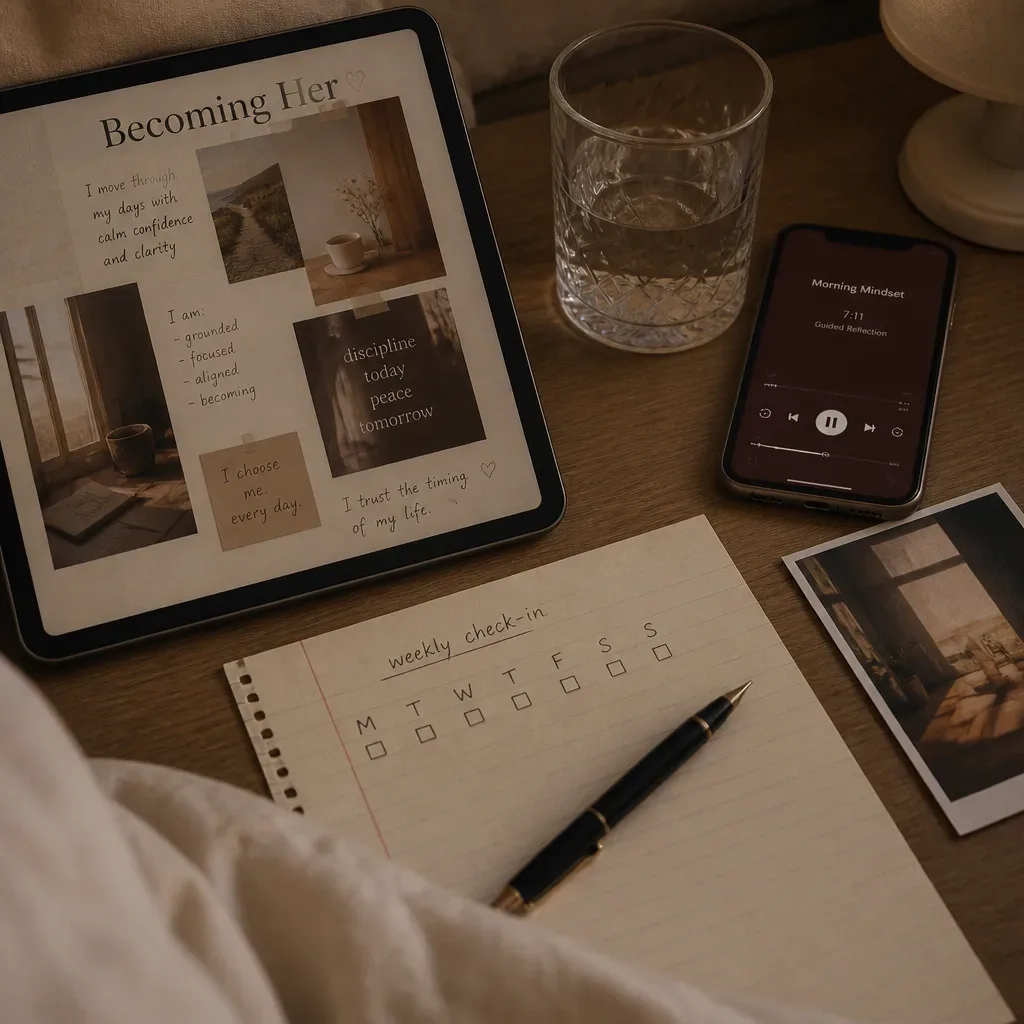
Track 3 things for 7 days:
- Did I listen to the audio today?
- Did I look at the board after listening?
- Did I take the small action shown on the board?
Seven days is enough to see friction. It is not enough to judge your life. Keep the review small. A 2022 Pew Research Center report found that 31% of U.S. adults said they were online almost constantly. Your attention is already being asked for. The board should not become another feed. It should become a place to return.
If it is working, you may feel less need to add more. That is a good sign. The board is becoming specific. Clarity often feels smaller than fantasy. It has fewer images. It has more truth.
One warning: don’t use the board to punish yourself. If an image starts making you feel late, remove it for now. You can want something and still need a softer way to hold it. Your nervous system is part of the practice, not an obstacle to it.
How should astrology, timing, and mood fit into the edit?
Astrology and mood can help you choose a review rhythm, but they should not replace daily listening.
Some people like updating a board with the new moon, the first day of the month, or a birthday. Fine. Ritual timing can make attention feel special. Calendar anchors work because they reduce decision fatigue. A monthly review gives you 12 clear chances a year to ask whether the board still tells the truth.
If astrology is part of your language, use it as a lens, not a boss. Astrology and manifestation can help you reflect on themes: home, work, relationship, voice, money, rest. But your Dream-Self audio still comes first. The sky can be a mirror. It should not be a substitute for listening.
There is also a practical reason to use timing gently. Mood changes fast. In affective science, researchers often distinguish between transient states and more stable traits; a single bad day is not reliable data. If you rebuild the whole board every time your mood drops, the board will start tracking weather, not direction.
Try this cadence:
| Timing | What to do | Time needed |
|---|---|---|
| Daily | Listen to Dream-Self audio | 2 to 5 minutes |
| Weekly | Check one image and one action cue | 5 minutes |
| Monthly | Replace stale visuals | 18 to 30 minutes |
| Seasonally | Rebuild sections if life has changed | 45 to 60 minutes |
This rhythm keeps the work calm. It also respects attention. You don’t need to keep asking what you want every morning. Some mornings, you only need to hear what you’ve already chosen.
What mistakes make a vision board feel noisy again?
A board gets noisy when it tries to hold every desire, every identity, and every possible future at once.
The first mistake is adding without removing. Most people do this because adding feels safer. But a board with 60 images rarely gives 60 times more clarity. It usually gives 60 invitations to compare. Miller’s famous 1956 paper on working memory suggested people can hold about 7 items, plus or minus 2, though newer research often argues the number is closer to 4 chunks. Either way, attention has a limit.
The second mistake is using only symbols. A door. A mountain. A gold circle. These can be beautiful, but too many symbols can make the board float away from your day. Pair each symbol with proof. If the symbol is a door, add the actual application page. If the symbol is a mountain, add the Saturday training plan.
The third mistake is confusing the board with the practice. The board is not there to do the listening for you. It cannot replace the Dream-Self Moment. It can only remind your eyes of what your ears have been hearing. This is why the app’s Manifestation Board works best as a complement, not a pillar. The audio remains the daily method.
If you want a broader frame, read the Manifestation pillar and the Affirmations pillar as supporting references. Then come back to the board and ask the smaller question: what is the next true image?
The final mistake is making it too public. You don’t owe anyone a board tour. Private goals often stay cleaner because they aren’t shaped by applause. Keep some images where only you see them. Not every future needs witnesses before it has roots.
Listen once. Then make the picture honest.