mindset
Social Media Comparison Reset With Future-Self Audio
A practical social media comparison reset using future-self audio, small habit design, and a 10-minute routine for returning to your own life.

Thursday. The phone was beside the kettle, screen still warm. A social media comparison reset works best when it is brief: stop the scroll, name the comparison, listen to future-self audio, and take one small action that belongs to your actual life. Ten minutes is enough if the steps are kept plain.
Why does social media comparison hit so hard in the morning?
It hits hard because the brain meets other people’s edited signals before it has met its own day.
I noticed this at 6:42 this morning, which is too early to know anything true about my life. I opened a work message and then, without deciding, opened the app beside it. Within 90 seconds I had seen a former colleague on a panel, a friend in Lisbon, and a stranger with a kitchen cleaner than my whole apartment. Pew Research Center reported in 2024 that 46% of U.S. teens say they are online almost constantly; DataReportal’s 2024 global report put average social media use near 2 hours and 23 minutes a day. I am not a teenager, but my thumb has no special wisdom.
Leon Festinger’s 1954 social comparison theory was simple: people evaluate themselves partly by comparing with others, especially when objective measures are absent. Social media gives the mind a thousand soft measures before breakfast. It gives visible bodies, visible rooms, visible work, visible love. It does not give context, debt, arguments, drafts, bad sleep, or the 14 tries behind the one posted photo.
The trap is not that other people are doing well. The trap is that I treat their visible moment as my missing instruction.
In my habit-tracking app, used by about fourteen thousand people, morning behavior had a blunt pattern: if the first tracked action took more than 2 minutes, people postponed it. If the phone filled that 2 minutes, the day became harder to steer. I do not think social media is evil. I think it is very good at becoming first.
I keep the reset next to the kettle now. Not because I am pure, but because I am predictable. The reset has to happen before the comparison builds a case.
What is the 10-minute reset I use after comparing myself online?
The reset is a timed return to my own evidence: body, audio, page, and one next action.
I use ten minutes because it is short enough to do badly and still finish. Christina Maslach’s burnout work often circles back to mismatches between demand and capacity; my small version is this: a reset that demands a new personality will fail by Wednesday. In 2018, Melissa Hunt and colleagues at the University of Pennsylvania found that limiting Facebook, Instagram, and Snapchat to 10 minutes each per platform per day, about 30 minutes total, reduced loneliness and depression symptoms over three weeks in undergraduates. I take that as a design hint, not a commandment: smaller exposure changes can matter.
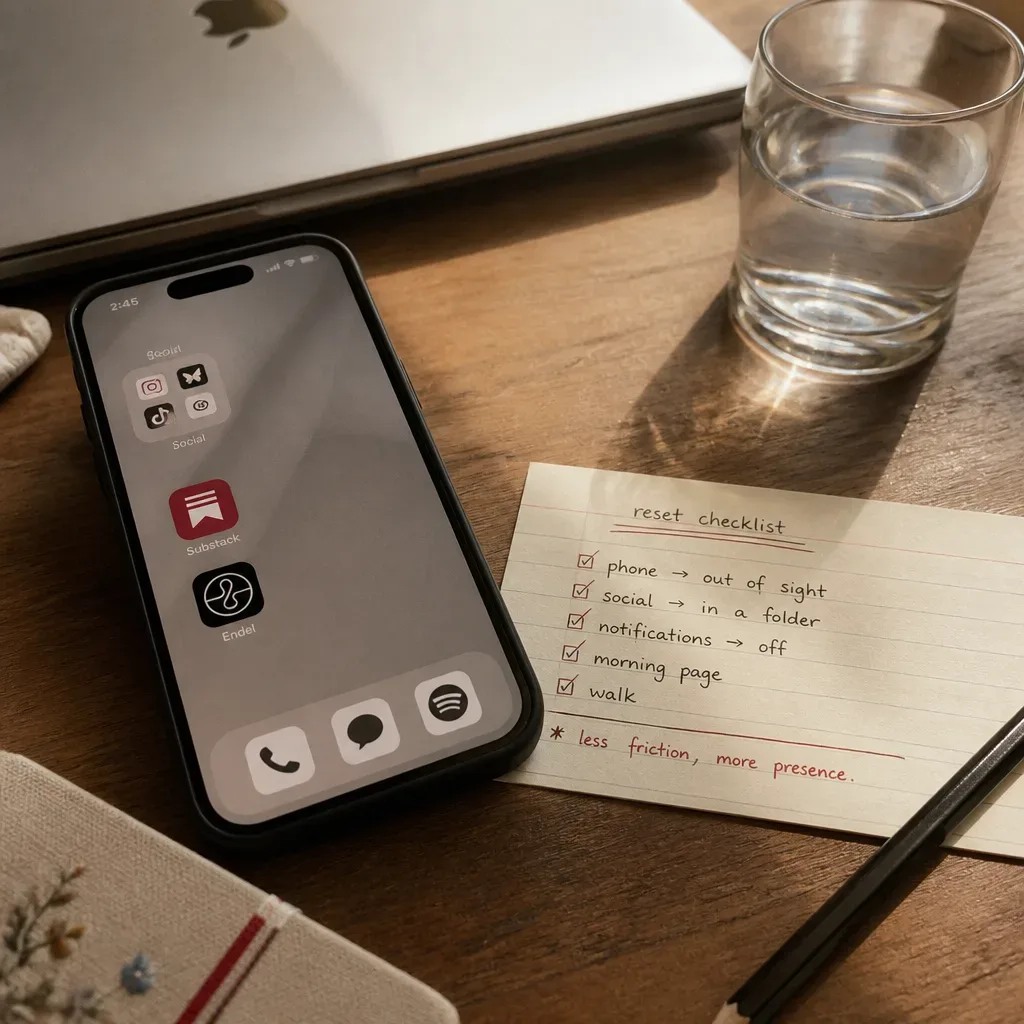
Here is the reset as I wrote it on an index card:
- Minute 0 to 1: put the phone face down. No moral speech. Just stop feeding the loop.
- Minute 1 to 2: write the comparison in one sentence. Mine often says, I am comparing my draft to their announcement.
- Minute 2 to 5: listen to future-self audio. I use my Dream-Self Moment from the AYA Method, which is a daily audio manifestation practice. Each day I listen to a short personalized recording narrated from the version of me who has already manifested the life I intend. Listening is the practice. Repetition is the work. The audio is the method.
- Minute 5 to 7: choose one evidence action. Not a life plan. One action.
- Minute 7 to 10: make tomorrow easier. Mute the account, move the app, set a limit, or write a line on the page.
A reset is not a punishment for being affected. A reset is a handrail.
I like that this practice has no drama in it. No candle. No speech. Just my hand turning the phone over, my ears taking in a different cue, and the next small piece of work finding me again.

How does future-self audio change the comparison loop?
Future-self audio gives the mind a rehearsed identity cue before comparison becomes instruction.
I used to answer comparison with analysis. I would tell myself that Instagram is edited, that LinkedIn rewards performance, that nobody posts the invoice they are scared to send. All true. Not enough. The body often understands speed before it understands nuance. Dr. Andrew Huberman has described dopamine as tied less to pleasure alone and more to motivation, pursuit, and prediction. Social platforms are engineered around variable rewards; the next post may soothe me or sting me, and that uncertainty keeps my thumb employed.
Future-self audio works differently for me because it is not another visual hierarchy. It is a repeated auditory cue attached to identity. The Manifestation pillar explains the broader idea, but I keep the mechanism small: I listen to the same future-oriented self-description daily, and over time it becomes less like a wish and more like a familiar route home. Joe Dispenza writes often about mental rehearsal and the body learning an anticipated state; I do not take every claim as settled science, but the habit mechanism is defensible. Repetition changes salience.
The posted life says, look over there. The practiced life says, come back here.
There is also research adjacent to this. In a 2009 study, Phillippa Lally and colleagues found that habit formation took an average of 66 days, with wide variation from 18 to 254 days. I do not expect one listen to erase envy. I expect one listen to interrupt one loop. That is enough work for a morning.
Here is the comparison I keep on the page:
| Trigger | Usual loop | Future-self audio reset |
|---|---|---|
| Seeing someone’s milestone | I am behind | I hear the person I am practicing becoming |
| Seeing a beautiful home | My life is unfinished | I choose one care action in my actual room |
| Seeing a body or face | I become an object to fix | I return to the body that has to live this day |
| Seeing praise for someone else | There is no room for me | I do one visible piece of my own work |
The audio does not argue with the app. It changes the room I am standing in.
What should I write down when comparison has already taken over?
I write the comparison, the cost, and the next piece of evidence in three plain lines.
This part matters because a mood feels total until it is dated. James Pennebaker’s expressive writing research, including studies from the 1980s and 1990s, found that writing about emotional events for as little as 15 to 20 minutes over several days was linked with improvements in health and well-being measures for some participants. My reset is shorter, but the principle helps: language can turn fog into an object on the table.
I use three lines because more becomes theatre for me. The page today said:
- Comparison: I saw someone announce a book and decided my unfinished chapter meant I had failed.
- Cost: I lost 18 minutes and became colder toward my own work.
- Evidence: I can open the chapter and fix one paragraph before lunch.
That is all. I do not ask the page to heal my whole personality. I ask it to stop the leak.
If the comparison is about money, I name the number I actually know. If it is about beauty, I name the body sensation, such as jaw tight, chest small, shoulders up. If it is about career, I name the specific fear, such as I am afraid I missed my window. Cognitive behavioral therapy often uses this move, identifying automatic thoughts and testing them against evidence. The Beck Institute still teaches this structure because vague thoughts are harder to examine than written ones.
A comparison loses some of its power when it has to become a sentence.
Sometimes I add one daily affirmation after the audio, especially if the line has already been living in my notes. I keep it as a complement, not the center. The Affirmations pillar is useful when I need better wording, but the audio remains the method in my morning. The sentence supports the listen. It does not replace it.
How do I make social media less likely to trigger comparison tomorrow?
I change the path to the app before I try to change my character.
After fourteen thousand habit-tracking users, I trust friction more than intention. BJ Fogg’s behavior model puts behavior at the meeting point of motivation, ability, and prompt. If the prompt is bright and the action is easy, I will probably do it. That is not a moral failure. That is design working. So I design back, quietly, while the kettle cools.
The smallest changes have helped me most:
- I moved social apps off the first screen of my phone.
- I turned off non-human notifications, especially likes and recommendations.
- I unfollowed accounts that made my body feel like a project.
- I muted people I love when their season of posting was not good for my nervous system.
- I put my future-self audio where the app used to be.
- I keep one note titled after my Astrology and manifestation reading, not because the planets run my day, but because the note reminds me to look for timing without surrendering agency.
The 2018 University of Pennsylvania study did not require total deletion; it used limits. That comforts me. I do not need a grand exit. I need fewer automatic entrances. Apple’s Screen Time and Android’s Digital Wellbeing both allow app limits in under 2 minutes; the setup is dull, which is exactly why it works.
I also use a rule I stole from product analytics: remove the highest-frequency trigger first. Not the most embarrassing one. Not the most meaningful one. The one that happens ten times a day. In my case, it was opening the app after email. I added a 3-minute audio listen between email and any feed. The practice did not make me saintly. It made me slower.
Slowness is not weakness when speed is the trap.
When should I use the Manifestation Board or affirmations in this reset?
I use them after the audio, only if they make the next action clearer.
The order matters to me. I listen first. Then, if I still feel scattered, I glance at the Manifestation Board or write one line. Visual tools can be helpful, but they can also become another comparison surface if I am not careful. A board full of perfect rooms and perfect bodies can quietly become the same app in softer clothing. The Manifestation pillar helped me separate naming a life from collecting proof that I do not have it yet.
Mental contrasting research from Gabriele Oettingen is useful here. Her WOOP method asks people to name a wish, outcome, obstacle, and plan. In multiple studies across health and academic goals, the obstacle-and-plan part mattered because fantasy alone could reduce effort. I take that seriously. If my board shows a calm desk, I ask: what is the obstacle on my desk today? Usually it is a cup, a receipt, and one open tab I have been avoiding.
So my order is:
- Listen to the future-self audio.
- Look at one image or line only.
- Name the obstacle in the room.
- Take one action that creates evidence.
The board is a mirror, not a replacement for movement.
The same is true for affirmations. If a sentence helps me return, I keep it. If it asks me to pretend I feel something I do not feel, I rewrite it until my body stops arguing. I prefer lines with verbs: I return to the draft. I protect the morning. I answer the email with care. The Affirmations pillar has more structure for that, but my test is simple. Can I do the next sentence with my hands?
This week, the line was small: I do not need to become someone else before I begin.
How do I know the reset is working?
I know it is working when the gap between trigger and return gets shorter.
I do not measure whether I never compare myself. That would be a childish metric. I measure whether I notice sooner, stop faster, and leave behind one piece of evidence. In habit science, consistency is often less clean than people think. Lally’s 2009 habit study showed missed days did not necessarily destroy formation, depending on the pattern. My own app data told the same story in a less formal way: users who recovered after a miss tended to last longer than users who treated a miss as a verdict.
Here are the numbers I track for this reset:
| Measure | Good enough target | Why it matters |
|---|---|---|
| Time from trigger to phone down | Under 2 minutes | Stops the loop while it is still small |
| Audio listens per week | 5 out of 7 | Keeps identity rehearsal familiar |
| Evidence actions per week | 3 or more | Turns mood into visible proof |
| Accounts muted or moved | 1 per week when needed | Reduces repeated exposure |
The Princeton Engineering Anomalies Research program is sometimes cited in manifestation conversations, especially around intention and random systems. I hold that material carefully because interpretations vary and replications are debated. For this reset, I do not need paranormal certainty. I need a repeatable practice that changes attention, identity cues, and behavior. That is already plenty.
A good reset does not make me superior to comparison. It makes me recoverable.
If you want the broader frame, I would start with the AYA Method, then read the Manifestation pillar and the Astrology and manifestation piece if timing and meaning are part of how you make sense of things. I keep the links like books on a shelf. I do not need all of them every morning. Most mornings, I need the audio, the page, and the cup rinsed in the sink.
Thursday now. The phone is still face down.