mindset
Fear of Being Seen: Future-Self Audio Before You Post
Fear of being seen can make posting feel like exposure. This quiet six-minute future-self audio ritual helps you steady your body before you share online.
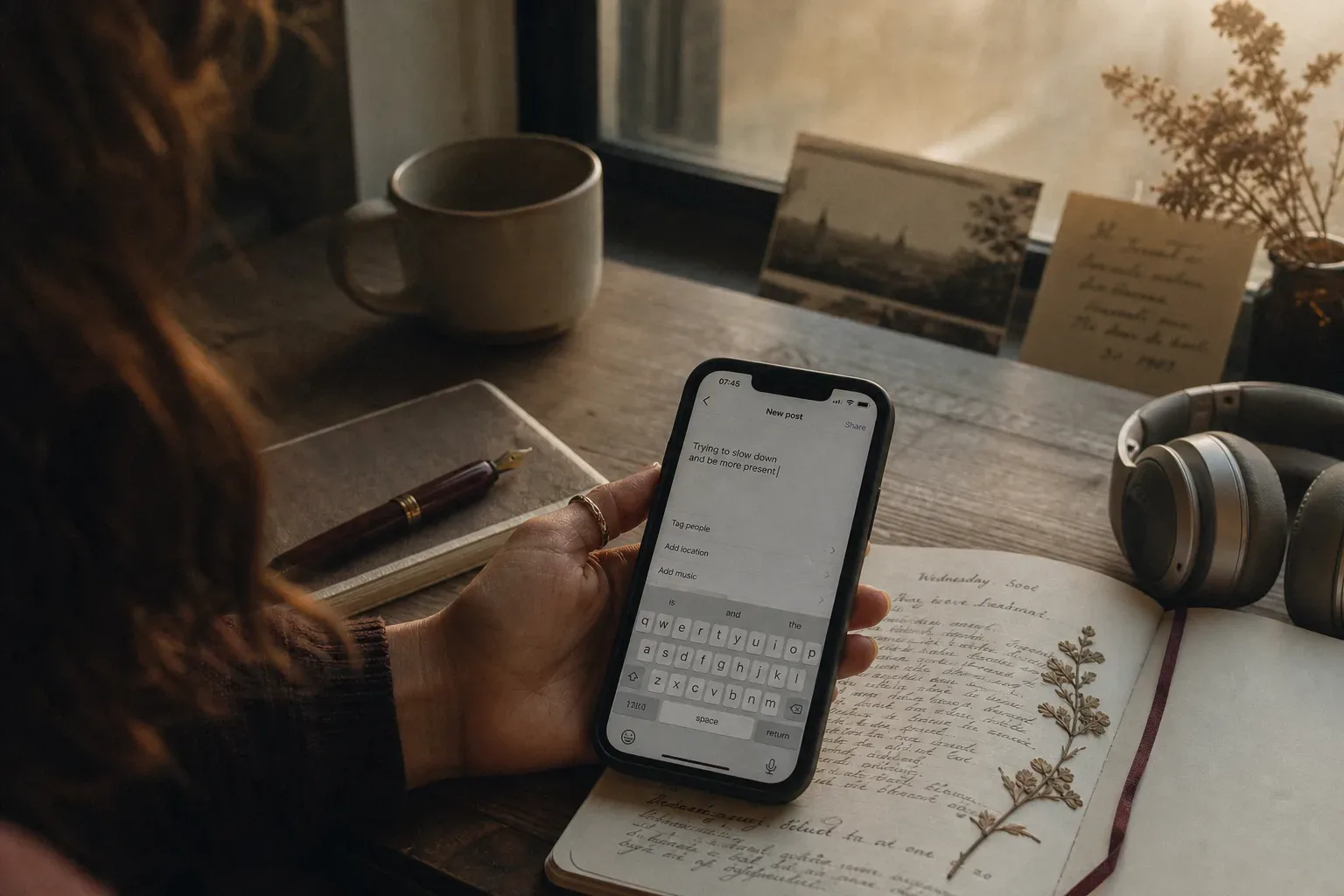
Your thumb hovers over Post. The caption is fine. The image is fine. The fear of being seen is the real thing in the room. A short future-self audio practice helps you steady your body, hear the self who already shares honestly, and post without abandoning yourself.
Why does the fear of being seen feel so physical?
Fear of being seen feels physical because your body can read visibility as social threat before your mind has time to explain it.
You may call it overthinking. Your nervous system may call it survival. Before you post, your chest tightens. Your mouth goes dry. You reread one sentence 14 times and suddenly the old story is awake: who do you think you are. That story is not proof. It is a signal.
Social pain uses some of the same neural alarm systems as physical pain. In a 2003 fMRI study by Naomi Eisenberger and colleagues, social exclusion during the Cyberball task activated the dorsal anterior cingulate cortex, a region also linked with distress. The study was small, but it gave language to something you already know: being left out hurts in the body.
Online visibility adds scale. A private room has 3 faces. A post can feel like 300, or 3,000, even when only 27 people see it. Pew Research Center has reported for years that a large majority of U.S. adults use at least one social platform; visibility is no longer rare. It is ordinary. That does not make it easy.
Being seen is a body event before it is a branding decision. The body asks a simple question: am I safe if they notice me. Your practice has to answer at that level, not only with strategy.
Visibility is not proof that you are unsafe; it is proof that you are findable.
What should you listen to before you post?
You should listen to a short future-self audio that speaks from the version of you who already knows how to be seen.
This is where the AYA Method enters quietly. The AYA Method is a daily audio manifestation practice. Each day you listen to a short personalized recording — your Dream-Self Moment — narrated from the version of you who has already manifested the life you intend. Listening is the practice. Repetition is the work. The audio is the method.
Before a post, that matters because fear has a voice. It says delete it, soften it, wait until you are better, wait until your hair is better, wait until no one can misunderstand you. A Dream-Self Moment gives another voice the room. Not louder. Clearer.
Mental rehearsal has a long research trail. Athletes have used imagery for decades; a 1994 review by Driskell, Copper, and Moran found that mental practice improved performance, especially when paired with physical practice. Posting is not Olympic sport. Still, your body can rehearse being visible without danger. That rehearsal can make the real action less strange.
This is also where manifestation becomes practical instead of decorative. You are not asking the world to clap. You are practicing the identity of someone who tells the truth in public and survives the silence after.
Your future self does not shout over fear. She gives it somewhere safe to sit.
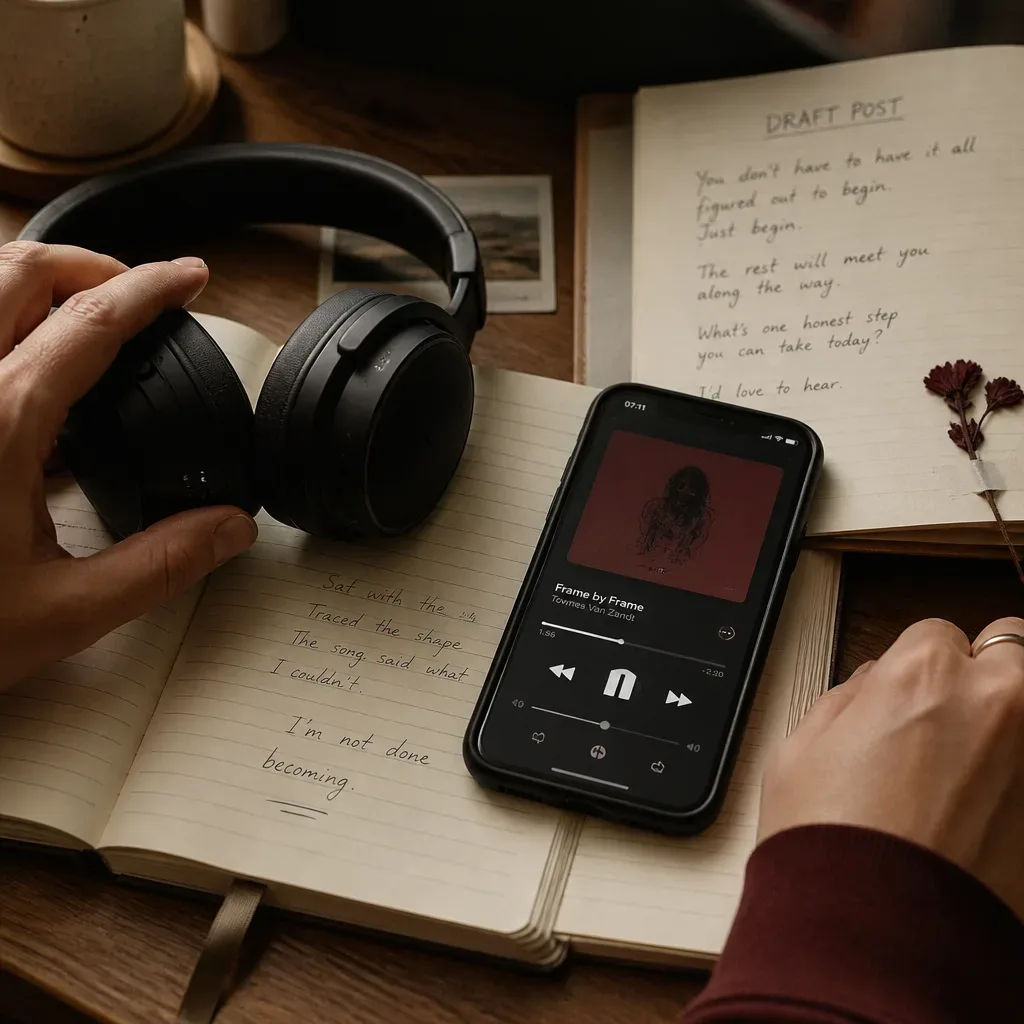
How do you do the six-minute pre-post practice?
You do it by slowing the moment down enough that posting becomes a chosen act, not a panic reflex.
Set a timer for 6 minutes. That number is small on purpose. Dr. Andrew Huberman often points to state shifts through breathing, light, and attention because the body changes through inputs, not lectures. You do not need a 40-minute ritual before a 40-word caption. You need a clean pause.
Here is the practice:
- Open the draft for 30 seconds. Let the post be visible. Do not edit. Your only job is to see what exists.
- Name the fear for 60 seconds. Write one sentence: I am afraid that if I post this, people will think ____.
- Listen for 3 minutes. Play your Dream-Self Moment, or a short future-self audio recorded in your own voice.
- Breathe for 45 seconds. Try one physiological sigh: inhale through the nose, take a second small inhale, then long exhale. Huberman Lab has discussed this pattern as a fast way to reduce arousal; Stanford research has also studied cyclic sighing in daily practice.
- Make one edit for truth. Not for approval. Not for hiding. Only for truth.
- Post or pause. If you pause, set a return time within 24 hours.
The post is not asking you to become fearless. It is asking you to stay with yourself for one more breath.
If you use Aya, the audio comes first. The app also includes a daily affirmation and Manifestation Board as complements, but they are not the center. The center is listening. The center is the Dream-Self Moment.
What do you say when shame starts editing the post?
You answer shame with simple, exact language instead of letting it become your editor.
Shame likes vague commands. Be less. Be safer. Be prettier. Be more useful. Be impossible to criticize. The trouble is that vague commands cannot be completed. Brené Brown’s early shame research, including her 2006 work on shame resilience, points toward naming and connection as antidotes. Shame loses some force when it is made specific.
Use this table when the draft starts shrinking in your hands:
| Shame says | You answer | Clean action |
|---|---|---|
| They will think I am too much | Some people will. My people need the signal clear | Remove one apology |
| I am not qualified enough | I can name what I know and what I am still learning | Add one honest boundary |
| No one will care | Silence is data, not a verdict | Post and track, do not spiral |
| Someone will misunderstand | I can be clear without controlling every reading | Clarify one sentence |
| I should wait | Waiting is wise only when I know why | Set a 24-hour review time |
A 2010 meta-analysis in Clinical Psychology Review found that self-compassion is strongly associated with lower anxiety and depression. That does not mean you can kindness your way out of every fear. It means the tone you use with yourself matters.
Try this phrase before the final tap: I can be seen in a human way. Not perfect. Not polished into glass. Human.
A post edited by fear often becomes less true and more forgettable. A post edited by care becomes easier to stand beside.
How can audio make posting feel safer than affirmations alone?
Audio can feel safer because it gives the nervous system rhythm, tone, and duration, not only a sentence to believe.
Affirmations can help. The affirmations practice is clean when the words are believable enough for your body to stay present. But research also gives a caution. In a 2009 study by Wood, Perunovic, and Lee, positive self-statements made some people with low self-esteem feel worse, likely because the statement felt too far from what they could accept.
That is why audio matters before visibility. A future-self recording does not have to force belief in one sharp line. It can give context. It can say: I remember when posting felt dangerous. I remember the old tightness. I posted anyway, not to prove anything, but because my work needed air.
Auditory cues are intimate. A 2019 review in Frontiers in Psychology discussed how voice carries social and emotional information through pitch, pace, and tone. You do not only hear words. You hear steadiness. You hear a self who is not rushing you.
Here are the roles, kept in their right size:
- Future-self audio: the main practice before posting; you listen and let the body rehearse being seen.
- Daily affirmation: a short complement; you repeat one true sentence after the audio if it helps.
- Manifestation Board: a visual complement; you glance at the life you are practicing, then return to the action.
- Posting: the real-world behavior; the place where the practice meets public air.
If timing rituals help you feel less alone, you can read about astrology and manifestation. Just do not make the moon responsible for your courage. Use timing as a frame, not a gate.
How do you know whether the practice is working?
You know it is working when your recovery time shortens and your choices become cleaner, even if fear still visits.
Do not measure success by instant calm. That is too harsh. Measure the gap between the fear and the action. Last month, it took 3 days to post. This week, it took 18 minutes. That is data. In behavior change research, small repeated actions often matter more than one dramatic breakthrough; BJ Fogg’s Tiny Habits model is built around making the behavior small enough to repeat.
Track 14 posts. Not forever. Two weeks is enough to see a pattern. Use a simple note on your phone:
- What did I want to post?
- What did I fear would happen?
- Did I listen before posting?
- How long did I wait?
- What actually happened in the first 24 hours?
- How did my body feel one hour after posting?
You may notice that the feared event happens less often than predicted. Cognitive behavioral therapy calls this prediction testing. In many CBT protocols for anxiety, clients compare feared outcomes with actual outcomes to weaken the threat story over time. You are doing a gentle version with your own public voice.
Do not turn tracking into surveillance. Fourteen entries. Then read them like a kind analyst. You may see that 9 posts were met with quiet, 3 with warmth, 1 with confusion, and 1 with a comment that stung. That is not a catastrophe. That is a life with other people in it.
Consistency is not drama. It is a small vote cast often enough to count.
What if being seen is part of the thing you asked for?
If being seen is part of what you want, then the practice is not to erase fear but to stop letting fear hold the account password.
A lot of people ask for clients, readers, love, respect, money, invitations, sales, and honest connection. Then the first doorway appears as visibility, and the body says no. This is not hypocrisy. It is protection. A 2023 Gallup report found that stress remains high for many adults worldwide, with 41 percent reporting a lot of stress the previous day. Your body is not broken for being cautious.
But there is a cost to permanent hiding. The work stays private. The offer stays invisible. The post stays in drafts, aging quietly. Neville Goddard wrote often about assuming the feeling of the wish fulfilled. Read gently, the useful part is not fantasy. It is rehearsal. Who are you when the thing you want requires a public signal.
That question belongs near future-self language and manifestation, because it turns desire into behavior. Not grand behavior. One post. One email. One sentence that does not apologize for existing.
Use the six-minute practice the next time your thumb pauses. Open the draft. Name the fear. Listen. Breathe. Make one clean edit. Post or pause with a reason you can respect.
There is no prize for panic-posting. There is also no prize for being perfectly hidden.
Post, then come back to the room.