affirmations
First Date Affirmations to Hear Future-You First
First date affirmations work best when they steady your nervous system before you leave, so you can meet the person without auditioning.
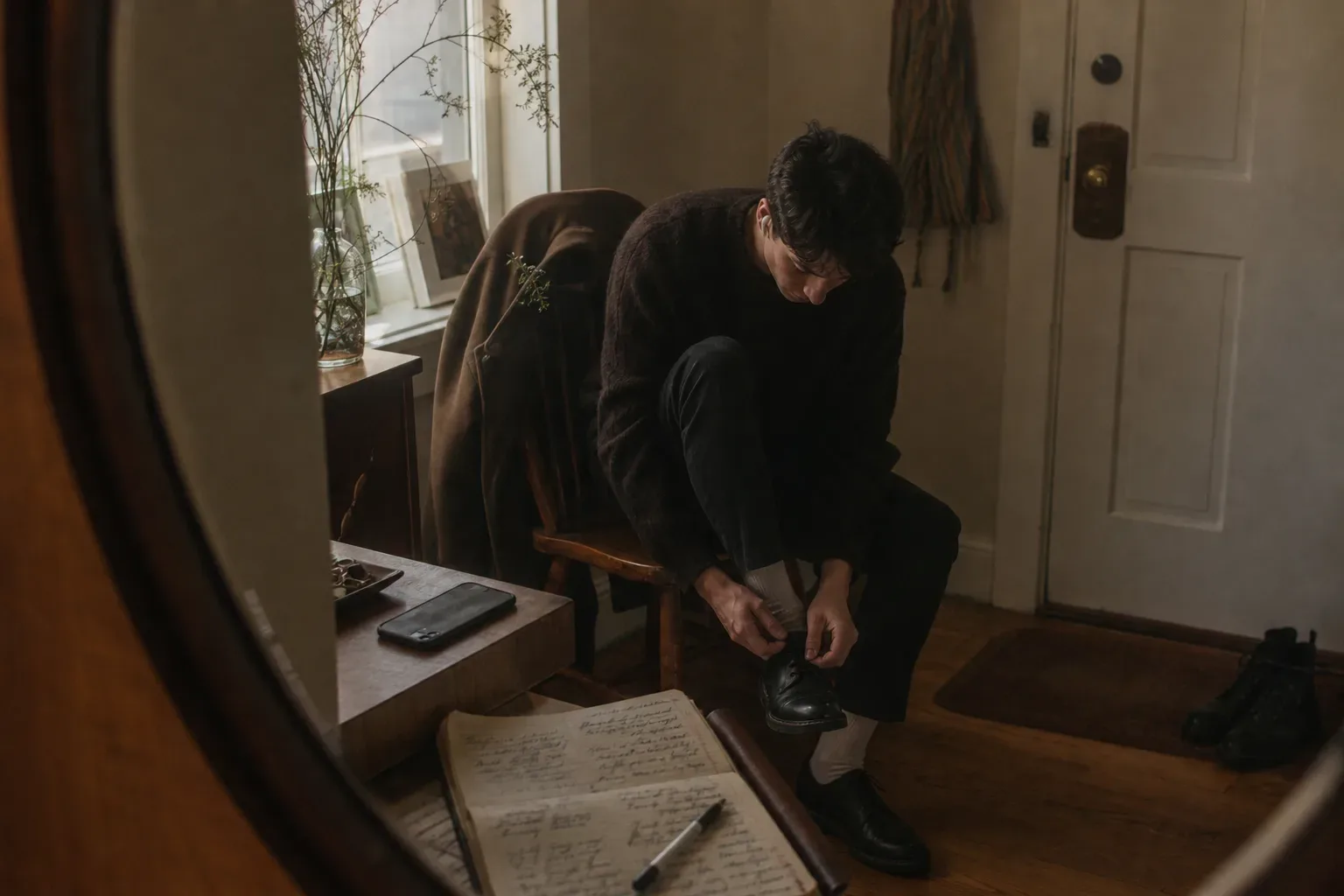
November 5th. The kettle clicked off while my shirt was still damp at the collar. First date affirmations help most when they make you less performative, not more impressive: they remind you what you already know, what you will not negotiate, and how you want to feel in your own body before you go.
Which first date affirmations should I use before I leave?
Use first date affirmations that name your behavior, not the other person’s reaction.
I wrote that down this morning because I have confused those two things before. I used to say sentences that tried to control the room: they will like me, this will go well, the chemistry will be obvious. Those lines made me more watchful. I kept checking whether the sentence had come true. A 2023 Pew Research Center report found that 47% of single U.S. adults said dating had become harder over the previous ten years, so I do not think I am the only one entering a date already braced.
The useful affirmations are smaller. They do not predict. They orient. Claude Steele’s self-affirmation theory, first published in 1988, was not about romantic confidence at all. It was about how people protect a sense of self-integrity under threat. That is what a first date can become if I let it: a tiny stage where a stranger’s pause feels like a verdict.
These are the ones I keep in my notes app:
- I can be curious without auditioning.
- I do not have to turn every silence into proof.
- I can want connection and still notice discomfort.
- I am allowed to leave with a neutral answer.
- My body gets a vote.
- I can enjoy attention without owing access.
- I am here to meet, not to be chosen.
The last one is the sentence that changed the most for me. It sounds plain. That is why it works. A good affirmation does not inflate you; it returns you. The date is not a courtroom. I am not the case.
I also keep one line from the Affirmations pillar close: repetition matters more than drama. If I have only said the sentence once, I do not expect it to hold much weight. If I have said it for seven mornings while making coffee, it has somewhere to stand.
How can I hear future-me before the date?
I hear future-me by listening first, before I start seeking proof from the other person.
This is where the AYA Method has become part of my dating routine, though I almost do not like calling it a routine. It is simpler than that. The AYA Method is a daily audio manifestation practice. Each day I listen to a short personalized recording, my Dream-Self Moment, narrated from the version of me who has already manifested the life I intend. Listening is the practice. Repetition is the work. The audio is the method.
Before a first date, I listen while I button my jacket or sit on the edge of the bed. It takes a few minutes. That matters because BJ Fogg’s behavior model at Stanford has long argued that tiny behaviors are more likely to repeat when motivation is unstable. Dating motivation is unstable by definition. One text can change the whole room in my chest.
The audio gives me a strange advantage: I do not have to generate steadiness from scratch. I receive it. Dr. Andrew Huberman has said often on his podcast that the nervous system changes through repeated state shifts, not through insight alone. I hear that in my body. The sentence that lands while I am calm becomes easier to reach when I am not.
I do not use audio to guarantee a result. I use it to decide which version of me is coming to the table. Future-me is not louder. She is less available for self-abandonment.
Here is the order I used last Friday:
| Minute | What I did | Why it helped |
|---|---|---|
| 0-2 | Listened to my Dream-Self Moment | Put my own voice in the room first |
| 2-3 | Chose one affirmation | Reduced decision noise |
| 3-4 | Checked the practical details | Kept the body from guessing |
| 4-5 | Put my phone away | Stopped rehearsing replies |
I still looked at my hair too many times. I still changed earrings once. The point was not purity. The point was sequence. Hear yourself first. Meet them second.
What should my affirmation actually sound like?
Your affirmation should sound like a sentence you would still believe with damp hair and five minutes left.
I distrust polished lines before dates. They make me feel like I am selling myself back to myself. The best ones sound almost boring. In a 2014 Annual Review of Psychology article, Geoffrey Cohen and David Sherman summarized decades of self-affirmation research and noted that affirmations work best when they connect people to core values, not when they deny reality. So I try not to say, I am completely calm, when I am clearly not.
Instead, I use this formula:
- Name the real feeling.
- Name the value I want to keep.
- Name the next behavior.
For example: I feel nervous, and I can still be honest. I value ease, so I will not force a spark. I want to stay kind to myself, so I will not overexplain my boundaries. These are not magic sentences. They are instructions for my attention.
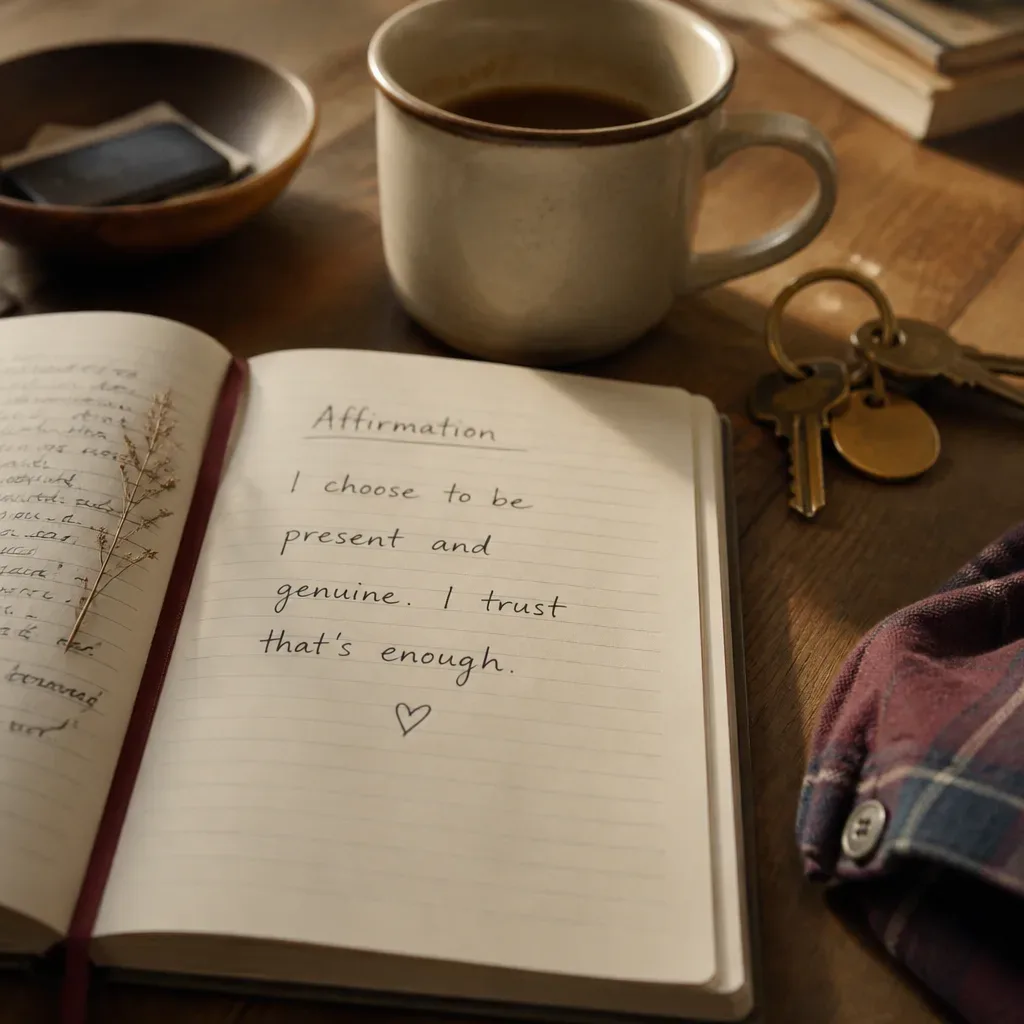
There is also a difference between confidence and compliance. I have gone on dates where I sounded confident because I answered quickly, laughed often, and filled the gaps. Then I came home tired in a way that felt like leaving a job interview. The affirmation I needed was not, I am magnetic. It was, I do not have to make this easy for both of us.
The Manifestation pillar makes a distinction I keep returning to: naming an intention is not the same as gripping an outcome. On a date, gripping looks like monitoring every facial expression. Naming looks like saying, I want mutual interest, and if it is not here, I will not invent it.
A sentence that asks you to abandon your body is not an affirmation. It is a costume.
Which first date affirmations help with anxiety in the body?
The affirmations that help anxiety are the ones paired with a physical cue your nervous system can repeat.
I learned this the unglamorous way, on a bus, when my mouth went dry three stops before the bar. I had a good sentence but no anchor. It floated above me. Since then, I pair each affirmation with something measurable: one exhale longer than the inhale, feet flat on the floor, hand on the cool glass of water. Clinical breathing studies are mixed in size, but slow breathing around 5 to 6 breaths per minute has been associated with improved heart rate variability in several small studies.
Here are the pairings that work for me:
- For racing thoughts: I can go slowly, with both feet on the floor.
- For people-pleasing: I can be warm without becoming available to everything.
- For fear of rejection: A no is information, not a disappearance.
- For overtalking: I can leave a silence untouched.
- For checking my phone: I do not need a second audience tonight.
The body part matters because first dates are not only cognitive events. The American Psychological Association has reported for years that stress shows up physically, with muscle tension, stomach discomfort, and sleep disruption among common symptoms. I can write the cleanest sentence in my notebook and still grip the edge of the table like I am on a ship.
So I practice the line in the kitchen first. Same chair. Same mug. If I only practice calm language when calm is easy, I am training for a life I do not have. Honest practice is built for the worst Tuesday, not the best Sunday.
I also give myself permission to be visibly human. A small laugh, a pause, a sip of water. Researcher Arthur Aron’s 1997 closeness study used 36 escalating questions to study interpersonal connection, and what I remember is not the number. I remember that closeness was structured through attention, not performance.
The right person does not need me edited beyond recognition.
How do I choose affirmations that do not make me fake?
Choose affirmations that keep you truthful, because fake confidence collapses under ordinary questions.
I have tried the glossy kind. I am irresistible. Everyone wants to know me. The room changes when I enter. Maybe those help someone else. In my body, they create a second task: now I have to act like a person who believes them. That is expensive. A 2022 Hinge dating report said that 90% of users wanted someone emotionally mature, which is another way of saying people can often feel the difference between presence and performance.
The better test is this: would I want a friend to date from this sentence? If not, I do not use it. I would not tell my friend to become whatever the evening rewards. I would tell her to notice whether she can breathe.
My list now has three categories:
| If I tend to… | I use this affirmation | I watch for this |
|---|---|---|
| Overperform | I can be interested without entertaining | Am I tired too early? |
| Attach quickly | I can enjoy this without naming it yet | Am I building a story from crumbs? |
| Withdraw | I can stay open and still protected | Am I confusing fear with wisdom? |
| Please | Kindness does not require agreement | Did I say yes too fast? |

The last column is important. An affirmation is not a mood sticker. It should change what I notice. If my sentence is, I can enjoy this without naming it yet, then I pay attention to whether I start imagining three holidays and a kitchen before the appetizers arrive. That is not romance. That is acceleration.
I have also learned from Astrology and manifestation readers who use timing as a reflective tool. I am not very mystical about dates, but I understand the comfort of a frame. If Mercury retrograde makes someone slow down and read the text twice before replying, the useful part may be the pause.
Truthful affirmations do not make me bigger than I am. They make me less willing to shrink.
What list of first date affirmations can I save today?
Save a short list that covers calm, boundaries, curiosity, and exit permission.
I keep mine in a note titled before leaving. Not romantic. Very useful. I review it for less than two minutes, which matters because habit adherence drops when the routine feels too long. In one 2009 study often linked to habit formation, Phillippa Lally and colleagues found an average of 66 days for a behavior to become automatic, with wide variation from 18 to 254 days. Two minutes is easier to repeat for that long.
Here is the list I would send my younger self, the one who thought being chosen was the same as being safe:
- I can be curious without auditioning.
- I am allowed to notice whether I like them.
- I do not have to earn ordinary respect.
- I can pause before I answer.
- Chemistry is not a command.
- I can leave a silence alone.
- My discomfort is data.
- I can be warm and still have edges.
- I do not need to become easier to love.
- A first date is information, not a contract.
- I can want partnership without rushing this person into the role.
- I can go home proud of how I treated myself.
The sentence I use most is number 2. I am allowed to notice whether I like them. It sounds embarrassingly obvious. It was not obvious to me for years. Pew reported in 2020 that 30% of U.S. adults had used a dating site or app, and app culture can train the eye toward being evaluated. Swipe systems are not neutral teachers.
This is why I still read the Affirmations pillar when I feel myself making affirmations too decorative. The practice is not to become a better advertisement. The practice is to become easier for myself to hear.
I sometimes write one sentence on paper and fold it into my coat pocket. It is not necessary. It helps. My grandmother kept grocery lists in every pocket she owned, and I think maybe this is my version: a small paper proof that I meant to remember myself.
How should I use these affirmations after the date?
Use them after the date to review your self-trust, not to grade your desirability.
This is the part I used to skip. I would come home and replay the other person: their laugh, their delayed reply, the way they looked at the door. Now I take five minutes before texting anyone. I ask three questions, the same kind I use when I review any practice: did I stay with myself, did the affirmation help at least once, and what would I change next time?
A short debrief keeps the date from becoming folklore. Memory is editable. In psychology, this is not a metaphor; recall changes with attention and later interpretation. I do not need to turn a 90-minute coffee into a referendum by midnight.
My after-date note looks like this:
- What did I feel in my body when I arrived?
- Which affirmation did I remember?
- Did I override myself anywhere?
- Was there mutual curiosity?
- Did I feel more like myself or less like myself after?
- What is the kindest next step?
I keep the daily audio practice separate but nearby. The next morning, I listen again through the AYA Method, not because the date needs a verdict, but because I do. The audio returns me to the longer thread. One person’s uncertainty is not large enough to become my identity.
If I liked them, I can say so cleanly. If I did not, I can be kind and brief. If I am unsure, I can wait. A 2019 Stanford study by Michael Rosenfeld and colleagues found that meeting online had become the most common way heterosexual couples in the U.S. met, which means many first dates now begin without shared context. That makes the after-note more important, not less.
The page is dated now. The kettle is cold. I am still here.