affirmations
Public Speaking Affirmations: Listen to Future-You First
Public speaking affirmations work better when they follow a short future-you audio cue, not panic. A calm 9-minute practice for your next talk.
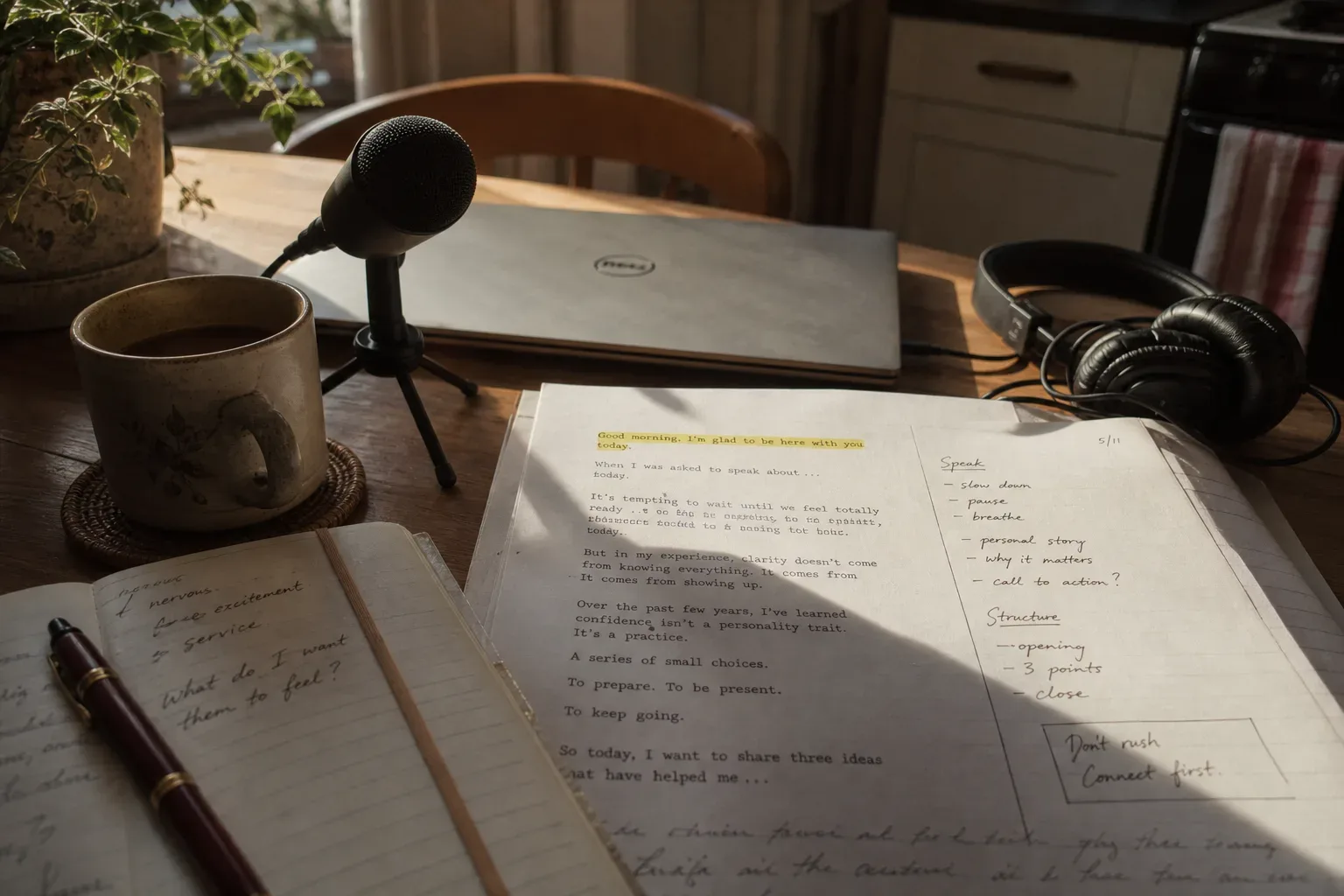
Saturday morning. The kettle clicked off while my notes sat open on the kitchen table. Public speaking affirmations work best when I listen to future-me first, then choose one believable sentence and rehearse the opening line. The order matters: audio, evidence, words, then the room.
Why should I listen before I use public speaking affirmations?
I listen first because my nervous system needs a scene before it can believe a sentence.
I learned this the boring way, which is usually the way I trust. Years ago I built a small habit-tracking app, and about fourteen thousand people taught me the same lesson in different handwriting: the first action must be easier than the ambition. For public speaking, my ambition wants to be calm, articulate, remembered. My first action is smaller. I put on headphones.
The National Institute of Mental Health estimates that about 15 million U.S. adults live with social anxiety disorder in a given year, and public speaking is one of the most common triggers people name in clinics and surveys. That number matters to me because it keeps me from making stage fear into a character flaw. Fear of a room is ordinary. The practice has to be ordinary too.
This is where the AYA Method has been useful in my own mornings. The AYA Method is a daily audio manifestation practice. Each day you listen to a short personalized recording, your Dream-Self Moment, narrated from the version of you who has already manifested the life you intend. Listening is the practice. Repetition is the work. The audio is the method.
I do not start with “I am a brilliant speaker.” My body hears that and files a complaint. I start with a voice that already knows the room. Then the public speaking affirmations become practical sentences, not theatre. A sentence should not have to drag the whole future by itself.
If you are new to this, the broader language around manifestation can sound too polished from the outside. I keep the useful part and leave the glitter. Identity rehearsed daily is not mystical to me. It is behavior design with a better microphone.
What makes public speaking affirmations believable enough to use?
A public speaking affirmation is believable when it describes a behavior you can perform under stress.
The word “confidence” is often too large. A pause is smaller. Feet on the floor are smaller. Looking at one friendly face is smaller. In a 2009 paper in Psychological Science, Joanne Wood and colleagues found that broad positive self-statements could make people with low self-esteem feel worse. I kept that study in my head because it explained something I had seen in app data too: when a prompt asks for too much, people quietly stop opening it.
So I write affirmations that pass the body test. If I say the sentence and feel my chest arguing, I edit it down. “I command every room” becomes “I can speak one clear sentence at a time.” “Everyone will love this” becomes “I can serve the next point.” The better line is not smaller because I am afraid. It is smaller because it can run.
Here is the table I wrote on the back of a meeting agenda three Tuesdays ago:
| Too big | Better for the body | Why it works |
|---|---|---|
| I am fearless on stage. | I can feel fear and keep speaking. | It does not require fear to disappear. |
| Everyone listens to me. | I can speak to one person at a time. | It gives the eyes a task. |
| I never forget my words. | If I lose my place, I can pause and return. | It includes recovery. |
| I am a perfect speaker. | I am prepared enough to begin. | It lowers the entry cost. |
A 2016 review in Social and Personality Psychology Compass described self-affirmation as most useful when it protects a valued identity under threat. That is the key. I am not trying to hypnotize myself into greatness. I am reminding myself that I am still myself when twelve people turn their faces toward me.
I keep the sentence close to action. The best affirmation is a handle, not a halo. If I can use it while walking to the front of the room, it stays. If it needs incense and twenty minutes of self-persuasion, I delete it.
How do I build the 9-minute practice before a talk?
I use a 9-minute sequence because it is short enough to repeat and long enough to change my state.
I have tested longer routines. They looked good in a notebook and failed on travel days. In my old app, streak breaks clustered around schedule disruption: flights, late work, family visits, illness. I do not need a perfect practice for the rare quiet morning. I need a sturdy one for the bus, the hotel bathroom, the office stairwell.
Here is the practice I kept:
- Minute 0 to 2: Sit and name the room. I write, “Tuesday product review, 11 people, 8 minutes.” Specificity lowers fog.
- Minute 2 to 5: Listen to future-you. I play my Dream-Self Moment through headphones. No multitasking.
- Minute 5 to 7: Write one evidence line. I record proof, not praise: “I answered the finance question last week without rushing.”
- Minute 7 to 9: Say one affirmation and the first sentence. I repeat the affirmation once, then speak the opening line of the talk.
Dr. Andrew Huberman often talks about physiological sighs, a double inhale followed by a long exhale, as a fast way to reduce autonomic arousal. The underlying breathing research is larger than one person; paced exhalation has been studied for heart-rate variability for decades. I sometimes use one physiological sigh before minute zero, mostly because it gives my hands something to do besides rearrange paper.
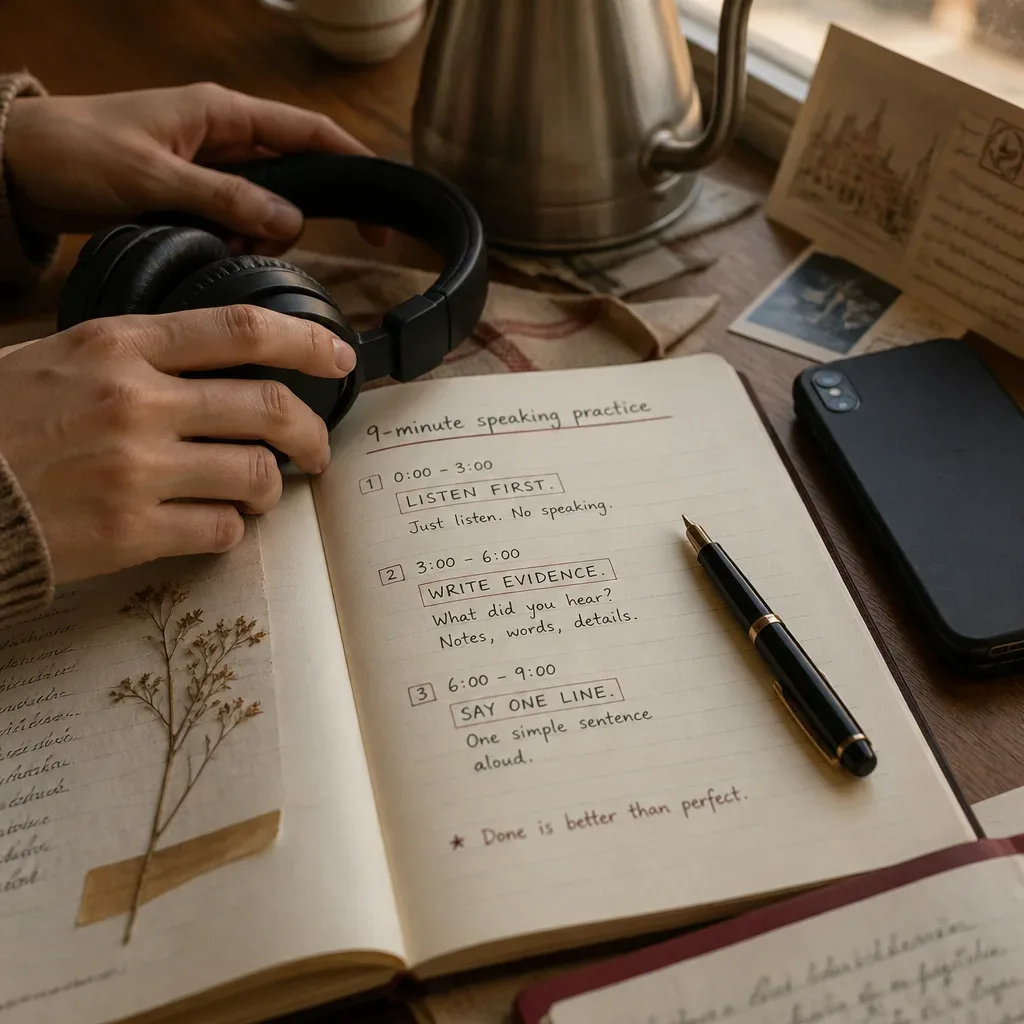
This is also where affirmations need to be treated as a complement, not the whole structure. A line spoken into panic has to work too hard. A line spoken after audio, breath, and evidence can stay plain. Plain is good. Plain survives fluorescent lighting.
For a toast or a classroom presentation, I keep the same 9 minutes. For a keynote or investor meeting, I may repeat the practice once the night before and once the morning of. Two repetitions are enough. After that, I am usually just feeding the worry and calling it preparation.
Which public speaking affirmations do I actually say?
I say public speaking affirmations that include the possibility of nerves and the next useful action.
This morning, my blue mug was next to the laptop, and I used the same three lines I have used for months. I did not invent new ones because novelty is expensive. In habit design, repetition lowers the decision load. A 2006 Duke University paper by Wood, Quinn, and Kashy estimated that about 45 percent of daily behavior is repeated in the same context. I want speaking practice to borrow that machinery.
These are the lines that have stayed:
- “I can pause, breathe, and continue.”
- “I know the first sentence, and the next sentence can meet me there.”
- “My job is to be clear, not flawless.”
- “I can speak to one face, then another.”
- “If my hands shake, I do not have to obey them.”
- “The room does not need a performance. It needs the point.”
I keep the list short. Six lines are more than enough. Before an actual talk, I choose one. Not three. Not a necklace of sentences. One line is easier to retrieve when adrenaline arrives, and adrenaline is famous for deleting decorative language.
There is a small body of research on implementation intentions, the “if-then” plans studied by Peter Gollwitzer since the 1990s. Meta-analyses have found moderate effects across many goal domains because the plan links a cue to a behavior. That is why I sometimes turn an affirmation into an if-then line: “If I lose my place, then I will look down, breathe, and read the next heading.” It sounds less poetic. It works better.
A good public speaking affirmation should have a verb in it. Pause. Breathe. Look. Continue. Begin. Return. The body understands verbs faster than adjectives.
If you like writing your own, use this little frame from my notebook:
- “Even if I feel ___, I can ___.”
- “My next job is ___.”
- “I do not need ___ in order to ___.”
- “If ___ happens, I will ___.”
I also keep one private line for the part of me that wants everyone to approve: “I can be useful without being adored.” I do not say it dramatically. I say it while closing the laptop.
How should I practice if my speech is tomorrow?
If the speech is tomorrow, I practice recovery more than confidence.
The night before a talk is not the time to rebuild a personality. It is the time to reduce avoidable friction. I charge my headphones. I put the notes in one place. I decide what I will do if the projector fails, if my mouth goes dry, if someone asks the question I do not want. A 2022 Gallup report found that stress remained near record highs globally, with 44 percent of employees saying they experienced a lot of stress the previous day. I assume stress will come. Then I give it fewer sharp objects.
My night-before version is only 12 minutes. I listen once. I mark the first sentence and the last sentence. I write three recovery plans. Then I stop. Over-rehearsal has a taste to it. Metallic. It pretends to be discipline, but it is often bargaining.
The recovery plans look like this:
| Moment | My sentence | My action |
|---|---|---|
| I blank. | “I’m going to return to the main point.” | Look at the next heading. |
| I rush. | “This part matters, so I’ll slow down.” | Put both feet flat. |
| I get challenged. | “That is a fair question.” | Answer one layer only. |
| I shake. | “My body can be loud while I stay clear.” | Hold the page with two hands. |
This is where I differ from a lot of public speaking advice. I do not try to erase the signs of nerves. Most audiences forgive nerves faster than vagueness. The Journal of Behavioral Medicine has published for years on acceptance-based approaches to anxiety, and the practical lesson is simple enough for a kitchen table: symptoms do not have to be enemies before you act.
I sometimes read about astrology and manifestation because timing language can be comforting, especially before a visible thing. But I do not outsource the speech to the date. I still print the notes. I still listen. I still practice the first line.
What do I do in the final five minutes before I speak?
In the final five minutes, I stop preparing and start cueing the body.
Five minutes before speaking, I do not open the whole deck. This is a rule I made after ruining too many entrances by scanning slide 37 like it was a legal document. Working memory is limited; George Miller’s famous 1956 paper suggested a span around seven items, plus or minus two, and later research often argues the usable number is even smaller. Either way, the doorway is not the place for twenty thoughts.
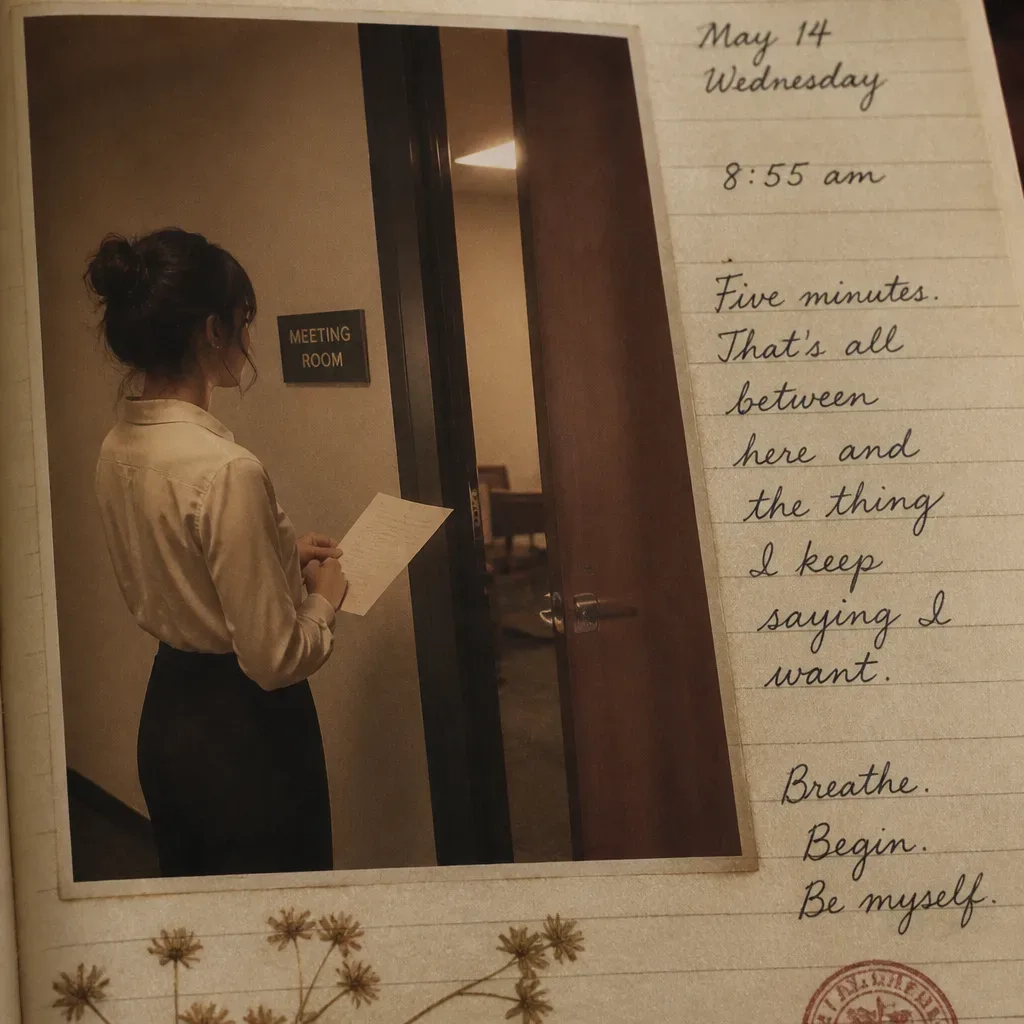
My final-five checklist is plain:
- Put both feet on the floor.
- Exhale longer than I inhale twice.
- Listen to the last 30 seconds of the audio if I can, or remember the tone if I cannot.
- Say the chosen affirmation once.
- Speak the first sentence quietly before I step in.
The final sentence might be, “I can pause, breathe, and continue.” Then I say the opening line: “I want to show you the one customer behavior we keep misreading.” That is all. No pep talk. No grand identity speech. The room is already enough stimulation.
Neville Goddard wrote often about assuming the feeling of the wish fulfilled. I read him carefully, but I translate the idea into a practice I can measure: rehearse the state briefly, then take the next behavior. Joe Dispenza speaks about mental rehearsal too, though I am more cautious with the neuroscience claims than his fans tend to be. Still, mental rehearsal has a serious home in sports psychology and performance training. Athletes have used imagery protocols for decades because the brain benefits from repeated maps.
The trick is not to confuse rehearsal with guarantee. Listening to future-you does not promise applause. It gives the present-you a better starting line. That is enough work for one tool.
How do I use evidence after the talk so the next one is easier?
After the talk, I write one piece of evidence before my memory turns the whole event into a verdict.
This may be the most important part, and it takes less than 90 seconds. I write one sentence in the notes app before I check messages. “I paused after the budget question.” “I made eye contact with Maya when I felt myself rushing.” “The first joke did not land, and I continued.” Small evidence is still evidence. The future self needs receipts.
Memory is not a clean recording. Psychologists have studied negativity bias for decades; bad events and errors often weigh more heavily than neutral or good ones. In speaking, that means one awkward answer can stain the whole meeting if I let it. So I do not let the meeting be remembered by the loudest discomfort. I date the proof.
My post-talk note has three lines:
- One thing I did well: a behavior, not a personality trait.
- One thing to adjust: a specific edit for next time.
- One line for future-me: the sentence I want in the next audio or affirmation.
Sometimes I add it to my Manifestation Board later, but only as a small reminder. The audio remains the practice. The board is a place where tomorrow-me can trip over the evidence. That distinction matters. Tools are useful when they know their job.
If you want the broader frame, I keep returning to the AYA Method because it treats repetition as the work instead of pretending one emotional morning will carry a whole identity. I also keep the Affirmations pillar open when I want cleaner wording. Words matter, but the order matters more: listen, notice, speak, record.
The quietest proof is usually the one that compounds. I have watched users abandon dramatic goals and keep tiny ones for 300 days. I believe the tiny ones now. Public speaking affirmations are tiny enough to keep, if I stop asking them to be magic and let them be cues.
Saturday now. The notes are folded beside the cup.