astrology manifestation
First Quarter Moon Manifestation in 5 Minutes
Use first quarter moon manifestation as a small decision point: listen to a 5-minute Dream-Self audio, choose one next action, and repeat it tonight.
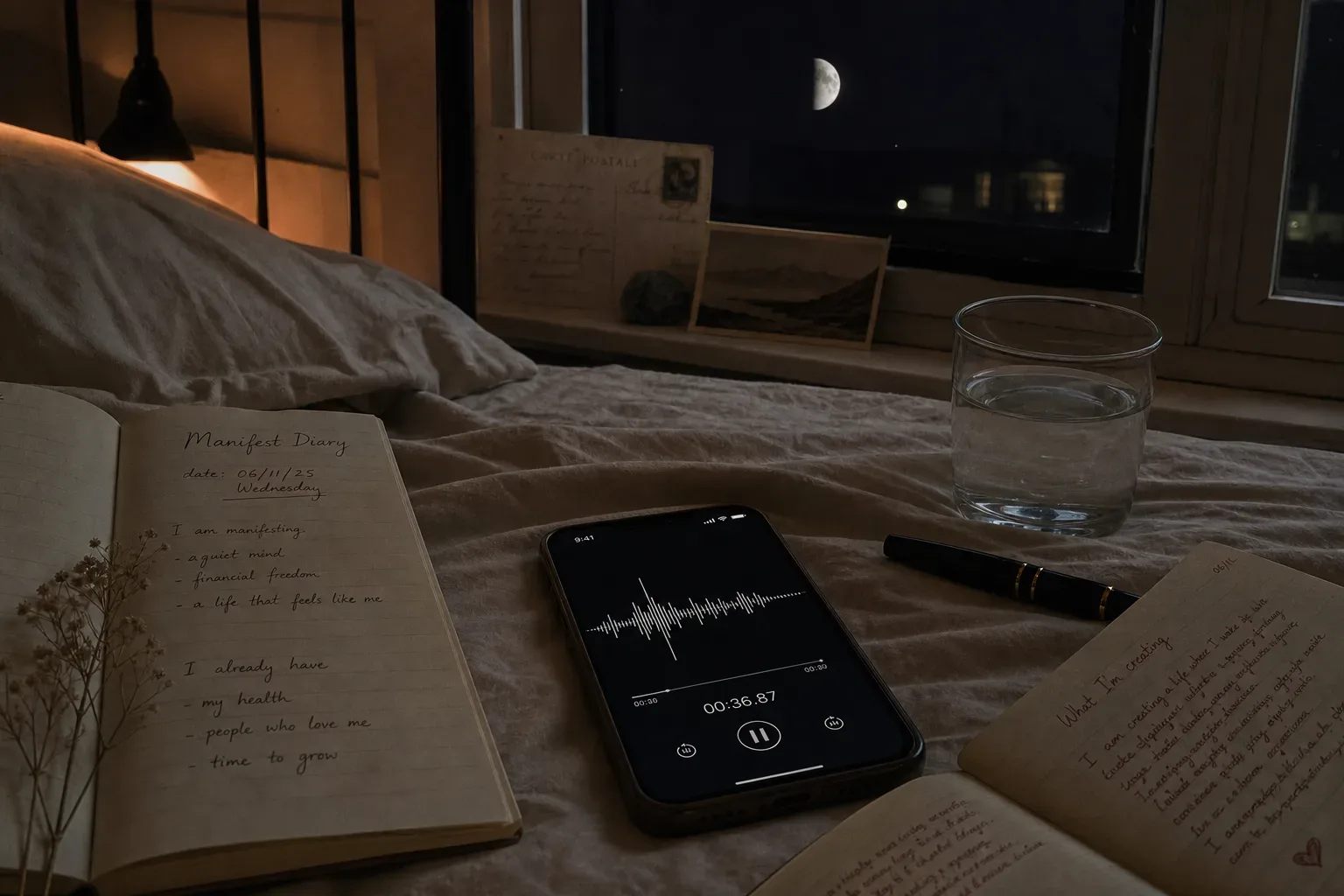
The moon looks cut in half. That is the point. First quarter moon manifestation works best as a 5-minute check-in: listen to your Dream-Self audio, name the friction between intention and action, and do one small thing before sleep. It is not a mood. It is a decision.
What is first quarter moon manifestation asking you to do?
It is asking you to turn an intention into one visible action.
The first quarter moon arrives about 7 days after the new moon. Astronomers call it first quarter because the Moon is one quarter of the way through its 29.53-day synodic cycle, even though it looks half-lit from Earth, according to NASA. This is why the phase feels useful for practice. It is not the beginning. It is not the harvest. It is the moment when the intention has to meet your calendar.
If the new moon is where you name what you want, the first quarter moon is where you stop negotiating with the vague version of it. You ask a small question. What is the next true move? Not the whole plan. Not a new identity speech. One move.
This is where astrology and manifestation can become practical instead of theatrical. Pew Research Center reported in 2018 that 29% of U.S. adults said they believe in astrology. But you do not need belief to use a lunar phase as a timing cue. A clock works even when you do not worship time.
A lunar ritual is only useful if it changes what you do after it ends.
For first quarter moon manifestation, the action is small by design. Send the message. Open the draft. Lay out the clothes. Put the form on the desk. A half-lit moon is honest. It says: some of this is clear, and some of this is still dark.
Why use a 5-minute Dream-Self audio instead of just journaling?
A 5-minute audio gives your attention a stable cue before your mind starts bargaining.
Journaling can help. I use it. But written reflection often becomes a second room where you can hide. Audio is harder to argue with when it is short, specific, and personal. You press play. You listen. You let the future-self language arrive before the familiar objections line up.
The AYA Method is a daily audio manifestation practice. Each day you listen to a short personalized recording — your Dream-Self Moment — narrated from the version of you who has already manifested the life you intend. Listening is the practice. Repetition is the work. The audio is the method.
That last sentence matters. The audio is not decoration around the method. It is the method. The app also includes a daily affirmation and a Manifestation Board, but they are complements. If you are working with words after listening, the affirmations pillar is a useful next room. Still, for this lunar practice, start with the recording.
Behavior science gives a quiet reason for this. Peter Gollwitzer and Paschal Sheeran reviewed 94 studies in their 2006 meta-analysis on implementation intentions and found that if-then plans had a medium-to-large effect on goal achievement. The audio sets the felt direction. The next sentence turns it into behavior: If it is 9:30 tonight, then I send the email.
Five minutes is not too small. It is small enough to survive a real Tuesday.
How do you prepare without making the ritual too complicated?
You prepare by removing choices before you begin.
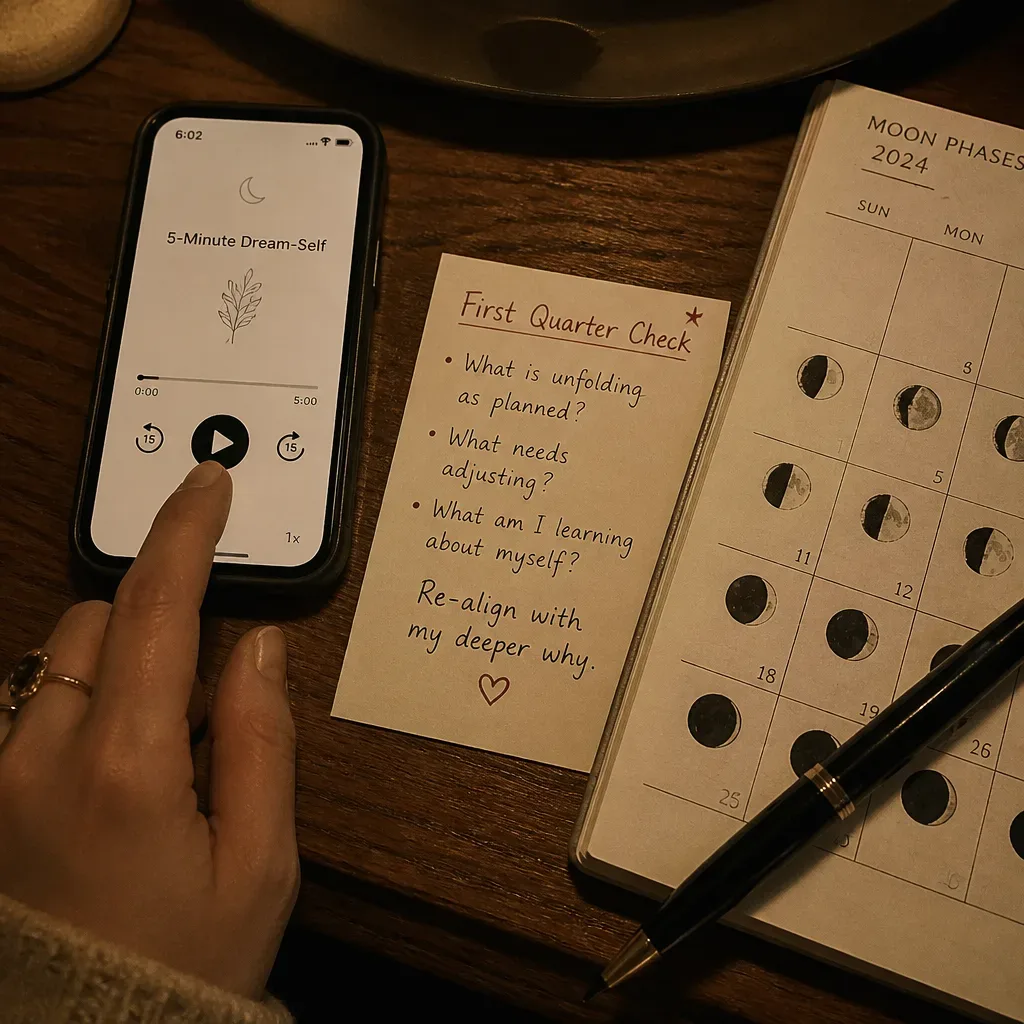
The first mistake is making the practice pretty enough to avoid doing it. You do not need candles, a new notebook, or a perfect moon view. You need a place to sit, your audio, and one clear way to write the next action. The ritual should be repeatable on a tired night.
Here is the simplest setup:
- A moon calendar or app showing the first quarter moon date
- Your 5-minute Dream-Self audio
- A timer, if you tend to drift
- One page or note titled First Quarter Check
- A pen, or the notes app you already use
- Ten minutes after the audio for one action
The lunar timing can be loose. Use the exact evening if you can. If not, use a 24 to 48 hour window. NASA gives the lunar cycle as an average of 29.53 days, but your nervous system does not need astronomical perfection. It needs a cue it can remember.
There is also a habit reason to lower the entry cost. In a 2009 study by Phillippa Lally and colleagues at University College London, habit automaticity took a median of 66 days, with a wide range from 18 to 254 days. Practices that rely on ideal conditions tend to break early. Practices that fit into ordinary rooms last longer.
Use this table as a quiet filter:
| If you want to add | Ask this first | Keep it if |
|---|---|---|
| A candle | Does it help me listen? | It lowers noise |
| A long journal session | Am I avoiding action? | It ends in one next step |
| A tarot or oracle pull | Does it clarify friction? | It names a choice |
| A Manifestation Board review | Does it remind me what is true? | It stays under 2 minutes |
The cleaner the ritual, the less there is to perform.
What are the 5 steps for a first quarter moon audio practice?
The practice is listen, notice, decide, act, and close.
Set a 5-minute container. You can do this seated on the edge of your bed. You can do it in a parked car. You can do it with one lamp on. The point is not to leave your life. It is to enter it with less noise.
- Find the moon window. Use the first quarter moon date, or the closest evening within 48 hours. The phase comes roughly 7 days after the new moon.
- Play your Dream-Self Moment once. Do not multitask. Do not rewrite the audio in your head. Listen.
- Write the friction in one sentence. Try: The thing I keep avoiding is. Stay factual.
- Choose one action under 10 minutes. Make it physical or sendable. Open the file. Book the class. Put the bill in the inbox.
- Do it before bed. Then stop. Do not add twelve more tasks to prove sincerity.
Goal-setting research supports this narrowness. Edwin Locke and Gary Latham reviewed about 35 years of findings in their 2002 American Psychologist paper and found that specific, difficult goals tend to improve performance more than vague goals. But for a nightly manifestation practice, difficult does not mean huge. It means honest enough to create movement.
A good first quarter action has three traits:
- It can be completed today
- It makes the intention harder to ignore tomorrow
- It leaves evidence, even small evidence
Evidence matters. Manifestation without evidence can become a private weather system. One completed action gives the mind something real to return to.
If your wider practice is still forming, read the manifestation pillar before you make the ritual bigger. The basics are enough here. Listen first. Act once. Repeat at the next cue.
What should your Dream-Self audio say at this moon phase?
It should speak from the self who acts calmly when resistance appears.
The first quarter moon is not a fantasy phase. It is a friction phase. The audio should not sound like a prize ceremony. It should sound like you, already steady, naming the way you move when the work becomes inconvenient.
A strong Dream-Self Moment for this phase includes 3 kinds of language. First, identity: I am the person who returns to the next true step. Second, evidence: I answer the message before I make it heavy. Third, tone: I do not rush, and I do not disappear.
Mental imagery research gives this some footing. A 2018 review in Frontiers in Psychology noted that imagery can influence emotion, motivation, and behavior because the brain treats imagined scenes as meaningful simulations, not empty decoration. That does not mean a scene makes life obey you. It means rehearsal can shape what feels available when the real moment arrives.
Here are a few lines that fit the first quarter moon:
- I meet the part of me that resists, and I still take the next step.
- I do not need the whole path to be lit.
- I keep promises small enough to keep.
- I let proof be quiet.
Do not overload the script. A 5-minute audio has room for clarity, not clutter. If your audio names 14 desires, your attention has to split 14 ways. For this moon, choose one intention and one behavior. The half-lit sky is already teaching the edit.
How do you know if the practice is working?
You know it is working when your next action becomes easier to repeat.
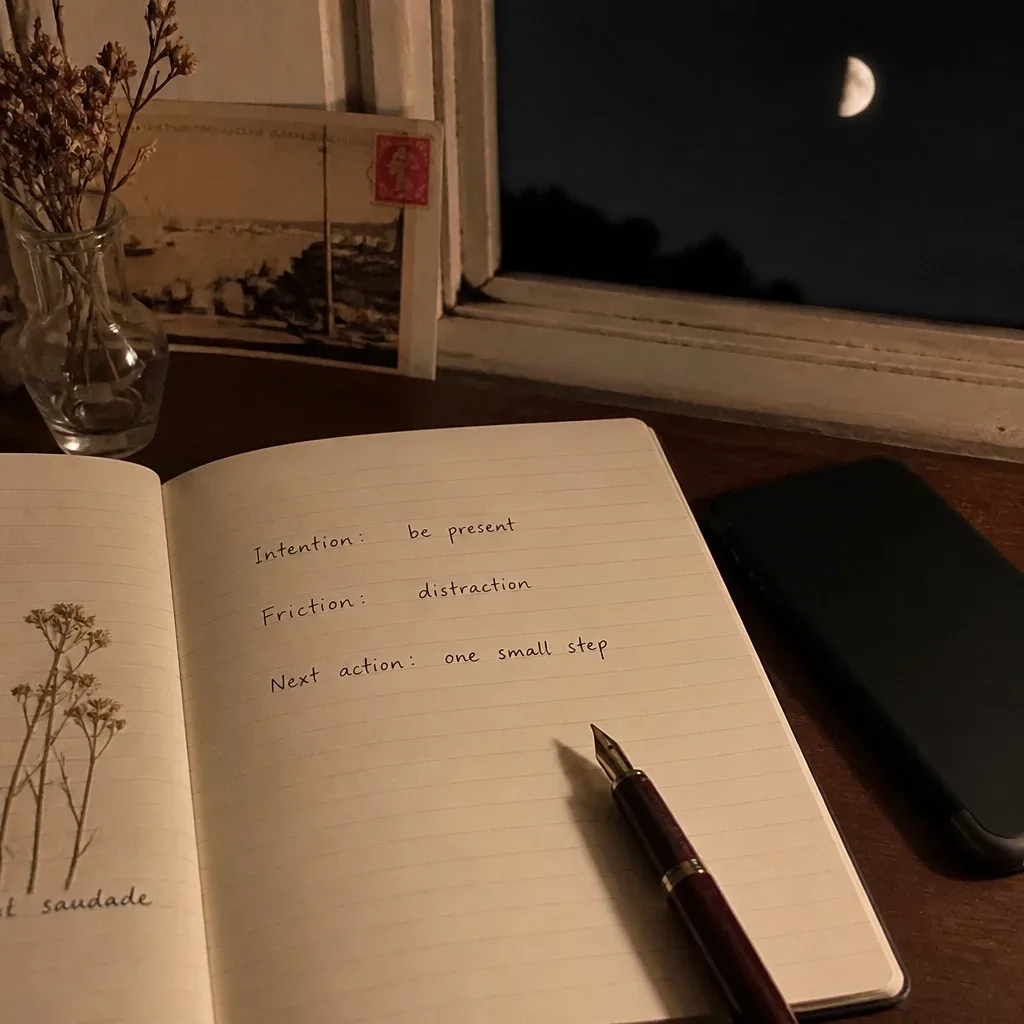
Do not measure first quarter moon manifestation by how intense it feels. Intensity is cheap data. Look for quieter signals. Did you complete the 10-minute action? Did you name the real obstacle instead of the pretty one? Did you return to the same intention without needing to start over?
A simple tracking note helps. I built a habit-tracking app years ago, and the pattern was not romantic: people stayed with habits when the checkmark was easy to earn and clearly tied to a behavior. Lallys 2009 habit study is useful here again because it shows repetition over time matters more than one perfect session. Median automaticity was 66 days, not 6.
Track only 3 things after each first quarter practice:
| Question | Yes or no |
|---|---|
| Did I listen to the full audio? | |
| Did I name one friction point? | |
| Did I complete one action? |
If you want more detail, add one sentence: The next true step was. That is enough. Too much tracking turns the ritual into paperwork.
You can also compare moon phases without making them compete. The new moon is for naming. The first quarter is for choosing. The full moon is for seeing. The last quarter is for releasing what no longer deserves your time. The frame is simple, and it pairs well with astrology and manifestation when you want a wider rhythm.
The sign that a practice is working is not drama. It is return.
If the practice feels flat, make the action smaller. If it feels scattered, make the intention fewer words. If it feels false, rewrite the Dream-Self audio so it sounds like a real version of you, not a stage voice.
What if resistance is the thing that shows up first?
Treat resistance as information, then give it a job.
The first quarter moon often exposes the gap. You said you wanted the thing. Now your body remembers the cost. Time, attention, fear, boredom, the old story. This does not mean the intention was wrong. It means the intention has reached the part of the day where it has to be lived.
Name the resistance plainly. I do not want to be seen. I do not want to be bad at this. I do not want to ask. A 2010 study by Sonja Lyubomirsky and colleagues on positive activity interventions noted that fit and dosage matter. In plain terms: a practice works better when it matches the person and does not ask for too much too soon.
Then give the resistance a smaller doorway. If you cannot write the chapter, write 100 words. If you cannot apply, open the form. If you cannot have the conversation, write the first sentence you will say. This is not self-deception. It is behavior design.
Use this final first quarter script after the audio:
- The intention I am staying with is.
- The friction I can name without shame is.
- The action I can complete tonight is.
- The time I will do it is.
That is the whole practice. Five minutes to listen. A few minutes to write. One small action to make the future less theoretical.
The half-lit moon is enough light for the next true step.