manifestation for life areas
Friendship Manifestation With Future-Self Audio
Friendship manifestation can be gentle: use future-self audio, small social cues, and one honest action a day to practice belonging without forcing anyone.

A phone rests face down beside a cup of tea. Friendship manifestation means using future-self audio to rehearse belonging, then taking one small social action that matches it. You are not making anyone choose you. You are practicing the version of you who knows how to be reachable, honest, and here.
What is friendship manifestation, really?
Friendship manifestation is the practice of becoming available to real belonging without trying to control another person.
It begins with a quiet correction. You are not asking life to hand you a perfect circle of people by Friday. You are asking to recognize, receive, and tend the friendships that are true for you. The U.S. Surgeon General’s 2023 advisory named social connection as a public health issue, noting that poor social connection is associated with a 29% increased risk of heart disease and a 32% increased risk of stroke. Belonging is not decorative. It is part of being well.
The practice gets tender because friendship can carry old stories. Maybe you moved. Maybe a group changed without naming it. Maybe you became the person who does not text first because the silence already answered once. A good manifestation practice does not shame that. It lets you tell the truth and then asks for one next honest move.
In the broader language of manifestation, you are working with attention, repetition, feeling, and action. For friendship, the action matters deeply. You can listen every morning, but someone still has to send the message, join the class, stay after the meeting, or say, “I’d like to see you again.” The spoken inner rehearsal prepares the outer step.
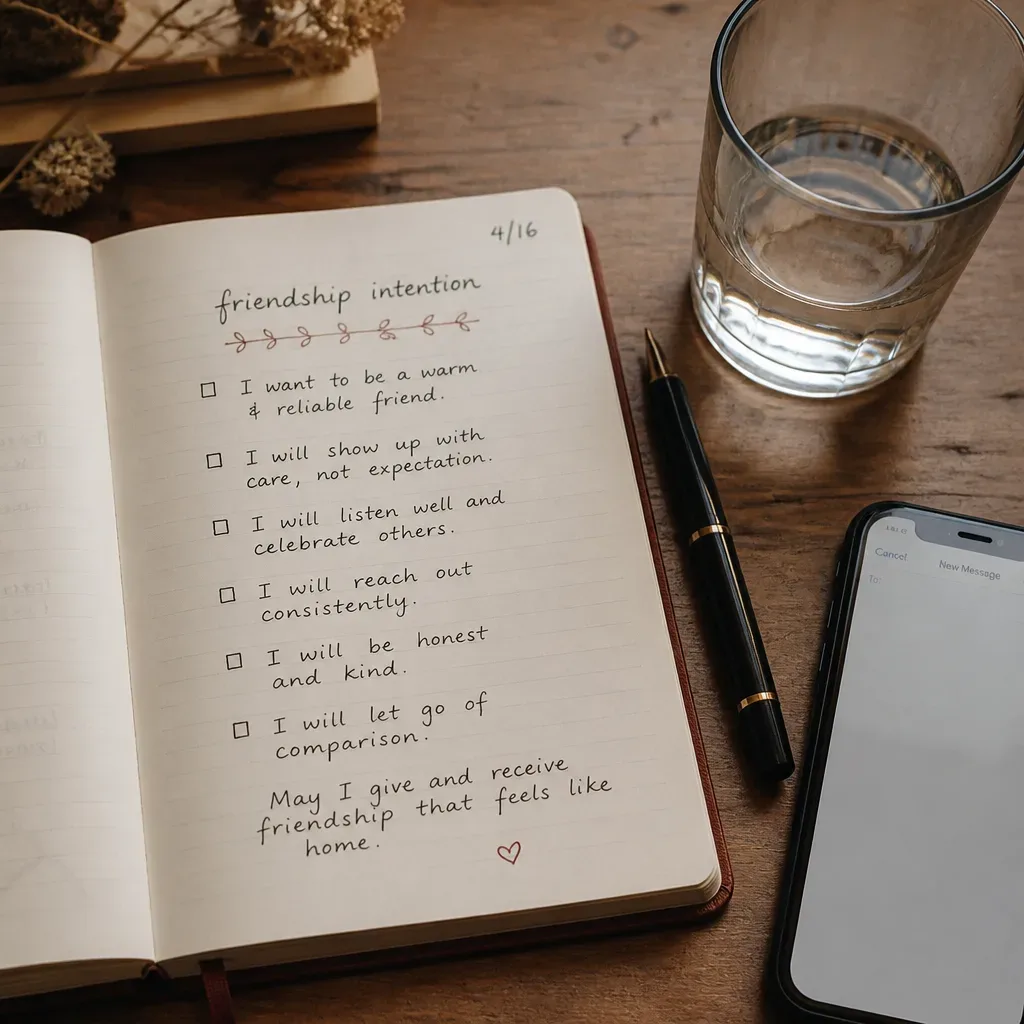
A simple friendship intention sounds like this:
- “I am becoming easy to know.”
- “I notice people who notice me.”
- “I make space for steady, mutual friendship.”
- “I can be new and still belong.”
Belonging is not proof that everyone likes you. It is the felt permission to be real with the right people.
Why use future-self audio for belonging?
Future-self audio helps because hearing your own future as already lived gives your body a specific social script to return to.
The the AYA Method is a daily audio manifestation practice. Each day you listen to a short personalized recording — your Dream-Self Moment — narrated from the version of you who has already manifested the life you intend. Listening is the practice. Repetition is the work. The audio is the method.
For friendship manifestation, that means you do not begin with a blank wish. You begin with a voice. A future version of you speaks from the simple fact of being included. Not adored by everyone. Not constantly invited. Included. The brain learns through repetition; psychologist Dr. Andrew Huberman often describes repeated cues and reward as part of how behavior becomes more likely. The exact mechanism is more complex than one sentence, but the daily cue matters.
Audio is intimate in a way a written note is not. It arrives through the ear. It sets pace. It can make a future scene feel close enough to practice. Research on mental rehearsal in sport and performance has shown that imagery can support skill preparation, especially when paired with action. Friendship is not a performance, but it does ask for skills: greeting, asking, following up, repairing, letting yourself be seen.
Use the audio to hear ordinary scenes. A friend saves you a seat. Someone says your name with ease. You leave a dinner without replaying every sentence. Your future self does not sound like a stranger who never gets nervous. They sound like you, with more room inside.
| Practice piece | What it does | What it does not do |
|---|---|---|
| Future-self audio | Rehearses belonging in a repeatable way | Replace real contact |
| Daily affirmation | Gives one clear sentence to carry | Serve as the whole method |
| Manifestation Board | Makes the desire visible | Force timing or people |
| One social action | Opens a real door | Guarantee a response |
How do you set a friendship intention without forcing someone?
Set the intention around qualities, not control.
This is where many people get quiet. They want a specific person to text back. They want a specific group to open. That desire is human. Still, ethical friendship manifestation leaves the other person free. A 2010 PLOS Medicine meta-analysis by Julianne Holt-Lunstad and colleagues reviewed 148 studies and found that stronger social relationships were linked with a 50% increased likelihood of survival. The need is real. But need does not make control kind.
Name the texture instead. Do you want friends who are playful, consistent, spiritually curious, sober, creative, practical, affectionate, direct? Do you want one close friend or a wider circle? Anthropologist Robin Dunbar’s work is often summarized as about 150 stable relationships, with a much smaller inner circle of around 5 close ties. You do not need everyone. You need the right scale for your life.
Try this 5-minute intention process:
- Write: “The friendship I am ready for feels like…”
- List 3 qualities that matter more than status.
- List 2 places where this kind of person might already be.
- Write 1 boundary that keeps the friendship mutual.
- Choose 1 action you can take within 24 hours.
For example, “I want friends who laugh easily and follow through” is cleaner than “I want that group to invite me.” “I want people who like slow Sunday walks” is more workable than “I want to be chosen by whoever looks popular.” When the intention is clean, your nervous system has less to defend.
If you use affirmations, keep them plain. “I am available for mutual friendship” is enough. The daily affirmation can support the practice, but it is not the center. The audio is where the scene becomes lived enough to return to.
What should you listen for in your Dream-Self Moment?
Listen for a small scene that feels believable, embodied, and socially specific.
A Dream-Self Moment for friendship does not need a grand party. In fact, a quieter scene often works better. You hear your future self describe walking into a familiar café and seeing two people wave you over. You hear the scrape of a chair. You feel your shoulders drop. You know what you ordered. Specificity helps memory and attention; cognitive research has long shown that concrete cues are easier to recall than vague ones.
Keep the scene short enough to repeat. Two to four minutes is plenty for many daily practices. In behavior design, BJ Fogg’s Tiny Habits model emphasizes making an action small enough to complete reliably. The same principle applies here. A practice you finish 10 days in a row will teach you more than a beautiful ritual you abandon after day 2.
Your audio can include these details:
- A place you might actually go.
- A line someone says to you.
- A way your body feels when you are not performing.
- A small act of reciprocity, like bringing soup or sending a meme.
- A gentle proof that you are remembered.
The future self should not sound flawless. It should sound returned.
The wording matters. “I am always surrounded by friends” may feel false if your phone has been quiet for weeks. “I am learning to notice the people who make room for me” may land more softly. Neville Goddard wrote often about assuming the feeling of the wish fulfilled; you can take that as a practice of lived inner posture, not a command to deny what hurts.
If you want to bring timing into the practice, keep it symbolic, not rigid. Some readers like pairing the ritual with lunar notes or astrology and manifestation. That can be a reflective calendar. It should not become a reason to wait. If today offers a true opening, take it.
How do you act after listening?
After listening, take one small action that makes you more available to friendship.
This is the part that keeps the practice honest. You listen first. Then you move. The action should be small enough that your body does not revolt. According to the American Time Use Survey, adults often spend several hours a day on solitary media and screen-based activities; the exact number shifts by age and year, but the pattern is clear. Friendship needs a little calendar space.
Choose one action from this list after your audio:
- Text someone, “I thought of you today. How are you?”
- Ask a coworker one real question before leaving.
- Attend the same class, group, or gathering twice.
- Follow up within 24 hours after meeting someone kind.
- Invite one person into a low-pressure plan.
- Say yes to one invitation that feels safe enough.
- Put your phone away for the first 10 minutes of a shared meal.
The action does not need to be impressive. It needs to be relational. If you send one message and receive no reply, the practice did not fail. You kept your side of the door open. Social connection research often distinguishes perceived support from received support; feeling that support may be available can itself matter for stress. Your practice is training that perception through evidence.
You can also use the broader manifestation frame here: attention shows you where the door is, repetition helps you return, and action gives the desire somewhere to land. A manifestation practice without action can become a private theater. A social action without inner safety can feel like exposure. Together, they become more humane.
A friend cannot enter a life with no open chair.
What if you are shy, grieving, or starting over?
Begin smaller than your pride wants and softer than your fear expects.
Shyness, grief, and starting over all change the pace. If you have left a long relationship, moved cities, changed faith communities, become a parent, lost a parent, or outgrown a friend group, your social body may be tired. The Campaign to End Loneliness in the UK has reported that chronic loneliness affects millions of adults; exact rates vary by measure, but the point is not rare. You are not strange for needing time.
Use a smaller Dream-Self Moment. Instead of “I host a table of close friends,” try “I recognize one kind face at the library.” Instead of “I have a full group chat,” try “I send one honest voice note and do not apologize for wanting connection.” The nervous system often accepts a believable next step before it accepts a new life picture.
If you are grieving, do not use manifestation to erase the absence. Let the audio include tenderness. A future self can say, “I still miss what I lost, and I have new people who know how to sit with me.” That sentence has room in it. Grief and belonging can share a chair.
If you are shy, practice low-risk repetition. Go to the same place weekly. Say hello to the same barista. Join a group where the activity gives your hands something to do. A 2022 review in the Journal of Social and Personal Relationships noted that repeated interaction and perceived responsiveness are central to closeness. You do not have to become louder. You have to become returnable.

How do you keep friendship manifestation gentle for 14 days?
Keep the container short, measurable, and kind.
Fourteen days is enough to build a thread without making the practice feel like a test of your worth. You listen daily. You take one action daily or nearly daily. You write one line of evidence. That is it. James Clear popularized the idea that habits are built through small repeated votes for identity; you do not need to adopt the whole framework to see the usefulness of small proof.
Here is a quiet 14-day structure:
| Day range | Audio focus | Social action | Evidence line |
|---|---|---|---|
| Days 1–3 | Feeling safe to be seen | Send one warm message | “I reached.” |
| Days 4–6 | Noticing mutual people | Ask one real question | “Someone answered.” |
| Days 7–9 | Returning to shared spaces | Attend or revisit one place | “I came back.” |
| Days 10–12 | Allowing invitation | Offer a simple plan | “I made room.” |
| Days 13–14 | Receiving belonging | Follow up with care | “This can grow.” |
The evidence line matters because loneliness edits memory. It may tell you nothing is happening when three small things have happened. Write them down. One smile. One reply. One plan. One moment you did not hide. The Princeton Engineering Anomalies Research work is often cited in manifestation circles, though its findings are debated and not a guide for friendship. For belonging, the stronger evidence is behavioral and relational: repeated contact, mutual care, and perceived responsiveness.
Do not turn the 14 days into a scoreboard. If you miss a day, listen the next day. If no one replies, choose a different door. If a plan falls through, let disappointment be real without making it final. The practice is not asking you to become invulnerable. It is asking you to remain gently reachable.
You can support the audio with a daily affirmation or a Manifestation Board if those help you remember. Keep their place clear. They are complements. The listening is the method. The friend is not a prize. The friend is another person, also hoping to be met well.
What belongs in your friendship manifestation script?
Your script should name the desired belonging, the body state, the mutual care, and the next true action.
Write it as if your future self is speaking from a life that already includes good friendship. Keep it ordinary. Research on implementation intentions by Peter Gollwitzer found that “if-then” planning can improve follow-through across many goals; for friendship, that might sound like, “If I think of someone kindly, then I send the message.” The script can hold both the inner scene and the outer cue.
Use this simple shape:
- Place: “I am walking into the Saturday ceramics class.”
- Body: “My breath is low. My shoulders are soft.”
- Belonging: “Mara waves me over. I know where to put my bag.”
- Mutuality: “I ask about her week and I listen without rushing.”
- Action: “After class, I suggest coffee next Saturday.”
- Proof: “I am learning that friendship can be steady and simple.”
A full script might be only 120 words. That is enough. Read it aloud once before recording if you are making your own audio, or use it as the basis for your Dream-Self Moment. If you want more context on how desire, repetition, and action work together, keep the AYA Method close and let the audio lead.
The right script does not beg to be chosen. It remembers how to choose back.
One more thing. Belonging may arrive sideways. Through a neighbor. Through a class you nearly skipped. Through the quiet person who also stayed after. Leave room for that. Your practice can be clear without being tight.
Stay where the real warmth can find you.