astrology manifestation
Full Moon Ritual With a Future-Self Audio
A quiet full moon ritual using future-self audio, release writing, and one next action, so manifestation feels specific, grounded, and real by morning.

A glass of water sits near the window. A full moon ritual with future-self audio is a simple release practice: listen to the person you are becoming, write what you are done carrying, and choose one small action for the next 24 hours. It should feel quiet, specific, and repeatable.
What is a full moon ritual when audio leads it?
A full moon ritual is a monthly pause for release, and the audio gives that pause a clear direction.
The full moon is exact for a moment, but the practice can be soft around the edges. NASA describes the synodic lunar month as about 29.53 days, which makes the moon a natural calendar cue. You do not have to believe that the moon removes anything from you. You can simply use its brightness as a reminder to see what has become too heavy.
For this ritual, the future-self audio comes first. Not the candle. Not the journal. Not the list of things to fix. The audio is the voice you listen to before you decide what is complete. A ritual without direction can become a mood. A ritual with a heard identity becomes a choice.
The AYA Method is a daily audio manifestation practice. Each day you listen to a short personalized recording — your Dream-Self Moment — narrated from the version of you who has already manifested the life you intend. Listening is the practice. Repetition is the work. The audio is the method.
This matters because release is not just subtraction. In behavioral science, a cue works best when it is tied to a routine and a reward; Charles Duhigg popularized this loop, and Wood and Neal described habit as context-dependent repetition in a 2007 review. The full moon is the cue. The audio is the routine. The quieter body at the end is the reward.
If you want more context for the moon as a timing symbol, the Aya guide to astrology and manifestation holds the larger frame. This post stays small. You are not asking the sky to do the work. You are using the sky to remember your own.
Why use future-self audio before you release anything?
Future-self audio helps you release from the identity you are choosing, not from the fear you are trying to escape.
Most release practices begin with pain. That can be honest, but it can also make the mind rehearse the same old story. In a 2014 line of research on self-talk, Ethan Kross and colleagues found that using distanced language can improve self-control and reduce rumination under stress. Future-self audio works in a similar direction: it lets you hear yourself from a little distance.
This is why the Dream-Self Moment belongs near the beginning of the full moon ritual. You listen first, then write. You let the future self become the room you write from. The sentence changes from I am so tired of being behind to I no longer organize my life around being behind. That difference is small. It is also the whole practice.
A full moon can make everything feel visible. That is useful, but visibility is not the same as truth. Some thoughts are loud because they are familiar, not because they are wise. The future self is not a fantasy version of you. It is a trained point of view.
There is no strong evidence that the full moon directly changes human behavior in a reliable way. A Psychological Bulletin review by Rotton and Kelly in 1985 looked across 37 studies and found weak support for common lunar claims. Still, ritual can help because humans respond to timing, repetition, and meaning. Pew Research Center reported in 2018 that 29 percent of U.S. adults said they believe in astrology, which shows how many people already use the sky as a symbolic language.
Here is the quieter claim: the moon does not have to control you to remind you. When you listen before you let go, release becomes less dramatic and more exact.
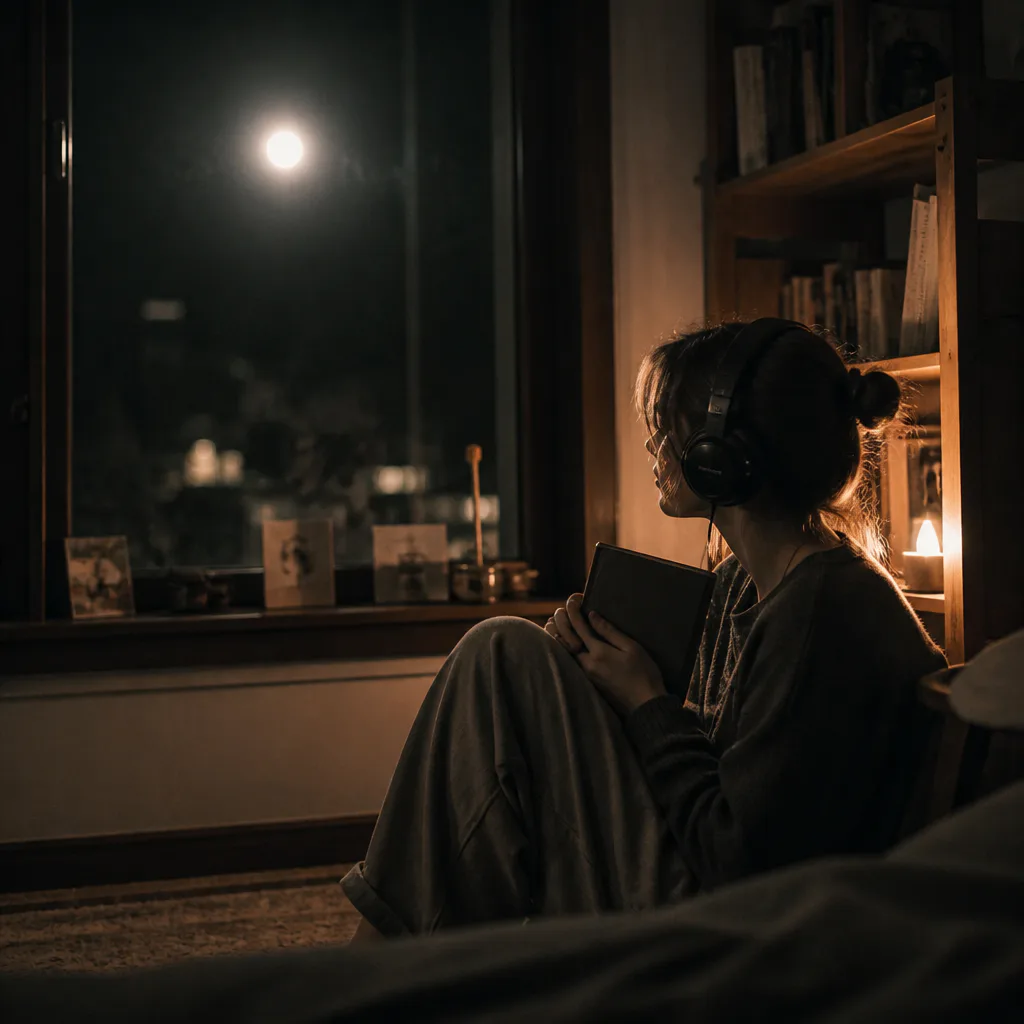
How do you prepare the room and your mind?
Prepare by making the practice easier to complete than to avoid.
You need fewer objects than most lists suggest. A glass of water. A notebook. A pen. Headphones. A light you can dim. If you like a candle, use one, but do not let the ritual become a performance. The body trusts repetition more than decoration.
Set a timer for 18 minutes. Specific time lowers friction. In Lally and colleagues’ 2010 study in the European Journal of Social Psychology, habit automaticity took a median of 66 days to form, with wide variation across people. One full moon ritual will not rewrite a pattern. A monthly ritual, paired with daily listening, can become a reliable review point.
You can prepare with this small checklist:
- Put your phone on Do Not Disturb.
- Open the audio before you begin.
- Write the date and moon phase at the top of the page.
- Name one area: body, work, love, money, home, or faith.
- Decide that enough is one honest page.
The area matters because vague release tends to stay vague. If you write I release fear, your mind may nod and keep everything the same. If you write I release checking my messages before I have eaten breakfast, the body knows what to do tomorrow morning.
If your practice includes a daily affirmation, keep it as a complement, not the center. Aya has a fuller guide to affirmations, and the useful part here is precision. One sentence can steady you. The audio still leads.
The room does not have to be silent. If you live with children, roommates, traffic, or grief, the ritual can still be real. Quiet is not the absence of sound. Quiet is the decision to stop arguing with the moment.
What are the exact steps for an 18-minute full moon ritual?
Use six short steps: settle, listen, name, release, choose, and close.
Here is the whole ritual in one table. Keep it near you the first time, then let it become familiar.
| Minute | Step | What you do |
|---|---|---|
| 0-2 | Settle | Sit down, breathe slowly, and look at the moon or the window. |
| 2-6 | Listen | Play your future-self audio once with headphones. |
| 6-10 | Name | Write what has felt heavy, repeated, or false this month. |
| 10-12 | Release | Choose three things that are complete now. |
| 12-15 | Choose | Write one action for the next 24 hours. |
| 15-18 | Close | Read one sentence aloud, drink water, and stop. |
The order is important. Listening before writing changes the emotional starting point. Affect labeling research by Lieberman and colleagues, published in Psychological Science in 2007, found that naming emotions was associated with reduced amygdala activity and increased right ventrolateral prefrontal activity. In plain language: naming can help the nervous system organize what it is carrying.
Use this numbered version if you prefer clear instruction:
- Sit where you can see a little night. It can be the moon, a window, or the dark glass of the room.
- Listen to your Dream-Self Moment. Do not clean, scroll, or answer anyone while it plays.
- Write one page without editing. Start with: This month showed me.
- Circle three sentences. These are the ones ready to be released.
- Write one next action. It must be possible within 24 hours.
- Close with one spoken line. Say: I know what is complete, and I know what comes next.
Do not burn paper unless it is safe and legal where you are. Fire can feel symbolic, but a torn page in the bin can be just as true. The nervous system does not require theater. It requires consistency.
If you are new to manifestation, think of this ritual as attention plus repetition plus action. Wanting is not enough. Hearing the future self, writing the old pattern, and doing one visible thing gives the mind a new path to practice.
What should you write during the release part?
Write what is specific enough to recognize tomorrow.
Start with three prompts. Keep your hand moving for 6 minutes. Pennebaker’s expressive writing studies often used 15 to 20 minutes across several days, but a shorter ritual can still be useful if it is honest and focused. The goal is not to empty every feeling. The goal is to name the pattern that is ready to stop leading.
Use these prompts:
- This month, I kept returning to.
- The story I am done rehearsing is.
- The choice my future self would make next is.
Then turn each release sentence into plain language. Not I release scarcity. Write I release postponing the dentist because I am scared of the bill. Not I release doubt. Write I release asking three people before I trust the answer I already know. Specificity is kindness because it gives tomorrow a handle.
A useful release sentence has three parts: the pattern, the cost, and the refusal to keep feeding it. For example: I release saying yes when my body has already said no, because it leaves me resentful, and I am no longer practicing resentment as proof of love.
Psychologist Peter Gollwitzer’s work on implementation intentions, first summarized in 1999, showed that if-then plans can improve goal follow-through across many domains. After each release sentence, add one if-then line. If I want to say yes too quickly, then I will ask for one night to answer. This is where ritual becomes behavior.
You may also write one affirmation, but keep it grounded. Aya’s affirmations guide can help if your sentence feels too wide. A good affirmation does not ask you to pretend. It asks you to practice a sentence your actions can begin to support.
How does the next action keep the ritual real?
The next action turns release into evidence.
After the writing, choose one action you can complete within 24 hours. Not this month. Not someday. Tomorrow. It should take 2 to 20 minutes. Send the email. Put the book by the bed. Delete the draft message. Book the appointment. Move the bill to the top of the folder.
Small actions matter because the brain learns from proof. A 2012 review by BJ Fogg and others in behavior design circles often emphasized tiny actions as a way to reduce friction; in academic terms, lower effort increases the chance that a behavior will be repeated. You do not need a grand sign. You need one kept promise.
Here is a simple filter:
| If your release is about | Choose an action like |
|---|---|
| Overgiving | Decline one nonessential request. |
| Avoidance | Open the document for 10 minutes. |
| Self-distrust | Make one choice without polling anyone. |
| Money fear | Look at one account without judgment. |
| Sleep | Put the phone outside the bed for one night. |
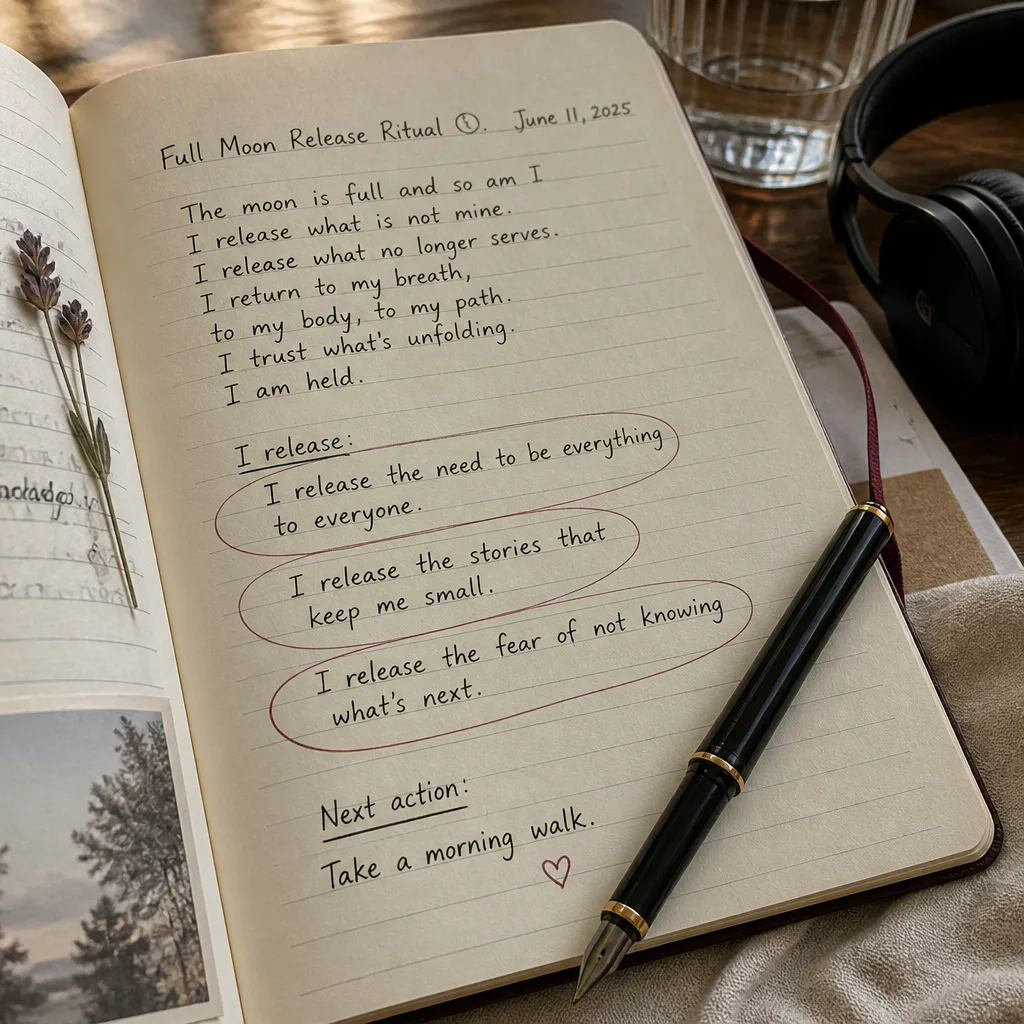
The action should match the future-self audio you heard. If your Dream-Self Moment speaks from a calmer home, your action might be clearing one chair, not redesigning the entire room. If it speaks from steadier work, your action might be writing the first paragraph, not planning a new career.
This is also where the AYA Method stays honest. The audio is the daily practice. The full moon ritual is a monthly mirror. The app also includes a Manifestation Board and daily affirmation, but those are supports around the listening. If you only keep one thing, keep listening.
The future is not proven by how intensely you feel tonight. It is proven by what you can repeat when the room is ordinary again.
How do you close the ritual without overthinking it?
Close by stopping while the practice still feels clean.
This is the part many people miss. After release, the mind wants to keep searching. One more card. One more post. One more interpretation. But a ritual loses its shape when you keep asking it to reassure you. Close before you turn the practice into checking.
Use one sentence. Read it aloud once. Try: I know what is complete, and I know the next small thing. Then drink the water. Put the notebook away. If you use the Aya app, you can return to your daily audio in the morning. Do not repeat the ritual at 2 a.m. because you got nervous.
Sleep matters here. The National Sleep Foundation has long advised 7 to 9 hours for most adults, and memory consolidation research links sleep with learning and emotional processing. A full moon ritual that costs you rest is not kinder than the pattern you released.
The next morning, do the one action before you explain it to anyone. This protects the practice from performance. You do not have to announce that you released something. You have to live one small sentence as if it were true.
If you track moon timing, keep it simple. The guide to astrology and manifestation can help you place the full moon within a wider symbolic cycle, but the ritual itself should stay close to the body. Listen. Write. Choose. Close.
A full moon ritual is not a test of belief. It is a date with what you already know.
The moon can be full, and you can be soft.