manifestation 101
Guided Visualization Manifestation vs Future-Self Audio
Guided visualization manifestation and future-self audio both help the mind rehearse a desired life, but they ask different things of attention.

Your phone is face down. The room is quiet. Guided visualization manifestation asks you to create an inner scene on purpose. Future-self audio asks you to listen to the self who already lives it. Both can help, but the steadier choice is usually the one your attention will return to daily.
What is guided visualization manifestation actually doing?
Guided visualization manifestation uses directed mental imagery to help you rehearse a desired outcome before it appears in your ordinary day.
A guided visualization usually asks you to close your eyes, slow your breath, and picture a specific scene. You might see yourself entering a new home, speaking with calm in a meeting, or waking beside someone you love. The guide gives sensory cues: light, sound, texture, posture. In sport psychology, imagery rehearsal has been studied for decades; a 1994 meta-analysis by Driskell, Copper, and Moran reviewed 35 studies and found mental practice had a positive effect on performance, especially when paired with physical practice.
Manifestation uses a softer frame. It isn’t just performance. It’s identity rehearsal. You don’t only picture a result. You practice being the person who no longer argues with the result. That matters. A 2016 review in Psychological Bulletin on prospection noted that imagining the future helps people plan, regulate emotion, and choose present action. The mind doesn’t treat a vividly rehearsed future as nothing.
But guided visualization asks for active construction. You need enough attention to make a scene, hold it, and keep returning when the mind leaves. For some people, 7 minutes feels kind. For others, 90 seconds is already too much. A quiet practice should not become another place to fail.
Here’s the simple distinction:
| Practice | Main input | What you do | Best when |
|---|---|---|---|
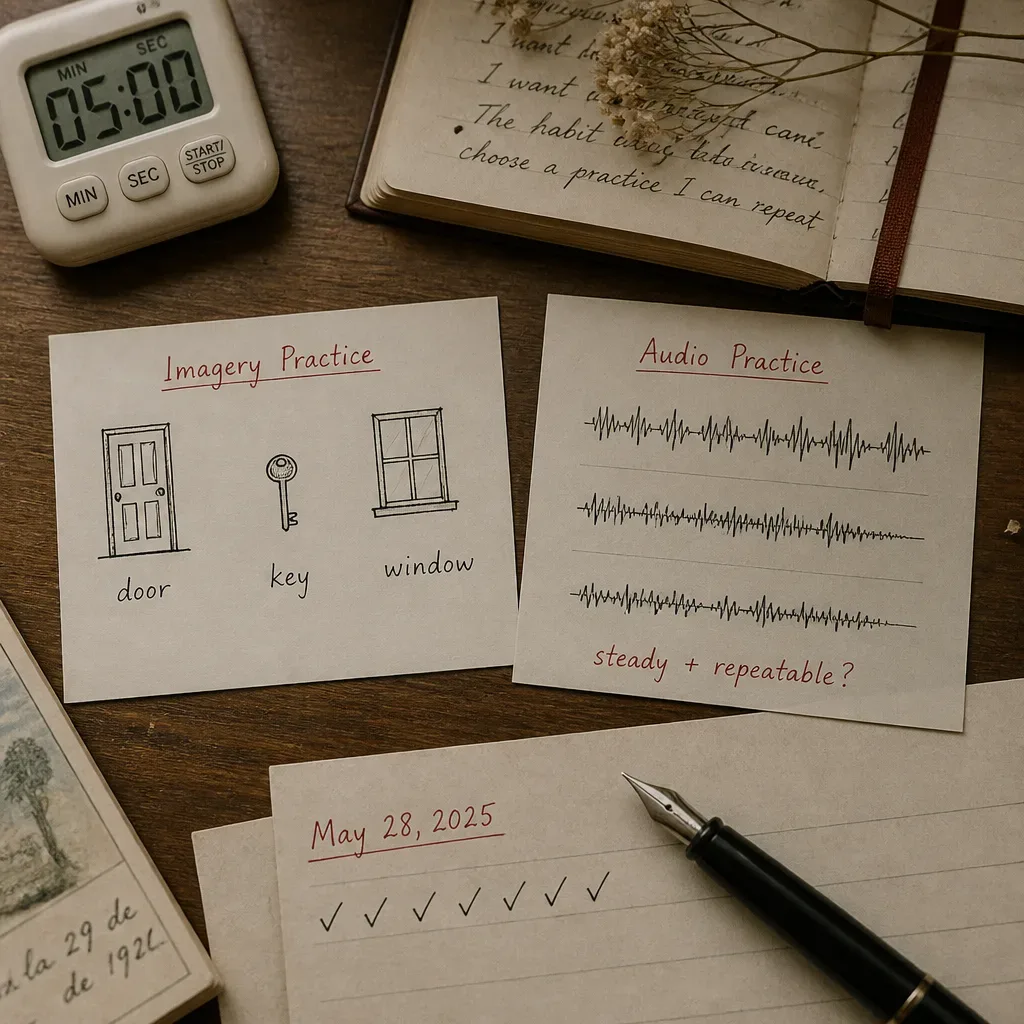
| Guided visualization | Inner imagery | Build a scene | Your mind sees pictures easily |
| Future-self audio | Spoken narration | Listen and receive | Your attention needs a hand |
A picture can be true without being sharp. A practice can be real without being dramatic.
If you’re new to the wider idea, the Manifestation pillar gives the broader frame: intention, repetition, and self-concept. Guided visualization sits inside that frame as one useful tool, not the whole house.
What is future-self audio doing differently?
Future-self audio gives your attention a voice to follow instead of asking it to build the whole scene alone.
This is where the AYA Method becomes specific: The AYA Method is a daily audio manifestation practice. Each day you listen to a short personalized recording — your Dream-Self Moment — narrated from the version of you who has already manifested the life you intend. Listening is the practice. Repetition is the work. The audio is the method.
That sentence matters because it names the difference. The practice is not a worksheet. It’s not a vision board. It’s not trying harder. It’s listening. The daily affirmation and Manifestation Board can support the practice, but the audio is the method. The Dream-Self Moment is the center.
Future-self audio works with a very old fact of attention: sound can carry you when willpower is thin. In a 2010 study in Consciousness and Cognition, auditory guidance was shown to shape attentional focus during imagery tasks. You don’t need to hold every word by force. You let the next sentence bring you back.
It also reduces decision cost. A guided visualization often asks, What do I picture now? Is this right? Am I doing it well enough? Future-self audio answers before the doubt grows. The voice says what is already true in the practice. You listen from there.
This is useful because habits fail less from lack of desire than from too much friction. Research by Wendy Wood and David Neal has shown that repeated behavior in stable contexts becomes more automatic over time. A 3-minute audio, played in the same chair after the same morning cue, has fewer moving parts than a 20-minute self-led visualization.
You don’t have to perform belief. You can borrow the sentence until it becomes yours.

Which practice is easier to repeat every day?
Future-self audio is usually easier to repeat because it needs less setup, less visual effort, and less negotiation with the mind.
That doesn’t make it better for everyone. It makes it lighter to begin. In behavior design, beginning is the gate. BJ Fogg’s work at Stanford, published in Tiny Habits, argues that behaviors become repeatable when motivation, ability, and prompt meet at the same time. A practice that takes 3 to 5 minutes and begins with one tap has high ability. You can do it half-awake. You can do it before coffee. You can do it when you’re not feeling noble.
Guided visualization can still be beautiful. It may be the right practice when your life has actual quiet in it. If you have a long walk, a lunch break, or a room where no one needs you for 15 minutes, imagery can be rich. In small clinical studies, guided imagery has been linked with stress reduction and pain coping, including work published in the Journal of Behavioral Medicine. The body often responds to imagined safety with real softening.
The friction shows up when daily life gets narrow. If you miss one day, then two, the practice starts to feel like evidence against you. Future-self audio lowers the entry point. It says: sit down, press play, listen. Not perfectly. Just again.
A simple repeatability test helps:
- Choose the practice you can do on a low-mood day.
- Choose the length you can keep for 7 days, not the length that flatters you.
- Choose the cue that already exists, like brushing teeth or opening curtains.
- Track completion only, not how mystical it felt.
Completion is a kind of honesty. It tells you what your life will actually hold.
For more on the spoken side of the practice, the Affirmations pillar is useful. Affirmations can be a complement, especially when they’re personal and believable enough to repeat without inner recoil.
Which one works better for belief and emotion?
The practice that works better is the one that changes your felt sense of what is normal, not the one that sounds more impressive.
Guided visualization can be strong for emotion because mental imagery often carries feeling quickly. If you picture your hand on the key of a new apartment, your body may respond before your logic does. Neuroscientist Dr. Andrew Huberman has discussed how visualization can recruit neural circuits related to planning and motor preparation, especially when imagery is specific and repeated. Specificity matters. A vague future rarely changes a concrete Tuesday.
Future-self audio works through a slightly different doorway. It gives your nervous system a repeated story in your own name. It says, I know how to live here. I know how to receive this. I know what I choose next. Over time, repetition can make the desired identity less strange. A 2009 study by Phillippa Lally and colleagues in the European Journal of Social Psychology found that habit automaticity took a median of 66 days, with wide variation from 18 to 254 days. The number is not a rule. It’s a mercy. Becoming familiar takes time.
Neville Goddard wrote often about assuming the feeling of the wish fulfilled. Joe Dispenza teaches a body-based version of rehearsing a future self. You don’t have to accept every claim around those names to notice the shared instruction: practice the state until it stops feeling foreign.
The quiet question is this: which practice lets you feel safe enough to repeat the state?
Guided visualization may stir emotion faster. Future-self audio may be easier to return to when emotion is low. One gives you a scene. One gives you a voice. Both are asking the same thing: become familiar with the self who no longer treats the desire as far away.
How do you choose the right practice for your mind?
Choose by your attention style, not by what sounds more spiritual or more disciplined.
Some minds see in images. Some minds think in words. Some minds know through the body. Research on aphantasia, including work by Adam Zeman and colleagues at the University of Exeter, suggests that voluntary mental imagery varies widely. In one 2015 paper, people with aphantasia described little or no mind’s-eye imagery, while still functioning with memory, language, and planning. So if guided visualization manifestation feels blank, that doesn’t mean you’re blocked. It may mean your mind uses another channel.
You can choose gently:
- If you see clear scenes, try guided visualization for 10 minutes, 3 times a week.
- If you hear words easily, use future-self audio daily for 3 to 5 minutes.
- If your body leads, listen while holding one calm posture or touching your heart.
- If you’re skeptical, track practice days for 14 days and ignore mood scores at first.
- If you love images but can’t stay consistent, use audio as the base and imagery as the supplement.
A good manifestation practice should make contact with your real life. Not your ideal schedule. Your actual one. Pew Research Center reported in 2023 that 41% of U.S. adults said they had used meditation or mindfulness practices at some point. Many start. Fewer keep going daily. The design has to respect mornings, children, work messages, grief, sleep, and the small interruptions that make a life.
Here is the honest comparison:
| Question | Choose guided visualization if… | Choose future-self audio if… |
|---|---|---|
| Do you picture easily? | Yes, images come fast | No, words feel steadier |
| Do you have quiet time? | You can protect 10 minutes | You need 3 to 5 minutes |
| Do you overthink? | Imagery calms the analysis | A script stops the spiral |
| Do you need daily consistency? | You already keep routines | You need the lowest entry point |
The right practice doesn’t punish your nervous system. It meets it at the door.
Can astrology or affirmations support the main practice?
Yes, astrology and affirmations can support manifestation, but they work best as complements to a steady core practice.
Astrology can give timing, language, and reflection. It can help you ask, What part of me is being asked to mature? What desire keeps returning? The Astrology and manifestation guide frames astrology as a mirror, not a command. That distinction matters. You don’t hand your agency to a chart. You use the chart to listen more carefully.
Affirmations can also help, especially when they’re specific enough to feel close. Generic phrases often create resistance. A sentence like “I trust myself with the next honest step” may land better than a grand claim your body rejects. In cognitive behavioral research, self-statements can support change when they match believable action. The Journal of Behavioral Medicine has published work showing that self-affirmation can buffer stress responses in some contexts, though results depend on the person and the task.
But neither astrology nor affirmations should replace the practice if the practice is audio. In the AYA app, the daily affirmation and Manifestation Board are supports. They help you see and name the desire. The Dream-Self Moment is still the daily listen. The audio carries the self-concept in a way you can return to without rebuilding everything from scratch.
Think of it like this:
- Astrology can help you choose the question.
- An affirmation can help you name the sentence.
- A Manifestation Board can help you see the direction.
- Future-self audio can help you rehearse the self who lives it.
One anchor. A few quiet supports. That is enough.
What should you try for the next seven days?
Try a seven-day comparison with one small metric: did you return to the practice today?
You don’t need to decide forever. You need clean data from your own life. As an engineer, I like the kind of tracking that doesn’t lie to make me feel better. For seven days, alternate practices or test one against the other in two short blocks. Keep the schedule small enough that you can do it on a bad day. In habit studies, consistency is often more predictive than intensity; Lally’s 66-day median is a reminder that repetition is not glamorous. It’s quiet proof.
Use this simple test:
- Days 1 to 3: practice guided visualization manifestation for 5 minutes. Use one scene only. Same scene each day.
- Days 4 to 6: listen to future-self audio for 3 to 5 minutes. Same time each day.
- Day 7: choose the one you’d actually repeat next week.
- Track only three numbers: minutes practiced, resistance before, softness after.
- Write one sentence: “This practice made it easier to act like the person I’m becoming when…”
You can also read the broader manifestation overview if you want the language around intention and repetition to feel clearer. If spoken practice keeps calling you, return to the AYA Method and notice how simple the core is: listen daily to the Dream-Self Moment.
The best method is not the one that impresses you. It’s the one you come home to when no one is watching.
Leave the phone nearby. Press play. Stay.