affirmations
I Am Affirmations as 3-Minute Future-Self Audio
I am affirmations become steadier when heard as a 3-minute future-self audio, turning repetition into a small daily cue your brain can remember.
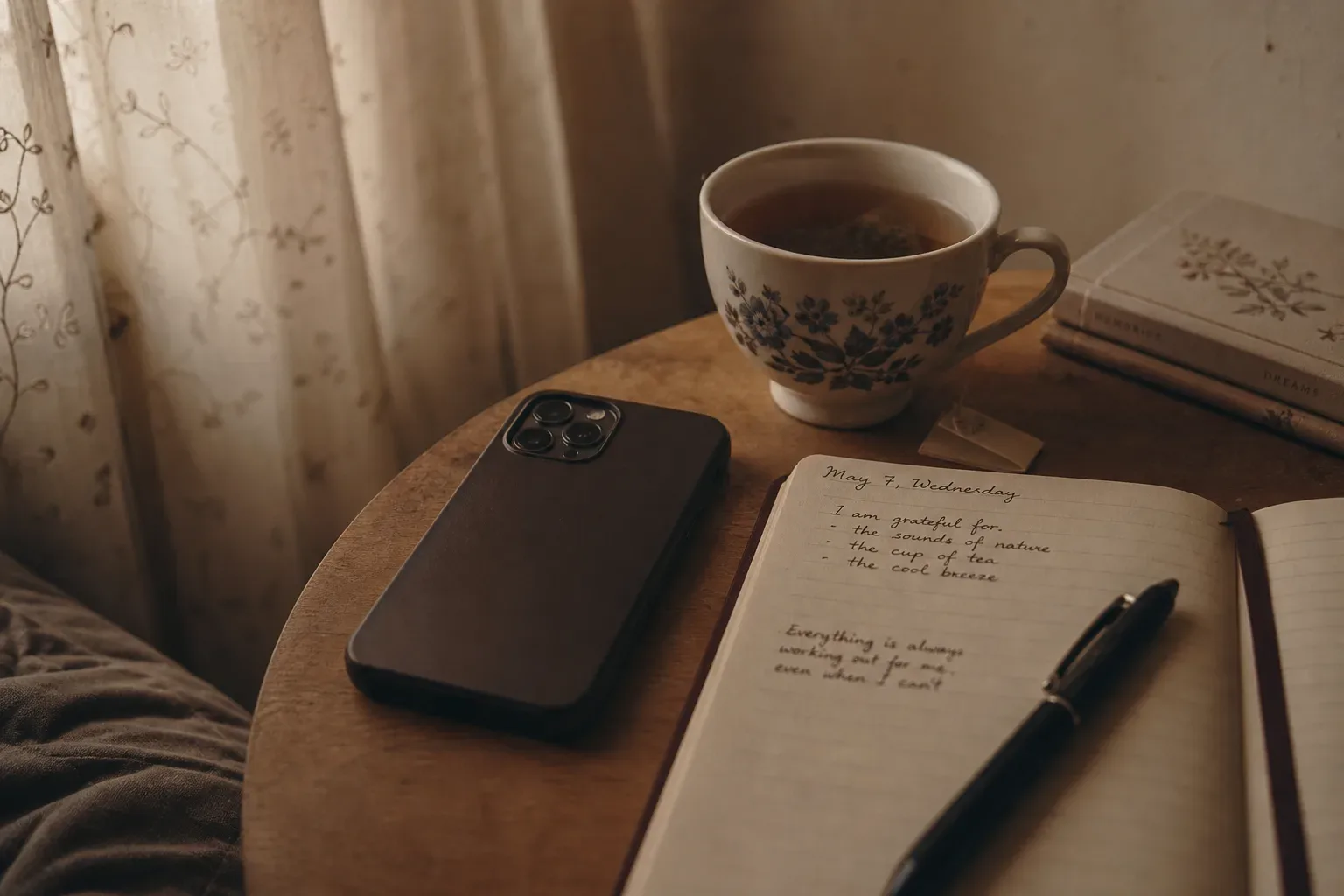
The phone is face down. Three minutes is still three minutes. I am affirmations work best when they’re heard as a short future-self audio: present-tense words, one specific scene, repeated daily until the new sentence feels familiar enough to guide the next small choice.
What makes I am affirmations feel real instead of forced?
I am affirmations feel real when they name an identity your body can practice today.
The problem isn’t the words I am. The problem is distance. If you say, I am completely fearless, while your chest tightens and your calendar is full of things you’re avoiding, the sentence can start a private argument. In a 2009 paper in Psychological Science, Joanne Wood and colleagues found that very positive self-statements could make some people with low self-esteem feel worse, not better. The sentence was too far from what they could receive.
So begin closer. Not smaller as punishment. Smaller as truth. I am learning to answer one email. I am someone who returns to the breath. I am safe enough to begin. A good affirmation doesn’t shout over the present. It gives the present a new instruction.
Self-affirmation research is not the same as manifestation, but it helps here. Claude Steele’s self-affirmation theory, first named in 1988, suggests that people can respond with more openness when their sense of self is protected. A 2014 review by Cohen and Sherman in Annual Review of Psychology notes that values-based affirmation can reduce defensiveness in certain settings. That doesn’t mean every sentence changes a life. It means language can help you stay near the part of yourself that remembers choice.
Use this quiet test:
- Does the sentence make your shoulders soften by even 5 percent?
- Can you repeat it without rolling your eyes?
- Does it point to a behavior you could do in the next 24 hours?
- Would future-you say it gently, not like a command?
An affirmation works best when it sounds like a memory your body can practice.
Why turn I am affirmations into audio?
Audio holds the practice for you when your mind would rather negotiate.
Reading a line is useful. Writing it down is useful too. But listening changes the burden. You don’t have to invent the words at 7:12 a.m. You don’t have to decide whether you deserve them. You press play and receive the same cue again. That matters because decision fatigue is real. In one often-cited 2011 study in PNAS, parole decisions were more favorable after breaks, suggesting that mental depletion can shape judgment, though later discussion has questioned how broad the effect is. Still, anyone who’s tried to build a morning habit knows the plain version: fewer choices helps.
This is where the AYA Method belongs, without ceremony. The AYA Method is a daily audio manifestation practice. Each day you listen to a short personalized recording — your Dream-Self Moment — narrated from the version of you who has already manifested the life you intend. Listening is the practice. Repetition is the work. The audio is the method.
The daily affirmation and Manifestation Board can support the practice, but they don’t replace the listening. The recording gives the nervous system a repeated scene to know. Neville Goddard called this kind of inner rehearsal living from the wish fulfilled. Joe Dispenza writes often about mentally rehearsing future states. You don’t need to agree with every claim around those names to test the simple part: repeat a clear inner scene and watch what becomes easier to choose.
Three minutes is not a shortcut. It is a small room you can return to.

How do you write a 3-minute future-self script?
Write it as if tomorrow-you is speaking softly from a life that has already begun.
A 3-minute audio is short, so every line has to earn its place. Most spoken audio lands at about 130 to 160 words per minute, according to common narration standards used in radio and podcast production. That gives you roughly 390 to 480 words. You do not need that many. For this practice, 220 to 320 words is often enough, because silence is part of the cue.
Use this simple structure:
- Arrive in the body. One breath. One sentence that tells you you’re here.
- Name three I am affirmations. Keep them close, clear, and present tense.
- Enter one future-self scene. Choose a moment with a place, a gesture, and a feeling.
- Connect it to today’s action. One small behavior, not a life overhaul.
- Close with return. End in a line you can carry.
Here is a quiet pattern you can adapt:
| Minute | What happens | Example |
|---|---|---|
| 0:00 to 0:30 | Settle | I am here. I don’t have to rush to be real. |
| 0:30 to 1:15 | Identity | I am steady. I am clear. I am someone who keeps small promises. |
| 1:15 to 2:30 | Future-self scene | I see myself opening the laptop, choosing the first task, and staying with it for 25 minutes. |
| 2:30 to 3:00 | Daily cue | Today, I begin before I explain myself out of beginning. |
Dr. Andrew Huberman has often spoken about the nervous system learning through repetition, attention, and state. The science is broader than any one protocol, but the principle is plain: what you repeat with attention has a better chance of becoming available under pressure. A 2015 study by Falk and colleagues in PNAS found that self-affirmation activated brain regions linked to self-related processing and future valuation. That is a useful clue. Your future-self audio gives the brain something specific to value.
The words don’t need to be beautiful. They need to be yours.
What should your I am affirmations actually say?
They should say who you’re practicing being, not what you’re trying to impress yourself with.
The cleanest I am affirmations sit between desire and evidence. If there’s no desire, the words are flat. If there’s no evidence at all, the words can feel fake. You are looking for the middle. I am becoming calm with money. I am available for honest love. I am the kind of person who finishes one true thing before checking for approval.
The Affirmations pillar goes deeper into how words shape attention. For this audio, keep the wording personal. In 2023, Pew Research Center reported that about 41 percent of U.S. adults had used YouTube to learn how to do something in the past year, which says something simple about modern behavior: people return to formats that show them what to do. Your audio should do the same. It should show you the next inner posture.
Try these swaps:
| If this feels too far | Try this instead |
|---|---|
| I am rich | I am learning to handle money with steadiness |
| I am fearless | I am safe enough to take the next step |
| I am loved by everyone | I am available for mutual care |
| I am perfectly disciplined | I am someone who returns after drifting |
A sentence that can survive a hard Tuesday is better than a sentence that only works on a perfect Sunday.
If you use manifestation language, keep it grounded in lived behavior. You can name what you intend. You can also name how you become someone who can receive and maintain it. That second part is where many practices become real. The future isn’t proved by intensity. It is practiced by return.
How do you record it so it lands in the body?
Record it slowly enough that your nervous system doesn’t feel chased.
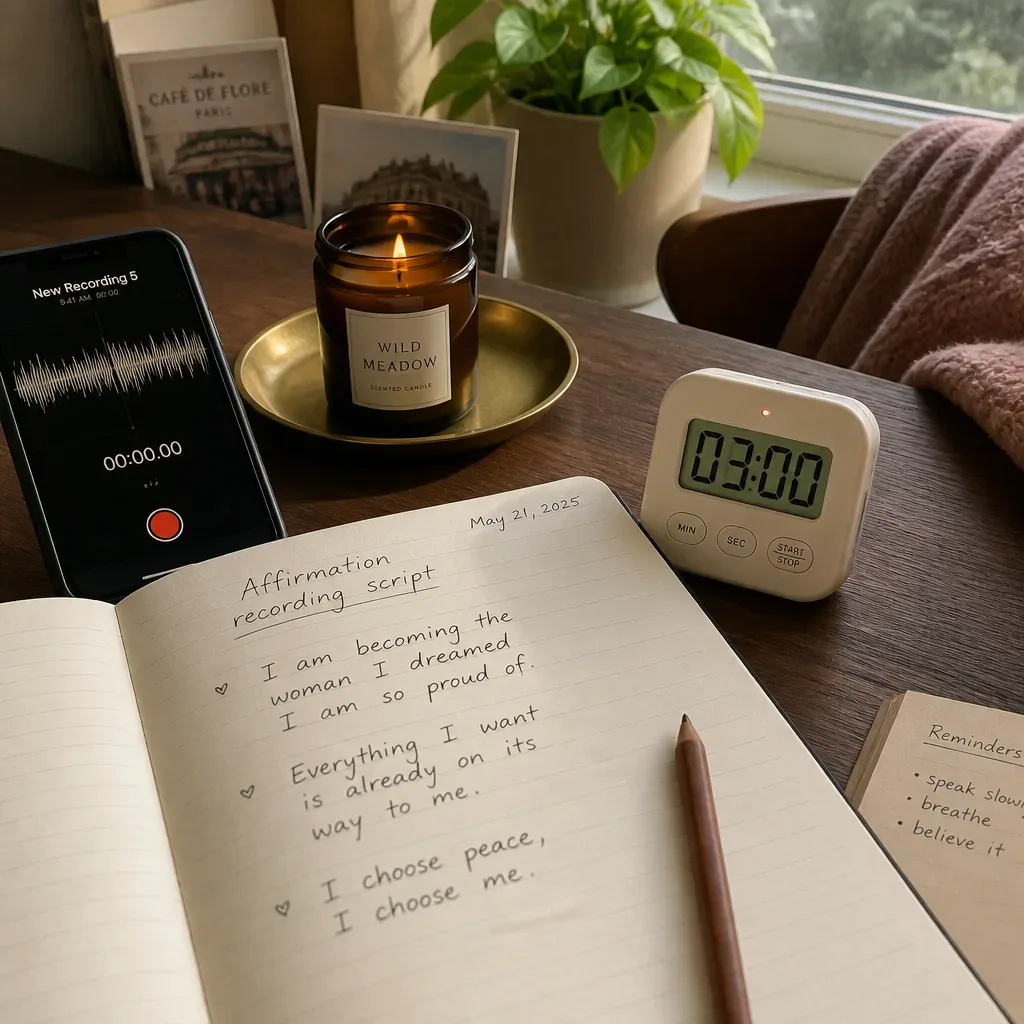
You can use your own voice, or you can use a personalized audio inside a practice like Aya. If you record it yourself, don’t perform. Sit close to the microphone. Leave one full breath between sections. Most people speak faster when they’re nervous; average conversational speech can run around 150 words per minute, while calming narration often sits closer to 120 to 140. For 3 minutes, slower is kinder.
Your recording environment matters less than your willingness to make it plain. A closet, a parked car, a quiet kitchen. Keep the phone 6 to 8 inches from your mouth. Record once without editing every breath. The tiny human sounds can help the audio feel less like content and more like contact.
A simple recording checklist:
- Put the phone on airplane mode for 3 minutes.
- Use the same opening line each time.
- Keep the volume low enough for the voice to feel near.
- Don’t add music if it makes the words harder to hear.
- Save the file with the date and theme, such as 2026-06-01 steady work.
In small clinical and workplace studies, brief audio practices have been linked with reduced stress markers, though results vary by design and population. A 2017 review in Journal of Behavioral Medicine found that mindfulness and related practices can support stress reduction for some people, especially when repeated. Your affirmation audio is not therapy. It is a daily cue. That distinction keeps the practice honest.
When should you listen, and for how many days?
Listen once a day at the same ordinary cue for at least 7 days.
The best time is not always morning. It is the time you can protect. After brushing your teeth. Before opening your laptop. Sitting on the edge of the bed. On the tram. Habit researcher Wendy Wood has written that stable cues help behavior become more automatic over time. A 2009 study by Phillippa Lally and colleagues in the European Journal of Social Psychology found that habit formation took 66 days on average, with wide variation from 18 to 254 days. So 7 days is not a finish line. It is a first listening window.
If you already use astrology as a timing language, keep it supportive, not controlling. You might pair the recording with a new moon or a personal transit, but the listening still matters more than the date. The piece on astrology and manifestation can help you keep timing symbolic and sane.
Here is a gentle 7-day rhythm:
- Day 1: Listen and notice any resistance without fixing it.
- Day 2: Listen at the same cue.
- Day 3: Write the one sentence that stayed with you.
- Day 4: Take one 10-minute action that matches the audio.
- Day 5: Listen even if you feel nothing.
- Day 6: Notice what has become easier to begin.
- Day 7: Decide whether to keep the same recording for another week.
Nothing has failed because you missed a day. Return is part of the practice. In the AYA app, the Manifestation Board can hold the visible image of what you’re practicing, and the daily affirmation can give you one line to carry. But the listening remains the center.
How do you know the audio is working?
You know it’s working when your next small choice changes before your whole life does.
Do not look first for fireworks. Look for a 2 percent shift. You answer the message with less dread. You pause before the old spiral. You choose the first task. You tell the truth a little sooner. These are not small because they are weak. They are small because they are repeatable.
Measurement helps, especially if you’re allergic to vague wellness claims, as I am. Track 3 markers for 14 days: whether you listened, one behavior that matched the audio, and your body state from 1 to 5. That’s enough data to see patterns without turning your inner life into a spreadsheet. The American Psychological Association has noted for years that self-monitoring can support behavior change, especially when paired with clear goals.
Use this simple log:
| Day | Listened? | Matching action | Body state 1 to 5 |
|---|---|---|---|
| 1 | Yes | Sent the proposal draft | 3 |
| 2 | Yes | Walked before email | 4 |
| 3 | No | Returned at night | 2 |
If your audio keeps making you feel smaller, rewrite it. If it asks you to deny grief, fear, debt, illness, or reality, rewrite it. I am affirmations should not be used to silence what needs care. They should help you remember who you are while you meet it.
For more language practice, keep affirmations close. For a wider frame, read the manifestation guide and come back to the smallest possible action. The future self is not a costume. It is a set of rehearsed returns.
The voice is quiet, and you still hear it.