manifestation for life areas
Manifest Creativity With 5-Minute Dream-Self Audio
Manifest creativity with a 5-minute Dream-Self audio practice for creative blocks, using attention, repetition, and one small next action.
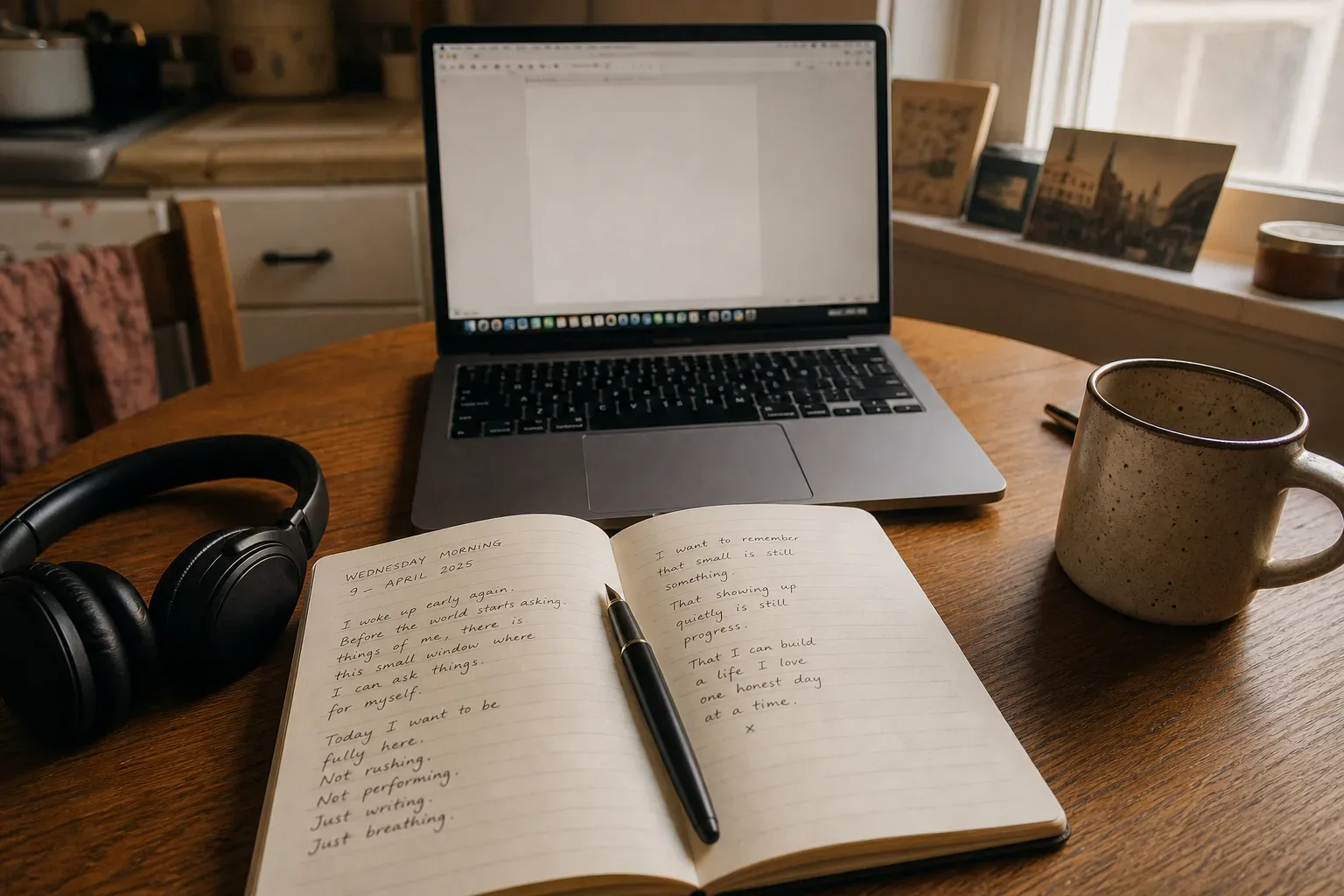
Saturday. The kettle clicked off while my draft sat open, still blank at the top. To manifest creativity, I use a five-minute Dream-Self audio, then take one small creative action immediately. The audio steadies attention; the action tells my brain the block is not the whole story.
What does it mean to manifest creativity when I am blocked?
It means I rehearse the identity of a working creator, then prove it with one small act before the spell of stuckness hardens.
I wrote that down this morning because I needed it. My coffee was cooling in the blue mug. The cursor had been blinking for 11 minutes, which is a tiny number until it is happening to you. A creative block often feels mystical from the inside, but from the outside it looks plain: attention narrows, threat rises, and the next action becomes too big to touch.
I use the phrase manifest creativity carefully. I do not mean asking for a finished chapter to arrive without labor. I mean naming the creative self I intend to live from and practicing that identity with enough repetition that it becomes easier to enter. On the Manifestation pillar, I keep returning to the same useful definition: attention plus repetition plus action changes what I notice and what I do next.
The research does not need to be inflated to be helpful. In a 2014 Stanford study by Marily Oppezzo and Daniel Schwartz, walking increased creative output by an average of 60% compared with sitting. That does not mean a walk writes the poem. It means state matters. If state matters, then a five-minute state cue is not silly. It is design.
A block is often a locked door made of yesterday’s evidence. I need new evidence, even if it is one sentence.
Here is the first distinction I kept on the page today:
| When I say this | I mean this in practice |
|---|---|
| I am blocked | I cannot find the first small action yet |
| I need inspiration | I need a state shift and a lower threshold |
| I want to manifest creativity | I want to become the person who returns |
| I failed today | I stopped before the next tiny proof |
Why do I use Dream-Self audio instead of waiting for inspiration?
I use Dream-Self audio because waiting asks the blocked mind to rescue itself, while listening gives it a ready-made track to follow.
The practice I use is the AYA Method. The AYA Method is a daily audio manifestation practice. Each day you listen to a short personalized recording, your Dream-Self Moment, narrated from the version of you who has already manifested the life you intend. Listening is the practice. Repetition is the work. The audio is the method.
That last sentence is the part that passed my product-designer test. The audio is the method. Not my mood. Not my handwriting. Not whether I have a candle nearby. The daily affirmation and the Manifestation Board can sit beside it like small companions, but they are not the center of the system. On hard mornings, I can still press play.
Habit researchers have been saying a quieter version of this for years. In a 2009 study in the European Journal of Social Psychology, Phillippa Lally and colleagues found that automaticity took a median of 66 days to form, with wide variation from 18 to 254 days. That range matters. A practice has to survive boredom, travel, and laundry.
I have reviewed enough wellness apps to distrust anything that only works during week one. Novelty is not a foundation. A good ritual should still make sense when I am tired, late, and unconvinced.
Audio helps because it removes the burden of invention. I do not have to come up with the right thought. I borrow the voice of my future pattern for five minutes, then I return to the chair.
How do I set up the 5-minute practice before I start?
I set it up by choosing one blocked project, one audio cue, and one action small enough to begin in under a minute.
This is the part I used to overbuild. I would make a playlist, clean the desk, open five tabs, and decide the whole room had to become worthy of the work. By then, 27 minutes had passed. The block had gained evidence. Now I make the setup almost bare.
I keep the five minutes like this:
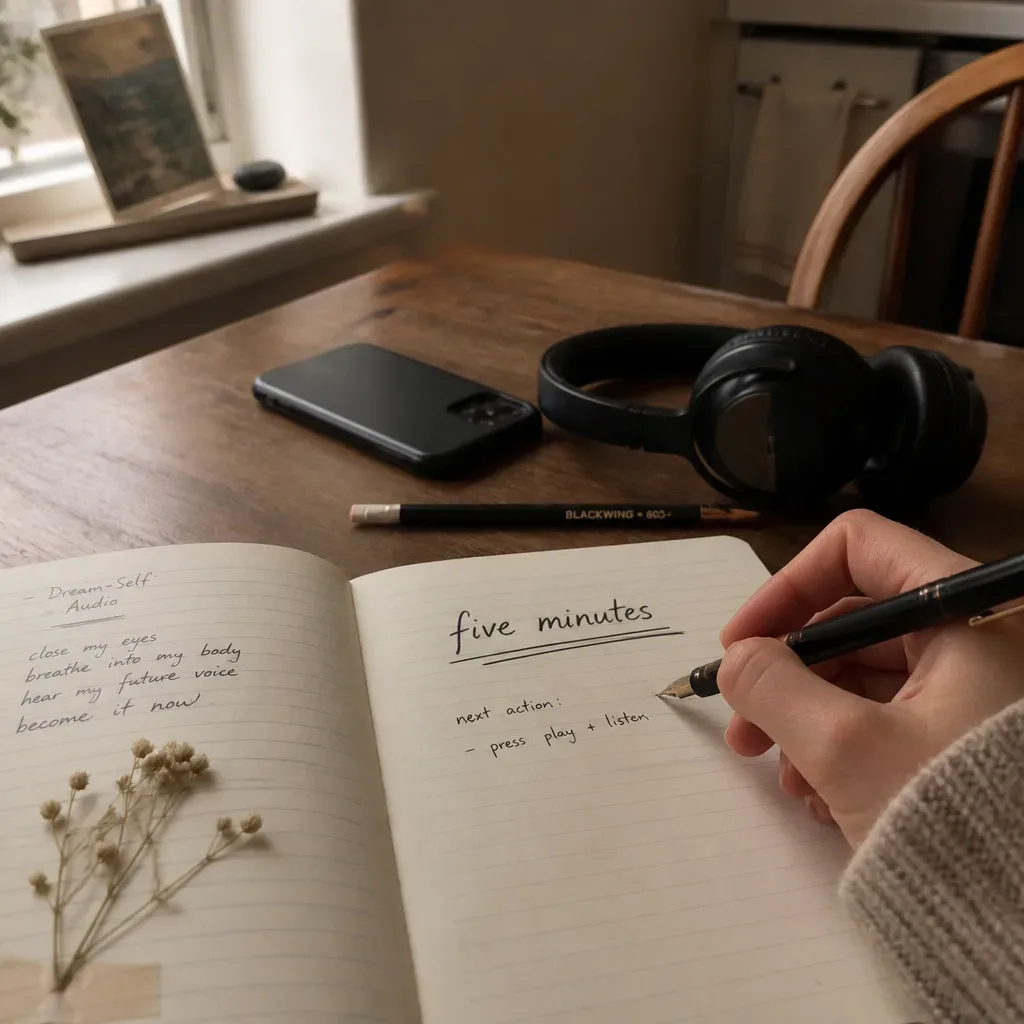
- Minute 0 to 3: I listen to my Dream-Self Moment without checking messages.
- Minute 3 to 4: I write one grounded next action on the page.
- Minute 4 to 5: I start that action, even badly.
I borrowed the tightness from behavior design, not from romance. BJ Fogg’s Tiny Habits model, published widely after his Stanford research, keeps asking for a behavior so small it can happen now. The point is not to make the dream smaller. The point is to make the doorway real.
My setup note from today was plain: open the draft, write the ugly first paragraph, stop judging verbs for ten minutes. That is not poetic. It worked better than poetic.
I also keep a few rules taped inside my notebook:
- One project only.
- One audio only.
- One next action only.
- No research until after the first visible mark.
- No rewriting the ritual while avoiding the work.
A blocked creator does not need a more impressive morning. A blocked creator needs fewer exits.
What should my Dream-Self audio say for creative work?
It should describe the ordinary behavior of the creator I am practicing becoming, not a fantasy version who never struggles.
I learned this after recording language that was too shiny. It did not help me to hear that my work was brilliant and received with tears. My body knew I was being sold to. What helped was hearing that I had opened the file before I felt ready, that I had kept my hand moving for 12 minutes, that I had come back after making lunch.
Neville Goddard wrote often about assuming the feeling of the wish fulfilled. I take that seriously, but I keep it grounded. For creative work, the fulfilled state is not applause. It is continuity. It is the evidence that I return. Joe Dispenza often speaks about rehearsing a future self until the body begins to recognize it; I use that idea in a modest way, with a timer and a draft.
A useful Dream-Self script for creativity has four parts:
- A present-tense scene: I am at the desk, the file is open, the morning is ordinary.
- A steady identity: I am someone who returns to the work without needing drama.
- A behavioral proof: I write one paragraph, sketch one shape, sing one line.
- A closing cue: I begin before I feel finished preparing.
If I add an affirmation after the audio, I keep it practical. The Affirmations pillar says the line has to be repeatable. Mine today was: I return to the page before I believe I can. Seven words would have been cleaner, but these 10 carried me.
The best Dream-Self audio does not flatter me. It reminds me who I said I was practicing being.
How do I move from listening into making?
I move by taking one physical action within ten minutes, because the practice loses force when it never touches the work.
This is the part I respect most. Listening changes the weather inside the room, but the draft still needs a mark. I do not wait for confidence after the audio. I use the softened edge. I open the file, put my hands on the keys, and make the smallest visible change.
There is research underneath this smallness. Psychologist Peter Gollwitzer’s work on implementation intentions found that if-then plans help people follow through by linking a cue to a behavior. Mine is almost boring: after I listen, I write one sentence. After I listen, I draw one line. After I listen, I record one rough vocal take.
I wrote this sequence in my notebook because I forget it when I am dramatic:
| Cue | Action | Evidence |
|---|---|---|
| Audio ends | Open the project | File is visible |
| First resistance appears | Lower the task | One sentence counts |
| Timer ends | Date the note | Record exists |
I sometimes use Astrology and manifestation as a reflective check-in, especially around timing and mood. But I do not let timing become another permission slip. If Mercury is messy, I can still revise a paragraph. If the moon is quiet, I can still choose one note.
The action after listening should be almost embarrassingly concrete:
- Rename the file.
- Write the bad title.
- Mix the first 8 bars.
- Choose the reference image.
- Cut 100 words.
- Put the brush in water.
Creativity returns through contact. Not through proving I am ready. Through contact.
How do I keep the practice from becoming another way to procrastinate?
I keep it from becoming procrastination by ending the ritual quickly and measuring whether it produces visible evidence.
This is where my old app-reviewer brain becomes useful. I do not trust streaks by themselves. A 30-day streak can still be 30 days of not making the thing. I track a different question: did the audio lead to contact with the project?
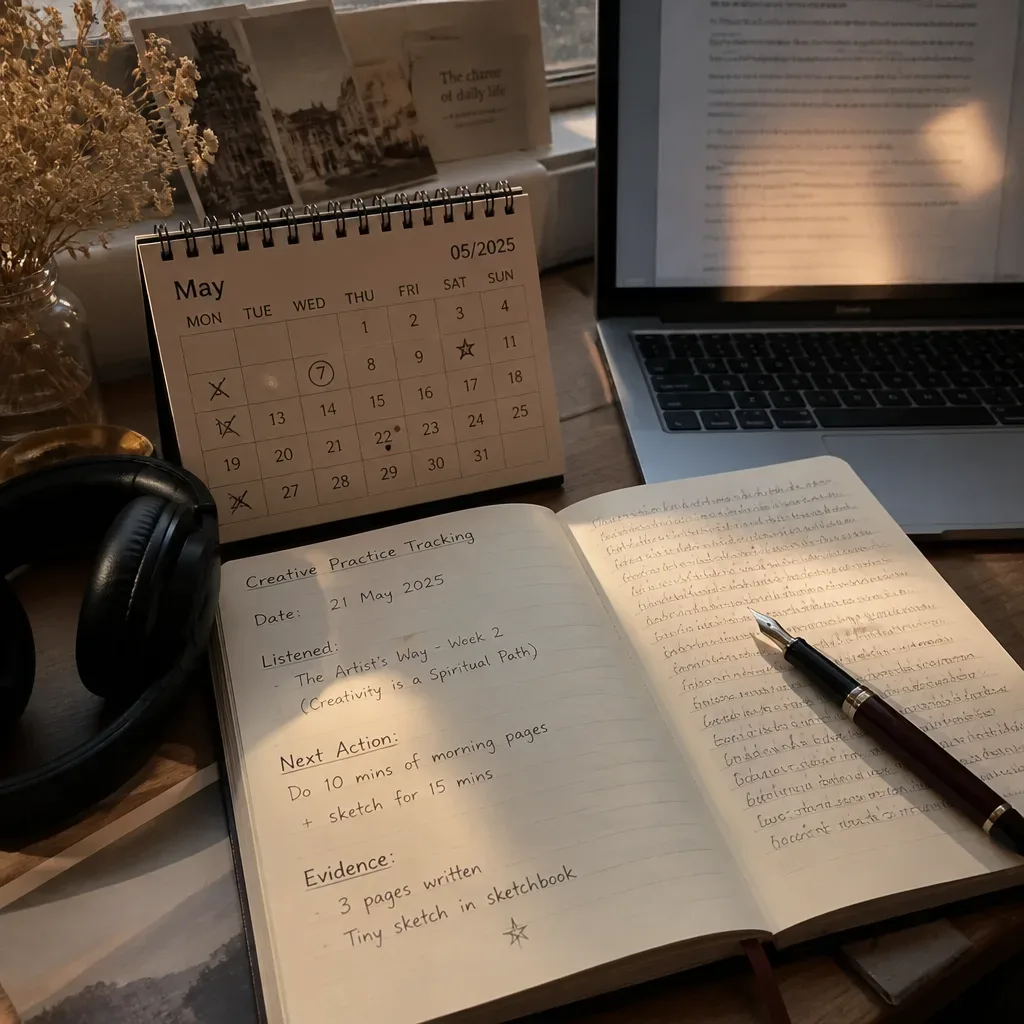
I use a note file with four columns. It takes less than 45 seconds to fill in, which is important because measurement can also become hiding. The columns are date, audio listened, next action, evidence. Evidence can be small: 92 words, one chord progression, three thumbnails, one edited paragraph.
In a 2018 Pew Research Center report, 85% of U.S. adults said they owned a smartphone. That number has only risen in many places, and it explains why phone-based practices are tempting. The phone is always there. The risk is that the phone becomes the whole event. For me, the audio has to point away from the phone and back to the work.
I make one exception for the Manifestation Board when I am choosing direction. I might glance at an image or line before listening, then I close it. It is a complement, not the practice. If I spend 20 minutes arranging pictures and no minutes making, I know what happened.
I also return to the AYA Method page when I need to remember the hierarchy: listening is first, repetition is the work, and the audio is the method. The rest has to earn its place.
How do I know if the creativity practice is working?
I know it is working when I make more often, recover faster from stuckness, and stop treating resistance as a final answer.
I give every practice 30 days because anything can feel convincing for three. By week three, novelty has usually gone quiet. That is when I find out whether the design is kind or fragile. The AYA Method passed my friction test because listening still happened on the mornings when I had no extra willpower to donate.
I track three signals:
- Frequency: How many days did I touch the project after listening?
- Recovery: How long did it take to return after a missed day?
- Output: What visible evidence exists at the end of the week?
I do not need the numbers to be heroic. If I touched the draft 4 days out of 7, that is useful. If I returned after one missed day instead of losing the whole week, that is useful. If I have 600 rough words on Friday, that is more honest than a perfect plan on Monday.
Dr. Andrew Huberman has popularized the role of attention, dopamine, and reward prediction in behavior. I am careful not to turn neuroscience into decoration. The useful takeaway for me is simple: the brain learns from repeated cues paired with action and reward. My reward is not applause. It is the dated line in the note file: I came back.
For deeper background, I keep Manifestation techniques bookmarked beside the main Manifestation pillar, but I try not to collect methods when I need to collect evidence. The method that matters today is the one that gets me into the chair.
A creative identity is not proven by intensity. It is proven by return.
Sunday now. The draft has a first paragraph, and the kettle needs descaling.