evening rituals
Journaling Before Sleep, Then Dream-Self Audio
Journaling before sleep can quiet mental loops. Pair it with a 5-minute Dream-Self audio to end the day with a clear inner cue.
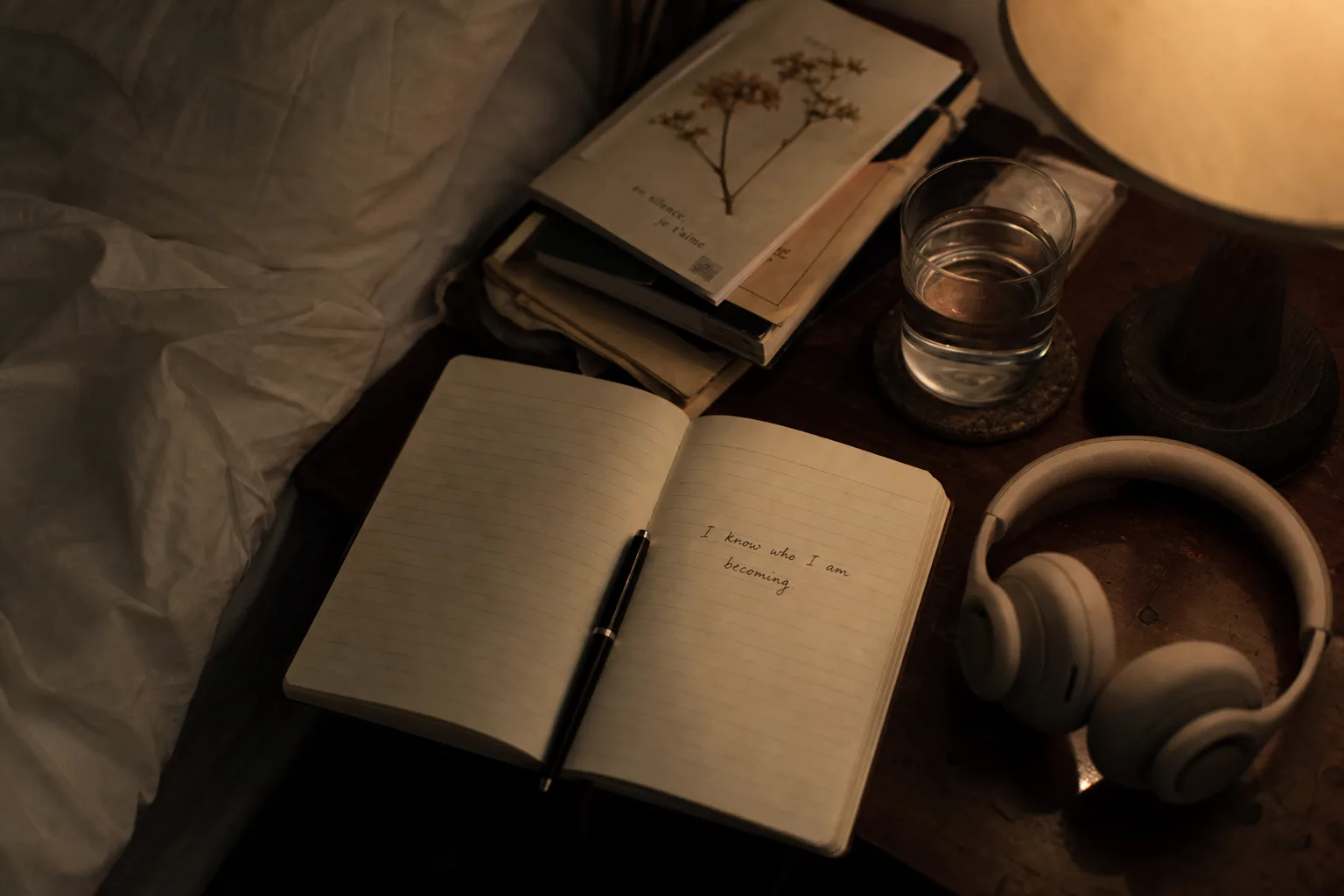
The notebook is open beside the bed. Journaling before sleep works best when it empties the day, then hands you to one clear cue: a 5-minute Dream-Self audio. Write for five to seven minutes, choose one true future-self sentence, then listen. The point is not more effort. It is a cleaner ending.
Why journal before sleep at all?
Journaling before sleep gives the mind a place to put unfinished thoughts before the lights go out.
At night, the mind often gets louder because there is less to distract it. The room goes quiet. The list comes back. The text you did not answer comes back. The small mistake from 2:14 p.m. comes back with strange confidence. Sleep researchers often call these cognitive intrusions. The words are clinical. The feeling is familiar.
A 2018 study by Michael Scullin and colleagues at Baylor University, published in the Journal of Experimental Psychology: General, tested a small bedtime writing practice with 57 adults. One group wrote a to-do list for five minutes. Another wrote about completed tasks. The to-do list group fell asleep faster, especially when the list was specific. The mind rested more easily when tomorrow had a place to live.
This is why the journal is not a performance. It is a shelf. A place for what you cannot carry into sleep. The sentence does not need to be wise. It needs to be out of your head.
For manifestation, this matters because a tired mind tends to rehearse worry. If you are learning the basics of manifestation, you already know repetition matters. The last repeated thought of the day can become a familiar room. You are not trying to force a feeling. You are choosing what gets the last word.
A bedtime journal is not where you become someone else. It is where you stop dragging the whole day into bed.
The CDC has reported that about 1 in 3 adults in the United States do not get enough sleep, using the standard of at least 7 hours for most adults. That number is not a moral failure. It is a clue. Your evening ritual has to be small enough to survive real life.
What should you write in the first five minutes?
Write what is unfinished, what can wait, and one sentence from the self you are practicing becoming.
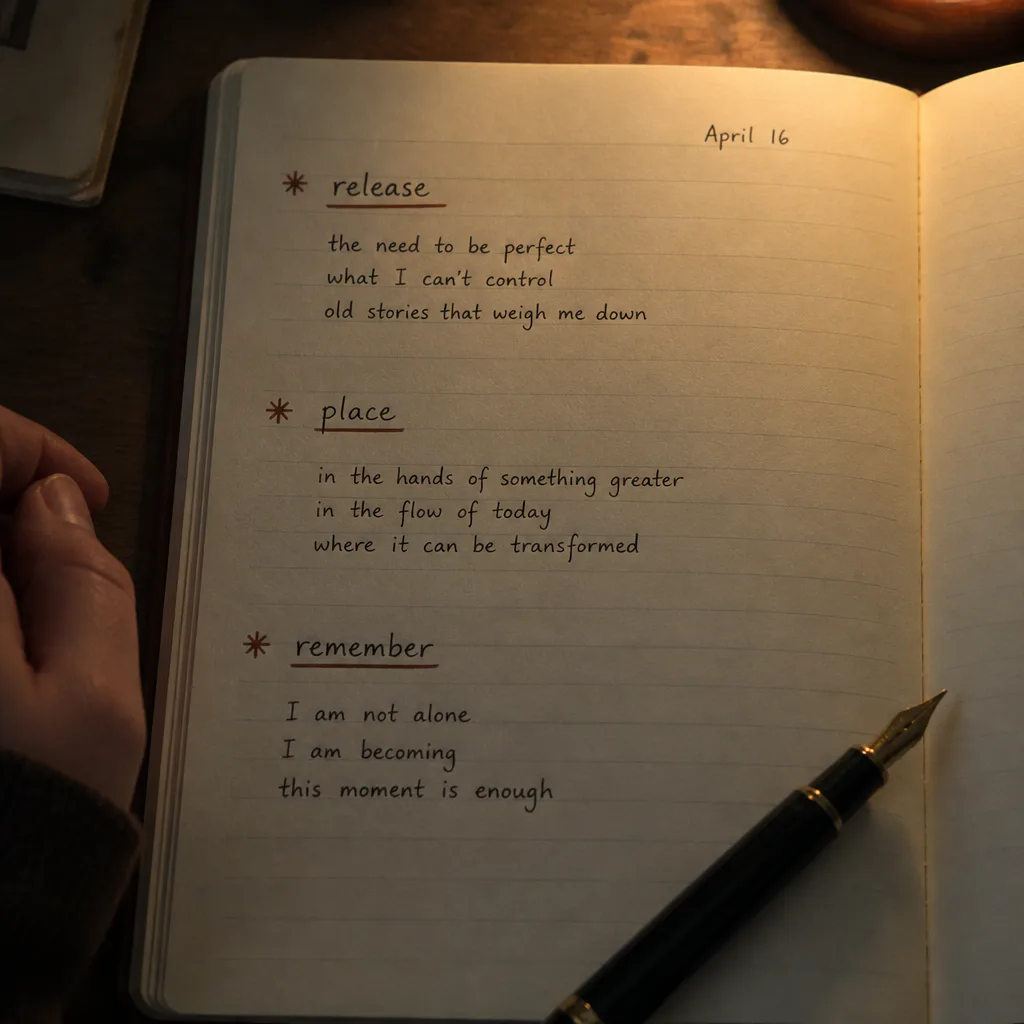
The best sleep journal is not a diary of everything. It is a short sorting ritual. You are not opening the whole archive. You are moving three kinds of thoughts into three simple places. This keeps the practice under seven minutes, which matters because long rituals often collapse on busy nights.
Use this structure:
- Release: one to three lines about what happened today that you do not want to keep holding.
- Place: a short list of what can wait until tomorrow.
- Remember: one sentence written from the version of you who already lives the change you intend.
The first part lets the nervous system stop scanning. The second part reduces the open-loop feeling. The third part creates a bridge to the audio. In expressive writing research, James Pennebaker’s early studies often used 15 to 20 minutes of writing across several days. That can be useful, but it is not always right before sleep. At bedtime, shorter is often kinder.
Here are examples that stay plain:
- I am leaving the meeting in today.
- Tomorrow can hold the invoice, the reply, and the decision.
- I know how to move slowly and still be on time.
- I am safe to receive the life I keep practicing in my mind.
If you use affirmations, keep the sentence close to the body. Not grand. Not brittle. A good affirmation does not shout over doubt. It gives doubt less to grip.
| Journal line | What it does | Keep it under |
|---|---|---|
| Release | Lowers mental noise | 3 lines |
| Place | Parks tomorrow’s tasks | 5 bullets |
| Remember | Names the future-self cue | 1 sentence |
The page is not proof that the practice worked. The page is the doorway. The listening comes next.
Why add a 5-minute Dream-Self audio after writing?
The audio gives your mind one repeated future-self scene after the journal has made space.
Writing clears. Listening impresses. These are not the same act. The journal has edges, ink, sequence. It helps you set things down. A short audio can meet you when your eyes are closed and your effort is lower. That is why five minutes is enough. You are not trying to convince yourself by force. You are returning to one familiar inner cue.
The AYA Method is a daily audio manifestation practice. Each day you listen to a short personalized recording — your Dream-Self Moment — narrated from the version of you who has already manifested the life you intend. Listening is the practice. Repetition is the work. The audio is the method. You can read more about the AYA Method if you want the full frame.
Neville Goddard often taught the value of entering sleep with the wish fulfilled already felt as real. Joe Dispenza speaks often about mental rehearsal and emotional familiarity. You do not have to adopt every idea from either teacher to use the simple design truth here: the mind repeats what has been made vivid.
Audio is useful because it reduces decisions. You do not have to invent the scene every night. You press play. You listen. You come back. In behavior design, BJ Fogg has written that tiny habits work better when they are easy and anchored to an existing routine. Bed is already an anchor. The journal and audio become the small action placed beside it.
The daily affirmation and Manifestation Board can support the practice inside Aya, but they are complements. They are not the pillars. If you only have room for one thing after the journal, listen to the Dream-Self Moment.
The future self becomes easier to hear when the present self has been allowed to exhale.
How do you do the ritual without making bedtime later?
Put the whole ritual inside a 12-minute container and stop before it turns into analysis.
This matters. A ritual that steals sleep will not stay kind. If you usually get into bed at 11:20 p.m., do not build a 40-minute practice that starts at 11:18. Use a smaller container. The American Academy of Sleep Medicine and the Sleep Research Society recommend 7 or more hours of sleep for healthy adults. Your manifestation practice should not quietly take from that.
Try this 12-minute version:
- Minute 0 to 1: lower the light, silence notifications, open the notebook.
- Minute 1 to 6: write release, place, remember.
- Minute 6 to 7: read only the final future-self sentence once.
- Minute 7 to 12: listen to the 5-minute Dream-Self audio.
- After minute 12: close the notebook and stop adding meaning.
That last step is the hardest for people who are used to self-improvement as a second job. The mind wants to grade the night. Was the feeling strong enough? Did the audio land? Did the sentence sound true? You do not need to answer.
The practice is allowed to be ordinary. It is allowed to happen while you are sleepy, annoyed, or half ready to quit. The point is the return. In habit research, consistency usually beats intensity. A practice repeated 20 nights in a month will teach more than one perfect two-hour session.
If you want to place this ritual inside a wider frame, the manifestation guide can help you understand the role of attention and repetition. But at night, keep the theory outside the bed. The bed gets the simple version.
A ritual becomes trustworthy when it does not ask you to become a better person before you begin.
What if your mind keeps racing after the audio?
If the mind keeps racing, make the ritual even more concrete and give worry a scheduled place tomorrow.
Some nights will not soften quickly. That is not failure. It is data. Stress, caffeine, late screens, conflict, and irregular sleep timing can all keep the body alert. Pew Research Center reported in 2021 that 31 percent of U.S. adults said they are online almost constantly. Many people arrive at bed with the nervous system still lit by messages, tabs, and unfinished inputs.
When the audio ends and the mind starts again, do not restart the whole journal. That can train the brain to keep asking for more. Instead, add one tiny protocol on a separate line:
- If it is actionable: write the next action and the time you will look at it.
- If it is emotional: write the feeling in three words.
- If it is imagined danger: write, this is a thought, not an instruction.
- If it is a real urgent need: take care of it without turning the ritual into scrolling.
This is close to what many cognitive behavioral therapy for insomnia protocols protect: the bed should not become a place for long wakeful problem-solving. CBT-I often uses stimulus control, sleep scheduling, and thought management. You do not need to perform therapy on yourself. You can borrow the principle. Bed is for rest, not courtroom arguments with your own mind.
If you track the moon or use timing as a symbolic support, you might enjoy astrology and manifestation. Keep it gentle. The sky can be a calendar. It does not need to become another pressure system.
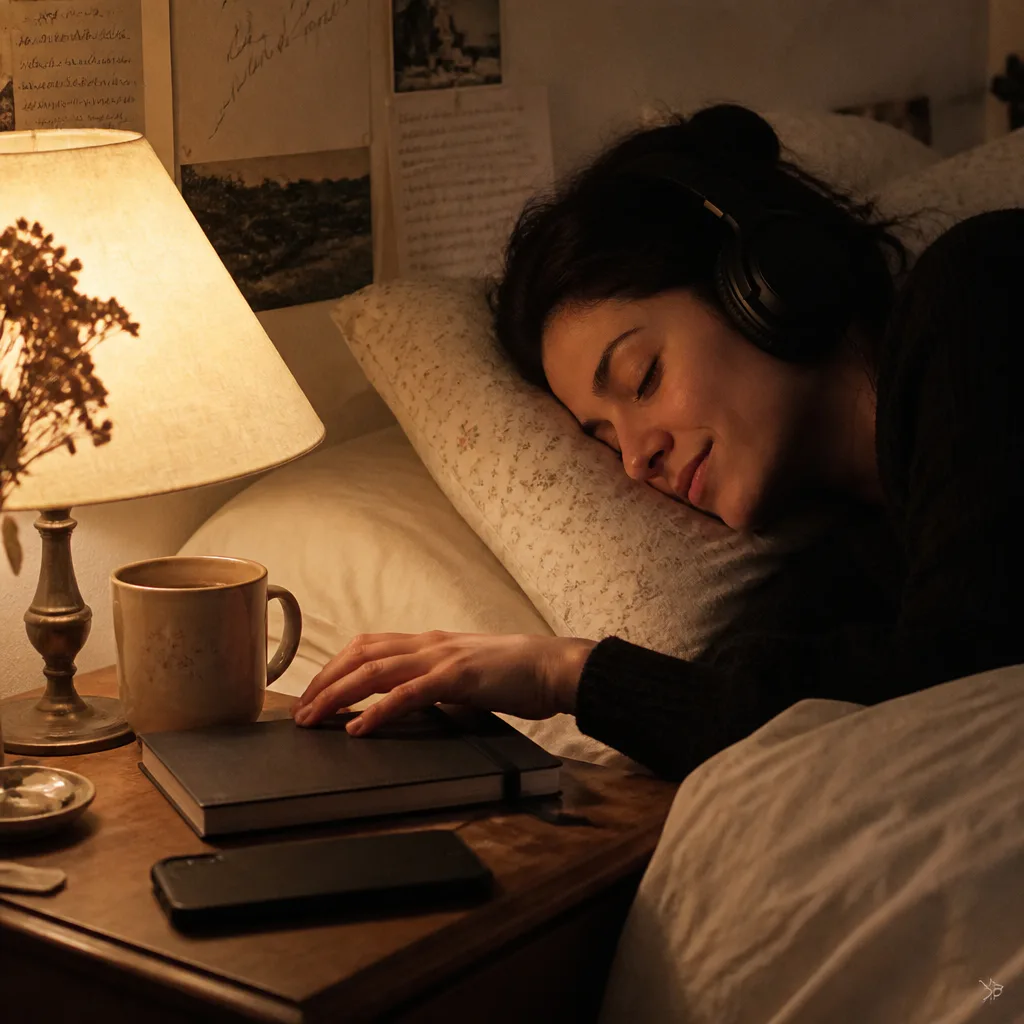
A racing mind does not mean the Dream-Self audio failed. It means the system is still learning the cue. Come back tomorrow. Same notebook. Same five minutes. Same voice.
How can you make the future-self sentence feel true?
Make the sentence specific, present-tense, and close enough that your body can stay with it.
A future-self sentence is not a demand. It is a small rehearsal of identity. If it is too far from what you can feel, the mind may reject it. If it is too vague, it may not hold. The middle path is a sentence that stretches you by one quiet inch.
Compare these:
| Too far | Too vague | Better |
|---|---|---|
| I never feel fear again | I am happy | I can feel fear and still choose the next kind step |
| Everything I want is mine now | I am successful | I keep promises to myself in small visible ways |
| My life is perfect | I feel good | I wake with one clear thing to do and enough trust to begin |
Research on self-affirmation theory, developed by Claude Steele in the 1980s, suggests that reflecting on valued parts of the self can reduce defensiveness under threat. Later studies have found mixed results depending on context, but the core idea is useful: a sentence works better when it touches something you actually value.
This is where affirmations can help, as long as they stay honest. Do not write the loudest sentence. Write the one you can return to without flinching. Then let the audio carry it deeper than the page can.
You can also connect the sentence to the Dream-Self Moment in Aya. If your audio is about being steady in your work, write: I move through tomorrow with clean attention. If it is about love, write: I receive care without making myself smaller. If it is about money, write: I meet my numbers with open eyes and a calm hand.
The truest affirmation is often the quietest one.
What should you track, if anything?
Track the practice lightly: whether you showed up, what sentence you used, and how sleep felt in the morning.
Do not turn the ritual into a spreadsheet that judges your soul. A designer would call this reducing friction. I would call it mercy. Track only what helps you return. Three marks are enough:
- Did I write for five minutes?
- Did I listen to the Dream-Self audio?
- How did I feel on waking: heavy, neutral, clear, or tender?
After 14 nights, look for patterns. Maybe the ritual works better when the phone stays outside the bedroom. Maybe the sentence has to be shorter. Maybe listening while sitting up keeps you present, while lying down lets you sleep sooner. None of this needs drama. It is interface testing, but for the self.
Small studies on audio-guided relaxation and mindfulness practices suggest that brief nightly listening can reduce perceived stress for some people, though results vary by person and protocol. Dr. Andrew Huberman has also spoken often about non-sleep deep rest as a way to teach the body downshifting. Your Dream-Self audio is not the same thing, but it shares one useful trait: you stop inventing and start listening.
The wider manifestation practice can hold your intention. The bedtime ritual should hold your hand. If you miss a night, do not repair it with guilt. Return the next evening. That is the whole design.
A notebook. A voice. The day placed down.