manifestation 101
Law of Assumption Practice With 5-Minute Audio
A quiet law of assumption practice using 5-minute future-self audio, daily repetition, and small evidence from your real day.

Your phone is on the table. The room is still. A law of assumption practice can be this small: listen for 5 minutes to future-self audio, assume that voice is already yours, then make one ordinary choice from that state today.
What does the law of assumption actually ask you to practice?
The law of assumption asks you to live from the state you intend, before the outer facts have fully changed.
Neville Goddard made the phrase familiar in lectures and books across the mid-20th century. In Feeling Is the Secret, published in 1944, he wrote that feeling is the inner act that gives an assumption weight. You don’t need to accept every metaphysical claim to use the practice well. You only need to notice this: the self you rehearse tends to become the self you consult.
The practice is not pretending all day. Pretending often feels tense. Assumption is quieter. It says, “If this were already true, how would I answer this email? How would I speak to myself after the mistake? What would I stop chasing?” One question can change the next 10 minutes.
Modern psychology gives this a grounded frame. Self-perception theory, proposed by Daryl Bem in 1972, says people infer who they are partly by observing what they do. If you act like someone who keeps a promise once a day, your mind starts collecting that evidence. Identity becomes less of a speech and more of a pattern.
This is why the law of assumption works best when it touches behavior. A state that never changes a choice is only decoration. A true assumption leaves fingerprints on the day.
If you want the broader foundation, start with manifestation as the parent idea. Then let this practice become specific: one state, one voice, one small action.
Why use 5-minute future-self audio instead of trying harder?
Future-self audio works because it gives your assumption a repeatable voice when your willpower is tired.
Most people fail at inner work because they make it too large. They design a 45-minute morning, miss it twice, and decide they lack discipline. A 5-minute practice has a different kindness. It can fit before coffee, after a shower, during a walk to the metro, or in the parked car before work.
There is a reason this matters. In a 2009 study in the European Journal of Social Psychology, Phillippa Lally and colleagues found that habit formation varied widely, from 18 to 254 days, with an average of 66 days for automaticity. The finding is often simplified, but the real lesson is better: repetition needs mercy. The practice has to be small enough to return to.
Audio also removes the pressure to visualize perfectly. Some people see clear images. Some don’t. A spoken future-self recording lets you listen instead of strain. Dr. Andrew Huberman has often described attention as a limited resource, and even outside his protocols the point is plain: fewer decisions make daily practice more likely.
Here is the clean placement of the method.
The AYA Method is a daily audio manifestation practice. Each day you listen to a short personalized recording — your Dream-Self Moment — narrated from the version of you who has already manifested the life you intend. Listening is the practice. Repetition is the work. The audio is the method.
The app also includes a daily affirmation and a Manifestation Board, but they are complements. The audio is the method. The voice is where the assumption becomes close enough to hear.

How do you set up the audio before you listen?
Set up the audio by choosing one assumed state and writing it in present-tense, first-person language that sounds lived, not forced.
Start narrow. Not “my whole life is perfect.” Try “I handle money with steadiness,” or “I speak clearly before I shrink,” or “I keep my promises to my body.” A useful assumption can be tested in one day. You should be able to ask, by tonight, whether you acted from it once.
Use this simple structure before you record or generate the audio:
- Name the state in one sentence.
- Add 3 concrete scenes from ordinary life.
- Include one sentence about how your body feels.
- Name one choice you now make differently.
- End with a line that sounds like return, not pressure.
Specificity is not cosmetic. Peter Gollwitzer’s 1999 research on implementation intentions showed that “if-then” plans can improve follow-through because they tie action to a cue. Your audio can use the same logic: “When I open my laptop, I begin with the one task that matters.” The assumed self becomes attached to a real doorway in the day.
Keep the tone believable. If your current life is anxious, a recording that says “I never worry” may make your body argue. Try, “I notice worry, and I don’t hand it the steering wheel.” The law of assumption doesn’t require fake certainty. It asks for practiced return.
A daily affirmation can help you reduce the state to one line. If that helps, use the guidance in affirmations after the audio is clear. One sentence can be a handle. It is not the whole door.
What should happen during the five minutes?
During the five minutes, you listen without performing belief and let the future-self voice become familiar.
Put the phone somewhere you won’t keep touching it. Headphones help, but they are not sacred. Sit, walk slowly, or lie down if you won’t fall asleep. The point is not theatrical stillness. The point is contact with the same assumed state, repeated enough times to stop feeling foreign.
Use a gentle sequence:
| Minute | What to do | Why it helps |
|---|---|---|
| 0:00-1:00 | Let your breathing slow | Your body gets a cue that this is safe |
| 1:00-3:00 | Listen to the future-self scenes | The assumption becomes concrete |
| 3:00-4:30 | Notice one matching choice for today | The state meets behavior |
| 4:30-5:00 | Repeat one line quietly | The practice closes simply |
In small mindfulness studies, even brief daily practice has been linked with changes in attention and stress markers, though results vary by design and sample size. A 2014 review in JAMA Internal Medicine found moderate evidence that mindfulness meditation programs can improve anxiety, depression, and pain. This is not the same as manifestation research, but it supports the value of short repeated attention practice.
Don’t check whether it “worked” while you listen. Checking is often fear in a lab coat. Let the audio be ordinary. Let it be the thing you do, like brushing your teeth, not a trial you have to win.
If you like visual timing, astrology and manifestation can help you choose days that feel symbolically clean. Keep it supportive. The calendar can mark a beginning, but repetition carries it.
How do you carry the assumption into the rest of the day?
Carry the assumption by taking one small action that would make sense if the future-self voice were true.
This is where many people get quiet results. Not fireworks. A different text message. A calmer invoice. A walk instead of another hour scrolling. The assumed self becomes real through the choices that look almost too plain to count.
After listening, ask one question: “What is the next honest action from this state?” Choose something that can be done in under 10 minutes. Behavior change research keeps returning to friction. BJ Fogg’s Tiny Habits model, popularized in 2019, argues that small actions attached to existing routines are easier to repeat. You don’t need a dramatic act. You need a repeatable one.
Useful matching actions include:
- Send the message you’ve been delaying.
- Put one bill, file, or tab in order.
- Drink water before the second coffee.
- Open the document and write 5 bad sentences.
- Decline one request without overexplaining.
- Place the phone outside the bedroom for one night.
The law of assumption is not proven by mood. It is practiced through conduct. Some mornings you will feel nothing. That is fine. Listening still counts. The action still counts. A quiet practice survives because it does not ask every day to be special.
For more ways to keep the practice simple, use simple manifestation techniques as a menu, not a command center. Pick one. Stay with it long enough to know what it does to your day.
How do you track proof without becoming obsessed?
Track proof by recording small evidence once a day, then leaving it alone.
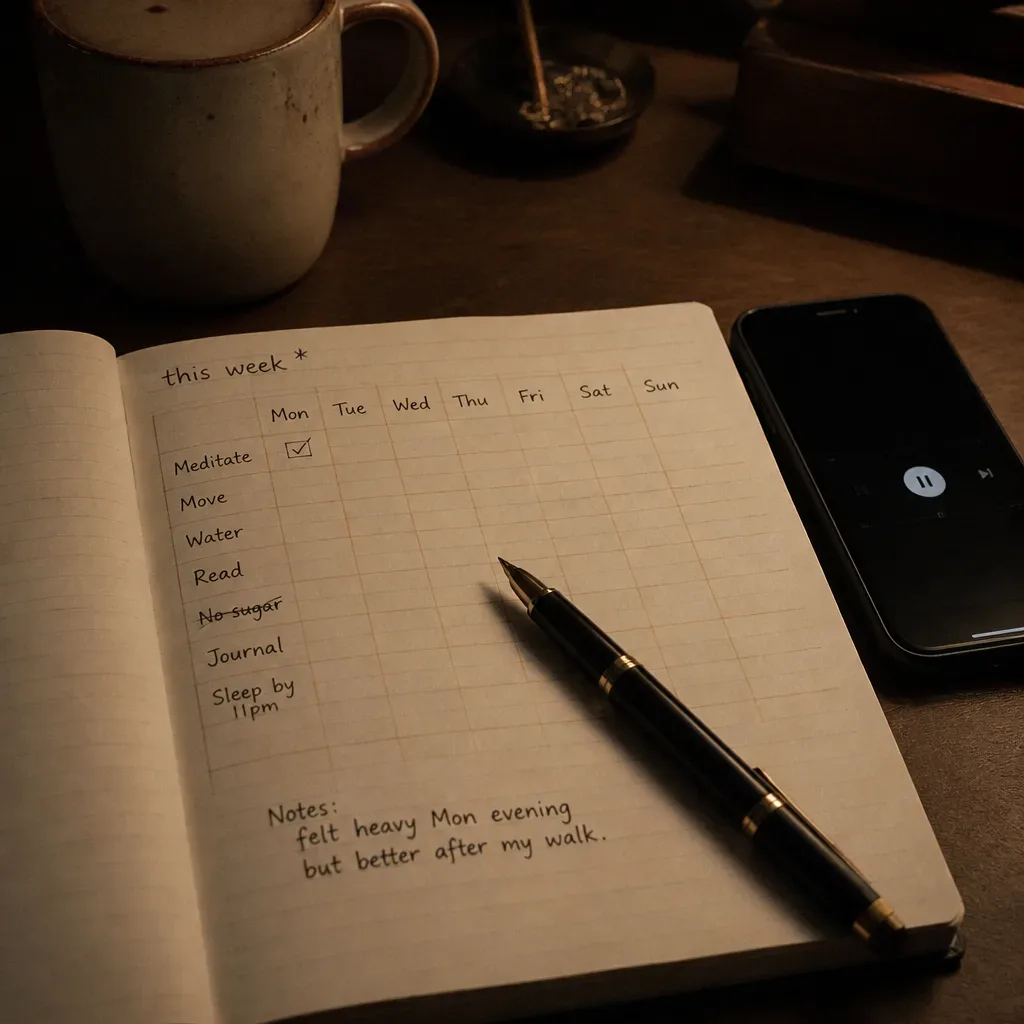
Obsession turns manifestation into surveillance. You don’t need to inspect every glance, delay, or coincidence. You need a small record that teaches your attention what to notice. One line at night is enough: “I answered directly,” “I didn’t apologize for needing time,” “I opened the savings account.” Evidence grows more convincing when it is boring and true.
Use a 7-day note, not a sprawling journal. The number matters because a week is long enough to reveal patterns and short enough to feel kind. In clinical and behavioral settings, self-monitoring is often used because it can change awareness by itself. A 2011 review in Psychological Bulletin on goal progress monitoring found that tracking progress is associated with better goal attainment, especially when the record is visible.
Try this format:
| Day | I listened | One matching action | One piece of evidence |
|---|---|---|---|
| 1 | Yes / No | ||
| 2 | Yes / No | ||
| 3 | Yes / No | ||
| 4 | Yes / No | ||
| 5 | Yes / No | ||
| 6 | Yes / No | ||
| 7 | Yes / No |
Do not grade your worth. Track contact. Track return. The difference is everything.
There is also a boundary here. If the practice increases panic, compulsive checking, or avoidance of needed care, soften it or stop. Talk to a qualified professional if anxiety or depression is making daily life hard. A manifestation practice should not replace medical, legal, financial, or mental health support.
What changes after seven days of this practice?
After seven days, you should know whether the assumed state feels more available in ordinary moments.
Do not demand a new life by Friday. Ask better questions. Did the voice feel less strange? Did one behavior repeat? Did you recover faster after doubt? Did you make even one choice that the old self usually avoided? Those are real signals.
Neville Goddard often used the phrase “living in the end.” In practice, that does not mean ignoring the middle. It means the middle is handled by the person who knows where they belong. A bill still gets paid. A hard talk still happens. The difference is the posture you bring to it.
Pew Research Center reported in 2023 that many adults describe themselves as spiritual in some way, even outside formal religion. That helps explain why practices like the law of assumption keep returning: people want inner rituals that touch daily life. But a ritual is only useful if it makes you more honest, more steady, and more present with the next small thing.
Here is a quiet 7-day review:
- Read your evidence notes once.
- Circle any repeated action.
- Keep the audio if the state still feels true.
- Rewrite one line if it felt false or inflated.
- Choose the next 7 days, not the next lifetime.
If you want a wider map of belief, practice, and daily repetition, return to the manifestation guide. Then come back to the voice. Five minutes is enough to begin again.
Stay with the voice until it starts to sound like home.